
WXT Burn for Q1 2026: WEEX Completes 62,998,141 WXT Token Burn


KEY TAKEAWAYS
WEEX has completed its Q1 2026 WXT token burn, removing 62,998,141 WXT from circulation as part of the WXT Burn Model. Users who want to follow WXT ecosystem updates can register on WEEX and track future platform announcements.
The burn value was approximately $1,004,127, calculated based on the market price on the date of the burn.
The transaction has been recorded on-chain, supporting WEEX's commitment to transparency and verifiable token supply management.
After this burn, the total amount of WXT burned has reached 4,253,096,699 WXT, while the current supply stands at 5,746,903,301 WXT.
The Q1 2026 burn reflects WEEX's ongoing effort to support the long-term development of the WXT deflationary ecosystem.
WEEX Completes Q1 2026 WXT Token Burn
WEEX has officially completed its Q1 2026 WXT token burn, marking another step in the platform's long-term deflation strategy for WEEX Token (WXT). The latest burn removed 62,998,141 WXT from circulation, with an estimated burn value of $1,004,127 based on the market price on the date of the burn.
Token burns are an important part of WXT's ecosystem design. By permanently removing a portion of tokens from the circulating supply, WEEX aims to support a more sustainable token economy and strengthen WXT's long-term value framework. This Q1 2026 burn was carried out in line with the official WXT Burn Model.
The announcement was released by WEEX on 2026/06/18 at 11:00:00. Users can verify the burn through the official on-chain burn record.
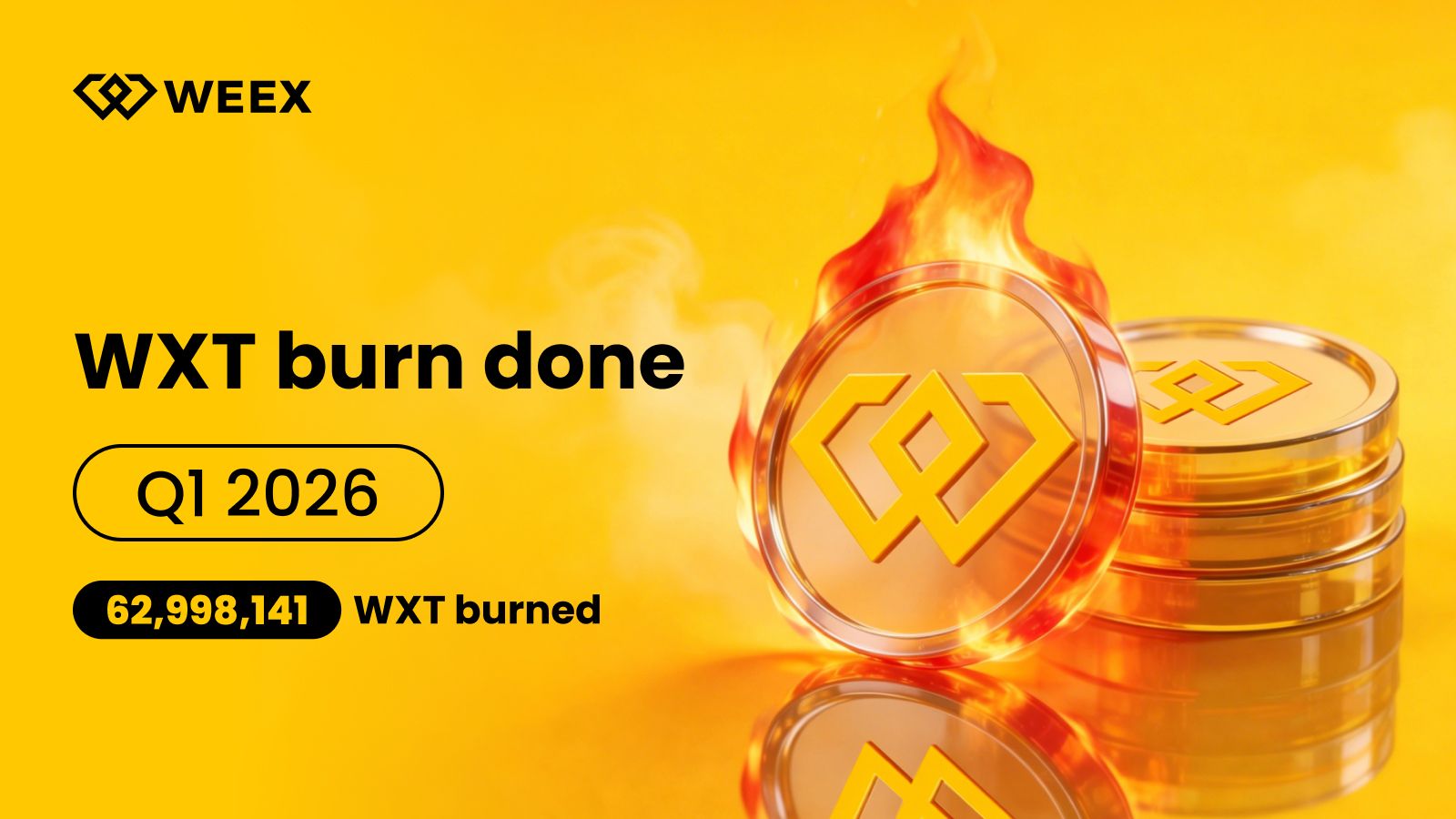
Q1 2026 WXT Burn Details
For this burn cycle, WEEX removed a total of 62,998,141 WXT from circulation. The burn value was approximately $1,004,127, calculated using the market price on the burn date. These figures help users understand both the size of the burn and its market-value equivalent at the time it was completed.
The key burn details are: quantity burned, 62,998,141 WXT; burn value, $1,004,127; total WXT burned after this cycle, 4,253,096,699 WXT; and current WXT supply after this cycle, 5,746,903,301 WXT. Together, these numbers show the continued execution of the WXT deflationary model.
Instead of treating token burns as one-time events, WEEX uses a structured model to guide burn activity and maintain a transparent supply reduction process. For WXT holders and WEEX users, this makes it easier to follow how the token economy evolves over time.
How the WXT Burn Model Works
The WXT Burn Model is designed to connect burn activity with multiple platform and market-related factors. According to the model, the burn calculation considers trading volume, price volatility, platform scale, liquidity conditions, and a base constant.
[Insert burn model formula image here: 销毁模型公式.webp]
The model includes the following parameters: Period (T), Trading Volume (V), Price Volatility Factor (sigma) of 0.513, Platform Scale Effect Term of ln(V)^0.2, Market Liquidity Adjustment Parameter (lambda) of 17.524, and Base Constant (C) of 10,000,000 WXT.
This structure helps make the burn process more systematic. Rather than using a simple fixed amount, the model reflects platform activity and market conditions during the burn period. For users following WXT, this provides a clearer framework for understanding how token supply reduction may be carried out over time.
Why WXT Burns Matter
A token burn permanently removes tokens from circulation. In the case of WXT, burns are used to support a deflationary ecosystem and reduce the available token supply over time. While token burns do not guarantee price appreciation, they can play an important role in token economy design when combined with real platform growth, user demand, and continued ecosystem utility.
For WEEX, WXT is connected to the broader platform ecosystem. As WEEX continues building products, services, and user benefits around WXT, transparent supply management becomes an important part of maintaining long-term market confidence. Users who want to monitor market activity can also follow the WXT/USDT spot market.
Post-Burn WXT Supply Overview
After the Q1 2026 burn, the cumulative amount of WXT burned has reached 4,253,096,699 WXT. The current WXT supply now stands at 5,746,903,301 WXT. This updated supply structure reflects the continued execution of WEEX's deflationary plan.
Each completed burn adds to the total amount permanently removed from circulation, helping users track the long-term progress of the WXT burn mechanism. WEEX remains committed to openness and transparency by publishing burn quantities, burn value, model parameters, and on-chain records.
What This Means for WEEX Users
For WEEX users, the Q1 2026 WXT burn is a signal of continued ecosystem development. It shows that WEEX is actively executing its token supply strategy and maintaining regular communication around WXT's deflationary mechanism.
Users should also understand token burns in a balanced way. A burn can reduce supply, but market value still depends on broader factors such as platform growth, trading demand, liquidity, user adoption, and overall crypto market conditions. WXT burns should be viewed as one part of the token's long-term ecosystem, not as a guaranteed price driver.
New users can also explore the WEEX welcome bonus to learn more about available platform incentives.
Conclusion
WEEX has completed its Q1 2026 WXT token burn, permanently removing 62,998,141 WXT from circulation with an estimated burn value of $1,004,127. After this burn, the total amount of WXT burned has reached 4,253,096,699 WXT, while the current supply stands at 5,746,903,301 WXT.
This burn reflects WEEX's continued commitment to building a transparent, deflationary WXT ecosystem. As the platform grows, WEEX will continue advancing its token strategy, strengthening supply transparency, and supporting WXT's long-term ecosystem development.
FAQ
1. What is the Q1 2026 WXT burn?
The Q1 2026 WXT burn is a token supply reduction event completed by WEEX, removing 62,998,141 WXT from circulation.
2. What was the value of the Q1 2026 WXT burn?
The burn value was approximately $1,004,127, based on the market price on the burn date.
3. Where can users verify the WXT burn?
Users can verify the burn through the on-chain transaction record published by WEEX.
4. How much WXT has been burned in total?
After the Q1 2026 burn, the total amount of WXT burned has reached 4,253,096,699 WXT.
5. What is the current WXT supply after the burn?
The current WXT supply after this burn is 5,746,903,301 WXT.
6. Does a WXT burn guarantee price growth?
No. Token burns can reduce supply, but price performance still depends on demand, liquidity, market sentiment, platform growth, and broader crypto conditions.
7. Why does WEEX burn WXT?
WEEX burns WXT to support the token's deflationary ecosystem, improve supply transparency, and strengthen the long-term token economy.
DISCLAIMER: WEEX and affiliates provide digital asset exchange services, including derivatives and margin trading, onlywhere legal and for eligible users. All content is general information, not financial advice-seek independentadvice before trading. Cryptocurrency trading is high risk and may result in total loss. By using WEEX services you accept all related risks and terms. Never invest more than you can afford to lose. See our Terms of Use and Risk Disclosure for details.
You may also like

Should You Sell META Stock in 2026? US–Iran Talks Shake Stock Market
Geopolitical headlines from US–Iran talks in Doha have stirred a risk-off rotation, pressuring tech and AI names, including…
Can META Reach $1000 in 2026? Meta Price Prediction
KEY TAKEAWAYS Current price: $612 for META, based on aggregated data from major market trackers at the time…
Buy, Sell, or Hold META Stock? Forecast 2026–2027 After Middle East Shock
A short-lived de-escalation headline out of the Middle East sparked a classic macro rotation and fresh volatility in…
Buy, Sell, or Hold MXL Stock? MaxLinear Forecast 2026–2027
This article breaks down whether MXL is a buy, sell, or hold, focusing on MaxLinear’s pivot to AI…
Meta Price Prediction (META) Forecast — July 2026: Can Consolidation Near $614 Turn Into A Breakout?
Meta (META) tokenized on real-world asset (RWA) markets is tracking the equity performance of Meta Platforms with crypto-market…
Who Is Orlando Gill? The Goalkeeper Who Knocked Germany Out of the 2026 Tournament
Orlando Gill’s penalty heroics against Germany turned a quiet name into a headline—an underdog story that traveled from…
Switzerland vs Canada 2026 Schedule: Kickoff Times and Seattle Venue Guide — Paraguay Eliminates Germany in the Biggest Football Upset of 2026
This guide unpacks two hot topics: the Paraguay vs Germany shock that reshaped the 2026 global football championship…
Cape Verde vs Spain: How a Nation of 525,000 People Drew With the 2026 Football Favorites
Cape Verde vs Spain delivered one of the most talked‑about results of this global tournament cycle: a 0‑0…
Australia Beats Turkey 2-0: The Most Underrated Football Upset of 2026
Australia vs Turkey ended 2-0 in a result that flipped pre-match narratives on their head. This article breaks…
Who Is Amad Diallo? The Man United Star Taking the 2026 Global Football Stage by Storm
Amad Diallo is having the moment every winger dreams about: decisive goals for Ivory Coast on the international…
Jonathan David Hat-Trick: Canada’s First Ever International Football Win and the Man Behind It
Jonathan David delivered a hat-trick in Canada’s 6-0 win over Qatar, marking Canada’s first-ever victory at a men’s…
Morocco Beats Netherlands on Penalties: Is This Their 2022 Magic All Over Again?
Morocco vs Netherlands delivered a tense, possession-chess match that broke open late, then swung on penalties—an echo of…
Paraguay vs Germany Upset; Switzerland vs Canada 2026 Schedule and Seattle Venue Guide
This guide covers two hot topics: the Paraguay vs Germany shock in the 2026 international tournament and a…
What is ANSEM(ANSEMSOL) Coin? Everything you need to know, how to buy, and when is the best time to trade ANSEMSOL/USDT
ANSEM (ticker: ANSEMSOL) is a newly listed Solana memecoin now tradable on WEEX; the ANSEMSOL/USDT pair opened for…
Buy or Sell MU Stock Now? Micron Forecast 2026–2027 AI Memory Boom
Micron Technology’s “MU” sits at the heart of the AI memory boom, with HBM and advanced DRAM anchoring…
Can MU Reach $1500 in 2026? Micron Technology Price Prediction
KEY TAKEAWAYS MU is currently priced at $1,150 against USDT. Reaching $1,500 implies an upside of approximately 30.4%…
Should I Sell MU Stock Now or Hold? Micron Forecast 2026–2027
MU sits at the crossroads of the AI memory supercycle and the next leg of data center buildouts.…
What is Strategy Stretch Preferred Corporation(STRCON) Coin? A comprehensive guide you shouldn’t miss
Strategy Stretch Preferred Corporation (STRCON) is the Ondo tokenized version of the Strategy Stretch Preferred (STRC), a perpetual…
Should You Sell META Stock in 2026? US–Iran Talks Shake Stock Market
Geopolitical headlines from US–Iran talks in Doha have stirred a risk-off rotation, pressuring tech and AI names, including…
Can META Reach $1000 in 2026? Meta Price Prediction
KEY TAKEAWAYS Current price: $612 for META, based on aggregated data from major market trackers at the time…
Buy, Sell, or Hold META Stock? Forecast 2026–2027 After Middle East Shock
A short-lived de-escalation headline out of the Middle East sparked a classic macro rotation and fresh volatility in…
Buy, Sell, or Hold MXL Stock? MaxLinear Forecast 2026–2027
This article breaks down whether MXL is a buy, sell, or hold, focusing on MaxLinear’s pivot to AI…
Meta Price Prediction (META) Forecast — July 2026: Can Consolidation Near $614 Turn Into A Breakout?
Meta (META) tokenized on real-world asset (RWA) markets is tracking the equity performance of Meta Platforms with crypto-market…
Who Is Orlando Gill? The Goalkeeper Who Knocked Germany Out of the 2026 Tournament
Orlando Gill’s penalty heroics against Germany turned a quiet name into a headline—an underdog story that traveled from…