
What Is Vanguard (VWA) and How Does VWA Work? Latest Price, Tokenomics, and Risk Guide

Quick Summary
Vanguard, usually shortened to VWA, is a Solana-based crypto project that presents itself as a real-world asset tokenization platform focused on precious assets such as gold, silver, and gemstones. Its official GitHub organization says the project is built to tokenize RWAs and improve liquidity, accessibility, and transparency in global markets, while current market trackers show VWA trading as a small-cap, highly volatile token rather than a mainstream institutional product.
The catch is that VWA’s public identity is still messy. Some independent sources describe it as an RWA platform, others classify it as a memecoin, and some trading coverage has even repeated unverified claims about ties to major financial brands. Independent reporting also notes that those brand links are not verified, which is why VWA has become both a narrative token and a legitimacy question at the same time.
| Fast Fact | Latest Public Snapshot |
|---|---|
| Token name | Vanguard (VWA) |
| Main chain | Solana |
| Claimed use case | Tokenizing precious assets and RWAs |
| Contract address | GJvLcMvQwznh1gAonWnqbqdSRrNCQmVzhfsZVvQdtM4b |
| Current market level | Micro-cap, highly volatile |
| Public identity | RWA project to some sources, memecoin to others |
The rest of this guide explains what VWA is, how VWA works, what the latest news says, and how to read the token without falling for hype. It also covers the current price snapshot, supply profile, and the legitimacy questions that every buyer should understand before touching the token.
What Is Vanguard (VWA)?
Vanguard (VWA) is a Solana-based cryptocurrency project that says it wants to bring real-world assets on-chain by tokenizing items such as gold, silver, gemstones, and other valuable physical goods. Multiple current writeups describe the project as an RWA platform, and the official GitHub organization says its mission is to bridge traditional finance and decentralized finance by turning tangible and intangible assets into digital tokens.
That sounds straightforward, but the public identity of VWA is not perfectly consistent. One set of sources frames it as a serious RWA initiative on Solana, while another set of market summaries and independent writeups treat it like a speculative token with meme-style market behavior. IQ.wiki explicitly notes this contradiction, saying the project presents conflicting identities across platforms.
The “Vanguard” branding also creates confusion because it sounds like a traditional finance name. Independent reporting says there is no verifiable connection between VWA and Vanguard Group, and no confirmed partnership with Ripple either, despite promotional chatter that has repeated such claims. That matters because brand-name confusion can make a token seem more legitimate than it really is.
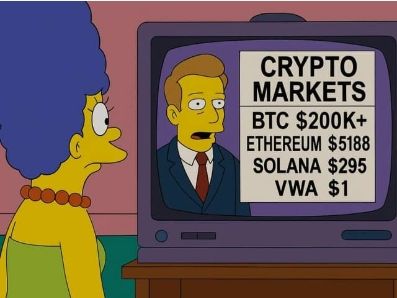
In practical terms, VWA is best understood as a story-heavy micro-cap token sitting inside the broader RWA narrative. The story says it is about tokenizing precious assets. The market behavior says it still trades like a very speculative small token whose value depends heavily on attention, liquidity, and belief.
How Does VWA Work?
At the technical level, VWA works as an SPL token on Solana. That means it uses Solana’s token standard and transaction layer, which is why the contract address is visible on Solana explorer pages and why current market pages repeatedly identify the token as a Solana asset. The published contract address on Solscan is GJvLcMvQwznh1gAonWnqbqdSRrNCQmVzhfsZVvQdtM4b.
According to project summaries, VWA is supposed to work by representing physical or high-value assets digitally so they can be traded more easily on-chain. In that model, gold, silver, gemstones, or similar assets are tokenized, and the token is supposed to provide a fractional, transferable claim to the economic value of those assets. That is the core RWA idea behind the project.
The project’s own materials and public summaries also describe utility beyond simple price exposure. Current writeups say VWA is intended to support minting, liquidity rewards, and possibly governance inside the ecosystem. In other words, the token is presented not only as a speculative asset but also as a utility token for a tokenization platform.
| Claimed Function | How It Is Supposed To Work |
|---|---|
| Asset tokenization | Physical value is represented digitally |
| Fractional ownership | Smaller investors can access expensive assets |
| Liquidity rewards | Participants may be incentivized to provide market depth |
| Ecosystem use | VWA may be used inside the project’s own system |
| Trading access | Token can move on Solana rails |
Because VWA sits on Solana, its on-chain movement is designed to be fast and cheap relative to many older blockchain systems. That is one reason tokenization projects often choose Solana: they want the user experience to feel more like modern financial infrastructure and less like a slow, expensive settlement layer. Public coverage around VWA repeatedly points to Solana’s speed and low fees as part of the project’s appeal.
The important caveat is that “how it works” in theory is not the same as “how it is trusted in the market.” VWA may have the architecture of an RWA tokenization project, but the public evidence still leaves open questions about transparency, audits, and real-world backing. That gap between the pitch and the proof is a major part of the VWA story.
Latest News About Vanguard (VWA)
The latest news around VWA is that the project appears to still be actively evolving rather than fading out after launch. The official X account posted in March 2026 that V2 migration is live, describing it as a stronger foundation for a more powerful ecosystem. That is a meaningful update because it shows the project is still trying to reorganize, refine, or relaunch parts of its structure.
Another recent social update referenced an airdrop portal for early supporters. Social snippets described a claim interface and dashboard for qualified wallets, which suggests the project is still using community incentives to drive engagement. Even when a token is controversial, active migration and airdrop messaging usually mean the team or community is still trying to keep the project moving.
VWA first came to wider attention in October 2025, when multiple market writeups said the token launched that month and quickly gained visibility through social media. Some coverage described early trading as aggressive, with fast volume and big narrative energy. That early burst matters because it explains why VWA still gets attention now: the token built a reputation for movement, hype, and controversy very quickly.
The most useful interpretation of the latest news is that VWA is still alive, still trying to maintain momentum, and still leaning on its RWA storyline. But the news also shows that the project is far from settled. A V2 migration and an airdrop portal are signs of activity, not necessarily signs of maturity or institutional-grade trust.
VWA Price Snapshot And Tokenomics
VWA remains a small-cap token, and current public trackers show a price cluster around $0.00037 to $0.00056, depending on the market page and data source. One current tracker shows a price of $0.0003707 with a market cap of $370.72K and 24-hour volume of $123.36. Another market page shows a price of $0.0005556 with a market cap of $382.15K and 24-hour volume of $1.37K. The fact that tracker data varies so much is itself a sign that liquidity is still thin.
The supply picture is clearer. Current public pages show a circulating supply of 999.99 million VWA and a maximum supply of 999.99 million VWA. That means nearly the entire supply is already in circulation, which can make the token look simpler to understand than projects with hidden emissions, but it does not remove volatility or legitimacy questions.
The current all-time high was $0.02156 on October 20, 2025, and the latest price snapshot is roughly 98.28% below that peak. That means VWA has already gone through a very large drawdown from launlassic sign of a project that has already seen a wave of speculative trading and is now living in the harder phase of market reality.
| Metric | Latest Public Snapshot |
|---|---|
| Current price | About $0.00037 to $0.00056 |
| Market cap | About $365K to $403K |
| 24h volume | Thin, around $123 to $1.37K on current pages |
| Circulating supply | 999.99M VWA |
| Maximum supply | 999.99M VWA |
| All-time high | $0.02156 |
| Drawdown from ATH | About 98.28% |
One older launch-phase writeup said early trading placed VWA around $0.007 to $0.008 with market capitalization near $7–8 million, but current market pages show that those launch highs did not hold. The token’s present market size is dramatically smaller than it was during the first wave of attention, which is another reminder that VWA trades more like a volatile narrative token than a stable RWA blue chip.
Is Vanguard (VWA) Legitimate?
The legitimacy question around VWA is complicated because the token is real, but the public story around it is not clean. There is a visible Solana contract, an active official X account, and ongoing migration updates, which confirms that the token and community are not imaginary. At the same time, current public sources describe conflicting identities, and some analyses say the project lacks a whitepaper, audited contracts, and a transparent roadmap.
That contradiction is the reason many people are cautious. One current analysis said about 89–90% of supply may be concentrated in 50 wallets, which would be a serious red flag if accurate because it implies high centralization and the risk of large holders exerting major influence on price. Another independent writeup said the token’s branding can mislead new investors into thinking there is institutional backing when no verified partnership exists.
The brand-confusion issue matters a lot. Public reporting says VWA has no verifiable link to Ripple, no verifiable link to Vanguard Group, and no confirmed institutional partnership that would justify treating it as a major-finance-backed asset. That does not automatically make it a scam, but it does mean the project’s strongest marketing claims should be treated as claims, not facts.
| Legitimacy Signal | What Current Sources Suggest |
|---|---|
| Real token exists | Yes, visible on Solana explorer |
| Active community | Yes, official X account still posts |
| Whitepaper / audit | Some analyses say no public version is available |
| Token concentration | Some reports flag heavy concentration |
| Major brand partnerships | No verified connection shown |
| Overall risk | High, especially for new buyers |
A balanced verdict is that VWA should be treated as a high-risk speculative token with RWA branding, not as a settled, institutionally verified asset-tokenization platform. The market may eventually reward the project if it proves real utility, but the current evidence does not support blind trust.
How Should Traders Read VWA?
Traders should read VWA as a token whose story is bigger than its current market size. On one side, the project fits a popular narrative: tokenized real-world assets, precious metals, and blockchain-based liquidity. On the other side, the token is still a tiny asset with thin trading volume, large drawdowns, and unresolved questions about distribution and transparency. That combination can create fast upside, but it can also produce violent reversals.
The most useful way to evaluate VWA is to separate the idea from the execution. The idea is easy to understand: put valuable assets on-chain and make them easier to trade. The execution is harder: prove backing, prove governance, prove liquidity, and prove that the token is more than a marketing wrapper. Until that proof is stronger, VWA belongs in the speculative bucket.
| What To Check | Why It Matters |
|---|---|
| Contract address | Confirms you are looking at the real token |
| Liquidity | Thin liquidity can exaggerate moves |
| Holder concentration | A few wallets can dominate price action |
| Official updates | Shows whether the project is still active |
| Claims vs evidence | Separates real utility from marketing |
If you are considering VWA, think like a risk manager. That means checking the contract, watching liquidity, and never assuming that a token with an RWA narrative is automatically backed, regulated, or stable. In crypto, narrative can create attention, but attention alone does not create durable value.
Final Thoughts
Vanguard (VWA) is best understood as a Solana token that sits inside the RWA story while also carrying the risk profile of a small, fast-moving speculative asset. Its official and semi-official materials describe a platform for tokenizing precious assets, and its latest social updates show the project is still active through migration and airdrop messaging. At the same time, market data, public commentary, and coverage all show that VWA remains controversial, thinly traded, and difficult to categorize cleanly.
That duality is the whole story. VWA could develop into a more serious RWA project if it improves transparency and proves real utility, but for now it is still a token whose market behavior is driven as much by narrative as by fundamentals. For traders who understand that risk, VWA is worth watching. For everyone else, it deserves caution first and excitement second. If you decide to trade it, start small, verify the contract, and use a disciplined platform to keep your risk controlled.
For more crypto trading, you can create your WEEX account and then act only when your own research says the setup is right.
FAQ
What Is Vanguard (VWA)?
Vanguard (VWA) is a Solana-based crypto project that claims to tokenize real-world assets such as gold, silver, and gemstones and turn them into digital tokens.
How Does VWA Work?
VWA works as an SPL token on Solana and is described as a utility token for an RWA platform that may support tokenization, liquidity rewards, and ecosystem functions.
Is VWA Backed By Real Assets?
The project claims to tokenize physical assets, but independent sources say there is no verified public proof of major brand backing, and the project still has transparency concerns.
What Is The Current VWA Price?
Public trackers currently show VWA around the $0.00037 to $0.00056 range, depending on the market page, with market cap roughly in the mid-hundreds of thousands of dollars.
Is Vanguard (VWA) Safe To Buy?
It is a high-risk speculative token. The token is real, but the public record still shows conflicting identity claims, thin liquidity, and
unresolved transparency questions.