
Norway vs England Prediction Market: Haaland vs Bellingham in the World Cup Semifinal


The Norway vs England prediction market is the narrowest of any quarterfinal at this tournament, and that alone tells you something important. Polymarket's current odds on the Norway vs England prediction market give England 53% in 90 minutes, Norway 23%, and a draw 27%, making this the closest split of the four quarterfinal markets.
What separates the Norway vs England prediction market from the other three matchups is not just the numbers but what those numbers reveal about two teams where one extraordinary individual on each side has defined everything, yet neither is dominant enough to push the favorite probability above the mid-fifties.
That near even distribution is not noise. It is the aggregate judgment of traders putting real money behind a match they consider too close to price with confidence in either direction.
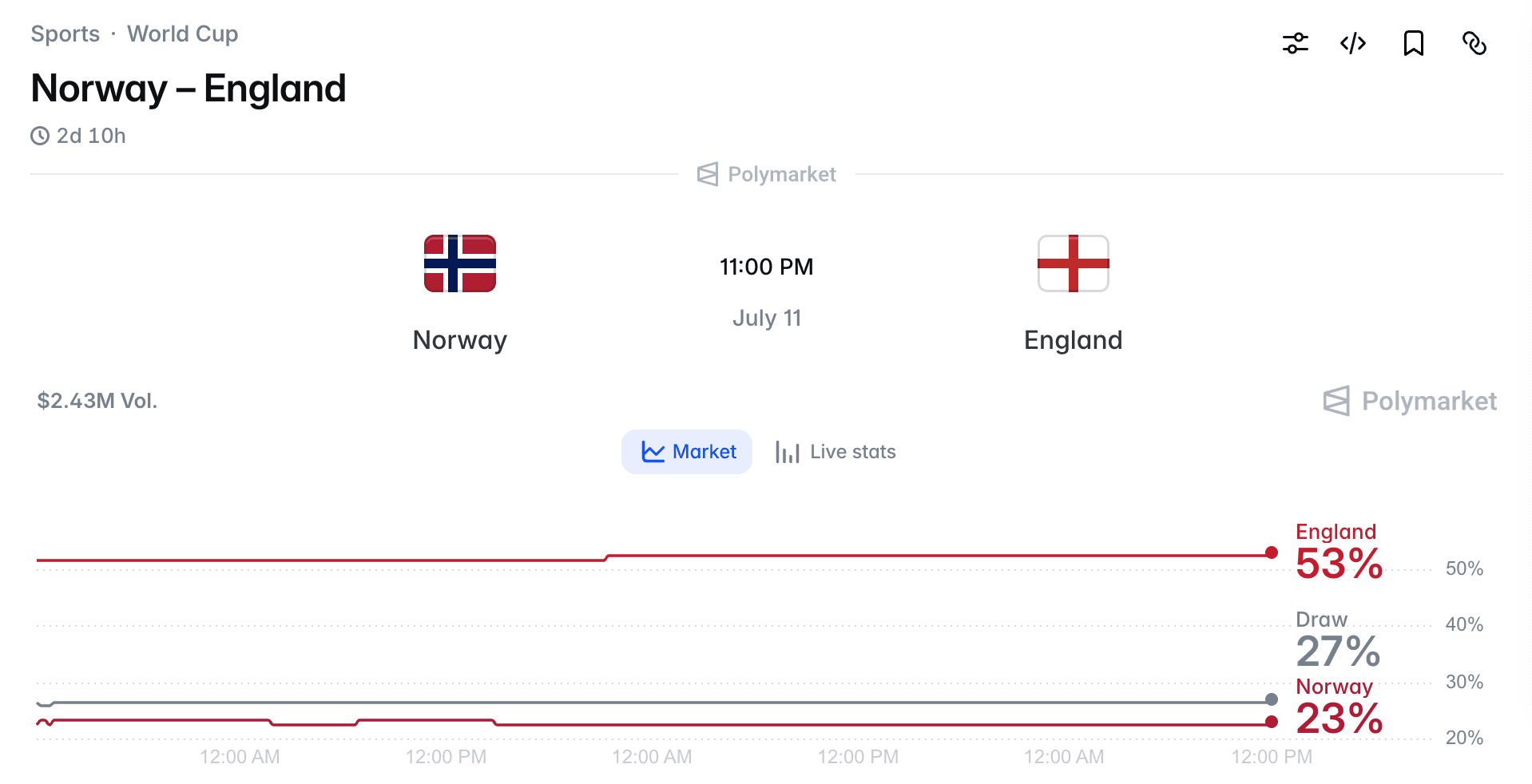
Why England at 53% Is a Fragile Favorite
England's path to the quarterfinal has been convincing enough to justify a slight edge but not dominant enough to justify more.
They beat Mexico in the round of 16 in what multiple analysts described as England's best win on foreign soil in their history. They moved through the group stage efficiently, including wins over Congo and a navigated group that left them as one of the better-organized sides heading into the knockout rounds. Jude Bellingham has been their most influential player, appearing in moments of creative and defensive importance across the tournament, and the combination of Harry Kane's finishing and Bellingham's engine in midfield has given England a functional attacking rhythm.
What the market has also observed is that England have not been tested by a team with anything close to Norway's attacking quality. Mexico, Congo, and their group stage opponents were manageable obstacles. Haaland is a different category of threat entirely, and the 53% probability reflects a market that has seen enough of England to believe they are capable but has also seen enough of Norway to know that Haaland in this form changes the probability calculation significantly.
The draw probability at 27% is slightly lower than the Argentina vs Switzerland draw probability but reflects a similar dynamic. England are well-organized defensively but have not been impenetrable, and Norway's ability to score in high volumes means any tactical plan to keep Haaland quiet carries genuine risk of a counter-attack producing a different kind of danger.
What Haaland Has Done That Changes the Market
The Norway win probability sitting at 23% is not a token acknowledgment of the underdog. It is a direct pricing of Haaland's specific impact on this tournament.
Haaland scored twice against Brazil in a 2-1 Norway win that remains one of the most discussed results of the tournament. He has been the single most physically dominant presence at the 2026 World Cup, combining pace, aerial threat, hold-up play, and a finishing ability that makes him dangerous from positions that would be harmless for most other strikers. His statistical output across five matches has been the kind that prediction market traders factor heavily into match pricing because it represents a consistent pattern rather than a single exceptional performance.
The specific challenge Haaland poses for England's defense is worth examining precisely. England's center-back pairing has not faced a striker with Haaland's combination of attributes in this tournament. His ability to receive the ball with his back to goal and spin is as dangerous as his more obvious aerial and pace threats, and England will need to decide whether to push up and compete physically, which risks the space in behind, or sit deeper and invite Norway to play into them, which gives Haaland time and space to collect the ball and turn.
That defensive decision is not something prediction markets can pre-price with precision. What they can price is the aggregate probability distribution of outcomes based on how England's defense has performed and how Norway's attack has performed across five matches each. The 23% Norway win probability is the market's answer to the question of how often Haaland and Norway's attack succeeds in translating their tournament form into a result against this specific English defense.
Bellingham as the Counterweight
The prediction market's slight edge for England rests primarily on the collective quality of the team rather than one individual, but Bellingham is the closest thing England has to a Haaland-level individual variable.
Bellingham's influence on this England team operates differently from Haaland's. Where Haaland is primarily a goal threat who changes what defenses must do when Norway have the ball, Bellingham changes what England can do in both directions. His ability to win the ball in midfield and immediately produce a forward pass that changes the angle of attack has been England's primary source of transitions into attack throughout the tournament.
The specific Haaland versus Bellingham matchup will play out partly through their respective teams' ability to create conditions where each player can operate effectively. Bellingham in space against a Norway midfield that is focused on supporting Haaland defensively is a dangerous proposition for Norway. Haaland against England center backs who have been pushed high trying to press is equally dangerous for England. Neither team has a clear structural advantage that explains why England should be at 53% and Norway at 23%.
The gap exists primarily because England have been more consistent in their results and because the collective depth of England's squad is arguably greater than Norway's outside of Haaland. When Norway need a second source of danger, the options narrow quickly. When England need a second source of danger, they have a broader pool to draw from.
The 27% Draw and What It Means for Saturday Night
The 27% draw probability deserves the same attention as the headline win probabilities because it shapes how the match is likely to feel while it is being played rather than just how it ends.
Both teams have demonstrated the capacity to keep matches tight. Norway beat Brazil in a match that was not as comfortable as the scoreline suggests. England beat Mexico in a match that required a specific game plan rather than constant pressure. Neither team's tournament profile suggests they will produce an end-to-end open match where the winner is settled comfortably before the 80th minute.
A match that reaches 70 minutes with the score level introduces the specific psychology that knockout football creates and that prediction markets struggle to price. England have not played in a knockout match at a major tournament without the pressure of expectation in recent memory, which creates a specific mental load that Norway, as a nation without that weight of history, does not carry in the same way. Whether that manifests in the players is genuinely uncertain, but it is the kind of intangible factor that prediction market traders factor into their individual positioning even when aggregate prices cannot reflect it directly.
The penalty scenario is worth noting for Norway specifically. Andreas Christensen and Erling Haaland shooting in a penalty shootout against Jordan Pickford is a different proposition from any shootout England have faced at this tournament, and the market's 27% draw probability implicitly includes some probability of a shootout that could go either way.
What the Prediction Market Cannot See
Polymarket's 53-27-23 distribution is based on five matches each of publicly observable information. Several things that will materially affect Saturday's result are not in that information set.
Team news and physical condition at kickoff is the most significant unknown. Both teams have played high-intensity knockout matches and the physical accumulation across a tournament is not uniform across squads. Any significant injury or tactical adjustment that is not public before the market closes will move odds immediately when disclosed but cannot be incorporated before that point.
The specific tactical approach each manager chooses introduces uncertainty that historical patterns can only partially inform. Gareth Southgate's England have a track record of being adaptable in knockout matches, which sometimes produces conservative and efficient results and occasionally produces performances that invite pressure. Stale Solbakken's Norway will have specific plans for limiting England's midfield creativity while getting Haaland into positions he can exploit. Neither game plan is observable in advance.
The match environment in Miami, the crowd composition, the temperature, and the specific referee assignment, introduces variables that aggregate statistics across five previous matches in different venues and conditions cannot fully account for.
For readers following the World Cup, WEEX is running the WEEX Cup: Dice Rush campaign through July 20, combining trading tasks with football match predictions and a 1,000,000 USDT prize pool.
Conclusion
The Norway vs England prediction market on Polymarket is the narrowest of any quarterfinal at this tournament, and that narrowness is earned rather than arbitrary. England at 53% reflects a team that has been efficient, organized, and capable without producing the kind of dominant tournament performances that would justify higher confidence. Norway at 23% reflects a team built almost entirely around one player whose specific tournament form has made him the single most dangerous individual at the 2026 World Cup.
The 27% draw probability is the market's honest acknowledgment that these two teams are capable of producing a tight match that is not decided in 90 minutes. Three percentage points between England and Norway in the pre-match market is as close to a genuine coin flip as a match with two identified favorites can produce.
Haaland versus Bellingham as a framing captures the individual story. England versus Norway as a prediction market captures the collective uncertainty that makes Saturday's quarterfinal in Miami the most difficult of the four to call with confidence.
FAQ
1. What does Polymarket say about Norway vs England?
Polymarket currently gives England 53% probability of winning in 90 minutes, a draw 27%, and Norway 23%. The three-percentage-point gap between England and Norway makes this the closest quarterfinal prediction market of the round.
2. Why is Norway given 23% despite being considered underdogs?
Haaland's individual impact has been the most significant single-player influence on tournament results at the 2026 World Cup. Norway's 23% reflects a market pricing his specific threat against an England defense that has not faced a striker of his quality in this tournament.
3. What makes the draw probability significant at 27%?
Both teams have shown the capacity to keep matches tight. Norway beat Brazil in a controlled performance rather than an open game, and England have won their knockout matches efficiently rather than comfortably. The 27% draw probability reflects genuine uncertainty about whether 90 minutes separates these teams.
4. How does Bellingham's role differ from Haaland's in this match?
Haaland is primarily a goal threat who changes what defenses must do when Norway have possession. Bellingham influences the match in both directions, winning the ball and immediately creating attacking opportunities. His impact is collective and structural rather than concentrated in specific goal threat moments.
5. When and where is Norway vs England played?
Norway vs England kicks off at 5pm Eastern Time on Saturday July 11 at Hard Rock Stadium in Miami Gardens. The match is broadcast on Fox Sports and Telemundo in the United States.
Disclaimer
For informational purposes only. Not financial advice. Any activities, rewards, campaigns, or promotions mentioned do not constitute an offer, solicitation, or recommendation to buy, sell, or trade crypto assets. Crypto assets are highly volatile and may lose value. WEEX services, products, or campaigns may not be available in all regions. Users are responsible for complying with applicable local laws before participating.
You may also like

Introducing Kaito ($KAITO): AI-Powered InfoFi Network and Price Prediction
Kaito is an AI-powered InfoFi platform, with KAITO drawing attention from mindshare products, governance, and unlock events.
$KAITO Airdrop on WEEX: Complete Guide to Kaito and Claim Free $KAITO
Kaito tokenomics support an AI-powered InfoFi network for attention, governance, and network currency, while eligible users can join the WEEX KAITO campaign to claim rewards from a 50,000 USDT prize pool before July 16, 2026 at 17:00 SGT.
Risks of Shorting Bitcoin You Should Know Before You Trade
Shorting can look simple: you profit when price falls. But the bitcoin short is different from buying because…
Shorting Bitcoin vs Buying Put Options: What’s the Difference
This guide breaks down two ways to express a bearish view on BTC: opening a bitcoin short with…
Prismevm (PP) Airdrop on WEEX: How to Unlock New User Rewards
This guide explains what Prismevm (PP) is, how the Prismevm (PP) airdrop on WEEX works, and a simple,…
How to Short Bitcoin: Methods and Platforms Compared
A bitcoin short lets you profit if BTC falls. This guide explains how to short bitcoin using futures,…
What Is Dollar-Cost Averaging (DCA)? A Beginner’s Guide
Dollar-cost averaging (DCA) is a simple strategy: invest a fixed amount on a fixed schedule, no matter the…
Why Did Semiconductor Stocks Crash Today? Is NVDA Stock a Buy Now
Semiconductor stocks sold off today after a long AI-driven run. This article explains the most likely catalysts behind…
PepsiCo Stock Price Prediction 2026: Can PEP Beat Q2 Earnings This Week
This piece offers a clear view of PepsiCo Stock Price Prediction 2026 and whether PEP can beat Q2…
JPMorgan Stock Price Prediction 2026-2030: Can JPM Reach 300 After July Earnings
This article lays out a data-driven JPMorgan Stock Price Prediction 2026-2030 with a clear look at whether JPM…
Delta Air Lines Stock Price Forecast 2026: Can DAL Stock Recover From Oil Spike
This article maps a practical path to a Delta Air Lines stock price forecast for 2026 by breaking…
Advanced Micro Devices (AMD) Stock Forecast 2026: Can AMD Reach 300 This Year
This article unpacks the Advanced Micro Devices (AMD) Stock Forecast 2026 with a simple, decision-focused framework. We explore…
What is the SOXL Stock and Who Should Actually Trade It After Crash
This guide explains what the SOXL stock is, how its 3x leverage really works, why it behaves differently…
Taiwan Semiconductor (TSM) Stock Price Prediction 2026-2030: Is TSM Safe to Buy
Taiwan Semiconductor Manufacturing Co. sits at the heart of the AI hardware boom, powering chips for Nvidia, Apple,…
SK Hynix Stock Forecast 2026: Can SK Hynix Recover and Reach New Highs
SK Hynix sits at the heart of the AI memory boom. This 2026 outlook explains how HBM leadership,…
Why is the PHLX Semiconductor Index SOX Dropping While Oil Prices Climb
Semiconductors are selling off while crude rises—a classic growth-versus-inflation standoff. This article explains why the PHLX Semiconductor Index…
SOXL Stock Price Prediction 2026-2030: Can SOXL Recover From July Tech Correction
SOXL Stock Price Prediction 2026-2030 comes down to one question: can semiconductors extend the AI boom after a…
Micron (MU) Stock Price Prediction 2026-2030: Can MU Reach 1500 After July Crash
This article unpacks the July pullback in Micron, builds a 2026–2030 Micron (MU) Stock Price Prediction using cyclical…
Introducing Kaito ($KAITO): AI-Powered InfoFi Network and Price Prediction
Kaito is an AI-powered InfoFi platform, with KAITO drawing attention from mindshare products, governance, and unlock events.
$KAITO Airdrop on WEEX: Complete Guide to Kaito and Claim Free $KAITO
Kaito tokenomics support an AI-powered InfoFi network for attention, governance, and network currency, while eligible users can join the WEEX KAITO campaign to claim rewards from a 50,000 USDT prize pool before July 16, 2026 at 17:00 SGT.
Risks of Shorting Bitcoin You Should Know Before You Trade
Shorting can look simple: you profit when price falls. But the bitcoin short is different from buying because…
Shorting Bitcoin vs Buying Put Options: What’s the Difference
This guide breaks down two ways to express a bearish view on BTC: opening a bitcoin short with…
Prismevm (PP) Airdrop on WEEX: How to Unlock New User Rewards
This guide explains what Prismevm (PP) is, how the Prismevm (PP) airdrop on WEEX works, and a simple,…
How to Short Bitcoin: Methods and Platforms Compared
A bitcoin short lets you profit if BTC falls. This guide explains how to short bitcoin using futures,…