
How to Buy SpaceX-Related Tokens: Risks and Steps for Exchange Users


KEY TAKEAWAYS
SpaceX-related tokens may offer price exposure to SpaceX narratives, but they are not the same as direct SpaceX stock ownership.
WEEX users can review the SPACEXPRE-USDT market page to check price, depth, spread, and trading activity before placing an order.
Users should verify the token name, pair, contract or listing details, liquidity, and product structure before trading.
Main risks include valuation uncertainty, liquidity risk, issuer or wrapper risk, copycat tokens, and misunderstanding ownership rights.
Beginners should use small size, avoid emotional entries, and build a clear exit plan before trading SpaceX-related tokens.
What are SpaceX-related tokens?
SpaceX-related tokens are crypto assets that reference SpaceX, SpaceX pre-IPO narratives, tokenized stock exposure, or private-company valuation themes. Some may be designed as tokenized stock products, while others may simply trade on the SpaceX story.
The important distinction is ownership. A SpaceX-related token does not automatically make the holder a SpaceX shareholder. Unless the product terms clearly state otherwise and provide enforceable legal rights, users should assume they are trading tokenized exposure or narrative-linked price movement rather than direct equity.
SpaceX-related tokens have become a hot topic as traders look for crypto-market exposure to private-company narratives, pre-IPO speculation, and tokenized stock products. On WEEX, users can track SPACEXPRE price and trading on WEEX, a SpaceX-related market pair that may interest users following tokenized private-market themes. This guide explains how exchange users can approach SpaceX-related tokens, what steps to check before trading, and why these products should not be confused with owning SpaceX shares. Users who are new to WEEX can also start crypto trading on WEEX after completing account setup and identity verification.
How to buy SpaceX-related tokens on WEEX
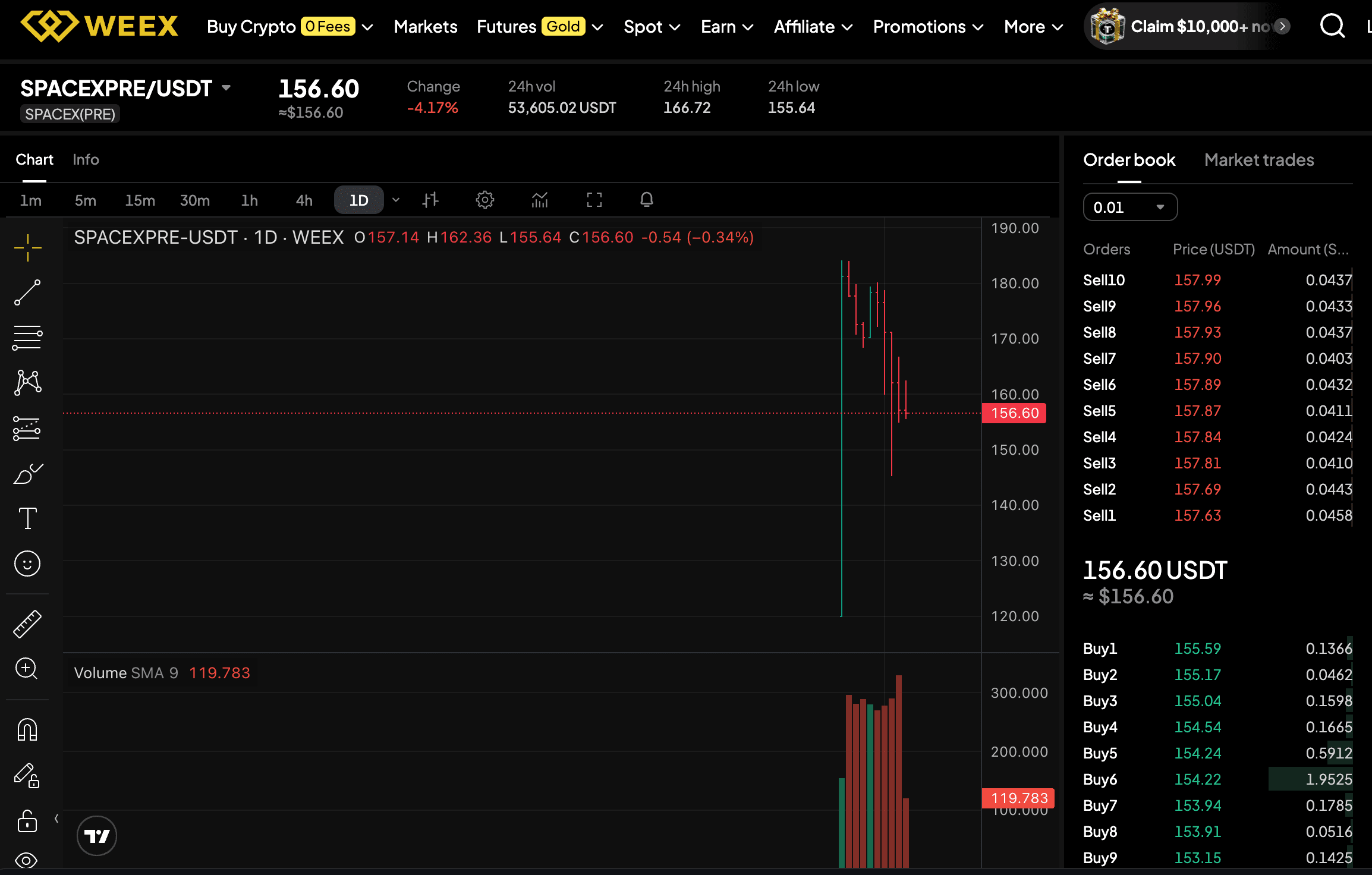
The first step is to open the relevant trading page, such as the SPACEXPRE-USDT spot market on WEEX. Users should check the current price, order book, recent trades, 24-hour volume, and whether the market has enough depth for their intended order size.
After that, users can fund their WEEX account with USDT, go to the spot trading page, choose the trading pair, and place a limit or market order. For beginners, a limit order may provide more control because it lets users set the price they are willing to pay. A market order is faster, but it may execute at a worse price if liquidity is thin.
Step 1: Confirm the correct market pair
Before trading, confirm that the pair is the one you intended to access. In this case, the relevant WEEX pair is SPACEXPRE-USDT. Similar names, tickers, or unofficial tokens may appear elsewhere in the market, especially when a famous brand name becomes popular.
This check matters because SpaceX-related assets can attract copycats. A trader who buys the wrong token may end up holding an unrelated asset with poor liquidity. On an exchange, checking the exact market page, ticker, and quote asset helps reduce confusion before any order is placed.
Step 2: Review price, spread, and liquidity
Price is only the first number. Before buying SPACEXPRE or any SpaceX-related token, WEEX users should review the bid-ask spread, order book depth, and recent trade activity. A narrow spread and deeper order book usually make execution cleaner.
Thin liquidity changes the risk profile. If the order book is shallow, even a small trade can move the price. That can make entry more expensive and exit harder. Users should avoid judging a token only by its chart. The order book often tells the more useful story.
Step 3: Choose order type carefully
A market order can be useful when speed matters, but it can also create slippage. If liquidity is limited, the final execution price may be worse than expected. This is especially relevant for narrative-driven tokens that may move quickly after news or social attention.
A limit order gives users more control. It may not fill immediately, but it prevents buying above the selected price. For beginners, using limit orders and smaller order sizes can reduce the chance of poor execution. Trading slowly is often better than entering at any price.
Step 4: Understand what you are buying
Before trading SpaceX-related tokens, users should understand whether the product is a tokenized stock, a pre-IPO exposure product, a derivative-style instrument, or a narrative token. These categories can look similar on a price chart but carry different rights.
If the token does not provide voting rights, dividends, redemption rules, or direct legal claims, then it should not be treated as ordinary stock. A token can follow SpaceX-related attention without giving the holder any shareholder status. This is the key risk for beginners.
SpaceX-related token risks
The first risk is ownership confusion. Users may assume a SpaceX-related token equals SpaceX equity, but that is usually not safe to assume. The second risk is valuation uncertainty. SpaceX is private, so there is no live public stock price to anchor every token movement.
The third risk is liquidity. If interest fades, the market may become harder to trade. The fourth risk is issuer or wrapper risk, depending on how the product is structured. The fifth risk is narrative volatility. SpaceX-related tokens may react sharply to IPO rumors, private-market valuation headlines, or broader RWA market sentiment.
Checklist before trading SPACEXPRE-USDT
A simple checklist can help users slow down before entering a trade. This is especially useful when a token is connected to a famous brand or pre-IPO story.
How to manage risk after buying
After buying a SpaceX-related token, users should continue monitoring liquidity and market conditions. Do not assume that a famous name will always attract buyers. Narrative tokens can cool down quickly when attention shifts.
Users should also decide in advance when to reduce or exit the position. That may be based on price levels, loss limits, weakening volume, or a change in the SpaceX pre-IPO narrative. The important part is to avoid turning a short-term trade into an unplanned long-term hold.
Are SpaceX-related tokens suitable for beginners?
Beginners can research SpaceX-related tokens, but they should understand the difference between token exposure and stock ownership before trading. These products may be easier to access than private-company shares, but easier access does not mean lower risk.
A beginner-friendly approach is to start with observation. Watch the SPACEXPRE-USDT market, study spread and liquidity, and compare price movement with related news. If users decide to trade, small position size and limit orders are more practical than chasing sudden moves.
Final thoughts
SpaceX-related tokens give crypto users a way to follow one of the strongest private-market narratives in the world. On WEEX, SPACEXPRE-USDT offers a direct market page for users who want to track price, liquidity, and trading activity.
The opportunity is access. The risk is misunderstanding that access. A SpaceX-related token should not automatically be treated as SpaceX stock. Before trading, confirm the market pair, understand the product structure, check liquidity, and define risk. The story may be exciting, but the trade still needs discipline.
FAQ
1. Where can users buy SpaceX-related tokens on WEEX?
Users can review the SPACEXPRE-USDT market on WEEX to check price, order book depth, spread, and trading activity before placing a spot order.
2. Is SPACEXPRE the same as SpaceX stock?
No. Users should not assume SPACEXPRE or any SpaceX-related token is the same as holding direct SpaceX shares. Tokenized exposure may not include voting rights, dividends, or shareholder status.
3. What should beginners check before buying?
Beginners should check the correct trading pair, current price, spread, order book depth, trading volume, product structure, and personal risk limits before buying.
4. Should users use market orders or limit orders?
Limit orders may be safer for beginners because they give more control over execution price. Market orders are faster but can lead to slippage when liquidity is thin.
5. What are the main risks of SpaceX-related tokens?
Main risks include ownership confusion, liquidity risk, valuation uncertainty, issuer or wrapper risk, narrative volatility, and copycat-token confusion outside official trading pages.
6. Can SpaceX-related tokens rise if SpaceX IPO rumors grow?
They can rise if market attention increases, but that is not guaranteed. Price depends on demand, liquidity, product structure, and broader market sentiment.
7. Are SpaceX-related tokens suitable for long-term holding?
They may not suit long-term holders unless users clearly understand the product rights, liquidity, issuer structure, and risks. Beginners should avoid treating them like ordinary stock.
8. What else can WEEX users review?
Users researching the WEEX ecosystem can also review WEEX Token (WXT), the platform token of WEEX. New users may also check the WEEX welcome bonus, which can include trading bonuses, coupons, or task-based rewards tied to account setup, deposits, or trading activity.
DISCLAIMER: WEEX and affiliates provide digital asset exchange services, including derivatives and margin trading, onlywhere legal and for eligible users. All content is general information, not financial advice-seek independentadvice before trading. Cryptocurrency trading is high risk and may result in total loss. By using WEEX services you accept all related risks and terms. Never invest more than you can afford to lose. See our Terms of Use and Risk Disclosure for details.
You may also like

How to Use DEXTools to Avoid Crypto Scams and Fake Tokens
DEXTools can dramatically cut your risk on decentralized exchanges by surfacing contract red flags, liquidity health, and trading…
DEXTools Pair Explorer Explained: How to Read On-Chain Data Like a Pro
This guide shows you how to use DEXTools Pair Explorer to read on-chain data with confidence. You’ll learn…
BlockDAG Mining Explained: How to Mine BDAG and Is It Worth It in 2026?
This guide breaks down how BlockDAG mining works, the gear options (CPU/GPU or official rigs), expected rewards, and…
BlockDAG Tokenomics Explained: Supply, Distribution and What It Means for Price
This guide breaks down BlockDAG (BDAG) tokenomics—total supply, distribution, halving-style emissions, and vesting—so you can judge potential price…
BDAG Price Analysis: What Is Driving BlockDAG Price Right Now
BlockDAG is a Layer-1 built on DAG architecture, and its BDAG token is trading in a tight band…
How to Use DEXTools to Research a Token Before You Buy
DEXTools helps you evaluate any DEX token before committing capital. This guide shows how to find the right…
What Is DEXTools? The Beginner’s Guide to On-Chain Token Analysis
DEXTools is a real-time analytics platform for decentralized exchanges (DEXs). It helps you research new tokens, track liquidity,…
How to Spot a Rug Pull on DexScreener: Red Flags Every Trader Should Know
Rug pulls thrive in fast-moving memecoin markets, but you can filter many of them in minutes using DexScreener.…
America250 Coin Price Analysis: Is the Hype Still Alive Days Before the July 4 Snapshot?
America250 Coin price analysis 2026: Will the July 4 snapshot trigger a rally or crash? Get the latest America250 Coin price, risks, and post-event outlook.
Mexico vs England Crypto Odds: Azteca Factor and the Divergence Between Traditional and Blockchain Prediction Markets
Mexico vs England crypto odds: Azteca factor narrows the gap. Get match analysis, score predictions, and crypto odds movement for this Round of 16 clash.
SNDK Stock Price Prediction 2026-2030: Can SNDK Stock Reach $3,000 on AI Storage Demand?
SNDK stock price prediction 2026: Can Sandisk reach $3,000? Get analyst targets, key drivers, and learn how to trade SNDK stock on WEEX TradFi 24/7.
DexScreener vs DEXTools: Which Token Screener Is Better for Crypto Traders?
DexScreener and DEXTools are the two most-used token screeners for onchain traders. This guide compares their data coverage,…
How to Use DexScreener to Find New Tokens Before They Pump
This guide shows you how to use DexScreener’s real-time tools—especially the New Pairs tab—to spot fresh listings with…
What Is DexScreener? The Beginner’s Guide to Reading DEX Data in 2026
DexScreener is a free, real‑time dashboard for decentralized exchange (DEX) pairs across dozens of blockchains. This guide shows…
What is Strategy(MSTR) Coin? Everything You Need to Know about MSTR/USDT Perpetual Futures on WEEX
This guide explains what Strategy (MSTR) Coin represents on WEEX, why the MSTR/USDT perpetual futures track equity momentum…
Can MSTR Reach $150 in 2026? MSTR Price Prediction
KEY TAKEAWAYS Current MSTR/USDT futures price: $103.49 at publication time. Required move to hit $150: about +45% from…
SNDK Stock Price Prediction 2030: Can Sandisk Reach $5,000?
Sandisk has become one of the most volatile AI memory and storage-linked stocks. This SNDK stock forecast looks at whether Sandisk can reach $5,000 by 2030, what needs to happen, and which risks traders should watch.
Sandisk Stock Forecast 2026: Can SNDK Recover From $1,843.99 and Reach $3,000?
Sandisk is trading around $1,843.99 after a 7.05% drop, putting the $3,000 target back in focus. This SNDK stock forecast explains the upside math, key support levels, catalysts, and risks for 2026.
How to Use DEXTools to Avoid Crypto Scams and Fake Tokens
DEXTools can dramatically cut your risk on decentralized exchanges by surfacing contract red flags, liquidity health, and trading…
DEXTools Pair Explorer Explained: How to Read On-Chain Data Like a Pro
This guide shows you how to use DEXTools Pair Explorer to read on-chain data with confidence. You’ll learn…
BlockDAG Mining Explained: How to Mine BDAG and Is It Worth It in 2026?
This guide breaks down how BlockDAG mining works, the gear options (CPU/GPU or official rigs), expected rewards, and…
BlockDAG Tokenomics Explained: Supply, Distribution and What It Means for Price
This guide breaks down BlockDAG (BDAG) tokenomics—total supply, distribution, halving-style emissions, and vesting—so you can judge potential price…
BDAG Price Analysis: What Is Driving BlockDAG Price Right Now
BlockDAG is a Layer-1 built on DAG architecture, and its BDAG token is trading in a tight band…
How to Use DEXTools to Research a Token Before You Buy
DEXTools helps you evaluate any DEX token before committing capital. This guide shows how to find the right…