
GOOG Stock Price Prediction 2026: Targets, Scenarios, and Risks




GOOG stock enters the second half of 2026 as one of the market's clearest AI winners, trading around $350 with a market value above $4.3 trillion. That strength is exactly why so many people now want a GOOG stock price prediction: after a huge run, is there room left, or is the easy money gone? This guide answers that in plain language for beginners. It explains where the stock sits today, what Wall Street analysts actually forecast, three realistic price scenarios, and the risks that could break the bull case.
A quick note before the numbers: "GOOG" is Alphabet's Class C share, which carries no voting rights. "GOOGL" is the Class A share with one vote. The two track each other within a dollar or two, so any GOOG stock price prediction applies to GOOGL as well.
Where GOOG stock stands in mid-2026
As of early July 2026, GOOG trades in the low-to-mid $350s, up sharply from its 52-week low of $172.77 and near the upper end of its 52-week range, which tops out around $408. Alphabet's market cap sits around $4.3 trillion, putting it in the same weight class as Apple, Microsoft, and Nvidia.
The rally is not built on hype alone. The fundamentals behind the price have been strong, and that matters for any forward-looking forecast.
| Metric (Q1 2026) | Result | Year-over-year |
|---|---|---|
| Total revenue | $109.9B | +20% |
| Net income | $62.6B | +81% |
| Earnings per share | $5.11 | +82% |
| Search revenue | $60.4B | +19% |
| Google Cloud revenue | — | +63% |
| 2026 capex guidance | $180B–$190B | Raised |
The key story here is the reversal of the old bear case. For years, investors feared that AI chatbots would eat Google Search. Instead, Search revenue still grew 19%, Cloud accelerated to 63% as enterprise AI demand kicked in, and the Gemini app crossed 750 million monthly users. The market has re-rated Alphabet as an AI beneficiary rather than an AI casualty. The catch is the bill: $180–$190 billion in planned 2026 capital spending is an enormous bet, and the durability of the stock depends on that spend turning into profit.
What analysts predict for GOOG stock
Wall Street is broadly bullish, though far from unanimous on how much upside is left. Based on surveys of roughly 60 analysts in mid-2026, the consensus rating is a "Strong Buy," with a 12-month average price target near $433 — meaningful upside from the current price. The forecasts scatter widely, which is the honest picture of any price prediction.
| Analyst view (12-month) | Price target | Implied move from ~$350 |
|---|---|---|
| Low estimate | ~$340 | Roughly flat to slightly lower |
| Average estimate | ~$433 | About +24% |
| High estimate | ~$515–$550 | Up to +50% |
The spread between $340 and $550 is the whole debate in one row. Bulls see AI monetization, Cloud margin expansion, and Gemini adoption compounding. Bears see a rich valuation, heavy spending, and regulatory overhang that could cap the multiple. A sensible reading: the average target reflects continued growth, but the low end is a reminder that a lot of good news is already priced in.
GOOG stock price prediction: three scenarios for 2026–2027
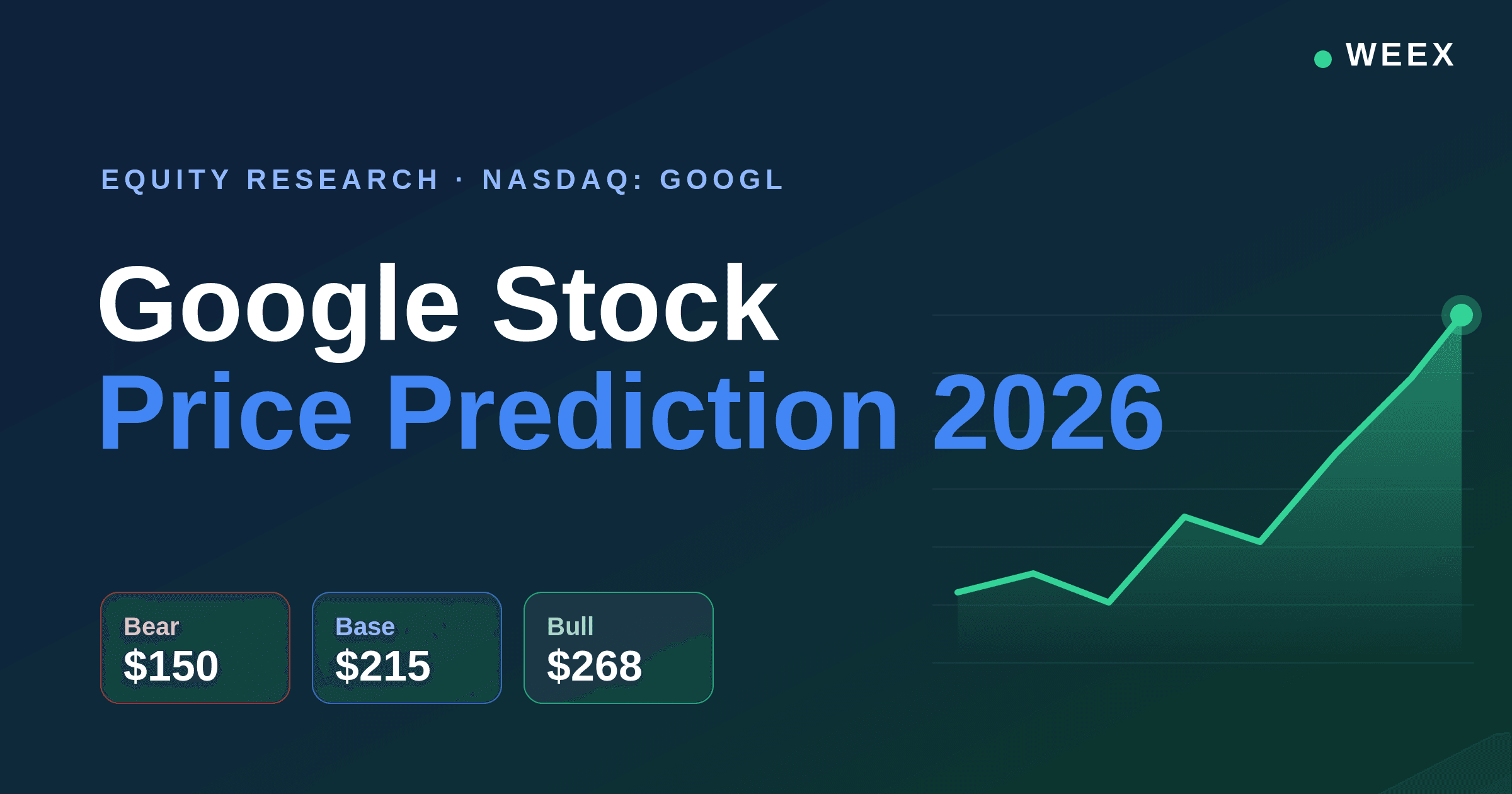
No one can predict a stock price with certainty, so the useful approach is scenarios, not a single magic number. The ranges below are illustrative, built from the analyst spread above and Alphabet's current trajectory. Treat them as a framework for thinking, not a promise.
| Scenario | What has to happen | Illustrative range (end of 2026) | 2027 direction |
|---|---|---|---|
| Bear | Capex overshoots without payback; antitrust remedies bite; ad growth slows | ~$290–$330 | Sideways to lower |
| Base | Search holds, Cloud keeps compounding, Gemini monetizes steadily | ~$380–$440 | Gradually higher |
| Bull | AI products drive re-acceleration; Cloud margins jump; multiple expands | ~$470–$540 | Continues higher |
The base case is the one most consistent with current analyst targets and Alphabet's momentum. The more important point for a beginner is not which number hits, but which conditions you are betting on. If you believe Cloud and Gemini keep converting demand into profit faster than the capex drags on margins, you lean bullish. If you think the spending and the regulatory constraints will grind down returns, you lean bearish.
The catalysts that will move the stock
A GOOG stock price prediction is really a prediction about a handful of drivers. The ones worth watching:
The AI monetization curve is the biggest swing factor. Gemini adoption is large, but the question is revenue per user and whether AI features defend Search economics rather than dilute them. Google Cloud is the clearest growth engine — 63% growth with a backlog reportedly above $460 billion — but management has flagged it is compute-constrained, meaning demand is currently outrunning capacity. The antitrust outcome removed the worst-case scenario, a forced breakup, but imposed new limits on data and distribution deals that could slowly chip at the Search moat. And the capex cycle cuts both ways: it funds the AI lead but pressures free cash flow if returns lag.
What beginners usually get wrong
The common mistake is treating a megacap like a lottery ticket. After a run from the $170s to the $350s, chasing GOOG with the expectation of another double in a year ignores how large the company already is — a $4.3 trillion company growing into a $6 trillion one is a very different bet than a small cap. The more durable approach for long-term investors is owning shares through a regulated broker, using fractional shares to start small, and adding around earnings and pullbacks rather than piling in at highs.
Traders who want short-term, leveraged exposure sometimes use derivatives instead. On crypto-native venues, a GOOGL/USDT perpetual lets you go long or short on Google's price using USDT as margin, with trading hours that extend beyond the Nasdaq session. That flexibility comes with real danger: leverage magnifies losses, and because the underlying stock gaps overnight and on weekends, a leveraged position can be liquidated on an earnings or news move before the regular market reopens. If that route interests you, read the mechanics first in WEEX's guide to trading GOOGLUSDT and its broader Google stock trading overview.
The bottom line on GOOG stock
The most honest GOOG stock price prediction for 2026 is a base case of steady, single-digit-to-mid-double-digit upside toward the ~$430 analyst average, with a wide band on either side. The bull case is real if AI monetization and Cloud margins deliver; the bear case is equally real if the capex bill and antitrust constraints outweigh the growth. For a beginner, the winning move is usually less about calling the exact number and more about position size, time horizon, and not confusing a great company with a guaranteed trade.
FAQ
1. What is the GOOG stock price prediction for 2026?
Analysts' 12-month targets in mid-2026 range from about $340 on the low end to $515–$550 on the high end, with an average near $433. A reasonable base-case range for year-end 2026 is roughly $380–$440, though forecasts carry significant uncertainty.
2. Is GOOG a buy right now?
Most analysts rate it a "Strong Buy," but a rating is not a personalized recommendation. The stock has already risen sharply, so a lot of good news is priced in. Whether it fits you depends on your time horizon, risk tolerance, and diversification, not on the rating alone.
3. What's the difference between GOOG and GOOGL?
GOOG is the Class C share with no voting rights; GOOGL is the Class A share with one vote per share. They trade at nearly the same price and both now pay a small dividend, so for pure price exposure the two are interchangeable.
4. What could make GOOG stock fall?
The main risks are heavy AI capital spending that fails to earn a return, antitrust remedies that erode the Search business, slowing ad growth, and broad tech-sector selloffs. Any of these could compress the valuation from its current premium level.
5. Can I trade GOOG around the clock?
Real shares trade only during stock market hours. Tokenized stocks and GOOGL/USDT perpetual derivatives trade close to 24/7 on some crypto venues, but the underlying stock can gap while the regular session is closed, which adds risk for leveraged positions.
Ready to act on your own view of Google's price? Long-term investors can buy real GOOG or GOOGL shares through a regulated broker, while active traders exploring USDT-margined exposure can review the GOOGL/USDT perpetual on WEEX and claim a new-user welcome bonus before opening a position.
Risk Warning
This article is general information, not investment advice. Stock prices are volatile and any GOOG stock price prediction can be wrong; Alphabet shares can fall sharply on earnings, regulatory, or macro news, and past performance does not guarantee future returns. Leveraged derivatives such as GOOGL/USDT perpetual futures add liquidation risk: adverse price moves, overnight or weekend gaps in the underlying stock, funding costs, and tracking differences between the contract and the real share price can quickly erode or wipe out a position. Tokenized and synthetic stock products add custody, issuer, and counterparty risk, and none of these instruments grant ownership of Alphabet shares. Crypto and leveraged trading may result in partial or total loss of capital — never invest more than you can afford to lose.