
AMD Stock vs Nvidia Stock: Which AI Stock Has More Upside?



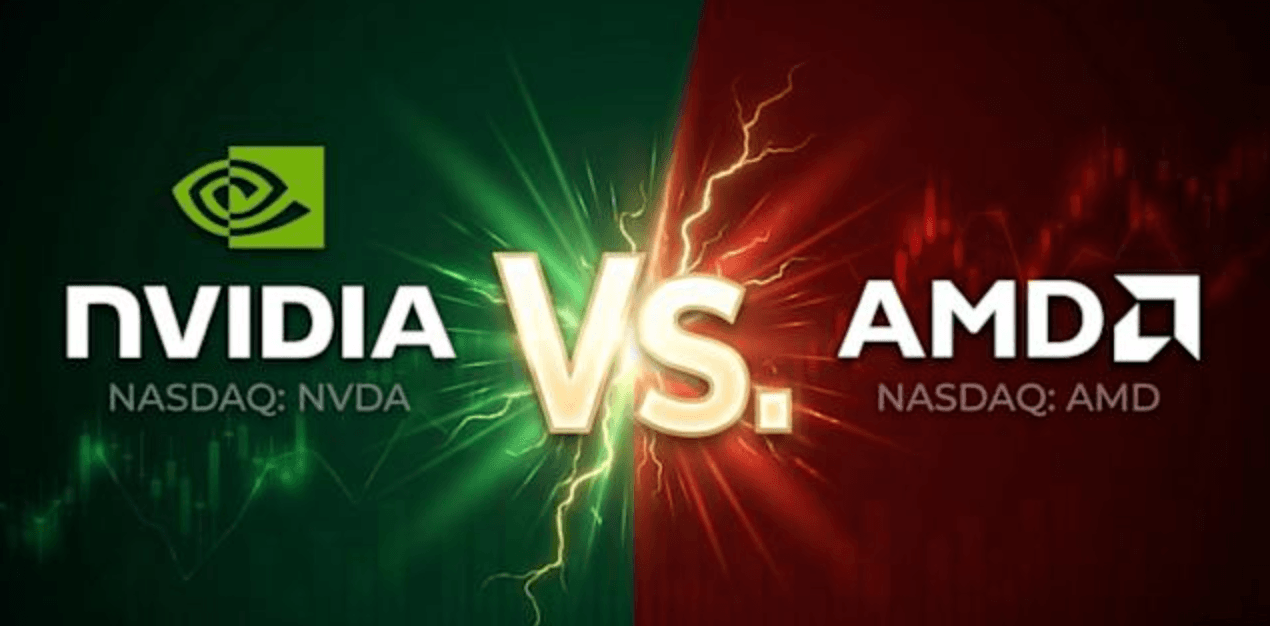
Artificial intelligence has already reshaped how investors think about technology companies. Over the past few years, the market has rewarded businesses supplying the infrastructure behind AI models, cloud systems, and enterprise computing, turning semiconductor companies into some of the biggest winners of the decade. At the center of that conversation sit two names: AMD stock and Nvidia stock.
At first glance, the answer may appear obvious. Nvidia dominates AI headlines, controls much of the GPU market, and has already become one of the market’s most valuable companies.
But markets are rarely that simple.When investors begin talking about upside, the conversation changes. The biggest company is not always the one with the largest future return potential. Sometimes, investors start looking for businesses that still have room to surprise. That is exactly why AMD stock has become increasingly interesting.
Nvidia Stock Already Won the First Phase of AI
To understand the comparison, it helps to recognize how far Nvidia stock has already come.
Nvidia did not suddenly become important because of ChatGPT or generative AI. The company spent years building an ecosystem around GPUs, positioning itself at the center of machine learning long before most investors paid attention.
Today, Nvidia hardware powers much of the infrastructure behind artificial intelligence. Major cloud providers, enterprise systems, and AI developers rely heavily on Nvidia chips.
But perhaps even more important than hardware is software. Nvidia’s CUDA ecosystem created a major competitive advantage. Once developers and enterprises build systems around a specific architecture, switching becomes difficult and expensive.
This helps explain why Nvidia stock has become one of the strongest-performing large-cap technology names.
For many investors, Nvidia feels like the safest AI stock because the business already benefits from demand that exists today rather than demand investors hope may eventually appear.
The challenge, however, is valuation. Great companies can still become difficult investments if expectations move too far ahead of reality. When markets price a company for near-perfect execution, future surprises become harder. That matters when discussing upside.
Why AMD Stock Is Suddenly Back in the Conversation
AMD stock enters this comparison from a very different position. Unlike Nvidia, AMD still feels earlier in its AI expansion story. For years, AMD competed mostly through CPUs and enterprise hardware, often living in the shadow of larger rivals.
Artificial intelligence changed that narrative. As demand for AI computing accelerated, investors began asking an important question: Can one company realistically supply everything? The answer increasingly appears to be no.
That shift created opportunity for AMD. The company’s growing focus on AI accelerators, enterprise partnerships, and data center expansion has slowly changed how markets talk about AMD stock. The conversation no longer revolves around survival or relevance.
Instead, investors increasingly focus on how much market share AMD could realistically capture. And in high-growth industries, capturing even a smaller percentage of a rapidly expanding market can still create meaningful upside.
This is one reason AMD stock has attracted renewed investor interest in 2026. The company does not necessarily need to replace Nvidia. It simply needs to become important enough.
Which Stock Actually Has More Upside?
This is where the debate becomes more interesting.
If investors define upside as safety combined with strong execution, Nvidia stock still looks difficult to ignore. The company already sits at the center of the AI economy and continues benefiting from massive enterprise demand.
But if upside means: percentage growth potential from current levels the answer becomes less obvious.
Because Nvidia stock has already climbed dramatically, markets now expect extraordinary performance every quarter. Even strong earnings sometimes struggle to satisfy investors when expectations become extremely high.
AMD stock may sit in a different position. Expectations remain lower. The AI story still feels earlier. And the company still has room to reshape how investors value the business.
If AMD continues expanding in data centers, wins larger cloud partnerships, and increases enterprise adoption of its AI chips, the stock could still experience significant revaluation.
In other words: Nvidia stock may feel more established. AMD stock may feel more open-ended.
For investors learning how to compare fast-moving AI names, some platforms including WEEX have introduced stock-focused features such as First Stock Trade Protected, reflecting how newer participants are paying closer attention not only to hype but also to volatility and long-term positioning.
What Risks Matter Most?
Neither AMD stock nor Nvidia stock comes without risk. For Nvidia, valuation remains one of the biggest concerns. Leadership often creates premium pricing, and premium pricing can become difficult to maintain if growth slows.
Competition also matters. Large cloud companies increasingly invest in custom chips, while rivals continue improving hardware alternatives.
AMD faces a different challenge: execution. The company still needs to prove it can expand meaningfully inside AI infrastructure while competing against one of the strongest technology ecosystems in the market.
Technology alone is rarely enough. Enterprise adoption takes time. Developer support matters. Software integration matters. This means AMD stock may carry higher uncertainty — but potentially higher reward if execution improves.
So, Which AI Stock Looks Better?
The answer depends on what investors want.
For investors prioritizing leadership, proven demand, and stronger visibility, Nvidia stock may still feel like the safer choice. The company already dominates major parts of the AI hardware market and remains deeply embedded in enterprise infrastructure.
For investors looking for more upside potential, AMD stock may feel more compelling. Expectations remain lower, the AI narrative still feels earlier, and even moderate gains in market share could significantly change how investors value the company.
Importantly, this does not necessarily need to be an either-or decision.
Many investors increasingly view AMD stock and Nvidia stock as different ways to gain exposure to the same long-term trend. One offers dominance. The other offers possibility.
Conclusion
The debate around AMD stock vs Nvidia stock is ultimately a question of upside versus certainty.
Nvidia stock remains the clear AI leader today, supported by deep software advantages, strong enterprise demand, and dominant positioning across major AI systems.
AMD stock, however, may still have more room to surprise. As artificial intelligence spending expands and the semiconductor race evolves, even modest market share gains could meaningfully reshape AMD’s future.
The better AI stock may depend less on who leads now — and more on what investors believe happens next.
FAQ
1. Is AMD stock better than Nvidia stock?
It depends on investment goals. Nvidia stock offers stronger leadership and stability, while AMD stock may offer more upside potential if AI growth continues accelerating.
2. Why is Nvidia stock considered the AI leader?
Nvidia benefits from strong GPU demand and its CUDA software ecosystem, which many enterprises and developers already use.
3. Why are investors paying attention to AMD stock?
AMD stock is gaining attention because of growing opportunities in AI chips, data centers, and enterprise cloud partnerships.
4. Does AMD need to beat Nvidia to perform well?
No. Many investors believe AMD only needs to capture enough market share inside a rapidly expanding AI market.
5. Can both AMD stock and Nvidia stock grow?
Possibly. Because artificial intelligence spending continues increasing, some investors believe multiple semiconductor companies may benefit at the same time.
Disclaimer
This content is provided for general informational and educational purposes only and should not be considered financial, investment, legal, or tax advice. Nothing in this article constitutes an offer, recommendation, solicitation, or invitation to buy, sell, or trade any asset or use any specific service. Markets are volatile and involve risk, including the potential loss of capital. WEEX services may not be available in all regions and are subject to applicable laws, regulations, and user eligibility requirements. Please carefully assess risks before making any financial decisions.
You may also like
META Stock Price Prediction 2026: Can Meta Stock Hit $1,000 in July?
META stock price prediction 2026: Can Meta hit $1,000? Analyst targets, AI cloud pivot, and how to buy META stock on WEEX explained.
USER Crypto Price Prediction 2026: Can USER Crypto Reach $1?
Is USER a good investment? Learn what is USER crypto, current price at $0.00140, and realistic USER price prediction 2026. Energy-AI narrative token analysis.
Introducing Morpho ($MORPHO): Open Credit Network and Price Prediction
Morpho is an open credit network for onchain lending, drawing attention as Morpho Midnight and ecosystem integrations expand.
MU Stock Price Prediction 2026-2030: Can Micron Hit $4,000 as AI Memory Demand Explodes?
Can MU stock reach $4,000 by 2030? Get the latest MU stock price prediction 2026-2030, analyst targets, and learn how to buy MU stock today.
$SYN Airdrop on WEEX: Complete Guide to Synapse and Claim Free $SYN
Learn Synapse tokenomics, cross-chain governance utility, and how to claim free tokens in the WEEX 50,000 USDT SYN airdrop before July 8, 2026.
MSFT Stock Analysis 2026: Why Microsoft's 33% Drop Could Be a Generational Buying Opportunity?
Top 5 TradFi Assets to Trade in 2026: Are TradFi Assets Worth Investing?
Trade Tesla, Gold, Silver, Nasdaq & Nvidia on WEEX TradFi. Compare top TradFi assets, leverage options, and how to invest in TradFi assets with USDT.
What is NVIDIA(NVDA) Coin? Everything You Need to Know About NVDA/USDT Perpetual Futures on WEEX
NVIDIA (NVDA) Coin on WEEX refers to the USDT‑margined perpetual futures tracking NVIDIA Corporation’s stock price rather than…
What is NVIDIA(NVDA) Coin? Everything You Need to Know and How to Trade NVDA/USDT on WEEX
NVDA/USDT perpetual futures were newly listed on WEEX, with trading opened on July 2, 2026. This derivative tracks…
Can NVDA Reach $250 in 2026? NVDA Price Prediction
KEY TAKEAWAYS Current price: NVDA/USDT futures trade near $196.13 at publication time. Required move: around +27.5% is needed…
NVIDIA (NVDA) Price Prediction: July 2026 Forecast, Technical Levels, and Strategy
NVIDIA (NVDA) has become the bellwether for AI risk appetite, and traders can access its crypto-settled exposure via…
Sandisk Stock Price Prediction 2026–2030: Can SNDK Reach $3,000?
Bernstein set a $3,000 price target on Sandisk stock the day before it fell 10% to start Q3. At approximately $2,023 today, getting to $3,000 means roughly 48% appreciation. This guide examines what that path requires, what the bear case says, and what the realistic range of outcomes looks like through 2030.
What Is Sandisk and Why Did It Go From $40 to $2,000 in One Year?
Sandisk stock went from approximately $40 in early 2025 to over $2,000 in 2026, a gain exceeding 4,900% in roughly eighteen months. This guide explains what Sandisk actually is, why it was ignored for years, and what changed to produce one of the most extraordinary stock price moves in recent market history.
Sandisk Stock Falls 10% to Start Q3: Is the AI Memory Rally Finally Over?
Sandisk stock dropped approximately 10% on July 1, the first trading day of Q3, after surging over 720% in the first half of 2026. The selloff had nothing to do with the company's business. This guide examines what actually triggered the decline, whether it signals the end of the AI memory rally, and what investors should actually be watching.
What is Synapse(SYN) Coin? Everything You Need to Know for Cross‑Chain Trading and Investing
Synapse (SYN) is a cross-chain interoperability protocol enabling secure asset transfers, messaging, and smart contract calls across multiple…
SK Hynix Stock Price Forecast 2026–2027: Structural HBM Shortage Analysis
Expect a clear look at how the AI-driven memory cycle and a structural HBM bottleneck could shape SK…
Can SK Hynix Reach $2000 in 2026? SK Hynix Price Prediction
KEY TAKEAWAYS Current price: $1523, based on live market data today from major crypto trackers. Required move to…
If You Can’t Buy SK Hynix Stocks, What Are the Trading Alternatives?
If your broker doesn’t support SK Hynix or you want 24/7 access, you can still trade SK Hynix…
META Stock Price Prediction 2026: Can Meta Stock Hit $1,000 in July?
META stock price prediction 2026: Can Meta hit $1,000? Analyst targets, AI cloud pivot, and how to buy META stock on WEEX explained.
USER Crypto Price Prediction 2026: Can USER Crypto Reach $1?
Is USER a good investment? Learn what is USER crypto, current price at $0.00140, and realistic USER price prediction 2026. Energy-AI narrative token analysis.
Introducing Morpho ($MORPHO): Open Credit Network and Price Prediction
Morpho is an open credit network for onchain lending, drawing attention as Morpho Midnight and ecosystem integrations expand.
MU Stock Price Prediction 2026-2030: Can Micron Hit $4,000 as AI Memory Demand Explodes?
Can MU stock reach $4,000 by 2030? Get the latest MU stock price prediction 2026-2030, analyst targets, and learn how to buy MU stock today.
$SYN Airdrop on WEEX: Complete Guide to Synapse and Claim Free $SYN
Learn Synapse tokenomics, cross-chain governance utility, and how to claim free tokens in the WEEX 50,000 USDT SYN airdrop before July 8, 2026.
MSFT Stock Analysis 2026: Why Microsoft's 33% Drop Could Be a Generational Buying Opportunity?