
WLFI Team Meeting, Ally Meeting, Seaside Villa Cryptocurrency Business Kickoff


Original Title: "WLFI Sets Up a Group, Allies Keep Their Appointment, Doing Crypto Business at Mar-a-Lago"
Original Author: Nancy, PANews
Not long ago, the road to Mar-a-Lago was officially renamed the "Donald J. Trump Avenue." This road, stretching from the Palm Beach International Airport, with a huge golden sign, has not only become a new local visual landmark but also a tangible manifestation of Trump's personal influence.
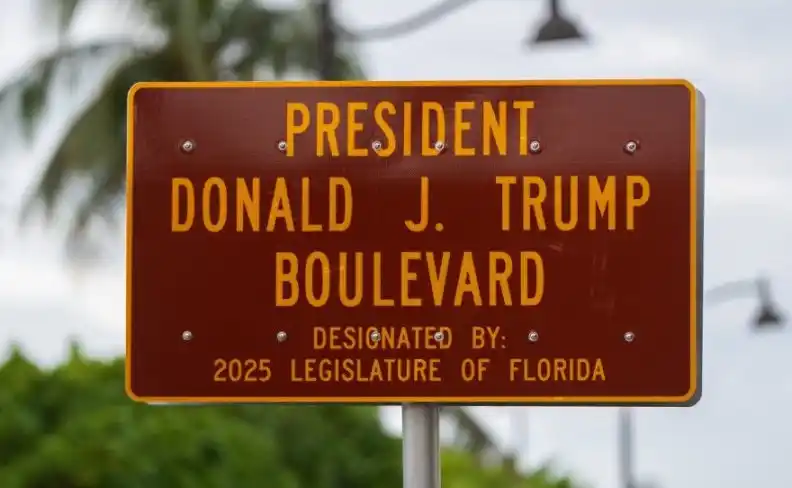
In Palm Beach, Florida, Mar-a-Lago is no longer just Trump's private club. It is both a power hub for American political and business elites and a cash cow for the Trump family with an annual income of tens of millions of dollars.
And this road, named "Trump Avenue," has long been crowded with crypto visitors.
WLFI Group Sets Up, Traditional Elites Sit at the Crypto Main Table
At the end of January, WLFI announced that the first World Liberty Forum would be held at Mar-a-Lago on February 18 (the second day of the Lunar New Year), with the forum limited to about 300 people.
This is not an open crypto conference but a selective closed-door elite gathering. Whether one can enter will depend on the participant's "weight." Invitees are divided into participants, speakers, and media. All applicants must submit their industry, position, contact information, and X (formerly Twitter) account, which will be uniformly reviewed by the organizer, and the spots are non-transferable.
From the announced speaker lineup, most are from Wall Street and key circles of American politics.
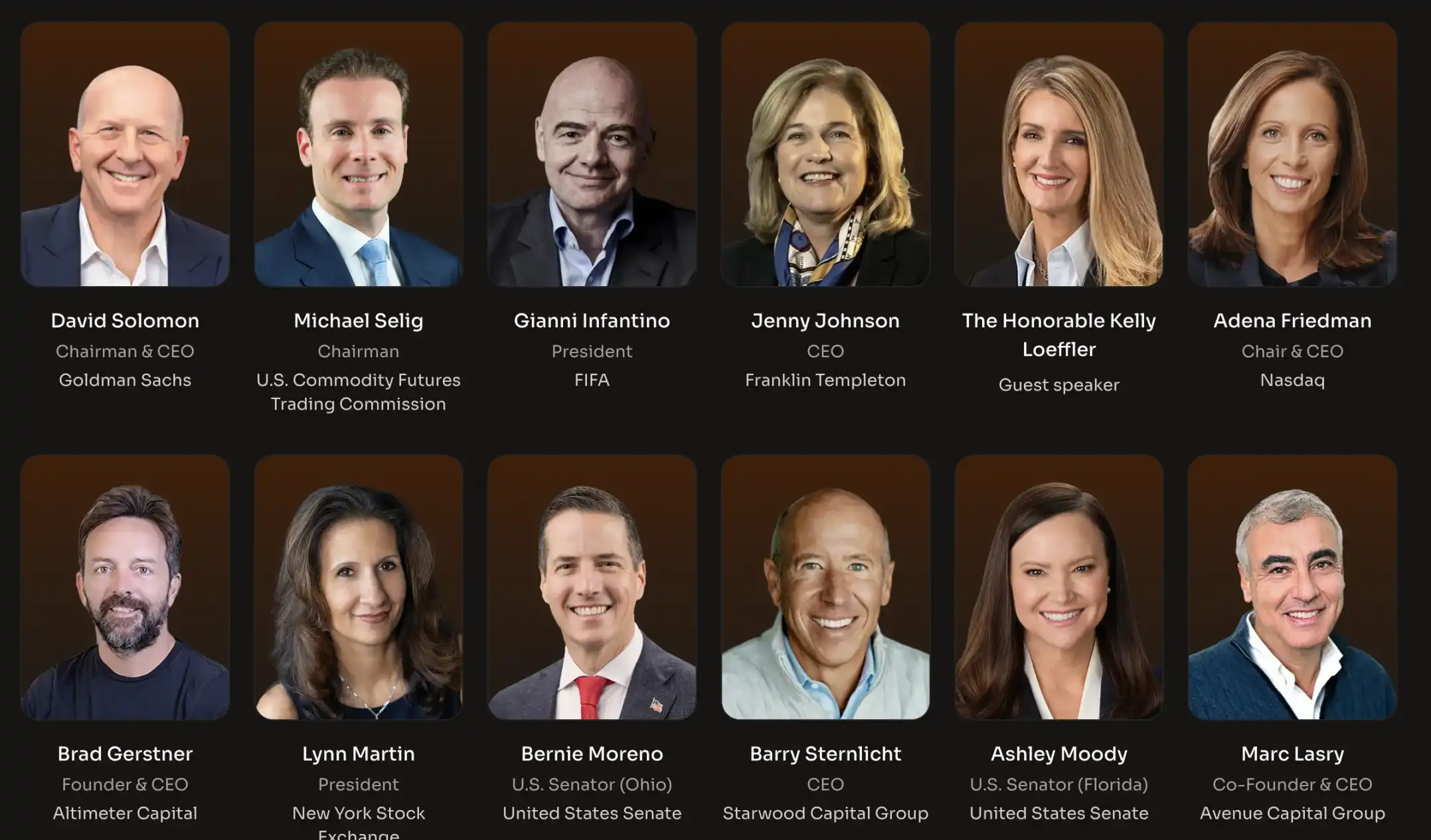
At the financial institution level, confirmed attendees include Goldman Sachs Chairman and CEO David Solomon, Nasdaq Chairman and CEO Adena Friedman, NYSE President Lynn Martin, covering key nodes in the financial system;
· In asset management and private equity, including Franklin Templeton CEO Jenny Johnson, Third Point founder Daniel Loeb, Altimeter Capital founder Brad Gerstner, and Avenue Capital co-founder Marc Lasry, are long-standing active traditional capital forces;
· On the regulatory and policy front, current CFTC Chairman Michael Selig, U.S. Senator Bernie Moreno, Ashley Moody, as well as White House Deputy Assistant Secretary of Economic Affairs Jacob Helberg are also on the official guest list;
· Other notable figures such as FIFA President Gianni Infantino, Turing Award winner Yoshua Bengio, and Canton Network co-founder Yuval Rooz, among interdisciplinary individuals, have also been included in the invitation list.
As the initiator, Donald Trump's two sons, Eric Trump, Donald Trump Jr., and several key members of WLFI will be actively involved throughout.
Compared to previous crypto events held at Mar-a-Lago, focusing on project teams, industry practitioners, and whales, this time, traditional elites have taken a seat at the crypto table.
This shift may be significantly related to WLFI's continuous strategic adjustments in recent months.
From WLFI's advancement of a national trust bank charter and other compliance actions to the launch plan of the lending platform World Liberty Markets, and the preparation of the "Digital Dollar Gateway" WLFI App, to the ongoing demonstration of stablecoin USD1's real-world use case and market scale, WLFI is attempting to play a serious role in DeFi to strengthen its infrastructure potential in the trend of TradFi and crypto integration.
It is worth noting that WLFI has recently opened a special channel to WLFI contributors. Applicants are required to submit their holdings and contributions in WLFI or stablecoin USD1 for official eligibility review and screening.
Differing from the past model of simply exchanging real assets for entry qualifications, this time leans towards a "Contribution + Audit" hybrid system. To some extent, this provides a channel for community members to join the Trump family meeting. Currently, more than X users have voluntarily shared their contribution posts, attempting to secure entry qualifications.
Exploring, Partnering, and Fundraising - The Trump Family's Cryptocurrency Hub
Prior to this, the approximately 80,000-square-meter "Winter White House" had already become the Trump family's secret meeting room with crypto leaders.
As early as 2023, Trump invited holders of his released NFTs to meet with him. This seemingly fan-oriented gathering has been seen by many observers as a turning point, marking Trump's first public discussion and promotion of crypto investments aimed directly at a specific group of supporters.
In May 2024, Trump hosted a crypto-themed event at Mar-a-Lago, where some supporters from the crypto industry pledged to support his re-election campaign. Subsequently, his campaign team started officially accepting cryptocurrency donations, turning crypto from a symbolic political gesture into a practical fundraising tool.
A month later, Trump welcomed executives from several Bitcoin mining companies at Mar-a-Lago and publicly stated that, if he returned to the White House, he would provide policy support for the mining community. Bloomberg noted at the time that Bitcoin miners were a key support base for the Trump campaign.
Months later, on election night, crypto leaders such as Cantor Fitzgerald CEO Howard Lutnick, Bitcoin Magazine CEO David Bailey, and Kraken Chief Legal Officer Marco Santori gathered at Mar-a-Lago to celebrate Trump's victory, marking the true beginning of a crypto-friendly era.
In January 2025, executives from top crypto companies like Crypto.com, Ripple, and Coinbase visited Mar-a-Lago to exchange views with the Trump team on policy direction and regulatory frameworks, and also made substantial donations to his political organization.
In May 2025, Trump hosted a private dinner at Mar-a-Lago for the top 220 holders of the meme coin $TRUMP. Attendees included Tron founder Justin Sun, former NBA player Lamar Odom, and others, raising approximately $148 million in funding.
From early supporter gatherings to campaign funding, policy statements, and regulatory discussions, Mar-a-Lago witnessed the entire process of the crypto industry's evolution from grassroots to mainstream.
You may also like

Morning Report | BitMine increased its holdings by 126,971 ETH last week; trader Eugene announced his exit from the crypto market

Wang Chuan: How can one not feel anxious after the neighbor Old Wang made thirty times profit by investing in storage stocks? (Seven) - A quarter-century cycle

Cryptocurrency CEXs are flocking to sell US stocks, and traditional brokerages are facing an "uninvited guest."

$75 billion in foreign capital has fled, and South Korean retail investors have absorbed it all using leverage

Japan’s Three Megabanks Plan Joint Stablecoin Issuance in Fiscal 2026
MUFG, SMBC, and Mizuho reportedly plan to jointly issue fiat-pegged stablecoins in fiscal 2026, signaling Japan’s growing push into bank-led digital payment infrastructure.

Humanity Discloses H Token Dual-Chain Attack Details, With Losses on Ethereum and BSC Exceeding $36 Million
Humanity said the H token attack across Ethereum and BSC caused more than $36 million in losses after leaked ProxyAdmin keys enabled malicious contract upgrades and token minting.
White House Discusses CLARITY Act With Law Enforcement Ahead of Senate Vote
The White House discussed the CLARITY Act with law enforcement ahead of a Senate vote, focusing on illicit finance risks and developer protections.

Bitcoin Trading Guide 2026: Strategies for Experienced Traders

What Is XAUT and PAXG? Why Tokenized Gold Is Booming in 2026

Will the SpaceX IPO Hurt Bitcoin? Here's What Traders Are Watching

Foreign selling in the South Korean stock market accelerates, with cumulative net sales reportedly reaching $75 billion this year
On June 9, The Kobeissi Letter, citing Goldman Sachs data, reported that global investors are selling South Korean stocks at an unusually rapid pace. In the latest trading session, foreign investors sold about $801 million worth of Kospi constituent stocks again; total foreign outflows last week reached about $10 billion, and the market has been in net foreign selling on nearly every trading day over the past month. According to the data cited in the report, foreign investors have sold about $75 billion worth of South Korean stocks so far this year. Meanwhile, South Korean retail and institutional investors together recorded roughly $69 billion in net buying over the same period, suggesting that the market’s main buying support has come from domestic capital rather than returning overseas funds. The information currently disclosed still mainly comes from The Kobeissi Letter’s retelling and Goldman Sachs data summaries, while public details on the statistical period and the specific definition of “selling” remain relatively limited.

Fortune Warns of Strategy’s Financing Structure Risks as Bitcoin Premium Narrows
Fortune warned that Strategy’s Bitcoin treasury model faces growing financing risks as MSTR’s net asset premium narrows and preferred stock dividend pressure increases.

Ferrari Challenge Le Mans: Carl Moon to Dominate in WEEX Livery

Sahara AI Responds to SAHARA’s Sharp Drop: No Contract or Product Security Issues Found, Internal Investigation Underway
Sahara AI responded to SAHARA’s 60% price drop, saying no token contract or product security issues have been found and an internal investigation is underway.

WEEX Deposit/Withdrawal Dynamic Island: Your Asset Status, Always in Sight
Scaling Crypto Derivatives: The Digital Asset Infrastructure Behind High-Volume Trading
In the fast-moving digital asset ecosystem, derivatives platforms face an extreme architectural test. High-leverage futures markets demand more than just standard security—they require absolute operational precision, zero-latency matching engines, and ironclad structural scalability, all while navigating intense market volatility.
As global platforms scale to meet these demands, the industry is shifting away from rigid, monolithic setups toward a more agile, "decoupled" infrastructure philosophy.
The Blueprint for High-Volume Copy TradingFor elite global exchanges like WEEX (founded in 2018), this architectural choice becomes critical when scaling high-volume retail features like social copy trading. When thousands of users automatically mirror the real-time strategies of elite traders simultaneously, it triggers sudden, monumental spikes in concurrent transactional volume.
To prevent execution latency or settlement bottlenecks during these peak volatility events, a platform's primary engine must remain entirely dedicated to risk management, copy-trade synchronization, and order matching.
The Architectural Rule: New-generation platforms must separate front-end user execution engines from heavy backend infrastructural overhead to eliminate operational friction.
By separating these layers, platforms can maintain complete sovereignty over their trading environments and user experiences while strategically aligning with institutional-grade infrastructure ecosystems. This strategic framework allows modern exchanges to leverage advanced Digital Asset Custody infrastructure such as Cobo’s behind the scenes, ensuring that backend wallet management scales elastically alongside trading spikes.
Capitalizing on Market Momentum and 400× LeverageIn a derivatives arena where platforms offer up to 400× leverage on perpetual contracts, capital efficiency and market agility are core business metrics. To capture market momentum, an exchange needs the ability to rapidly expand its asset offerings, supporting everything from legacy crypto assets to sudden, trending altcoins across a massive library of trading pairs.
Adopting a flexible, scalable Wallet-as-a-Service (WaaS) solution such as Cobo’s could completely rewrite the development timeline for high-growth exchanges. Instead of spending months of engineering capital building out custom backend wallet architectures for every new blockchain network, platforms can deploy localized infrastructure in days.
This agility allows platforms to instantly scale their listings to over a thousand trading pairs without compromising security or delaying time-to-market. It mirrors the exact operational advantages seen during high-velocity market events, similar to how advanced wallet infrastructure empowers platforms during sudden asset surges; allowing exchanges to pass that speed and liquidity directly to their global user base.
A Mature Foundation for GrowthThe synergy between trusted infrastructure ecosystems and global trading platforms represents the natural evolution of a maturing crypto market. As WEEX continues to scale its global spot and derivatives offerings for over 6 million users, adopting robust backend paradigms proves that platforms no longer have to compromise between cutting-edge trading velocity and uncompromised structural security.

Get Paid to Onboard? Try WEEX’s New Homepage with Rewards for Registration, Deposit & Trade
WEEX Custom Layout: Build Your Perfect Trading Workspace in Seconds
Morning Report | BitMine increased its holdings by 126,971 ETH last week; trader Eugene announced his exit from the crypto market
Wang Chuan: How can one not feel anxious after the neighbor Old Wang made thirty times profit by investing in storage stocks? (Seven) - A quarter-century cycle
Cryptocurrency CEXs are flocking to sell US stocks, and traditional brokerages are facing an "uninvited guest."
$75 billion in foreign capital has fled, and South Korean retail investors have absorbed it all using leverage
Japan’s Three Megabanks Plan Joint Stablecoin Issuance in Fiscal 2026
MUFG, SMBC, and Mizuho reportedly plan to jointly issue fiat-pegged stablecoins in fiscal 2026, signaling Japan’s growing push into bank-led digital payment infrastructure.
Humanity Discloses H Token Dual-Chain Attack Details, With Losses on Ethereum and BSC Exceeding $36 Million
Humanity said the H token attack across Ethereum and BSC caused more than $36 million in losses after leaked ProxyAdmin keys enabled malicious contract upgrades and token minting.


