
Will Ondo's RWA Landscape Explode with Trump's Backing of Wall Street?

Original Author: Joshua Jake, Founder of fomoed news
Original Translation: Ashley, BlockBeats
Editor's Note: Ondo Finance has launched the Layer 1 public chain Ondo Chain, promoting the tokenization of RWA and its integration with DeFi. The chain incorporates permissioned validators, built-in oracle, and cross-chain bridges to enhance compliance and security. With institutional-grade finance going on-chain, the demand for $ONDO tokens may see a significant increase, worth paying attention to.
The following is the original content (slightly reorganized for better readability):
$ONDO has the potential to break into the top ten altcoins.
With the launch of Ondo Chain, the utility and demand for $ONDO will be further enhanced.
Ondo Chain: Layer 1 Public Chain for Institutional Finance Market
Ondo Finance has officially launched Ondo Chain, a PoS Layer 1 public chain designed to bring the institutional finance market onto the blockchain.
The project aims to combine the transparency and accessibility of public chains while meeting the compliance and security requirements of traditional finance.
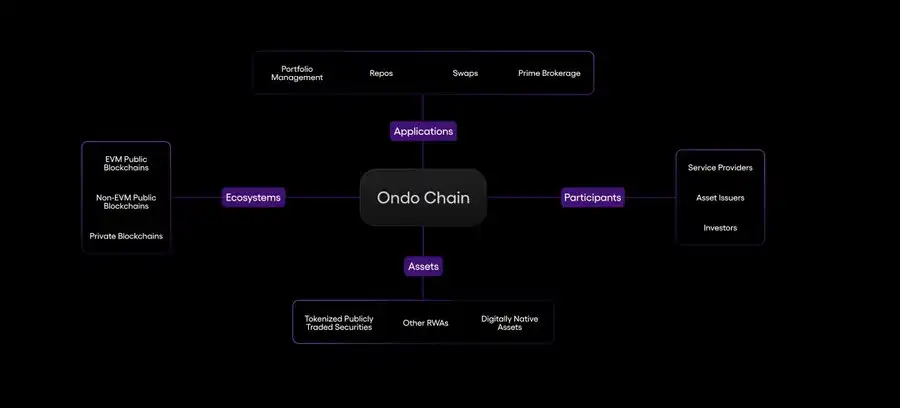
RWA Tokenization: Native Support for Real World Assets
Ondo Chain supports RWA tokenization, such as tokens issued by Ondo GM. These assets are seamlessly integrated into the blockchain ecosystem and can be used for network security, oracles, cross-chain bridges, and other applications.
Validators will continuously verify the collateral assets of these tokens, enhancing market trust and reliability.
Validator Mechanism: Institutional-Grade Security and Fairness
Ondo Chain adopts a Permissioned Validators mechanism to ensure network integrity and meet institutional standards.
These validators undergo continuous monitoring to prevent malicious behavior, creating a fair and secure environment suitable for institutions with high transaction standards.
These validators will be operated by selected financial institutions to achieve seamless integration between the Ondo Chain and the traditional financial system, reducing transaction latency and providing additional asset and liquidity support.
Built-in Oracle: Real-time Offchain Data Synchronization
The Ondo Chain introduces Enshrined Oracles, allowing validators to publish key Offchain data (including asset prices, interest rates, etc.) to the Onchain.
This mechanism ensures the accuracy, trustworthiness, and real-time nature of on-chain data, reducing the risks of information manipulation and transaction errors.
Ondo Bridge: Secure Cross-chain Asset Transfers
The blockchain also integrates the Ondo Bridge, supporting secure cross-chain token transfers and message relays. The primary security is provided by Ondo Chain validators through a decentralized validation network to enhance the security and reliability of cross-chain interactions.
Validators will automatically verify with custodians or brokerage firms to ensure all RWA tokens are adequately backed by off-chain assets, increasing transparency, reducing fraud risks, and enhancing market confidence.
Although the validators are permissioned, Ondo Chain remains open to all developers, allowing anyone to issue tokens, build applications, or participate in the ecosystem as users and investors.
User identity verification and permission management are core features of the Ondo Chain, allowing appropriate access control at the smart contract level.
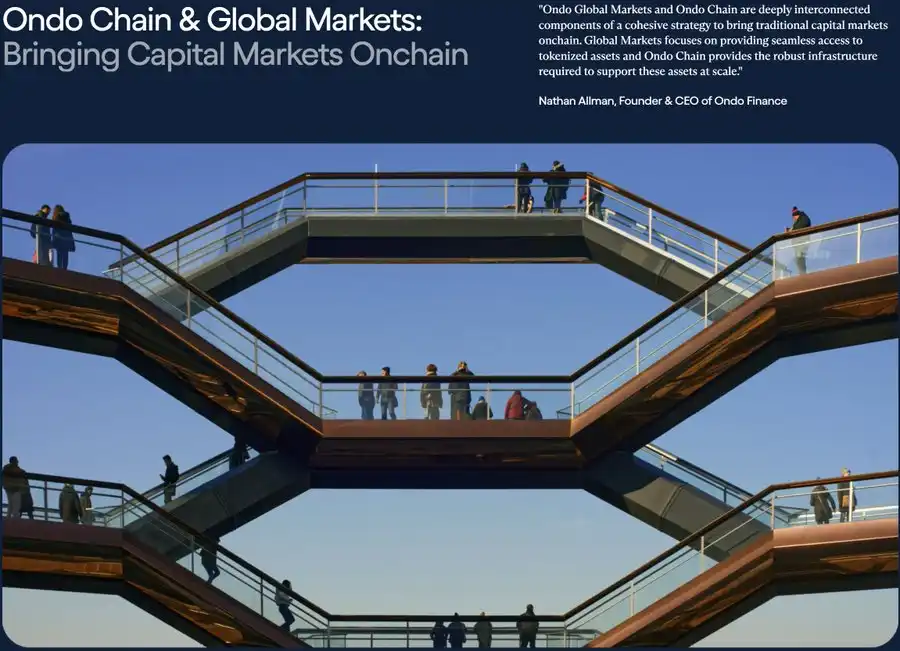
DeFi Ecosystem: Applications of RWA in Lending, Collateral, and More
Developers can natively support RWA in DeFi applications on the Ondo Chain, enabling these assets to be used in lending, staking, and other scenarios, further expanding their utility in the DeFi ecosystem.
The launch of the Ondo Chain marks a milestone in the integration of traditional financial assets with blockchain, addressing many obstacles of the existing infrastructure and paving the way for a more open, efficient, and inclusive financial system.
Impact on $ONDO
As the native token of the Ondo ecosystem, $ONDO will play a key role in network operation, governance, and transaction fees.
As the adoption of the Ondo Chain in RWA tokenization and DeFi grows, the demand for the $ONDO token may also significantly increase, thereby positively impacting its value.
Furthermore, the integration of RWAs and strengthening of compliance and security may attract institutional investors to participate, further solidifying $ONDO's position in the market.
You may also like

Galaxy Deep Research Report: How Hyperliquid's HIP-4 Upgrade Changes the Landscape of Prediction Markets?

ZachXBT: Humanity private key leak and abnormal surge in H token should be viewed separately
On June 9, according to related disclosures, on-chain investigator ZachXBT posted an update on Humanity’s roughly $31 million security incident, saying that after further analyzing fund flows, he currently tends to believe the project team was not involved in an “inside job” or a self-staged attack. According to him, the official explanation about the private key leak was broadly accurate, but before the token unlock, the price of H had been artificially pushed higher, and the hacker later took advantage of that market environment; therefore, the private key leak and the earlier abnormal price pumping should be regarded as two separate and independent events. This reframing has shifted the market’s understanding of the nature of the incident. Earlier discussion around Humanity had focused on whether the team directly participated in the attack or used the security incident to cover up internal operations. ZachXBT’s latest remarks shift the focus from “whether it was self-theft” to “whether there were pre-unlock market structure issues.” He also questioned whether the team may have.

Morning Report | OpenAI has submitted an S-1 registration statement draft to the U.S. SEC; Morpho completes $175 million financing

Morning Report | BitMine increased its holdings by 126,971 ETH last week; trader Eugene announced his exit from the crypto market

Wang Chuan: How can one not feel anxious after the neighbor Old Wang made thirty times profit by investing in storage stocks? (Seven) - A quarter-century cycle

Cryptocurrency CEXs are flocking to sell US stocks, and traditional brokerages are facing an "uninvited guest."
$75 billion in foreign capital has fled, and South Korean retail investors have absorbed it all using leverage

Japan’s Three Megabanks Plan Joint Stablecoin Issuance in Fiscal 2026
MUFG, SMBC, and Mizuho reportedly plan to jointly issue fiat-pegged stablecoins in fiscal 2026, signaling Japan’s growing push into bank-led digital payment infrastructure.

Humanity Discloses H Token Dual-Chain Attack Details, With Losses on Ethereum and BSC Exceeding $36 Million
Humanity said the H token attack across Ethereum and BSC caused more than $36 million in losses after leaked ProxyAdmin keys enabled malicious contract upgrades and token minting.
White House Discusses CLARITY Act With Law Enforcement Ahead of Senate Vote
The White House discussed the CLARITY Act with law enforcement ahead of a Senate vote, focusing on illicit finance risks and developer protections.

Bitcoin Trading Guide 2026: Strategies for Experienced Traders

What Is XAUT and PAXG? Why Tokenized Gold Is Booming in 2026

Will the SpaceX IPO Hurt Bitcoin? Here's What Traders Are Watching

Foreign selling in the South Korean stock market accelerates, with cumulative net sales reportedly reaching $75 billion this year
On June 9, The Kobeissi Letter, citing Goldman Sachs data, reported that global investors are selling South Korean stocks at an unusually rapid pace. In the latest trading session, foreign investors sold about $801 million worth of Kospi constituent stocks again; total foreign outflows last week reached about $10 billion, and the market has been in net foreign selling on nearly every trading day over the past month. According to the data cited in the report, foreign investors have sold about $75 billion worth of South Korean stocks so far this year. Meanwhile, South Korean retail and institutional investors together recorded roughly $69 billion in net buying over the same period, suggesting that the market’s main buying support has come from domestic capital rather than returning overseas funds. The information currently disclosed still mainly comes from The Kobeissi Letter’s retelling and Goldman Sachs data summaries, while public details on the statistical period and the specific definition of “selling” remain relatively limited.

Fortune Warns of Strategy’s Financing Structure Risks as Bitcoin Premium Narrows
Fortune warned that Strategy’s Bitcoin treasury model faces growing financing risks as MSTR’s net asset premium narrows and preferred stock dividend pressure increases.

Ferrari Challenge Le Mans: Carl Moon to Dominate in WEEX Livery

Sahara AI Responds to SAHARA’s Sharp Drop: No Contract or Product Security Issues Found, Internal Investigation Underway
Sahara AI responded to SAHARA’s 60% price drop, saying no token contract or product security issues have been found and an internal investigation is underway.

WEEX Deposit/Withdrawal Dynamic Island: Your Asset Status, Always in Sight
Galaxy Deep Research Report: How Hyperliquid's HIP-4 Upgrade Changes the Landscape of Prediction Markets?
ZachXBT: Humanity private key leak and abnormal surge in H token should be viewed separately
On June 9, according to related disclosures, on-chain investigator ZachXBT posted an update on Humanity’s roughly $31 million security incident, saying that after further analyzing fund flows, he currently tends to believe the project team was not involved in an “inside job” or a self-staged attack. According to him, the official explanation about the private key leak was broadly accurate, but before the token unlock, the price of H had been artificially pushed higher, and the hacker later took advantage of that market environment; therefore, the private key leak and the earlier abnormal price pumping should be regarded as two separate and independent events. This reframing has shifted the market’s understanding of the nature of the incident. Earlier discussion around Humanity had focused on whether the team directly participated in the attack or used the security incident to cover up internal operations. ZachXBT’s latest remarks shift the focus from “whether it was self-theft” to “whether there were pre-unlock market structure issues.” He also questioned whether the team may have.
Morning Report | OpenAI has submitted an S-1 registration statement draft to the U.S. SEC; Morpho completes $175 million financing
Morning Report | BitMine increased its holdings by 126,971 ETH last week; trader Eugene announced his exit from the crypto market
Wang Chuan: How can one not feel anxious after the neighbor Old Wang made thirty times profit by investing in storage stocks? (Seven) - A quarter-century cycle
Cryptocurrency CEXs are flocking to sell US stocks, and traditional brokerages are facing an "uninvited guest."


