

Why Does the Price Drop Every Time I Buy? Calculating the Growth Spiral of Memes from First Principles
Original Title: "Why Your Meme Coin Always Dumps? - Deconstructing the Meme Growth Spiral and Volume with First Principles"
Original Author: danny, Crypto Analyst
To most people, a Meme coin represents irrational exuberance, a casino of absurdity. But from a mathematical perspective, the birth of every thousandfold myth is not accidental. It is actually an application problem of middle school spatial geometry.
This article presents a disruptive viewpoint: the market cap of a Meme coin is not "pumped" but "supported" into existence. The value of a meme can be calculated!
We are accustomed to focusing on the Z-axis (price height) fluctuations, but we overlook that life and death are determined by the base radius constructed by X (narrative density) and Y (propagation nodes). A Meme with only height and no base is just an extremely thin "needle," easily tipped over by the wind; only an expanding consensus radius can, under the gravity of capital, support a stable, geometrically growing wealth cone.
Disclaimer: This article is an "Econophysics" popular science article, not a rigorous econometric paper, providing everyone with a brand-new perspective on memes.
1. The Beginning of Theory: The Three-Dimensional Coordinate System of Memes
In today's cryptocurrency market, Meme coins are often seen as irrational exuberance. But is it really so?
If we strip away the emotional noise, KOL shilling, and community hype, we will find that every emergence and demise of a phenomenal Meme follows a strict set of mathematical logic.
The essence of a Meme coin is the tokenization of attention economics. Its market cap is not determined by traditional discounted cash flows (DCF) but is collectively built by the breadth of narrative, community resonance, and the explosiveness of funds.
For better discussion, we define these factors as the XYZ three-dimensional growth spiral model.
These three axes are not just independent variables; they exhibit strong reflexivity - that is, a change in one variable will reinforce another variable, forming a positive feedback loop.
Now let's explain these parameters:
X-Axis: Narrative Density and Cultural Memes
Definition: The "genes" of a Meme. It includes core memes (such as Doge), origin stories (such as CZ's pet's name), cultural symbols (such as Pepe's Sad Frog), and the richness of community derivatives.
Key Metrics: Narrative Originality, Replicability, Emotional Resonance.
Y-Axis: Propagation Potential and Node Network
Definition: Information transmission pathway. From top nodes (CZ, Elon Musk) to mid-tier nodes (Alpha Callers, KOLs), down to end nodes (regular retail holders).
Key Metrics: Node Weight, Dissemination Coverage, Pump Frequency.
Z-Axis: Capital Flow and Liquidity Conduit
Definition: Monetization of attention. Includes on-chain capital flows, liquidity depth — i.e., embedded value or total sell-side depth.
Key Metrics: Market Cap, Trading Volume, Turnover Rate, and Liquidity (most critical).
2. XYZ Axis Interaction Growth Spiral Graph
If we were to plot these three axes in 3D space, a successful Meme Growth Trajectory typically follows an upward spiral trend: (see diagram below)
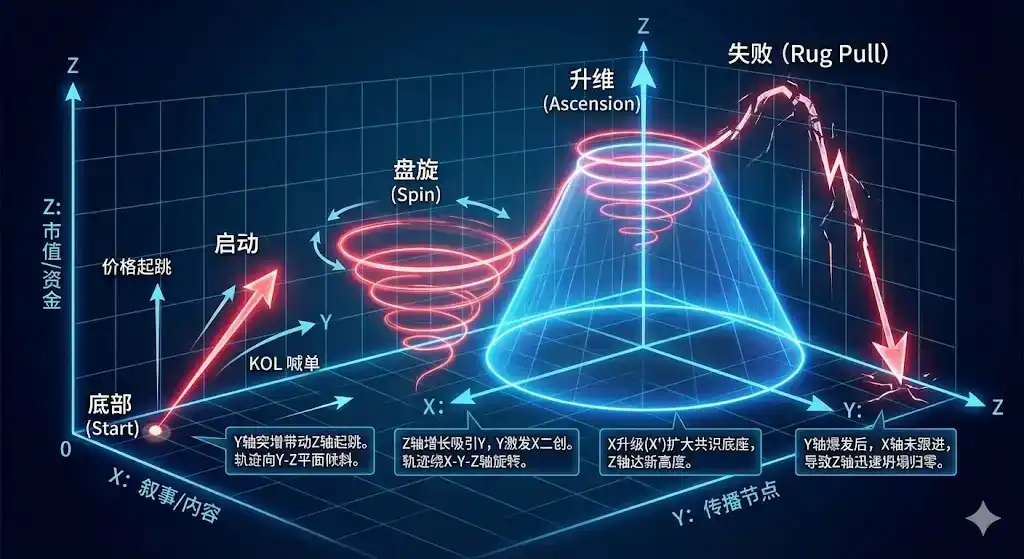
· Bottom (Start): X, Y, Z all close to zero.
· Ignition: Y-Axis spikes (KOL Pump), propelling Z-Axis (price) upwards. Trajectory tilts towards the Y-Z plane.
· Spin: Z-Axis growth attracts more Y (more discussion), Y triggers X's elaboration (richer content). Trajectory starts rotating around the X-Y-Z axes.
· Ascension: With X's upgrade (X'), the base of the cone expands (consensus widens), Z-Axis (market cap) reaches new heights.
· Failed Meme (Rug Pull): Typically seen as a Y-Axis surge, followed by a brief Z-Axis spike, but X-Axis fails to upgrade (lack of narrative), leading to a rapid collapse of Z-Axis back to zero, trace line forms an inverted V-shaped plunge.
3. Growth Curve Evolution: Spiral Ascension through Four Stages
From the previous section, we understand that a Meme's lifecycle is not linear but a vortex expanding around the Z-Axis (capital flow). In this section, we will analyze based on the four development stages of a Meme.
The following diagram illustrates its standard evolution path:
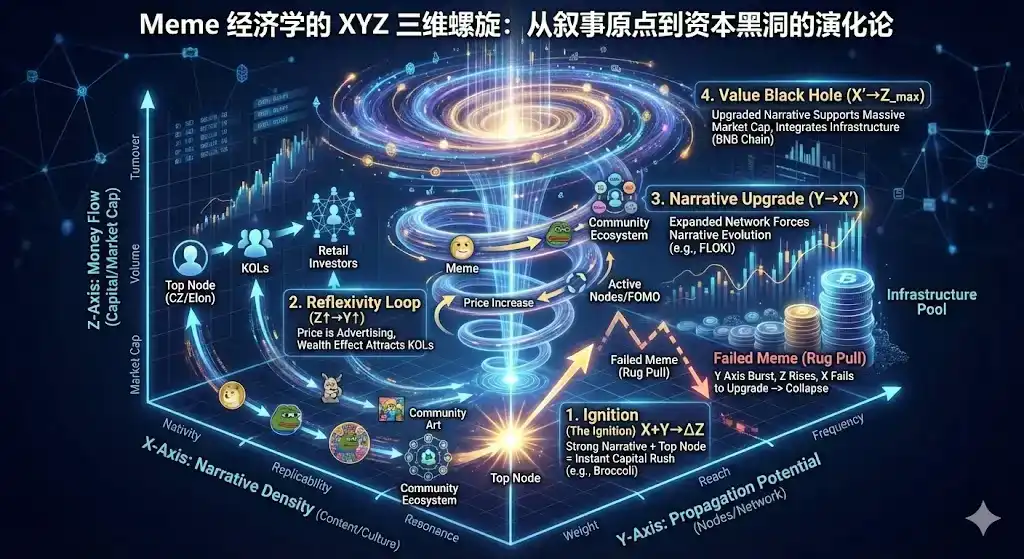
Phase One: The Ignition——X + Y → ΔZ
A powerful narrative (X) combined with a high-weight propagation node (Y), instantly igniting funds (Z).
Using Broccoli as an example:
· X (Narrative): On February 13, 2025, CZ announced his pet dog's name as "Broccoli." This is not just a simple pet name but carries deep metaphors of "CZ's comeback" and "BNB ecosystem resurgence," with "Broccoli" itself possessing a unique sound symbol and visual image (green = price increase).
· Y (Node): CZ himself as a top industry traffic node (Y-Max), with the propagation potential of a single tweet surpassing even that of a Super Bowl ad.
· Z (Outcome): Instant fund response. Hundreds of tokens with the same name quickly emerged on Solana and BNB Chain, with the market cap of a top token surpassing $1.5 billion within hours, and early snipers making millions in profits within 20 minutes.
The growth of the Z-axis in this phase is pulsatile, entirely dependent on the single-point outbreak of the Y-axis.
Phase Two: Reflexivity Establishment (The Reflexivity Loop)——Z↑→ Y↑
Price (Z) itself becomes the best advertising and propagation channel (Y). When the Z-axis (market value) rises rapidly, creating a "hundredfold golden dog" wealth effect, it will have a reverse impact on the Y-axis.
· Passive Propagation: KOLs who originally ignored the meme start actively mentioning it to ride the trend (capturing traffic).
· FOMO Spread: The Top Gainers list itself is the most potent propagation node. Media reports (like "an address profits $6 million") further expand the reach.
· BNB Chain Strategy: The BNB Chain officially injects energy into the Z-axis through a "Meme Innovation Contest" and a "Daily Airdrop" plan (airdropping golden dogs worth 33 BNB to the community daily), artificially maintaining the vitality of the Y-axis.
Phase Three: Narrative Upgrade and Solidification (Narrative Upgrade) — Y_expansion → X'
The expanded network effect (Y) forces the narrative (X) to undergo a secondary iteration (X'). Relying solely on the "CZ's Dog" meme (X) is insufficient to sustain long-term market value. When the Y-axis expands to hundreds of thousands of holder addresses, the community spontaneously begins creating new narratives (X').
From "Meme" to "Culture": The community starts creating memes, establishing the "Broccoli Cult," imbuing the token with a certain spiritual significance (e.g., "Anti-VC Coin," "Symbol of BNB Chain Revival").
Narrative Instrumentalization: For example, FLOKI evolved from a simple meme to an ecosystem with the Valhalla game and DeFi protocols. This is also a form of X → X' upgrade.
Phase Four: The Value Black Hole — X'→ Z_max
The upgraded narrative (X') can carry a larger scale of funds (Z).
When the X-axis completes the upgrade from "Meme" to "Totem," the upper limit of the Z-axis is unlocked.
Change in Fund Nature: From early "fast in, fast out" smart money to "diamond hand" community funds and institutional funds attempting to allocate.
Infrastructure Vampirism: At this point, the meme is no longer just a customer acquisition tool; it begins to feed back into on-chain infrastructure. Massive trading volume brings a significant amount of BNB burn and fee income to the BNB Chain, while also providing liquidity entry points for other applications in the ecosystem (such as Aster derivatives trading, Pancake's volume).
4. A Conjecture Triggered by a Cone Formula?
If you are observant, you may notice that the three-dimensional graph above looks somewhat like a cone. Is it possible that we can apply the volume formula of this cone
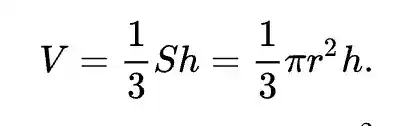
V = ⅓ * Base Area * Height into the growth model of a Meme coin
4.1. Variable Mapping: Building a Growth Model
We will map the various geometric elements of the cone to the variables x, y, z you proposed:
Base Radius r = x * y: Boundary of social consensus
· x (Content/Narrative): This is the "gene" of a Meme. Good content determines the virality of consensus.
· y (Propagation Nodes): These are the community, KOLs, and hodler addresses. Nodes determine the reach of the narrative.
· r (Radius): Represents the physical boundary of consensus. A larger radius means more people know and are willing to believe in the story, leading to a more stable foundation.
· Height h = z (Capital/Sentiment Leverage): The speed and density of capital inflow determine the vertical height of price appreciation.
· Volume V = Market Cap: The resulting scale of market capitalization.
4.1.1 Why is the relationship between radius x * y squared?
In the world of Memes, the combination of narrative and nodes exhibits network effects.
If content x is just mediocre imitation, even with many nodes y, the radius r is hard to expand.
When a highly penetrating narrative (x) meets highly interactive propagation nodes (y), the consensus surface area expands exponentially. The squared term in the formula implies that as the underlying community consensus expands slightly, the potential supported volume (market cap) grows exponentially.
4.1.2 Why is capital z a linear height?
Capital z determines how high the price pumps. However, in the Meme model, without the underlying surface area (x and y) supporting the capital height, it is unstable. If there is only z (whale entry for a pump) without r (widespread retail consensus), the cone will become an extremely thin "needle" that collapses at the slightest breeze.
True blue-chip Memes (like DOGE, PEPE) have a huge base diameter, allowing the overall volume to remain substantial even if the capital height h fluctuates.
4.1.3 The Allure of the 1/3 Coefficient: Meme Erosion and Attention Decay
Scientists have found that the volume of a cone is only one-third that of a cylinder with the same base and height. In the Meme market, this represents the frictional loss of attention, although 1/3 is an assumed value and could actually be 1/300.
Not everyone who hears the narrative will buy in. Not all incoming capital can translate into long-term held market value. This coefficient reminds us that a Meme's market cap can never fully cover the attention flow it reaches, with a significant amount of bubble evaporation and attention diversion.
4.2 Trajectory Analysis: From "Point" to "Cone"
The upward trajectory of a Meme coin usually follows the generation process of a cone:
· Sprout: Narrative x has just come into being, node y is extremely few, and funding z is just starting to be injected. At this point, the volume is negligible.
· Rooting Downward: As more node y join, narrative x begins to proliferate. At this stage, the most important thing is not the price (height), but increasing the number of holding addresses and community activity (expanding radius r).
· Vertical Eruption: When the consensus base is large enough, the influx of funding z will create an astonishing leverage effect. Since the base radius has solidified, increasing the same z will cause the volume V to rapidly expand.
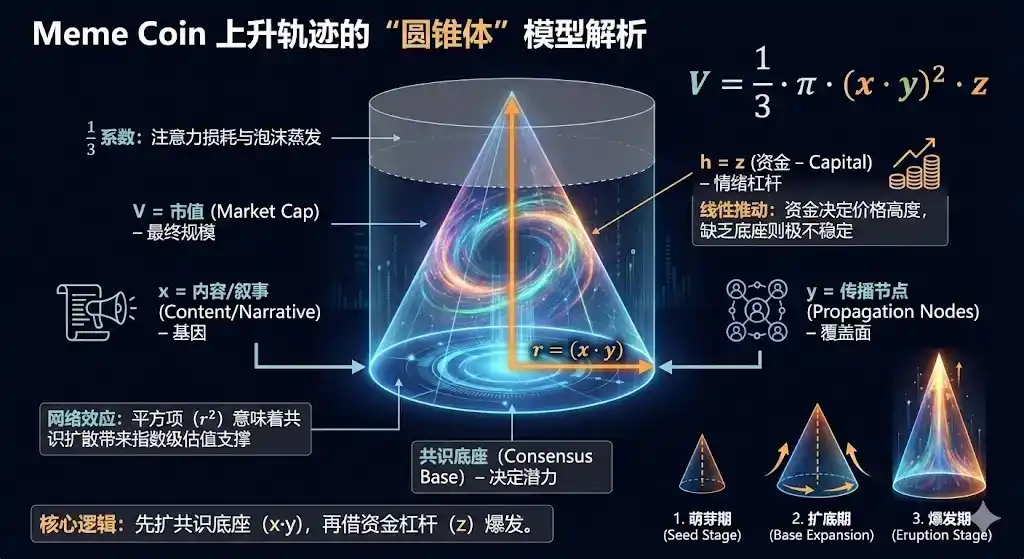
A successful Meme coin trajectory is essentially about expanding the base first, then increasing the height.
5. Volume Formula of Cone: Boundaries and Limitations
5.1 Defining the States of "Healthy" and "Malformed" Growth
This model sets r (narrative × node) as a square term and sets z (funding) as a linear term. There are two main, fairly obvious effects:
· Capturing Network Effects: In the Meme field, a 10x narrative spread (r) often can support a 100x market cap (V) growth. This explains why some coins, even if the funding amount (h) has not reached a tipping point, as long as the community foundation (r) is thick enough, its valuation potential will experience a geometric leap.
· Explaining the Physical Structure of "Collapse": If a project's radius r (consensus) is shrinking, even if you pour in a lot more funding z to pump the price, the volume of the cone will rapidly shrink due to the collapse of the base.
In addition, through this geometric model, we can easily distinguish two typical failure models:
· "Bar" Model (high z, very low r): Only whales wash trading or pump the price, lacking community discussion and narrative consensus. This kind of cone is extremely unstable, and once the funding z is withdrawn, the volume instantly drops to zero.
· "Flat Pancake" Model (large r, very low z): The community is very lively, the narrative is good, but there is simply no funding coming in. This kind of cone only has area but no volume, representing a "all bark and no bite" poor community.
5.2 Limitations
In the real-world secondary market application, there are several important "physical deformations" to note:
· Coupling between variables: In the formula, r and h are independent variables, but in the Meme market, an increase in z (funds) will in turn strengthen x (narrative) and y (propagation nodes). This is the famous "bulls are on steroids" effect. The higher the price, the more the narrative resembles truth, and the faster the node diffusion.
· Dynamic nature of the ⅓ coefficient: In an extremely crazy bull market, this coefficient may approach 1 (become a cylinder) as emotions smooth out all losses; whereas in a bear market, this coefficient may become 1/1000, meaning the vast majority of attention cannot be converted into purchasing power.
· Lack of a time dimension: A cone is a static geometric shape, but Meme is time-sensitive. Introducing a "decay rate" would make this model more perfect, as the narrative x of a Meme will naturally shrink with aesthetic fatigue.
6. Broccoli Case Study
6.1. Elements of Broccoli
· x (Content/Narrative): "CZ Personally Certified" — This is top-tier narrative and influence.
· y (Propagation Nodes): CZ's tens of millions of fans, BNB Chain official account, Four.Meme platform, and the lurking "scientists" and PVP players across the entire network.
· z (Funds/Market Value): Funds held on the BNB chain and "hot money" brought in from other chains through cross-chain transactions.
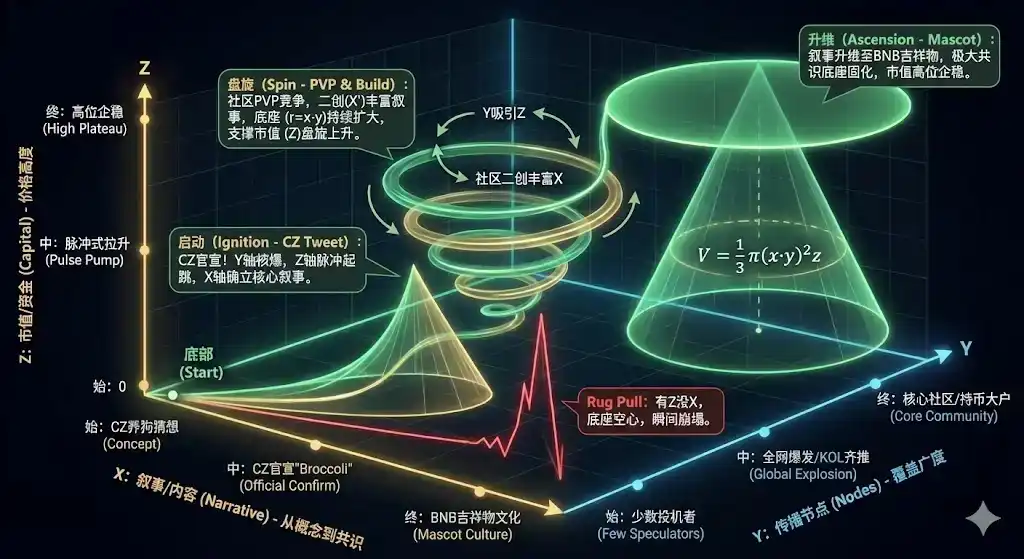
6.2. Four-Stage Trajectory Reconstruction
Stage One: Bottom (Start) — Fog Phase
February 13, 2025, CZ teases the upcoming reveal. x, y, z are almost zero, but the market is full of "static electricity." The entire network begins to speculate on the name, leading to a plethora of tiny misdirected cones like BNBDog, CZDoge, and so on.
Stage Two: Ignition (Launch) — Narrative Nuclear Explosion
CZ tweets, officially announcing the dog's name as Broccoli with an accompanying image. The y-axis (nodes) instantly max out. Twitter, Telegram channels almost instantaneously propagate in sync on a second-by-second basis.
Due to the narrative x being directly provided by CZ, authenticity is confirmed. Funds z poured in wildly, and hundreds to thousands of tokens with the same name instantly emerged on platforms like Four.Meme. The trajectory line at this moment exhibited an almost vertical incline in the y-z plane.
Phase Three: Spin — Jungle Combat (PVP)
Within 2-12 hours after the reveal, thousands upon thousands of Broccolis appeared in the market. To compete for the "true identity," various communities began frenzied derivative creations (x's competition). At this point, the model is in a spinning state. Some tokens rely on community-driven buy pressure to increase z, while others enrich x with more entertaining memes.
Only those Broccolis that can continuously stimulate y (more node discussions) and enrich x (narrative upgrades, such as charity work or gaming) can maintain the spin. The rest, due to a lack of x, lose their spinning power and directly enter the collapse process.
Phase Four: Ascension — Consensus Settling
In the end, only 1-2 "chosen ones" stand out, gaining attention from the BNB Foundation or recognition from mainstream trading platforms.
By this time, the base area r = x * y has solidified due to extensive community building. The narrative has ascended from "CZ's pet" to "BNB Chain's mascot." Even if fund z experiences occasional fluctuations, the market value cone remains towering due to its extremely stable base.
6.3 Warning: Ascended Broccolis
In the brawl of 2025, 99.99% of Broccolis plummeted in an "inverted V-shaped" fall.
During the launch period, they relied on counterfeiting or internal pumps to raise the z-axis significantly. The Dev team was purely focused on harvesting, with no intention of managing x (content) and y (genuine community nodes). Therefore, this cone was an extremely thin "needle," and after reaching the peak of the z-axis, due to the base radius r approaching zero, it instantly lost balance, and the trajectory line plummeted vertically, leaving a mess behind.
CZ's Broccoli case proved: The ultimate battle of Meme coins is not about who mints first (z) but about who can expand the "CZ's pet" point (x) into the largest circle (r) through community power (y).
Broccoli was perhaps the largest "same-base-area cone speed competition" on Meme in 2025. Under the same x narrative, tens of thousands of projects competed in y and z, ultimately proving that only "narrative upgrades + node stickiness" can lead to a breakthrough in market value.
7. Case Study of Pnut
Pnut's Three-Dimensional Coordinate Breakdown
· X Axis (Narrative Density - Emotion and Justice): This is not just a squirrel meme; it carries the narratives of "resisting government overreach" and "seeking vengeance for innocent life." From "a cute squirrel → a hero killed by the establishment → a political totem of the MAGA movement." Its narrative density has remarkably achieved cross-border, cross-class resonance in meme history.
· Y Axis (Dissemination Node - Dimensionality Reduction Strike): Top node Y_max: Elon Musk continuously tweeted, followed by other top influencers like Joe Rogan. These nodes are not just "pumping KOLs" but giant nodes with the ability to set social agendas.
· Z Axis (Funds Conduit - Emotional Leverage): With lightning-fast liquidity on the Solana chain, coupled with rapid listing on top CEXs like Binance, funds z flowed in rapidly.
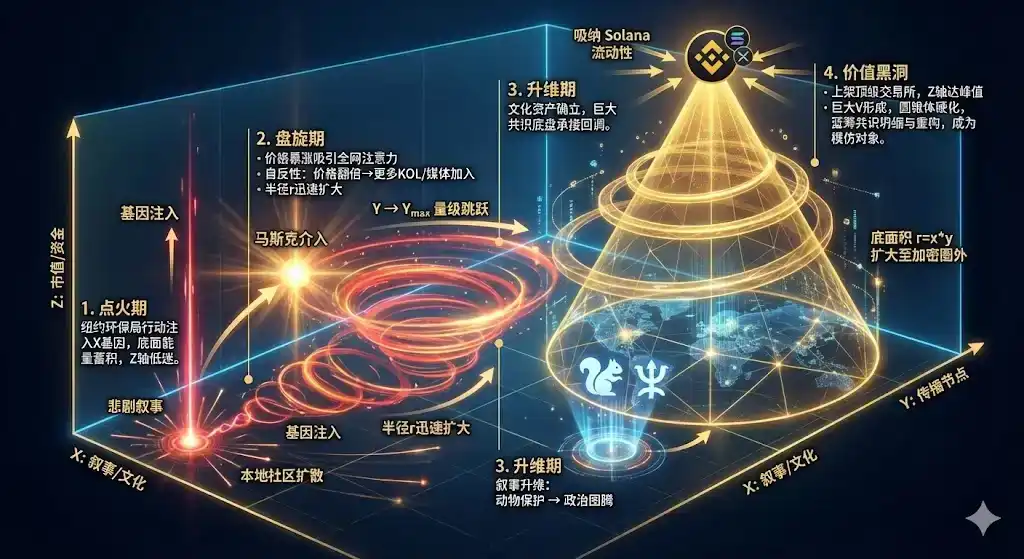
Phase 1. Ignition Phase: Injection of Tragic Narrative Genes
x (Justice/Vengeance) formed instantly, y (local community) began to spread. The trajectory bounced vertically from the origin. The action of the New York Environmental Protection Agency injected a highly penetrating x gene into Pnut. At this time, z (funds) were still languishing on-chain, but the energy at the bottom had begun to accumulate.
Phase 2. Spiral Phase: "Gravity Pull" of Top Nodes
The Y-axis experienced a magnitude jump due to Musk's (Elon Musk) intervention (Y → Y_max).
The skyrocketing price z attracted the attention of the entire network. As Elon's tweets had strong self-referentiality, for every doubling of the price, more traditional media and political KOLs (new nodes) joined the discussion. The trajectory line began to rotate vigorously in three-dimensional space, and the radius r expanded rapidly.
Phase 3. Dimensional Upshift: From "Squirrel" to "Political Totem"
The X-axis completed the upshift (from "animal protection" to "US election/resisting the establishment"). This is Pnut's most solid step. Due to the upgrade of narrative x, the circular base area r = x*y is no longer limited to the crypto community. At this stage, Pnut is no longer a local meme but a cultural asset. Even if funds z experience a phase-wise pullback, the huge consensus base can still withstand selling pressure.
Phase 4. Value Black Hole: The Collapse and Reconstruction of Blue-Chip Consensus
Listed on top exchanges such as Binance, with funds soaring to new heights. A massive V (Market Cap) has been formed. It begins to absorb liquidity within the Solana ecosystem like a black hole. At this point, the Pnut cone has fully solidified, becoming the object that all subsequent animal-type Memes attempt to imitate.
A Final Note
After reading so much theoretical analysis, you ask me as an ordinary user, how should I identify, participate in, and embrace meme opportunities on the BNB Chain, Solana, Base, and Xlayer? How can I seize a great opportunity and achieve great results?
To be continued in the next breakdown.
You may also like

Token Cannot Compound, Where Is the Real Investment Opportunity?

February 6th Market Key Intelligence, How Much Did You Miss?

China's Central Bank and Eight Other Departments' Latest Regulatory Focus: Key Attention to RWA Tokenized Asset Risk
Foreword: Today, the People's Bank of China's website published the "Notice of the People's Bank of China, National Development and Reform Commission, Ministry of Industry and Information Technology, Ministry of Public Security, State Administration for Market Regulation, China Banking and Insurance Regulatory Commission, China Securities Regulatory Commission, State Administration of Foreign Exchange on Further Preventing and Dealing with Risks Related to Virtual Currency and Others (Yinfa [2026] No. 42)", the latest regulatory requirements from the eight departments including the central bank, which are basically consistent with the regulatory requirements of recent years. The main focus of the regulation is on speculative activities such as virtual currency trading, exchanges, ICOs, overseas platform services, and this time, regulatory oversight of RWA has been added, explicitly prohibiting RWA tokenization, stablecoins (especially those pegged to the RMB). The following is the full text:
To the people's governments of all provinces, autonomous regions, and municipalities directly under the Central Government, the Xinjiang Production and Construction Corps:
Recently, there have been speculative activities related to virtual currency and Real-World Assets (RWA) tokenization, disrupting the economic and financial order and jeopardizing the property security of the people. In order to further prevent and address the risks related to virtual currency and Real-World Assets tokenization, effectively safeguard national security and social stability, in accordance with the "Law of the People's Republic of China on the People's Bank of China," "Law of the People's Republic of China on Commercial Banks," "Securities Law of the People's Republic of China," "Law of the People's Republic of China on Securities Investment Funds," "Law of the People's Republic of China on Futures and Derivatives," "Cybersecurity Law of the People's Republic of China," "Regulations of the People's Republic of China on the Administration of Renminbi," "Regulations on Prevention and Disposal of Illegal Fundraising," "Regulations of the People's Republic of China on Foreign Exchange Administration," "Telecommunications Regulations of the People's Republic of China," and other provisions, after reaching consensus with the Cyberspace Administration of China, the Supreme People's Court, and the Supreme People's Procuratorate, and with the approval of the State Council, the relevant matters are notified as follows:
(I) Virtual currency does not possess the legal status equivalent to fiat currency. Virtual currencies such as Bitcoin, Ether, Tether, etc., have the main characteristics of being issued by non-monetary authorities, using encryption technology and distributed ledger or similar technology, existing in digital form, etc. They do not have legal tender status, should not and cannot be circulated and used as currency in the market.
The business activities related to virtual currency are classified as illegal financial activities. The exchange of fiat currency and virtual currency within the territory, exchange of virtual currencies, acting as a central counterparty in buying and selling virtual currencies, providing information intermediary and pricing services for virtual currency transactions, token issuance financing, and trading of virtual currency-related financial products, etc., fall under illegal financial activities, such as suspected illegal issuance of token vouchers, unauthorized public issuance of securities, illegal operation of securities and futures business, illegal fundraising, etc., are strictly prohibited across the board and resolutely banned in accordance with the law. Overseas entities and individuals are not allowed to provide virtual currency-related services to domestic entities in any form.
A stablecoin pegged to a fiat currency indirectly fulfills some functions of the fiat currency in circulation. Without the consent of relevant authorities in accordance with the law and regulations, any domestic or foreign entity or individual is not allowed to issue a RMB-pegged stablecoin overseas.
(II)Tokenization of Real-World Assets refers to the use of encryption technology and distributed ledger or similar technologies to transform ownership rights, income rights, etc., of assets into tokens (tokens) or other interests or bond certificates with token (token) characteristics, and carry out issuance and trading activities.
Engaging in the tokenization of real-world assets domestically, as well as providing related intermediary, information technology services, etc., which are suspected of illegal issuance of token vouchers, unauthorized public offering of securities, illegal operation of securities and futures business, illegal fundraising, and other illegal financial activities, shall be prohibited; except for relevant business activities carried out with the approval of the competent authorities in accordance with the law and regulations and relying on specific financial infrastructures. Overseas entities and individuals are not allowed to illegally provide services related to the tokenization of real-world assets to domestic entities in any form.
(III) Inter-agency Coordination. The People's Bank of China, together with the National Development and Reform Commission, the Ministry of Industry and Information Technology, the Ministry of Public Security, the State Administration for Market Regulation, the China Banking and Insurance Regulatory Commission, the China Securities Regulatory Commission, the State Administration of Foreign Exchange, and other departments, will improve the work mechanism, strengthen coordination with the Cyberspace Administration of China, the Supreme People's Court, and the Supreme People's Procuratorate, coordinate efforts, and overall guide regions to carry out risk prevention and disposal of virtual currency-related illegal financial activities.
The China Securities Regulatory Commission, together with the National Development and Reform Commission, the Ministry of Industry and Information Technology, the Ministry of Public Security, the People's Bank of China, the State Administration for Market Regulation, the China Banking and Insurance Regulatory Commission, the State Administration of Foreign Exchange, and other departments, will improve the work mechanism, strengthen coordination with the Cyberspace Administration of China, the Supreme People's Court, and the Supreme People's Procuratorate, coordinate efforts, and overall guide regions to carry out risk prevention and disposal of illegal financial activities related to the tokenization of real-world assets.
(IV) Strengthening Local Implementation. The people's governments at the provincial level are overall responsible for the prevention and disposal of risks related to virtual currencies and the tokenization of real-world assets in their respective administrative regions. The specific leading department is the local financial regulatory department, with participation from branches and dispatched institutions of the State Council's financial regulatory department, telecommunications regulators, public security, market supervision, and other departments, in coordination with cyberspace departments, courts, and procuratorates, to improve the normalization of the work mechanism, effectively connect with the relevant work mechanisms of central departments, form a cooperative and coordinated working pattern between central and local governments, effectively prevent and properly handle risks related to virtual currencies and the tokenization of real-world assets, and maintain economic and financial order and social stability.
(5) Enhanced Risk Monitoring. The People's Bank of China, China Securities Regulatory Commission, National Development and Reform Commission, Ministry of Industry and Information Technology, Ministry of Public Security, State Administration of Foreign Exchange, Cyberspace Administration of China, and other departments continue to improve monitoring techniques and system support, enhance cross-departmental data analysis and sharing, establish sound information sharing and cross-validation mechanisms, promptly grasp the risk situation of activities related to virtual currency and real-world asset tokenization. Local governments at all levels give full play to the role of local monitoring and early warning mechanisms. Local financial regulatory authorities, together with branches and agencies of the State Council's financial regulatory authorities, as well as departments of cyberspace and public security, ensure effective connection between online monitoring, offline investigation, and fund tracking, efficiently and accurately identify activities related to virtual currency and real-world asset tokenization, promptly share risk information, improve early warning information dissemination, verification, and rapid response mechanisms.
(6) Strengthened Oversight of Financial Institutions, Intermediaries, and Technology Service Providers. Financial institutions (including non-bank payment institutions) are prohibited from providing account opening, fund transfer, and clearing services for virtual currency-related business activities, issuing and selling financial products related to virtual currency, including virtual currency and related financial products in the scope of collateral, conducting insurance business related to virtual currency, or including virtual currency in the scope of insurance liability. Financial institutions (including non-bank payment institutions) are prohibited from providing custody, clearing, and settlement services for unauthorized real-world asset tokenization-related business and related financial products. Relevant intermediary institutions and information technology service providers are prohibited from providing intermediary, technical, or other services for unauthorized real-world asset tokenization-related businesses and related financial products.
(7) Enhanced Management of Internet Information Content and Access. Internet enterprises are prohibited from providing online business venues, commercial displays, marketing, advertising, or paid traffic diversion services for virtual currency and real-world asset tokenization-related business activities. Upon discovering clues of illegal activities, they should promptly report to relevant departments and provide technical support and assistance for related investigations and inquiries. Based on the clues transferred by the financial regulatory authorities, the cyberspace administration, telecommunications authorities, and public security departments should promptly close and deal with websites, mobile applications (including mini-programs), and public accounts engaged in virtual currency and real-world asset tokenization-related business activities in accordance with the law.
(8) Strengthened Entity Registration and Advertisement Management. Market supervision departments strengthen entity registration and management, and enterprise and individual business registrations must not contain terms such as "virtual currency," "virtual asset," "cryptocurrency," "crypto asset," "stablecoin," "real-world asset tokenization," or "RWA" in their names or business scopes. Market supervision departments, together with financial regulatory authorities, legally enhance the supervision of advertisements related to virtual currency and real-world asset tokenization, promptly investigating and handling relevant illegal advertisements.
(IX) Continued Rectification of Virtual Currency Mining Activities. The National Development and Reform Commission, together with relevant departments, strictly controls virtual currency mining activities, continuously promotes the rectification of virtual currency mining activities. The people's governments of various provinces take overall responsibility for the rectification of "mining" within their respective administrative regions. In accordance with the requirements of the National Development and Reform Commission and other departments in the "Notice on the Rectification of Virtual Currency Mining Activities" (NDRC Energy-saving Building [2021] No. 1283) and the provisions of the "Guidance Catalog for Industrial Structure Adjustment (2024 Edition)," a comprehensive review, investigation, and closure of existing virtual currency mining projects are conducted, new mining projects are strictly prohibited, and mining machine production enterprises are strictly prohibited from providing mining machine sales and other services within the country.
(X) Severe Crackdown on Related Illegal Financial Activities. Upon discovering clues to illegal financial activities related to virtual currency and the tokenization of real-world assets, local financial regulatory authorities, branches of the State Council's financial regulatory authorities, and other relevant departments promptly investigate, determine, and properly handle the issues in accordance with the law, and seriously hold the relevant entities and individuals legally responsible. Those suspected of crimes are transferred to the judicial authorities for processing according to the law.
(XI) Severe Crackdown on Related Illegal and Criminal Activities. The Ministry of Public Security, the People's Bank of China, the State Administration for Market Regulation, the China Banking and Insurance Regulatory Commission, the China Securities Regulatory Commission, as well as judicial and procuratorial organs, in accordance with their respective responsibilities, rigorously crack down on illegal and criminal activities related to virtual currency, the tokenization of real-world assets, such as fraud, money laundering, illegal business operations, pyramid schemes, illegal fundraising, and other illegal and criminal activities carried out under the guise of virtual currency, the tokenization of real-world assets, etc.
(XII) Strengthen Industry Self-discipline. Relevant industry associations should enhance membership management and policy advocacy, based on their own responsibilities, advocate and urge member units to resist illegal financial activities related to virtual currency and the tokenization of real-world assets. Member units that violate regulatory policies and industry self-discipline rules are to be disciplined in accordance with relevant self-regulatory management regulations. By leveraging various industry infrastructure, conduct risk monitoring related to virtual currency, the tokenization of real-world assets, and promptly transfer issue clues to relevant departments.
(XIII) Without the approval of relevant departments in accordance with the law and regulations, domestic entities and foreign entities controlled by them may not issue virtual currency overseas.
(XIV) Domestic entities engaging directly or indirectly in overseas external debt-based tokenization of real-world assets, or conducting asset securitization activities abroad based on domestic ownership rights, income rights, etc. (hereinafter referred to as domestic equity), should be strictly regulated in accordance with the principles of "same business, same risk, same rules." The National Development and Reform Commission, the China Securities Regulatory Commission, the State Administration of Foreign Exchange, and other relevant departments regulate it according to their respective responsibilities. For other forms of overseas real-world asset tokenization activities based on domestic equity by domestic entities, the China Securities Regulatory Commission, together with relevant departments, supervise according to their division of responsibilities. Without the consent and filing of relevant departments, no unit or individual may engage in the above-mentioned business.
(15) Overseas subsidiaries and branches of domestic financial institutions providing Real World Asset Tokenization-related services overseas shall do so legally and prudently. They shall have professional personnel and systems in place to effectively mitigate business risks, strictly implement customer onboarding, suitability management, anti-money laundering requirements, and incorporate them into the domestic financial institutions' compliance and risk management system. Intermediaries and information technology service providers offering Real World Asset Tokenization services abroad based on domestic equity or conducting Real World Asset Tokenization business in the form of overseas debt for domestic entities directly or indirectly venturing abroad must strictly comply with relevant laws and regulations. They should establish and improve relevant compliance and internal control systems in accordance with relevant normative requirements, strengthen business and risk control, and report the business developments to the relevant regulatory authorities for approval or filing.
(16) Strengthen organizational leadership and overall coordination. All departments and regions should attach great importance to the prevention of risks related to virtual currencies and Real World Asset Tokenization, strengthen organizational leadership, clarify work responsibilities, form a long-term effective working mechanism with centralized coordination, local implementation, and shared responsibilities, maintain high pressure, dynamically monitor risks, effectively prevent and mitigate risks in an orderly and efficient manner, legally protect the property security of the people, and make every effort to maintain economic and financial order and social stability.
(17) Widely carry out publicity and education. All departments, regions, and industry associations should make full use of various media and other communication channels to disseminate information through legal and policy interpretation, analysis of typical cases, and education on investment risks, etc. They should promote the illegality and harm of virtual currencies and Real World Asset Tokenization-related businesses and their manifestations, fully alert to potential risks and hidden dangers, and enhance public awareness and identification capabilities for risk prevention.
(18) Engaging in illegal financial activities related to virtual currencies and Real World Asset Tokenization in violation of this notice, as well as providing services for virtual currencies and Real World Asset Tokenization-related businesses, shall be punished in accordance with relevant regulations. If it constitutes a crime, criminal liability shall be pursued according to the law. For domestic entities and individuals who knowingly or should have known that overseas entities illegally provided virtual currency or Real World Asset Tokenization-related services to domestic entities and still assisted them, relevant responsibilities shall be pursued according to the law. If it constitutes a crime, criminal liability shall be pursued according to the law.
(19) If any unit or individual invests in virtual currencies, Real World Asset Tokens, and related financial products against public order and good customs, the relevant civil legal actions shall be invalid, and any resulting losses shall be borne by them. If there are suspicions of disrupting financial order and jeopardizing financial security, the relevant departments shall deal with them according to the law.
This notice shall enter into force upon the date of its issuance. The People's Bank of China and ten other departments' "Notice on Further Preventing and Dealing with the Risks of Virtual Currency Trading Speculation" (Yinfa [2021] No. 237) is hereby repealed.

Former Partner's Perspective on Multicoin: Kyle's Exit, But the Game He Left Behind Just Getting Started
Why Bitcoin Is Falling Now: The Real Reasons Behind BTC's Crash & WEEX's Smart Profit Playbook
Bitcoin's ongoing crash explained: Discover the 5 hidden triggers behind BTC's plunge & how WEEX's Auto Earn and Trade to Earn strategies help traders profit from crypto market volatility.

Wall Street's Hottest Trades See Exodus

Vitalik Discusses Ethereum Scaling Path, Circle Announces Partnership with Polymarket, What's the Overseas Crypto Community Talking About Today?

Believing in the Capital Markets - The Essence and Core Value of Cryptocurrency

Polymarket's 'Weatherman': Predict Temperature, Win Million-Dollar Payout
$15K+ Profits: The 4 AI Trading Secrets WEEX Hackathon Prelim Winners Used to Dominate Volatile Crypto Markets
How WEEX Hackathon's top AI trading strategies made $15K+ in crypto markets: 4 proven rules for ETH/BTC trading, market structure analysis, and risk management in volatile conditions.

A nearly 20% one-day plunge, how long has it been since you last saw a $60,000 Bitcoin?

Raoul Pal: I've seen every single panic, and they are never the end.

Key Market Information Discrepancy on February 6th - A Must-Read! | Alpha Morning Report

2026 Crypto Industry's First Snowfall

The Harsh Reality Behind the $26 Billion Crypto Liquidation: Liquidity Is Killing the Market

Why Is Gold, US Stocks, Bitcoin All Falling?

Key Market Intelligence for February 5th, how much did you miss out on?

Wintermute: By 2026, crypto had gradually become the settlement layer of the Internet economy
Token Cannot Compound, Where Is the Real Investment Opportunity?
February 6th Market Key Intelligence, How Much Did You Miss?
China's Central Bank and Eight Other Departments' Latest Regulatory Focus: Key Attention to RWA Tokenized Asset Risk
Foreword: Today, the People's Bank of China's website published the "Notice of the People's Bank of China, National Development and Reform Commission, Ministry of Industry and Information Technology, Ministry of Public Security, State Administration for Market Regulation, China Banking and Insurance Regulatory Commission, China Securities Regulatory Commission, State Administration of Foreign Exchange on Further Preventing and Dealing with Risks Related to Virtual Currency and Others (Yinfa [2026] No. 42)", the latest regulatory requirements from the eight departments including the central bank, which are basically consistent with the regulatory requirements of recent years. The main focus of the regulation is on speculative activities such as virtual currency trading, exchanges, ICOs, overseas platform services, and this time, regulatory oversight of RWA has been added, explicitly prohibiting RWA tokenization, stablecoins (especially those pegged to the RMB). The following is the full text:
To the people's governments of all provinces, autonomous regions, and municipalities directly under the Central Government, the Xinjiang Production and Construction Corps:
Recently, there have been speculative activities related to virtual currency and Real-World Assets (RWA) tokenization, disrupting the economic and financial order and jeopardizing the property security of the people. In order to further prevent and address the risks related to virtual currency and Real-World Assets tokenization, effectively safeguard national security and social stability, in accordance with the "Law of the People's Republic of China on the People's Bank of China," "Law of the People's Republic of China on Commercial Banks," "Securities Law of the People's Republic of China," "Law of the People's Republic of China on Securities Investment Funds," "Law of the People's Republic of China on Futures and Derivatives," "Cybersecurity Law of the People's Republic of China," "Regulations of the People's Republic of China on the Administration of Renminbi," "Regulations on Prevention and Disposal of Illegal Fundraising," "Regulations of the People's Republic of China on Foreign Exchange Administration," "Telecommunications Regulations of the People's Republic of China," and other provisions, after reaching consensus with the Cyberspace Administration of China, the Supreme People's Court, and the Supreme People's Procuratorate, and with the approval of the State Council, the relevant matters are notified as follows:
(I) Virtual currency does not possess the legal status equivalent to fiat currency. Virtual currencies such as Bitcoin, Ether, Tether, etc., have the main characteristics of being issued by non-monetary authorities, using encryption technology and distributed ledger or similar technology, existing in digital form, etc. They do not have legal tender status, should not and cannot be circulated and used as currency in the market.
The business activities related to virtual currency are classified as illegal financial activities. The exchange of fiat currency and virtual currency within the territory, exchange of virtual currencies, acting as a central counterparty in buying and selling virtual currencies, providing information intermediary and pricing services for virtual currency transactions, token issuance financing, and trading of virtual currency-related financial products, etc., fall under illegal financial activities, such as suspected illegal issuance of token vouchers, unauthorized public issuance of securities, illegal operation of securities and futures business, illegal fundraising, etc., are strictly prohibited across the board and resolutely banned in accordance with the law. Overseas entities and individuals are not allowed to provide virtual currency-related services to domestic entities in any form.
A stablecoin pegged to a fiat currency indirectly fulfills some functions of the fiat currency in circulation. Without the consent of relevant authorities in accordance with the law and regulations, any domestic or foreign entity or individual is not allowed to issue a RMB-pegged stablecoin overseas.
(II)Tokenization of Real-World Assets refers to the use of encryption technology and distributed ledger or similar technologies to transform ownership rights, income rights, etc., of assets into tokens (tokens) or other interests or bond certificates with token (token) characteristics, and carry out issuance and trading activities.
Engaging in the tokenization of real-world assets domestically, as well as providing related intermediary, information technology services, etc., which are suspected of illegal issuance of token vouchers, unauthorized public offering of securities, illegal operation of securities and futures business, illegal fundraising, and other illegal financial activities, shall be prohibited; except for relevant business activities carried out with the approval of the competent authorities in accordance with the law and regulations and relying on specific financial infrastructures. Overseas entities and individuals are not allowed to illegally provide services related to the tokenization of real-world assets to domestic entities in any form.
(III) Inter-agency Coordination. The People's Bank of China, together with the National Development and Reform Commission, the Ministry of Industry and Information Technology, the Ministry of Public Security, the State Administration for Market Regulation, the China Banking and Insurance Regulatory Commission, the China Securities Regulatory Commission, the State Administration of Foreign Exchange, and other departments, will improve the work mechanism, strengthen coordination with the Cyberspace Administration of China, the Supreme People's Court, and the Supreme People's Procuratorate, coordinate efforts, and overall guide regions to carry out risk prevention and disposal of virtual currency-related illegal financial activities.
The China Securities Regulatory Commission, together with the National Development and Reform Commission, the Ministry of Industry and Information Technology, the Ministry of Public Security, the People's Bank of China, the State Administration for Market Regulation, the China Banking and Insurance Regulatory Commission, the State Administration of Foreign Exchange, and other departments, will improve the work mechanism, strengthen coordination with the Cyberspace Administration of China, the Supreme People's Court, and the Supreme People's Procuratorate, coordinate efforts, and overall guide regions to carry out risk prevention and disposal of illegal financial activities related to the tokenization of real-world assets.
(IV) Strengthening Local Implementation. The people's governments at the provincial level are overall responsible for the prevention and disposal of risks related to virtual currencies and the tokenization of real-world assets in their respective administrative regions. The specific leading department is the local financial regulatory department, with participation from branches and dispatched institutions of the State Council's financial regulatory department, telecommunications regulators, public security, market supervision, and other departments, in coordination with cyberspace departments, courts, and procuratorates, to improve the normalization of the work mechanism, effectively connect with the relevant work mechanisms of central departments, form a cooperative and coordinated working pattern between central and local governments, effectively prevent and properly handle risks related to virtual currencies and the tokenization of real-world assets, and maintain economic and financial order and social stability.
(5) Enhanced Risk Monitoring. The People's Bank of China, China Securities Regulatory Commission, National Development and Reform Commission, Ministry of Industry and Information Technology, Ministry of Public Security, State Administration of Foreign Exchange, Cyberspace Administration of China, and other departments continue to improve monitoring techniques and system support, enhance cross-departmental data analysis and sharing, establish sound information sharing and cross-validation mechanisms, promptly grasp the risk situation of activities related to virtual currency and real-world asset tokenization. Local governments at all levels give full play to the role of local monitoring and early warning mechanisms. Local financial regulatory authorities, together with branches and agencies of the State Council's financial regulatory authorities, as well as departments of cyberspace and public security, ensure effective connection between online monitoring, offline investigation, and fund tracking, efficiently and accurately identify activities related to virtual currency and real-world asset tokenization, promptly share risk information, improve early warning information dissemination, verification, and rapid response mechanisms.
(6) Strengthened Oversight of Financial Institutions, Intermediaries, and Technology Service Providers. Financial institutions (including non-bank payment institutions) are prohibited from providing account opening, fund transfer, and clearing services for virtual currency-related business activities, issuing and selling financial products related to virtual currency, including virtual currency and related financial products in the scope of collateral, conducting insurance business related to virtual currency, or including virtual currency in the scope of insurance liability. Financial institutions (including non-bank payment institutions) are prohibited from providing custody, clearing, and settlement services for unauthorized real-world asset tokenization-related business and related financial products. Relevant intermediary institutions and information technology service providers are prohibited from providing intermediary, technical, or other services for unauthorized real-world asset tokenization-related businesses and related financial products.
(7) Enhanced Management of Internet Information Content and Access. Internet enterprises are prohibited from providing online business venues, commercial displays, marketing, advertising, or paid traffic diversion services for virtual currency and real-world asset tokenization-related business activities. Upon discovering clues of illegal activities, they should promptly report to relevant departments and provide technical support and assistance for related investigations and inquiries. Based on the clues transferred by the financial regulatory authorities, the cyberspace administration, telecommunications authorities, and public security departments should promptly close and deal with websites, mobile applications (including mini-programs), and public accounts engaged in virtual currency and real-world asset tokenization-related business activities in accordance with the law.
(8) Strengthened Entity Registration and Advertisement Management. Market supervision departments strengthen entity registration and management, and enterprise and individual business registrations must not contain terms such as "virtual currency," "virtual asset," "cryptocurrency," "crypto asset," "stablecoin," "real-world asset tokenization," or "RWA" in their names or business scopes. Market supervision departments, together with financial regulatory authorities, legally enhance the supervision of advertisements related to virtual currency and real-world asset tokenization, promptly investigating and handling relevant illegal advertisements.
(IX) Continued Rectification of Virtual Currency Mining Activities. The National Development and Reform Commission, together with relevant departments, strictly controls virtual currency mining activities, continuously promotes the rectification of virtual currency mining activities. The people's governments of various provinces take overall responsibility for the rectification of "mining" within their respective administrative regions. In accordance with the requirements of the National Development and Reform Commission and other departments in the "Notice on the Rectification of Virtual Currency Mining Activities" (NDRC Energy-saving Building [2021] No. 1283) and the provisions of the "Guidance Catalog for Industrial Structure Adjustment (2024 Edition)," a comprehensive review, investigation, and closure of existing virtual currency mining projects are conducted, new mining projects are strictly prohibited, and mining machine production enterprises are strictly prohibited from providing mining machine sales and other services within the country.
(X) Severe Crackdown on Related Illegal Financial Activities. Upon discovering clues to illegal financial activities related to virtual currency and the tokenization of real-world assets, local financial regulatory authorities, branches of the State Council's financial regulatory authorities, and other relevant departments promptly investigate, determine, and properly handle the issues in accordance with the law, and seriously hold the relevant entities and individuals legally responsible. Those suspected of crimes are transferred to the judicial authorities for processing according to the law.
(XI) Severe Crackdown on Related Illegal and Criminal Activities. The Ministry of Public Security, the People's Bank of China, the State Administration for Market Regulation, the China Banking and Insurance Regulatory Commission, the China Securities Regulatory Commission, as well as judicial and procuratorial organs, in accordance with their respective responsibilities, rigorously crack down on illegal and criminal activities related to virtual currency, the tokenization of real-world assets, such as fraud, money laundering, illegal business operations, pyramid schemes, illegal fundraising, and other illegal and criminal activities carried out under the guise of virtual currency, the tokenization of real-world assets, etc.
(XII) Strengthen Industry Self-discipline. Relevant industry associations should enhance membership management and policy advocacy, based on their own responsibilities, advocate and urge member units to resist illegal financial activities related to virtual currency and the tokenization of real-world assets. Member units that violate regulatory policies and industry self-discipline rules are to be disciplined in accordance with relevant self-regulatory management regulations. By leveraging various industry infrastructure, conduct risk monitoring related to virtual currency, the tokenization of real-world assets, and promptly transfer issue clues to relevant departments.
(XIII) Without the approval of relevant departments in accordance with the law and regulations, domestic entities and foreign entities controlled by them may not issue virtual currency overseas.
(XIV) Domestic entities engaging directly or indirectly in overseas external debt-based tokenization of real-world assets, or conducting asset securitization activities abroad based on domestic ownership rights, income rights, etc. (hereinafter referred to as domestic equity), should be strictly regulated in accordance with the principles of "same business, same risk, same rules." The National Development and Reform Commission, the China Securities Regulatory Commission, the State Administration of Foreign Exchange, and other relevant departments regulate it according to their respective responsibilities. For other forms of overseas real-world asset tokenization activities based on domestic equity by domestic entities, the China Securities Regulatory Commission, together with relevant departments, supervise according to their division of responsibilities. Without the consent and filing of relevant departments, no unit or individual may engage in the above-mentioned business.
(15) Overseas subsidiaries and branches of domestic financial institutions providing Real World Asset Tokenization-related services overseas shall do so legally and prudently. They shall have professional personnel and systems in place to effectively mitigate business risks, strictly implement customer onboarding, suitability management, anti-money laundering requirements, and incorporate them into the domestic financial institutions' compliance and risk management system. Intermediaries and information technology service providers offering Real World Asset Tokenization services abroad based on domestic equity or conducting Real World Asset Tokenization business in the form of overseas debt for domestic entities directly or indirectly venturing abroad must strictly comply with relevant laws and regulations. They should establish and improve relevant compliance and internal control systems in accordance with relevant normative requirements, strengthen business and risk control, and report the business developments to the relevant regulatory authorities for approval or filing.
(16) Strengthen organizational leadership and overall coordination. All departments and regions should attach great importance to the prevention of risks related to virtual currencies and Real World Asset Tokenization, strengthen organizational leadership, clarify work responsibilities, form a long-term effective working mechanism with centralized coordination, local implementation, and shared responsibilities, maintain high pressure, dynamically monitor risks, effectively prevent and mitigate risks in an orderly and efficient manner, legally protect the property security of the people, and make every effort to maintain economic and financial order and social stability.
(17) Widely carry out publicity and education. All departments, regions, and industry associations should make full use of various media and other communication channels to disseminate information through legal and policy interpretation, analysis of typical cases, and education on investment risks, etc. They should promote the illegality and harm of virtual currencies and Real World Asset Tokenization-related businesses and their manifestations, fully alert to potential risks and hidden dangers, and enhance public awareness and identification capabilities for risk prevention.
(18) Engaging in illegal financial activities related to virtual currencies and Real World Asset Tokenization in violation of this notice, as well as providing services for virtual currencies and Real World Asset Tokenization-related businesses, shall be punished in accordance with relevant regulations. If it constitutes a crime, criminal liability shall be pursued according to the law. For domestic entities and individuals who knowingly or should have known that overseas entities illegally provided virtual currency or Real World Asset Tokenization-related services to domestic entities and still assisted them, relevant responsibilities shall be pursued according to the law. If it constitutes a crime, criminal liability shall be pursued according to the law.
(19) If any unit or individual invests in virtual currencies, Real World Asset Tokens, and related financial products against public order and good customs, the relevant civil legal actions shall be invalid, and any resulting losses shall be borne by them. If there are suspicions of disrupting financial order and jeopardizing financial security, the relevant departments shall deal with them according to the law.
This notice shall enter into force upon the date of its issuance. The People's Bank of China and ten other departments' "Notice on Further Preventing and Dealing with the Risks of Virtual Currency Trading Speculation" (Yinfa [2021] No. 237) is hereby repealed.
Former Partner's Perspective on Multicoin: Kyle's Exit, But the Game He Left Behind Just Getting Started
Why Bitcoin Is Falling Now: The Real Reasons Behind BTC's Crash & WEEX's Smart Profit Playbook
Bitcoin's ongoing crash explained: Discover the 5 hidden triggers behind BTC's plunge & how WEEX's Auto Earn and Trade to Earn strategies help traders profit from crypto market volatility.













