
Why Did Bitcoin Break $97,000?

Original Article Title: Bitcoin's Strategic Rebound: A Post-CPI Bull Case for 2026
Original Article Author: AInvest News Editorial Team
Translation: Peggy, BlockBeats
Editor's Note: Last night, Bitcoin saw a short-term consecutive breakthrough, with a 24-hour gain of 3.91%. This article explains why Bitcoin may still experience a round of structural rebound based on three clues: macro liquidity, institutional behavior, and on-chain valuation. First, if the Federal Reserve initiates rate cuts and QE in 2026, liquidity inflow will re-elevate the valuation of risk assets. Second, during market pullbacks, ETF funds may retreat, but core institutions continue to accumulate amidst volatility, pre-positioning for the rebound. Third, multiple on-chain valuation indicators show that Bitcoin is approaching its historical "value range," providing a more cost-effective entry point for medium- to long-term funds.
Below is the original article:
The cryptocurrency market, especially Bitcoin (BTC), has long been seen as a key indicator of macroeconomic changes and institutional sentiment. As we move towards 2026, multiple macro-level tailwinds and a resurgence of institutional funds are converging, laying the foundation for a strategic rebound in Bitcoin's price. This article will analyze the Federal Reserve's policy path, cooling inflation, and changes in institutional behavior to illustrate a strong bullish case for Bitcoin in the coming year.
Macro Trends: Federal Reserve Policy Shift and Inflationary Boost
The Federal Reserve has decided to start rate cuts and quantitative easing (QE) in the first quarter of 2026, signaling a critical shift in monetary policy. These measures are aimed at stimulating economic growth and addressing inflation pressures that are still present but moderating. Historically, such policies tend to favor risk assets, including Bitcoin.
By the end of 2025, core CPI had cooled to 2.6%, alleviating market concerns about persistently high inflation and reducing the urgency for aggressive rate hikes. In such an environment, funds are more likely to reallocate to alternative assets, with Bitcoin increasingly being seen as "digital gold," a digital asset mirroring gold.
The Federal Reserve's QE program, in particular, is likely to further amplify market liquidity, providing a favorable external environment for Bitcoin's price increase. Historically, Bitcoin has shown an average return rate of about 50% in the first quarter, often accompanied by a corrective rebound from the volatility of the fourth quarter. As central banks around the world gradually shift their policy focus from "inflation control" to "growth priority," the macro narrative around Bitcoin is also transitioning from a defensive logic to a more constructive bullish framework.
Institutional HODLing: Continual Accumulation Amidst Volatility
Despite significant fund outflows towards the end of 2025, such as a $6.3 billion net outflow from the November Bitcoin ETF, institutional interest in Bitcoin remains strong. Companies like MicroStrategy continue to accumulate: it added 11,000 BTC (approximately $1.1 billion) in early 2025.
Simultaneously, mid-sized hodlers further increased their share of the total Bitcoin supply in the first quarter of 2025, demonstrating a strategic buy-the-dip approach amidst volatility, reflecting institutional and mid-sized fund commitment to Bitcoin as a "value store tool" in the long term.
The deviation between ETF outflows and ongoing institutional accumulation highlights a more subtle structural shift in the market: during price declines, ETF outflows, largely driven by retail sentiment, occur, while core institutional investors seem to be positioning themselves for a rebound.
This trend aligns with a typical pattern in Bitcoin's history: although Bitcoin has a long-term upward trajectory overall, short-term holders tend to continuously "sell at a loss" during periods of volatility. This can be validated by the Short-Term Holder Spent Output Profit Ratio (SOPR): in early 2025, this metric remained below 1 for over 70 consecutive days, indicating that short-term holders were generally in a loss-making state when selling.
This behavior often signals the market entering a phase of "long-term fund accumulation": as short-term funds are forced to exit through stop-loss, it creates a more strategic buying opportunity for long-term investors and provides conditions for institutions to seek entry points at lower levels.
On-Chain Metrics: In a "Value Range" but Caution Needed Against Bearish Risks
BTC Absolute Momentum Strategy (Long Only)
Long when the 252-day Rate of Change is positive and the price closes above the 200-day Simple Moving Average (200-day SMA). Exit when the price closes below the 200-day SMA; or exit when any of the following conditions are met: exit after holding for 20 trading days; take profit (TP) +8% / stop loss (SL) -4%
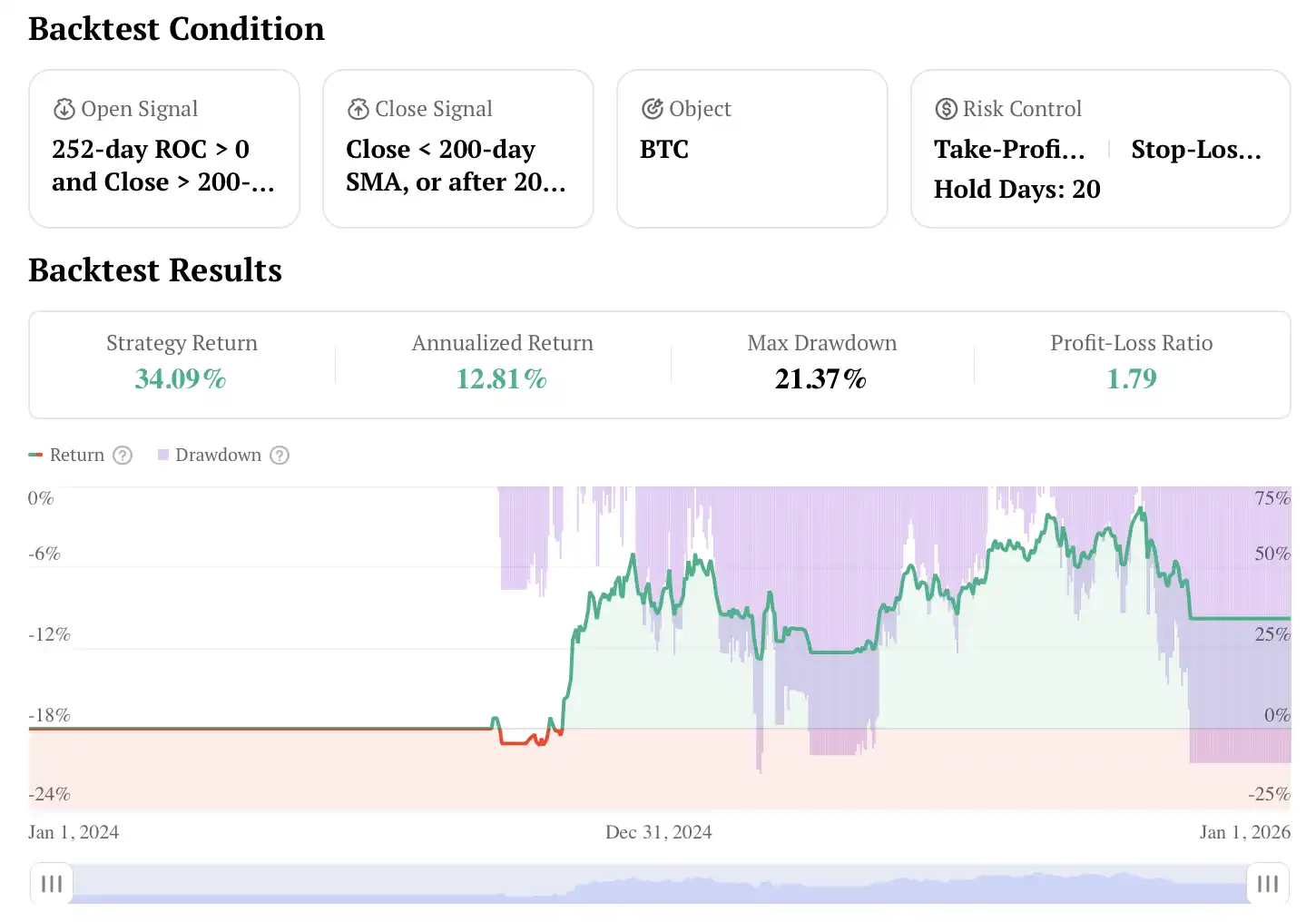
By the end of 2025, Bitcoin's price trend exhibited a clear retracement: with an approximately 6% decline for the year, and a drop of over 20% in the fourth quarter. Meanwhile, on-chain signals have shown differentiation. While metrics like "Percent Addresses in Profit" continue to weaken, indicating increased selling behavior among long-term holders, other indicators such as "Dynamic Range NVT" and "Bitcoin Yardstick" suggest that Bitcoin may be in a historical "value range," similar to valuation states seen at multiple significant bottom regions in the past.
This paradox implies that the market is at a key juncture: the short-term bearish trend continues, but the underlying fundamentals suggest that the asset may be undervalued. For institutional investors, this structural differentiation actually provides an asymmetrical opportunity—limited downside risk, with significant potential upside. Especially with the Federal Reserve's policy shift and Bitcoin's historical performance in the first quarter of 2026 potentially catalyzing this opportunity further; at the same time, Bitcoin's narrative as an "inflation hedge asset" is also gaining market recognition.
Conclusion: A Rebound in 2026 is Brewing
The combination of macro tailwinds and the return of institutional funds is building a more compelling bullish case for Bitcoin in 2026. The Fed's rate cuts and QE initiation, coupled with easing inflation, may channel more liquidity into alternative assets, including Bitcoin; and even amidst significant volatility in the fourth quarter of 2025, institutional investors' continued buying has, to a certain extent, reflected their confidence in Bitcoin's long-term value.
For investors, the core conclusion is clear: Bitcoin's upcoming "strategic rebound" is not just a price recovery, but rather a result shaped by changes in the monetary policy environment and institutional behavior. As the market seeks a new equilibrium during this transition phase, those who are early to identify macro and institutional trends moving in the same direction may be in a more advantageous position in the next phase of Bitcoin's market.
You may also like

Champion's Final Bow: FC Barcelona vs Real Betis – Celebrate the Title with a Home Finale

Best Oil Trading Platform for Crypto Users in 2026

5 Futures Trading Strategies Smart Traders Use to Cut Crypto Fees and Boost Futures Returns

What Is TradFi? How Crypto Traders Can Now Access Crude Oil, Gold, and Global Markets

How WEEX Bridges Crypto and Football: A Deep Look at the LALIGA Partnership Inside the WEEX App
WEEX is not just a LALIGA sponsor. It’s a true partner. From iPhone Dynamic Island to LALIGA-themed app icons and smart posters, see how WEEX brings football passion into every trade — and builds a real bridge between crypto and sports.

FC Barcelona vs Real Madrid Preview: El Clásico – Can Barça Clinch the Title at Spotify Camp Nou?
FC Barcelona vs Real Madrid El Clásico match preview for May 11, 2026. Barça need just 1 point to win LALIGA. Can Madrid delay the trophy? Full preview inside.

At the Stripe conference, I saw the future of the AI economy

Miners welcome a new life

Seven Important Judgments by Claude Code's Founder at the Sequoia Conference

The payment moment of AI agents: Who will become the Stripe of the machine economy?

Morning Report | MoonPay acquires Solana's execution layer DFlow; Strategy releases Q1 financial report; Manta Network announces the termination of Manta staking program

Rented Tracks: What is this wave of stablecoin FX hot money really paying for?

Dialogue Velocity Eric: What is the stablecoin track that the CFO really wants?

Strategy should have said that selling coins is not ruled out

How MegaETH Achieved a TVL of 700m Within a Week of TGE? Analyzing the Packaging Strategy

Futures Trading Hours: Trade Cryptocurrency 24/7 and Earn Back Up to 45% in Trading Fees
Learn futures trading hours and the best time to trade crypto futures. Discover 24/7 market insights, peak trading sessions, and how to earn back up to 45% in fees.
Why is a16z Crypto raising another $2.2 billion to heavily invest in Web3?
Polymarket Underlying Algorithm Explained
Champion's Final Bow: FC Barcelona vs Real Betis – Celebrate the Title with a Home Finale
Best Oil Trading Platform for Crypto Users in 2026
5 Futures Trading Strategies Smart Traders Use to Cut Crypto Fees and Boost Futures Returns
What Is TradFi? How Crypto Traders Can Now Access Crude Oil, Gold, and Global Markets
How WEEX Bridges Crypto and Football: A Deep Look at the LALIGA Partnership Inside the WEEX App
WEEX is not just a LALIGA sponsor. It’s a true partner. From iPhone Dynamic Island to LALIGA-themed app icons and smart posters, see how WEEX brings football passion into every trade — and builds a real bridge between crypto and sports.
FC Barcelona vs Real Madrid Preview: El Clásico – Can Barça Clinch the Title at Spotify Camp Nou?
FC Barcelona vs Real Madrid El Clásico match preview for May 11, 2026. Barça need just 1 point to win LALIGA. Can Madrid delay the trophy? Full preview inside.


