
What Epstein Really Did to Bitcoin


The recently released Epstein files contain a lot of insider information about Bitcoin and the cryptocurrency industry. We provided a more comprehensive review in our previous article "Unpacking the Epstein Files, Revealing His Encounter with Satoshi Nakamoto."
Today, we are going to talk about the "Bitcoin Hijacking Theory," a theory that has regained attention due to the Epstein files.
What is the "Bitcoin Hijacking Theory"?
The "Bitcoin Hijacking Theory" comes from Roger Ver's book published in 2024, titled "Hijacking Bitcoin: The Hidden History of BTC." This was the first time he used a book title and the entire book to systematically expound the "Bitcoin Hijacking Theory."
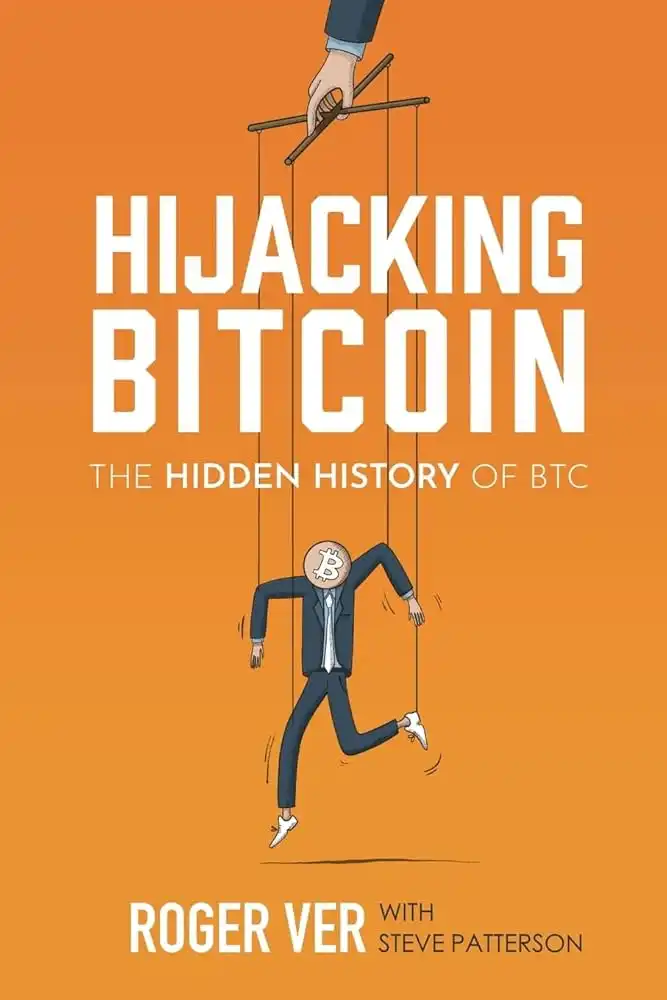
The "Bitcoin Hijacking Theory" believes that Bitcoin has transformed from a "peer-to-peer electronic cash" designed to combat fiat currency hegemony into a speculative asset, deviating from Satoshi Nakamoto's original vision for Bitcoin. It is seen as the deliberate result of various conspiracies (internal business interests, external funding such as Epstein's, and the U.S. government's desire to maintain dollar hegemony), indicating that "Bitcoin's development was not natural and organic. It was supposed to be a currency that people all over the world could finally choose to use freely, but it ended up being dominated by the digital gold narrative."
Roger Ver believes that Bitcoin Core developers' decisions are not independent but influenced by external funding. In 2014-2015, the collapse of the Bitcoin Foundation left Bitcoin Core developers without stable salaries. The Digital Currency Initiative (DCI) at the MIT Media Lab began paying several Bitcoin Core developers, leading Gavin Andresen, Wladimir van der Laan, and Cory Fields, three Bitcoin Core developers, to join the MIT Media Lab.
This information became a hot topic of discussion again due to the recent Epstein files disclosure. However, as early as 2019, when MIT admitted to accepting donations from Epstein, it was already known to the public. Therefore, Roger Ver introduced it into his book, considering it as evidence of external funding influencing Bitcoin's development, even though the developers funded by MIT were unaware that the donations came from Epstein.
He also mentioned another Bitcoin Core developer, Adam Back, leading Blockstream, accepting VC funding from a16z, among others. The mainnet congestion benefited the company's business, and commercial interests also led to Bitcoin being "co-opted," serving the narrative of sidechains/Bitcoin Layer 2.
During the "block size war," Bitcoin Core developers stuck to small blocks, rejecting various scaling proposals. They openly supported and pursued full blocks, high fees, and transaction congestion, considering this a "natural state of market competition," believing it could long-term replace block rewards for miner incentives to maintain network security.
On the other hand, Roger Ver believed this ultimately resulted in slow, expensive, and unreliable Bitcoin transactions, hindering Bitcoin's widespread adoption as a world currency and daily payment tool. He hoped Bitcoin could truly enter the lives of ordinary people, having coffee, buying clothes, watching sports...
"If blocks are always full, it's as absurd as Starbucks intentionally running out of coffee every day. Block space is a consumer good, and miners should meet Bitcoin's real usage needs."
He also pointed out that due to Bitcoin's small block limit, it had to turn to solutions like custodial wallets or the Lightning Network. Bitcoin has become a settlement layer rather than electronic cash. Meanwhile, whether it's custodial wallets or sidechains/Bitcoin Layer 2, ultimately it still forces users to rely on centralized services.
The big block advocates lost the "block size war," and Roger Ver turned to BCH, which later split into BSV and XEC. However, did the small block advocates really "win"? At the time, they believed that large blocks would skyrocket the cost of running a full node, making it increasingly unaffordable for ordinary people to run full nodes, leading to government, mining pool, big company, and data center control over Bitcoin validation rights.
However, many years later, government influence on Bitcoin continues to grow. The envisioned path of "decentralization first, with payments coming later" has not developed ideally. Companies like Valve, Stripe, Dell, Expedia once supported direct Bitcoin payments (without converting to fiat settlement), but eventually withdrew support due to long transaction times, high fees, or low user willingness to use.
Nowadays, hardly anyone is talking about Bitcoin's world currency attributes, and the digital gold narrative has become mainstream.
Then, he went further to mention U.S. government intervention, pointing out that U.S. intelligence agencies were interested in similar technology even before Bitcoin's birth, using NSA's 1996 paper "How to Make a Mint: The Cryptography of Anonymous Electronic Cash" as evidence. The paper describes an anonymous digital currency system similar to Bitcoin, indicating that the U.S. government may have been monitoring or trying to influence Bitcoin's development early on to prevent it from truly threatening the national currency system.
In an interview in 2024, he further stated:
「As early as 2011, we knew that the CIA was interested in Bitcoin because they had reached out to Bitcoin developers for information. When most people hadn't even heard of Bitcoin, the CIA had already started researching it.
But around 2012, a person claiming to be 'John Dylan' alleged to be a member of an intelligence agency and spent over $10,000 (a significant amount) creating propaganda trying to deceive people into believing that keeping the Bitcoin block small would make it more decentralized. This was completely contrary to the truth and to the original design intentions of Bitcoin's creator, Satoshi Nakamoto. The design philosophy and use of Bitcoin were not like that at the beginning. Initially, no one believed this propaganda.
Later on, the Bitcoin community went through a massive censorship wave. Some anonymous individuals took control of all major Bitcoin discussion platforms, and overnight, any advocacy for using Bitcoin as a currency was banned. They censored anyone trying to promote Bitcoin for payments. Initially, people could see through these operations, but as new users joined, they were indoctrinated with these censored ideas.」
Credibility of the 'Bitcoin Hijacking Theory'
Roger Ver, an early influential figure in the crypto industry, began investing in Bitcoin in early 2011. He is the founder of Bitcoin.com, a co-founder of Ripple and Blockchain.com, and an early investor in Kraken. He actively promoted Bitcoin and cryptocurrency-related startups in the early days and was already a millionaire before investing in Bitcoin, yet he still sold his Lamborghini to buy more Bitcoin. Thus, he was dubbed 'Bitcoin Jesus.'
However, since the 'Block Size War,' he has long criticized small block advocates, Bitcoin Core developers, and Blockstream, and has been a staunch supporter of BCH. Therefore, the Bitcoin community's reactions to his statements have almost always been mockery, such as 'Roger is still making excuses for the lost war of 2017; BCH is the real hijacking of Bitcoin.'
It wasn't until 2024 when he published a new book that he first integrated various elements such as the 'Block Size War,' Epstein's funding of Bitcoin Core developers, NSA papers, and potential U.S. government censorship of pro-big block speech into a comprehensive 'Bitcoin Hijacking Theory.'
Approximately 3 weeks after the book was published, he was arrested in Spain for tax evasion, with the U.S. subsequently requesting extradition. The U.S. Department of Justice charged him with selling approximately $240 million in Bitcoin in 2017 without reporting taxes (resulting in at least $48 million in losses to the IRS) and undervaluing Bitcoin assets when renouncing his U.S. citizenship in 2014, including charges of mail fraud, tax evasion, false tax returns, and 8 total charges, facing up to 109 years in prison.
In a subsequent interview, Roger Ver claimed that he was retaliated against only after he exposed the "truth about Bitcoin's hijacking" and the U.S. government's involvement. However, the charges against him were made months before the publication of his book, and the arrest was executed only after the book was released.
In October 2025, he reached a deferred prosecution agreement with the U.S. Department of Justice, paying approximately $49.9 million (taxes + fines + interest), after which the case was dismissed.
In conclusion, he has a stance (supporting big blocks and BCH), and his arrest did not have direct evidence that it was because he "exposed the U.S. government's deliberate effort to turn Bitcoin from a currency into a speculative asset to uphold the dollar's dominance." However, he still perseveres in expressing his views amid the Bitcoin community's lack of understanding and even hostility, unable to erase his contributions in the early days of Bitcoin. More importantly, his view that "Bitcoin deviated from its original positioning, thereby diminishing its own value," has actually gained considerable recognition.
PayPal co-founder Peter Thiel explicitly stated in a recent interview that Bitcoin has deviated from its decentralized and anti-establishment origins. It is no longer a revolutionary tool against the old system but has been "co-opted" by the old system, becoming part of it. Peter Thiel pointed out that FBI agents once told him that they would prefer criminals to use Bitcoin instead of the dollar, indicating that Bitcoin has not achieved its intended anonymity and resistance to censorship but has become a more traceable tool. While Bitcoin ETFs have introduced incremental changes to the market, it does not signify that traditional finance has bowed to cryptocurrency; on the contrary, Bitcoin has been "co-opted" by traditional finance. The liberating technology that aimed to subvert fiat currency has ultimately become a mainstream financial product.
The recent massive disclosures from the Epstein files have caused cognitive and perceptual shocks. These pieces of information were previously inaccessible and unimaginable, so when they are finally unveiled, people shocked and impacted will "retaliate" by expanding their imaginative space.
Roger Ver's "Bitcoin hijacking theory" has started to receive renewed attention and is considered "correct." @miyaspokeofthis even combined Nikolai Mushegian (MakerDAO co-founder, WETH development lead)'s death with Epstein, Tether co-founder Brock Pierce, and the "Bitcoin hijacking theory," crafting a comprehensive article.
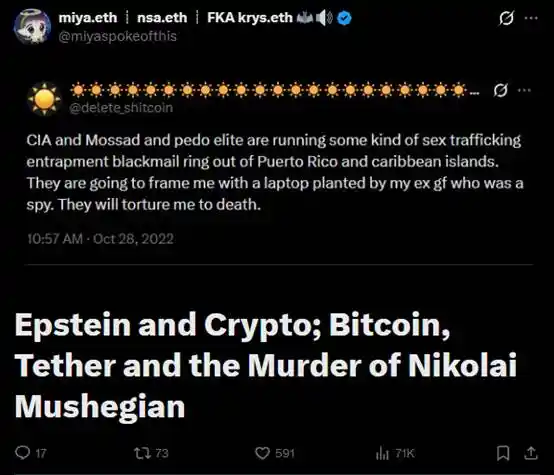
I am unwilling to label all of this as a "conspiracy theory" because when a corner of the iceberg of evil is suddenly exposed to the sunlight, no one can convince themselves, "Human nature is inherently good, and I should not have more doubts."
You may also like

Champion's Final Bow: FC Barcelona vs Real Betis – Celebrate the Title with a Home Finale

Best Oil Trading Platform for Crypto Users in 2026

5 Futures Trading Strategies Smart Traders Use to Cut Crypto Fees and Boost Futures Returns

What Is TradFi? How Crypto Traders Can Now Access Crude Oil, Gold, and Global Markets

How WEEX Bridges Crypto and Football: A Deep Look at the LALIGA Partnership Inside the WEEX App
WEEX is not just a LALIGA sponsor. It’s a true partner. From iPhone Dynamic Island to LALIGA-themed app icons and smart posters, see how WEEX brings football passion into every trade — and builds a real bridge between crypto and sports.

FC Barcelona vs Real Madrid Preview: El Clásico – Can Barça Clinch the Title at Spotify Camp Nou?
FC Barcelona vs Real Madrid El Clásico match preview for May 11, 2026. Barça need just 1 point to win LALIGA. Can Madrid delay the trophy? Full preview inside.

At the Stripe conference, I saw the future of the AI economy

Miners welcome a new life

Seven Important Judgments by Claude Code's Founder at the Sequoia Conference

The payment moment of AI agents: Who will become the Stripe of the machine economy?

Morning Report | MoonPay acquires Solana's execution layer DFlow; Strategy releases Q1 financial report; Manta Network announces the termination of Manta staking program

Rented Tracks: What is this wave of stablecoin FX hot money really paying for?

Dialogue Velocity Eric: What is the stablecoin track that the CFO really wants?

Strategy should have said that selling coins is not ruled out

How MegaETH Achieved a TVL of 700m Within a Week of TGE? Analyzing the Packaging Strategy

Futures Trading Hours: Trade Cryptocurrency 24/7 and Earn Back Up to 45% in Trading Fees
Learn futures trading hours and the best time to trade crypto futures. Discover 24/7 market insights, peak trading sessions, and how to earn back up to 45% in fees.
Why is a16z Crypto raising another $2.2 billion to heavily invest in Web3?
Polymarket Underlying Algorithm Explained
Champion's Final Bow: FC Barcelona vs Real Betis – Celebrate the Title with a Home Finale
Best Oil Trading Platform for Crypto Users in 2026
5 Futures Trading Strategies Smart Traders Use to Cut Crypto Fees and Boost Futures Returns
What Is TradFi? How Crypto Traders Can Now Access Crude Oil, Gold, and Global Markets
How WEEX Bridges Crypto and Football: A Deep Look at the LALIGA Partnership Inside the WEEX App
WEEX is not just a LALIGA sponsor. It’s a true partner. From iPhone Dynamic Island to LALIGA-themed app icons and smart posters, see how WEEX brings football passion into every trade — and builds a real bridge between crypto and sports.
FC Barcelona vs Real Madrid Preview: El Clásico – Can Barça Clinch the Title at Spotify Camp Nou?
FC Barcelona vs Real Madrid El Clásico match preview for May 11, 2026. Barça need just 1 point to win LALIGA. Can Madrid delay the trophy? Full preview inside.

Contents
Popular coins
Latest Crypto News