
 Buy Crypto
- Markets
 Futures
- Spot
- Copy Trade
- Earn
- More
Web3 and DApps in 2026: A Utility-Driven Year for Crypto

Key Takeaways
- The transition to utility in the crypto sector has set a new path for 2026, emphasizing real-world applications over speculative incentives.
- With growing maturity, decentralized applications (DApps) must now compete with Web2 by providing seamless user experiences similar to traditional applications.
- Significant ecosystems like Ethereum and Solana are leveraging their strengths in smart contract development and consumer transactions to push forward.
- Various sectors, including decentralized physical infrastructure networks (DePIN) and creator-focused DApps, are poised to redefine blockchain applications.
WEEX Crypto News, 2025-12-24 14:15:49
As 2026 approaches, the crypto realm stands poised on the brink of transformation. With its infrastructure now mature, the demand has shifted towards decentralized applications (DApps) to manifest tangible utility, attract genuine users sans the allure of incentives, and challenge the existing Web2 applications head-on.
The Dawn of a Utility-Driven Era
Unlike previous cycles characterized by the excitement of decentralized finance (DeFi) surges or non-fungible token (NFT) booms, 2025 set the stage for a pragmatic pivot towards utility. The landscape this year emphasizes grounded development trajectories and technological advancements aimed at fostering real-world applications. DApps, operating on blockchain networks via smart contracts, are enabling users to partake in finance, gaming, and social media with enhanced autonomy over personal data and assets.
Developers in the crypto space have shifted their focus from short-term speculative projects to more sustainable long-term ventures. As reported by Electric Capital, the number of dedicated full-time crypto developers increased by 5% year-on-year, even as the overall count showed a slight dip. This trend highlights a winnowing of speculative participants, leaving behind a core of deeply invested builders who see crypto not as a passing fad, but as a foundational career path.
In the realm of Web3 gaming, developers have identified key factors essential for the success of gaming DApps. Sustainable monetization models, polished gameplay, and infrastructure that underpins consumer spending have become priorities, as highlighted by the Blockchain Gaming Alliance (BGA). The reliance on external giant game developers has decreased as Web3 aims to establish self-sufficient, player-driven economies with interoperability and the integration of artificial intelligence.
Laying the Groundwork for 2026
The year 2025 functioned as a pivotal preparatory phase, focusing on usability and refining the crypto experience. Layer-2 integration paths from the previous year matured into robust groundwork with initiatives aimed at enhancing account abstraction, refining wallet UX, and expanding mobile channels, particularly through ecosystems like Solana’s Saga and The Open Network’s synergy with Telegram.
Regulatory clarity has also improved, with clear frameworks established for stablecoins, custody, and reporting requirements across major jurisdictions like the United States, Europe, and Asia. This development provides much-needed structure and stability, allowing developers to innovate confidently. With the groundwork laid down in 2025, the year 2026 has been earmarked as a decisive test for the relevance and sustainability of DApps. The crucial challenge lies in establishing lasting utility and user retention without resorting to speculative incentives.
Competing with Web2: DApps’ 2026 Challenge
As DApps transition from competing amongst themselves to facing Web2 giants, they face the challenge of replicating the seamless user experiences offered by traditional applications. The barriers that once impeded mass adoption, such as cryptographic complexities and seed phrases, are gradually being dismantled. The introduction of account abstraction promises to offer a more intuitive user experience akin to conventional log-in processes.
Gas sponsorships are emerging as a crucial solution, with applications shouldering transaction costs, thereby enhancing user convenience. Moreover, technological advancements in blockchain networks, such as sub-second finality on Solana and modular rollups on Ethereum, have considerably reduced latency. This technological progress narrows the gap between DApp experiences and traditional Web2 applications.
The integration of artificial intelligence agents capable of interacting with smart contracts is set to revolutionize user interfaces, making them feel more like traditional applications rather than crypto tools. The stark contrast between 2025 and 2026 underscores the industry’s shift towards integrated super apps, providing diverse services—payments, savings, NFTs, and social networking—within a single cohesive interface. This mirrors successful Web2 models like WeChat, offering a multitude of services within a unified ecosystem, simplifying user experiences and enhancing engagement.
Ecosystems Positioned for Success
As 2026 unfolds, certain ecosystems display distinct capabilities, not only in technological advances but also through optimized user distribution channels and real-world applications. Ethereum continues to lead with its robust smart contract capabilities. In 2025, Ethereum’s incremental upgrades focused on enhancing data availability and zero-knowledge proof capabilities, paving the way for efficient and cost-effective settlements.
Solana, on the other hand, distinguishes itself by targeting consumer-centric needs, delivering swift payment processing, in-app microtransactions, and mobile-native experiences that feel quintessentially Web2. TON (The Open Network) showcases unmatched reach, leveraging Telegram’s expansive user base and seamlessly integrated wallet solutions to craft an exceptional distribution channel. This user funnel is crucial for onboarding new users into the crypto ecosystem, making TON’s strategy noteworthy.
Beyond individual chains, emerging thematic sectors such as decentralized physical infrastructure networks (DePIN) are poised to redefine blockchain’s scope. Anchoring crypto to tangible workflows, whether through bandwidth, energy credits, or mobility networks, these networks offer sustainable revenue streams independent of speculative yield farming. According to a World Economic Forum (WEF) report from June 2025, this sector could burgeon to $3.5 trillion by 2028, propelled by blockchain and AI integration.
Meanwhile, creator-focused DApps are transcending NFTs, evolving toward innovative models of ownership, micro-IP rights, music royalties, and monetization driven by fans. The ecosystems best poised for success in 2026 will be those that harmoniously combine distribution prowess, scalability, and clear everyday use cases—not merely those with the fastest networks but those with the most active users.
A Decisive Juncture for Utility in Crypto
Marking the transition from infrastructure buildup to a more discerning phase of evaluation, 2026 stands as a pivotal year for the crypto industry. Having spent years bolstering network robustness, catalyzing security, refining user interfaces, and fortifying regulatory foundations, the industry now shifts focus to usability and real-world value. With consumer-ready infrastructure, the emphasis now falls on product utility over technical prowess.
Whereas 2025 was characterized by intense construction efforts, 2026 is a year of evaluation—where the ultimate measure of success for DApps will be their ability to deliver genuine value and utility. Innovative DApps that emulate everyday applications, offering seamless onboarding and invisible transaction costs, will likely emerge as victor in this crucial confidence test.
With a definitive push towards utility, the world of Web3 and DApps in 2026 promises a landscape rich with potential, encouraging exploration of new avenues and challenging the status quo of traditional applications.
FAQ
What is the primary focus for DApps in 2026?
The primary focus for DApps in 2026 is to establish their utility in real-world scenarios, moving beyond speculative incentives to attract and retain a steady user base by providing genuine and practical applications.
How are Web3 gaming developers redefining success?
Web3 gaming developers are tying success to polished gameplay, sustainable monetization models, and infrastructure that supports consumer spending, rather than relying on the intervention of large traditional game companies.
What advancements are making DApps more user-friendly?
Advancements such as account abstraction, gas sponsorships, and the integration of AI agents capable of interacting with smart contracts are making DApps more user-friendly, mimicking experiences offered by traditional applications.
Which ecosystems are notable in 2026, and why?
Ecosystems like Ethereum, Solana, and TON stand out due to their strong throughput, effective user funnels, and real-world relevance. Additionally, their capabilities in smart contract development and consumer-centric transactions position them well for success.
What are Decentralized Physical Infrastructure Networks (DePIN)?
Decentralized Physical Infrastructure Networks (DePIN) are thematic sectors gaining traction, anchoring crypto to real-world applications such as bandwidth and energy credits, providing sustainable revenue streams aside from speculative yield farming.
You may also like

Uniswap is trapped in an innovation dilemma

What is the key to competition in crypto banking?

The flow of stablecoins and the spillover effects in the foreign exchange market

After two years, Hong Kong's first batch of stablecoin licenses finally issued: HSBC, Standard Chartered make the cut
The person who helped TAO rise by 90% has now single-handedly crashed the price again today

3-Minute Guide to Participating in the SpaceX IPO on Bitget

Top 5 Cryptos to Buy in 2026 Q1: A ChatGPT Deep Dive Analysis
Explore the top 5 cryptos to buy in Q1 2026 including BTC, ETH, SOL, TAO, and ONDO. See price outlooks, key narratives, and institutional catalysts shaping the next market move.

How to Earn $15,000 with Idle USDT Before Altcoin Season 2026
Wondering if altcoin season is coming in 2026? Get the latest market update, and learn how to turn your idle stablecoins waiting for entry into extra rewards up to 15,000 USDT.
Can You Win Joker Returns Without Large Trading Volume? 5 Mistakes New Players Make In WEEX Joker Returns Season 2
Can small traders win WEEX Joker Returns 2026 without huge volume? Yes—if you avoid these 5 costly mistakes. Learn how to maximize card draws, use Jokers wisely, and turn small deposits into 15,000 USDT rewards.

Altcoin Season 2026: 4 Stages to Profit (Before the Crowd FOMO In)
Altcoin Season 2026 is starting — discover the 4 key stages of capital rotation (from ETH to PEPE) and how to position before the peak. Learn which tokens will lead each phase and avoid missing the rally.

Will Alt season come in 2026? 5 Tips to Spot the Next 100x Crypto Opportunities
Will altcoin season arrive in 2026? Discover 5 rotation stages, early signals smart traders watch, and the key crypto sectors where the next 100x altcoin opportunities may emerge.

The bear market has arrived, and cryptocurrency ETF issuers are also getting involved

The richest man had a quarrel with his former boss
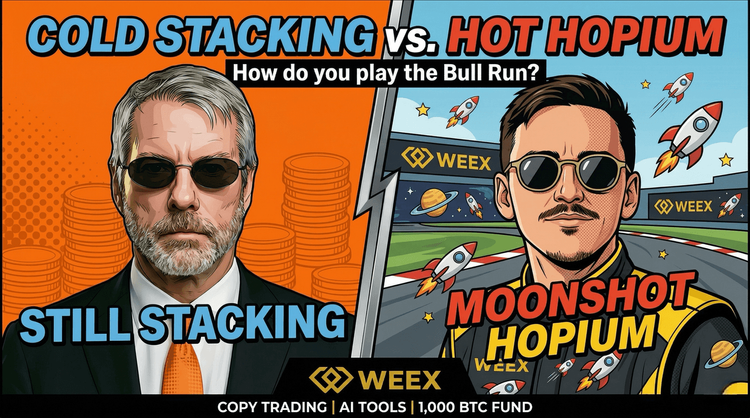
BTC Firm Above 70K! Saylor’s "Institutional Logic" vs. Moon’s "Retail Faith": Who is Really Harvesting the Market?
Bitcoin is holding firm above the $70,000 support level following a massive short squeeze that liquidated $427 million. As the "Four-Year Cycle" narrative shifts, the market is split: Michael Saylor’s cold, institutional "indiscriminate stacking" vs. Carl Moon’s high-energy retail "hopium." This article decodes these two polar-opposite strategies for the 2026 bull run and reveals how WEEX’s institutional-grade liquidity and AI trading tools empower every type of investor to convert market volatility into profit.

The Girl Who Created the SBTI Test: A Story of a Doomed Cyber Love, an E-Widow Ratfolk

B.AI Officially Launched: Building AI Agent Financial Bedrock Platform, Driving AGI Era Business Underlying Logic

B.AI Officially Launched: Breaking Down A2A Collaboration Barriers to Unlock the Smart Body Economy's Full Potential


 App
App