
U-Coin Strategy: A Deep Dive into the "Earn while HODL" Strategy Using CEX Staking and DeFi Yield Farming

Source: Gate.io
1. Centralized Exchange (CEX): Beginner-Friendly "Brain-off Investment" Scheme
Using Binance, OKEx, Gate.io, and Bitget (as of February 28):
Binance: The real-time annual interest rate for USDT single-asset staking is currently 2.4%, with Tier 1 (0-500 USDT) at 7% and Tier 2 (500-5000 USDT) with an additional 2% bonus, estimating an annual interest rate between 1.9% to 9.4%;
· The real-time annual interest rate for USDC single-asset staking is currently 1.63%, with Tier 1 (0-500 USDC) at 10% and Tier 2 (500-10,000 USDC) with a 3% bonus, estimating an annual interest rate of 11.62%;
· The real-time annual interest rate for FDUSD single-asset staking is currently 1.43%, with Tier 1 (0-400 FDUSD) at 8%, with a minimum investment of 0.1.
OKEx: The real-time annual interest rate for USDT single-asset staking is currently 5%, and the USDC single-asset staking is also at 5%, with a minimum investment of 0.01.
Gate.io: The real-time annual interest rate for USDT single-asset staking is currently 3.96%, with an additional 10% bonus in the form of $GT tokens. The tiered annual interest rate varies with the number of days staked, currently at 2.89% for 3 days, 3.42% for 7 days, and 3.68% for 14 days, with a minimum investment of 1; USDC single-asset staking is currently at 5%, with a minimum investment of 1.5.
Bitget: The real-time annual interest rate for USDT single-asset staking is currently 5.96%, with an additional 8% bonus for deposits within 0-500 USDT.
CEX product operations are simple and offer flexible access, making them beginner-friendly. Binance/OKEx offer similar rates for their flexible products, while Gate.io provides a 3.9% annualized return for USDT staking plus a 10% bonus in the platform's token GT.
2. On-chain Lending: The "Fixed Deposit" of the DeFi World
For mainstream on-chain lending (as of February 28), the base interest rates are as follows:
Ethereum
· Aave V3: USDT 3.48%; USDC 3.93%; DAI 4.75%;
· Compound V3: USDT 4.53%; USDC 4.48%;
· Yearn Finance: USDT 4.56%; USDC 4.36%; DAI 10.38%;
· Uniswap V3: USDC-USDT LP 19.01%; DAI-USDT LP 19.13%;
· Morpho Aave: USDT 7.21%; USDC 5.02%;
· Flux Finance: USDT 4.79%; USDC 4.89%;
· Fluid Lending USDT 4.34%; USDC 4.30%;
· Spark: USDT 5.53%; USDC 4.77%; DAI 5.91%;
Solana
· Kamino Lend: USDT 2.88%; USDC 5.28%;
· NX Finance: USDT 10.85%; USDC 7.45%;
· Pluto: USDC 6.19%;
· Vaultka: USDT 20.83%; USDC 16.34%
· Francium: USDT 16.49%.
BSC
· Venus Core Pool: USDT 4.83%; USDC 5.85%;
· Wing Finance: USDC 5.92%
Base
· Aerodrome Slipstream: USDT 8.12%;
· Morpho Blue: USDC 5.47%;
· AAVE V3: USDC 4.23%
· Fluid Lending: USDC 2.35%;
Note: The above data is sourced from DefiLlama, as of February 28th.
3. Advanced Player Session: Deconstructing Yield as "Financial Lego"
Pendle: Yield Rate Tokenization
Pendle is a decentralized protocol that allows users to split their assets into principal and yield-bearing tokens to enhance yield.
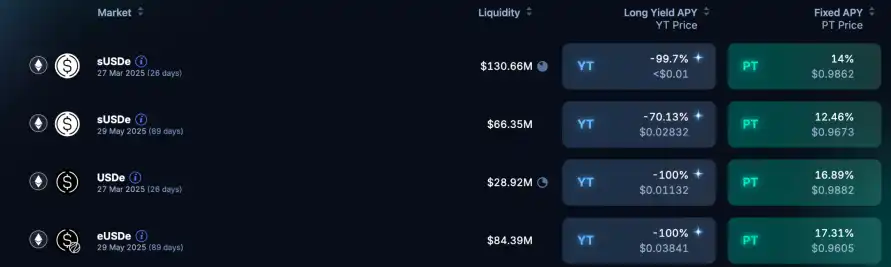
Through Pendle, users can split assets (such as stablecoins) into two parts: Ownership Token (OT) and Yield Token (YT) and trade them independently. For example, by depositing sUSD in Pendle's Yield Token pool (YT), one receives Yield Token (PT). Upon maturity, PT can be redeemed back to sUSD at a 1:1 ratio, with an annualized yield of approximately 14%. Similarly, using USDC can yield around 16.89% APY.
Usual: RWA Yield Capturer
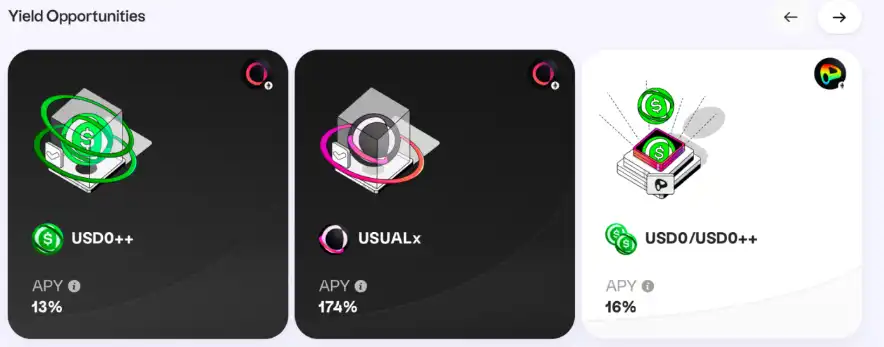
Usual is a decentralized fiat-backed stablecoin issuer that integrates growingly tokenized real-world assets (RWA) like Belvedere, Ondo, Mountain Protocol, M0, Hashnote, etc., into a permissionless, on-chain verifiable, and composable stablecoin USD0.
Users can deposit USDC/USDT and receive USD0 at a 1:1 ratio. The current APY ranges from 13% to 17%, relatively stable based on market conditions.
Solayer: Ecosystem Bonus Aggregator
Solayer combines USDC and the Solana chain, offering users a dual-benefit opportunity. Users can earn rewards by depositing USDC while participating in other promising projects within the Solana ecosystem, multi-pooling, with the current APY around 4%.
4. Author's Practical Configuration: Asset Pyramid from Defense to Offense
In the crypto field, risk management is key. To ensure investment diversification, below is a personal stablecoin strategy for reference only, without any investment advice.
Defense Layer (50% of Funds)
CEX Instant Liquidity Backstop: Binance/OKX on-demand liquidity pools to address sudden liquidity needs
On-chain Safety Net: Solana ecosystem projects like NX Finance (USDT 10.85%) and Pluto (USDC 6.19%), focusing on both yield and airdrop expectations.
Offense Layer (30% of Funds)
Yield Combo: Pendle protocol internal allocation with YT:OT = 7:3, with 60% in the USDe pool and 40% in the eUSDe pool, balancing dynamic interest rate fluctuations risk.
Exploration Layer (20% of Funds)
Blind Mining: Small fund participation in new protocol liquidity mining, with a single-project allocation not exceeding 5% of the total position.
This article is a contributed submission and does not represent the views of BlockBeats.
You may also like

How much longer can Ethereum's last big buyer hold on?

The pricing controversy of Trade.xyz exposes the fatal weakness of Pre-IPO perpetual contracts

World Cup 2026 Coming – WEEX Celebrates with $1M Prize Pool & Michael Owen Live

Galaxy in-depth report: Is Solana still worth paying attention to?
Young people in South Korea make a "final effort" in the epic bull market

Dialogue with OmenX Founder: Why does the prediction market need an evolution from "spot" to "derivatives"?
When the P2P illicit funds from ten years ago turned into 60,000 bitcoins

Morning News | CME Group launches Nasdaq Cryptocurrency Index futures; Asset management giant Janus Henderson strategically invests in Ethena
Why did Oracle deliver the strongest financial report in history, yet its stock price fell?

Bitcoin Layer 2 Network Botanix: Why Did We Choose to Dissolve?

Morning Report | OpenAI has submitted an S-1 registration statement draft to the U.S. SEC; Morpho completes $175 million financing

Galaxy Deep Research Report: How Hyperliquid's HIP-4 Upgrade Changes the Landscape of Prediction Markets?

Latest research from 13 top universities including Cornell University: The current state, challenges, and misconceptions of the fusion of Crypto and AI
Deconstructing Anthropic: The Best AI Company, Possibly Also a Type of Organizational Invention

Every exchange is a "Universal Exchange."

The counterattack of traditional finance: Alliance chains are quietly reviving
Pantera Capital Partner: How Tokenization is Restructuring the Private Equity and Early Investment Ecosystem?

Mastercard Launches Agent Pay for AI, Plans to Record AI Agent Payment Authorizations on Polygon
Mastercard launched Agent Pay for AI, a new payment protocol designed to help AI agents make small payments such as pay-per-use access to data and APIs. The system plans to record human-granted AI agent permissions on Polygon, focusing on verifiable authorization, identity, and payment controls.
How much longer can Ethereum's last big buyer hold on?
The pricing controversy of Trade.xyz exposes the fatal weakness of Pre-IPO perpetual contracts
World Cup 2026 Coming – WEEX Celebrates with $1M Prize Pool & Michael Owen Live
Galaxy in-depth report: Is Solana still worth paying attention to?
Young people in South Korea make a "final effort" in the epic bull market
Dialogue with OmenX Founder: Why does the prediction market need an evolution from "spot" to "derivatives"?


