
- Buy Crypto
- Markets
 Futures
- Spot
- Copy Trade
 Earn
Earn- More
The Trump Family Project WLFI Sells Off ETH at a Loss of Millions, How Many Chips Does It Still Hold?

Original Article Title: "The Behind-the-Scenes of WLFI's ETH Dump: Stop Loss or Another Scheme?"
Original Article Author: Luke, Mars Finance
On April 9, 2025, a wallet allegedly linked to World Liberty Financial (WLFI) dumped 5,471 ETH at an average price of $1,465, cashing out approximately $8.01 million. This was no small matter—this wallet had previously splurged $210 million to accumulate 67,498 ETH at an average price of $3,259, now facing an unrealized loss of $125 million. As a DeFi star project endorsed by the Trump family, WLFI's move is puzzling: why liquidate at this critical moment? How much more ETH can be sold? Will there be more dumps in the future?
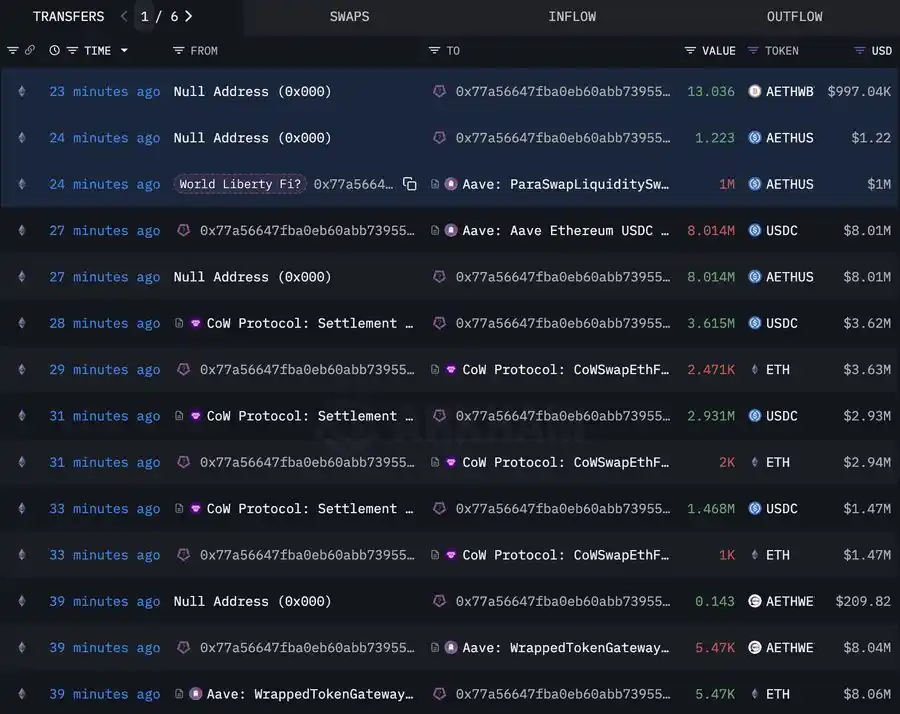
A Tough Decision in the Chilling Market
Currently, the crypto market seems to be shrouded in cold air, with ETH price fluctuating between $1,465 and $1,503, more than halving from WLFI's purchase price. Looking back to the beginning of 2025, the optimism brought by Trump's inauguration had prompted WLFI to significantly increase its ETH holdings, seemingly attempting to soar with the policy tailwind. Unfortunately, the good times did not last long, and the continued slump of ETH turned this enthusiasm into a massive $125 million unrealized loss. From $89 million in March to $125 million now, the snowball of losses keeps growing.
The timing of the sell-off is intriguing. On the same day, a whale scooped up 4,677 ETH at $1,481, intensifying the market's long vs. short game. WLFI's decision to act at this moment may indicate a sense of a short-term bottom or a fear of further price decline. Regardless, this $8.01 million cash-out is like selling an old coat in the winter—it's reluctant but inevitable.
Why Sell: Stop Loss or Another Plan?
Why did WLFI cut losses at this point? The answer may not be simple.
Firstly, the logic of stop-loss is obvious. With each ETH dropping by $1,794, selling 5,471 ETH may incur a near-million-dollar loss, but it's better than watching the remaining 62,027 ETH continue to depreciate. It's like cutting off a "deadbeat stock" in the stock market, securing cash first. After all, if fully liquidated at the current price, the loss would almost hit $111 million—who can bear that?
Furthermore, the pressure on cash flow cannot be ignored. WLFI basked in the glory of a $590 million token sale for a while, but expenses for operations, partnerships, and new projects will not stop. While $8.01 million may not be a lot, it can provide relief in a market downturn. Just think, a project backed by the Trump family surely cannot let its wallet run dry, right?
Moreover, this may be an attempt at a strategic pivot. WLFI's asset pool contains not only ETH but also "veterans" like WBTC, TRX, and "rising stars" in the RWA space. By reducing ETH holdings, freeing up funds to invest in partners like Ondo Finance or betting on the potential of Layer 2 could be a way to prepare for the future. After all, the stage of DeFi is large, and ETH is just one of the players.
Lastly, don't forget about external perception. As the "favorite son" of the Trump family, WLFI shines with prestige but also carries controversy. With 75% of profits in the whitepaper going to the family while risks are shifted to token holders, this model has long raised suspicions. Could this sell-off be due to investor pressure to prove that they are not solely relying on the "celebrity effect" to thrive? It's unlikely, but not entirely unreasonable.
Overall, stop-losses and liquidity are the most immediate driving forces, while strategic adjustments may hint at what's to come. As for external pressures, perhaps they are just the background music of this drama.
How Much More Can Be Sold: Trump Card and Bottom Line
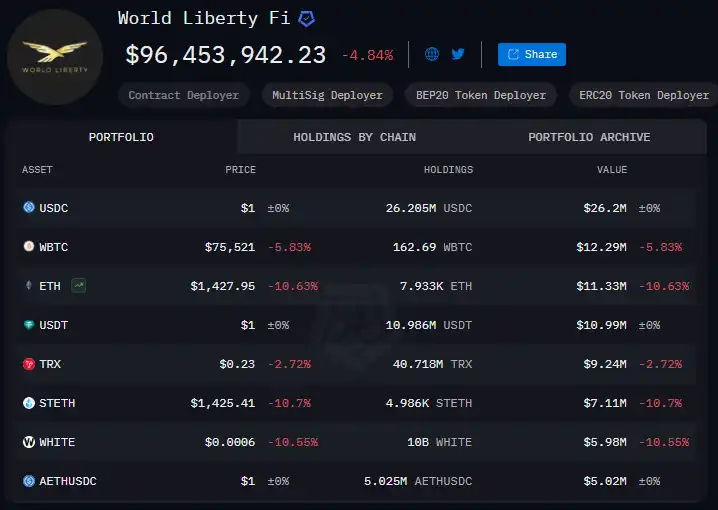
After selling 5,471 tokens, WLFI still holds 62,027 ETH, which is worth approximately $90.9 million at the current price. How much more can this trump card reveal?
From a funding perspective, if each sale targets around $8 million in cash flow, selling another approximately 5,000 tokens would suffice, leaving a "safety net" of $56 million in holdings. However, if there is a larger funding gap, such as for a new project launch or debt maturity, selling a few tens of thousands of tokens is not out of the question. However, doing this would undoubtedly raise doubts about ETH's core position.
The market's ability to handle this is also crucial. The recent $8.01 million sale did not cause much of a stir, and the daily trading volume of ETH at $5 billion seems able to absorb it. But if WLFI were to dump tens of millions of dollars' worth of assets in one go, panic could further drive down prices. For precaution, selling in small batches appears to be their style.
Much more crucial is the strategic bottom line. WLFI views ETH as a "strategic reserve," and if holdings drop below half (around 33.74 million tokens), its image as a DeFi leader may be at risk. Unless absolutely necessary, they are unlikely to easily deplete this reserve. In the short term, selling another 5,000 to 10,000 tokens (approximately $7.3 million to $14.65 million) is a reasonable estimate, both quenching thirst and avoiding harm.
Will the Sell-off Continue?
In the future, will WLFI continue to sell off? The answer lies within three key clues.
First, watch the market sentiment. If ETH drops below $1,400 and the unrealized losses increase by another one or two hundred million, the urge to sell off may be unstoppable. However, if the price rebounds to $1,800, and unrealized losses shrink to $90 million, they might hold onto their assets tightly, even regaining confidence to buy back. Currently, the $1,450 support level and $1,600 resistance level serve as indicators.
Second, internal calculations are also crucial. If WLFI still aims to play a leading role in the DeFi space, they cannot afford to see ETH's position heavily impacted. In this case, the sell-off may gradually slow down. However, if they set their sights on other trends, such as RWA or emerging tokens, ETH may become a "cash machine," accelerating the sell-off pace.
Third, external factors matter. The pro-crypto stance of the Trump administration acts as a shield for WLFI. If a significant move is made in the second quarter leading to market recovery, they might sit comfortably on the sidelines. Yet, if the family is caught up in political turmoil or investors demand transparency, the pressure to cash out will be inevitable.
In the short term (one to two months), there is a possibility of small-scale sell-offs, with the total amount ranging from $10 to $20 million. If the market continues to slump, a mid-term sell-off could account for 30% to 50% of the remaining holdings, totaling $27 to $45 million. Looking ahead, unless ETH stages a complete turnaround, WLFI may gradually fade from this field, moving their chips to a new battleground.
Ethereum Fundamental Transition: Why Are Whales Turning Bearish?
In recent years, Ethereum's fundamentals seem to be undergoing a quiet transition, which may be a crucial reason why whales are becoming pessimistic about ETH's future. Glassnode data shows that over the past four years, Ethereum's active address count has remained almost stagnant, hovering around the same level, failing to significantly grow alongside market trends. This is not the "efficiency range" of technical optimization but rather resembles a depletion of growth momentum, indicating Ethereum's fatigue in attracting new users and developers.
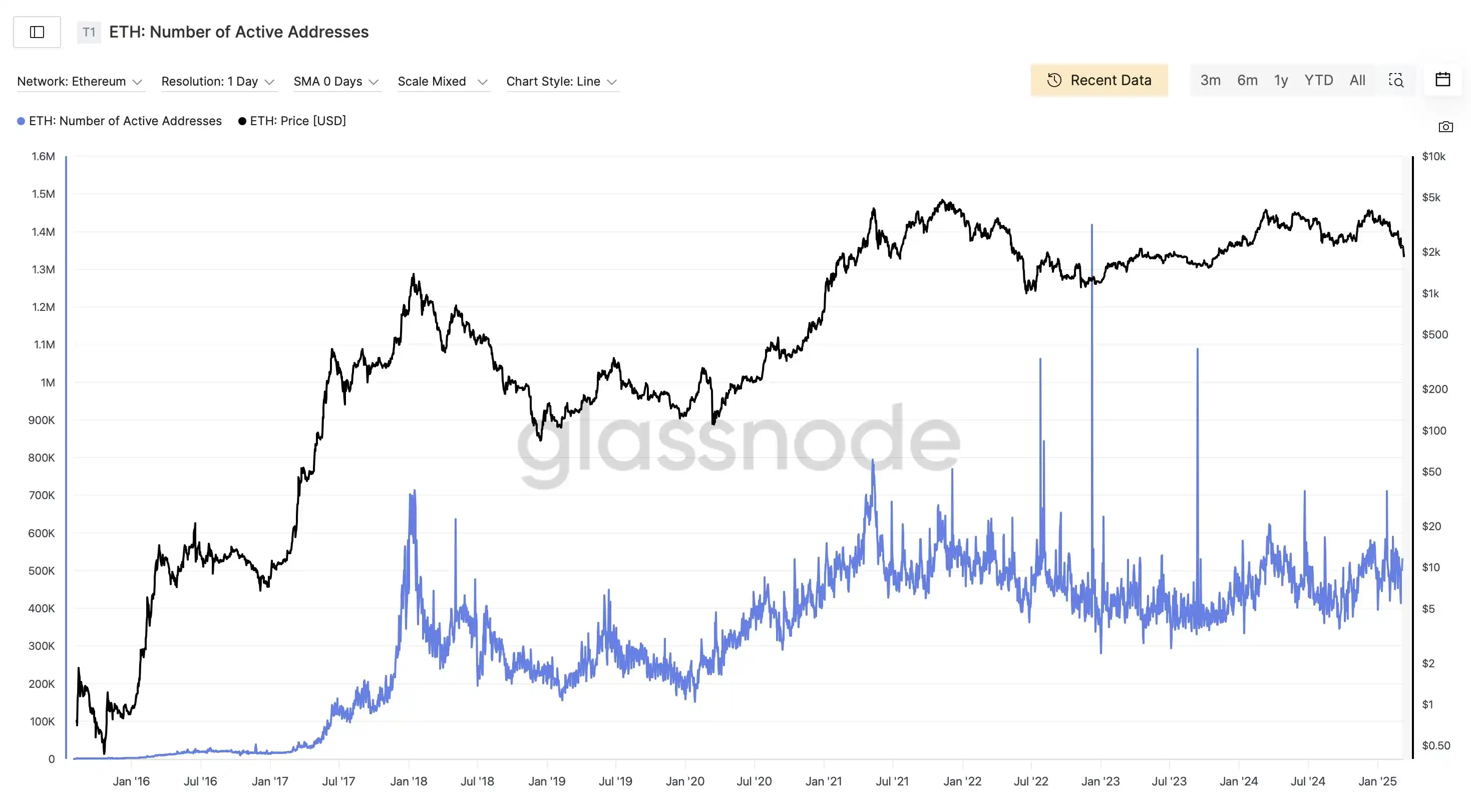
Meanwhile, the emergence of Layer 2 (L2) solutions was supposed to bring new vitality to Ethereum but unexpectedly weakened its value capture ability. L2 significantly reduced mainnet Gas fees by diverting transaction volume (Gas fees dropped over 70% in March 2025). While this is user-friendly, it allows L2 to intercept the value that was supposed to be fed back to ETH holders through the EIP-1559 burning mechanism, further squeezing Ethereum's "profit space." Some analyses suggest that unless the mainnet can revitalize its demand for block space through large-scale tokenization, Ethereum's long-term competitiveness may be at risk.
The perspective of institutions also reflects this concern. In a report, CoinShares pointed out that the frequent adjustments to the Ethereum protocol (such as the Dencun hard fork) have brought about uncertainty, hindering institutional investors from building reliable valuation models, thereby diminishing its attractiveness. In March 2025, Standard Chartered lowered its price target for Ethereum in 2025 to $4,000, citing structural decay as the reason.
Jon Charbonneau, Co-Founder of the crypto investment firm DBA, also stated that Ethereum's issuance model under the Proof of Stake (PoS) mechanism faces fundamental trade-off issues, with adjustment being difficult to resolve the core contradiction. On the X platform, some users even bluntly said that Ethereum has "barely changed since 2016," with upgrades being slow and missing the window for rapid transformation, seemingly becoming a "victim" of its own success.
Meanwhile, EigenLayer's Stakedrop event also left the market disappointed, as the narrative of enhancing ETH holding rewards through Restaking was shattered due to unfair distribution, further undermining the confidence of large holders. These signals collectively point to a reality: Ethereum's fundamentals are being eroded by internal and external factors, with its once growth engine now showing signs of fatigue, and the pessimism of large holders may indeed be a direct response to this trend.
Summary
This sell-off event not only revealed WLFI's struggle in the market downturn but also highlighted Ethereum's deeper predicament. The stagnant growth of active addresses, L2 value diversion, signals of institutional pessimism, all contribute to casting a shadow over Ethereum's fundamentals, with the confidence of large holders wavering. WLFI's next move, whether to continue selling or strategically pivot, will unfold in the dual game of markets and policies.
For investors, while chasing the hype may be enticing, a more composed judgment is needed: Can Ethereum's future be revitalized? Where will WLFI's bold gamble lead? The answer, perhaps, can only be revealed with time.
You may also like

February 9th Market Key Intelligence, How Much Did You Miss?

After being questioned by Vitalik, L2s are collectively saying goodbye to the "cheap" era

WEEX AI Trading Hackathon Paris Workshop Reveals: How Retail Crypto Traders Can Outperform Hedge Funds
Witness how WEEX's Paris AI Trading Hackathon revealed AI's edge over human traders. Explore key strategies, live competition results & how to build your own AI trading bot.

U.S. Oil (USOR) Price Prediction 2026–2030
Key Takeaways U.S. Oil (USOR) is a speculative Solana-based crypto project that aims to index the United States…

USOR Surges on Meme Narrative Despite No Real-World Asset Backing
Key Takeaways: USOR, a Solana-based token, has seen a notable surge driven by speculative narratives rather than verifiable…

How to Buy U.S. Oil Reserve (USOR) Cryptocurrency
Key Takeaways U.S. Oil Reserve (USOR) is a Solana-based token primarily traded on decentralized exchanges (DEXs). Claims have…

USOR vs Oil ETFs: Understanding Why the ‘Oil Reserve’ Token Doesn’t Track Crude Prices
Key Takeaways The U.S. Oil Reserve (USOR) token has become noteworthy for its claims, yet it does not…

Trend Research Reduces Ether Holdings After Major Market Turbulence
Key Takeaways: Trend Research has significantly cut down its Ether holdings, moving over 404,000 ETH to exchanges recently.…
Investors Channel $258M into Crypto Startups Despite $2 Trillion Market Sell-Off
Key Takeaways: Investors pumped approximately $258 million into crypto startups in early February, highlighting continued support for blockchain-related…
NBA Star Giannis Antetokounmpo Becomes Shareholder in Prediction Market Kalshi
Key Takeaways: Giannis Antetokounmpo, the NBA’s two-time MVP, invests in the prediction market platform Kalshi as a shareholder.…

Arizona Home Invasion Targets $66 Million in Cryptocurrency: Two Teens Charged
Key Takeaways Two teenagers from California face serious felony charges for allegedly attempting to steal $66 million in…

El Salvador’s Bukele Approval Reaches Record 91.9% Despite Limited Bitcoin Use
Key Takeaways: El Salvador President Nayib Bukele enjoys a record high approval rating of 91.9% from his populace,…

Crypto Price Prediction for February 6: XRP, Dogecoin, and Shiba Inu’s Market Movements
Key Takeaways: The crypto market experienced a notable shift with Bitcoin’s significant surge, impacting altcoins like XRP, Dogecoin,…

China Restricts Unapproved Yuan-Pegged Stablecoins to Maintain Currency Stability
Key Takeaways: China’s central bank and seven government agencies have banned the issuance of yuan-pegged stablecoins abroad without…

Solana Price Prediction: $80 SOL Looks Scary – But Smart Money Just Signaled This Might Be the Bottom
Key Takeaways Despite Solana’s descent to $80, some traders find security as smart money enters the fray, suggesting…

XRP Price Prediction: Major Ledger Upgrade Quietly Activated – Why This Could Be the Most Bullish Signal Yet
Key Takeaways: The activation of the Permissioned Domains amendment on XRPL represents a significant development in XRP’s potential…

Dogecoin Price Prediction: Death Cross Confirmed as DOGE Falls Below $0.10 – Is DOGE Reaching Zero?
Key Takeaways The death cross event signals potential bearish trends for Dogecoin as its price dips under $0.10,…

Stablecoin Inflows Have Doubled to $98B Amid Selling Pressure
Key Takeaways Stablecoin inflows to crypto exchanges have surged to $98 billion, doubling previous levels amidst heightened market…
February 9th Market Key Intelligence, How Much Did You Miss?
After being questioned by Vitalik, L2s are collectively saying goodbye to the "cheap" era
WEEX AI Trading Hackathon Paris Workshop Reveals: How Retail Crypto Traders Can Outperform Hedge Funds
Witness how WEEX's Paris AI Trading Hackathon revealed AI's edge over human traders. Explore key strategies, live competition results & how to build your own AI trading bot.
U.S. Oil (USOR) Price Prediction 2026–2030
Key Takeaways U.S. Oil (USOR) is a speculative Solana-based crypto project that aims to index the United States…
USOR Surges on Meme Narrative Despite No Real-World Asset Backing
Key Takeaways: USOR, a Solana-based token, has seen a notable surge driven by speculative narratives rather than verifiable…
How to Buy U.S. Oil Reserve (USOR) Cryptocurrency
Key Takeaways U.S. Oil Reserve (USOR) is a Solana-based token primarily traded on decentralized exchanges (DEXs). Claims have…


 App
App