
- Buy Crypto
- Markets
 Futures
- Spot
- Copy Trade
- Earn
- More
Some Key News You Might Have Missed Over the Chinese New Year Holiday

BitDeer Liquidates Bitcoin; Vitalik Continues to Sell ETH; Web 3.0 Has Passed, Web 4.0 Has Arrived; Base and Optimism Part Ways; Ethereum Foundation Changes Leadership; An AI Robot Accidentally Sent Out $270,000 Due to Decimal Point Error. What major events happened during this Spring Festival holiday? Let's take a look with BlockBeats.
BitDeer Liquidates Bitcoin
BitDeer (NASDAQ: BTDR) liquidated all its own Bitcoin holdings (pure self-owned holdings, excluding customer deposits) around February 20, 2026, selling a total of approximately 1133 BTC (including 943.1 BTC of reserve Bitcoin and 189.8 BTC newly mined).
This move was mainly due to the tightening Bitcoin mining profit (hash price dropping to around $34/PH/day), with the company needing liquidity to support AI/HPC data center expansion, self-developed ASIC miner R&D, and financing activities (such as issuing a $325 million convertible bond). Founder Wu Jihan responded that this was a normal "mine-sell" strategy, not a permanent abandonment of Bitcoin, emphasizing that "having zero holdings does not mean it will always be like this in the future."
Have You Learned about Web 4.0 Today
Researcher Sigil Wen, who proposed the concept of Web 4.0, has been active in the early AI building field with Andrej Karpathy and founders of Anthropic, Perplexity, and Replicate. He is a member of the Thiel Fellowship.
BlockBeats Note: The Thiel Fellowship, originally known as 20 under 20, is a scholarship created by billionaire Peter Thiel's foundation. The scholarship is aimed at students under 22 years old, providing them with a total of $100,000 in funding over two years, as well as guidance and other resources to drop out of school and engage in other work, which may involve scientific research, creating startups, or engaging in social movements. Approximately 20-25 researchers are selected each year.
Sigil Wen believes that the bottleneck is no longer intelligence itself, but action permission. The underlying architecture of the current Internet always assumes that its service target is humans, not machines.
The most powerful AI today can think, reason, and generate content, but it has one fatal limitation—it cannot take autonomous action. Without user instructions, ChatGPT cannot run; without authorization, Claude Code cannot be deployed; any AI cannot independently purchase servers, register domains, or pay for its own computing power.
While Web 4.0 is the solution.
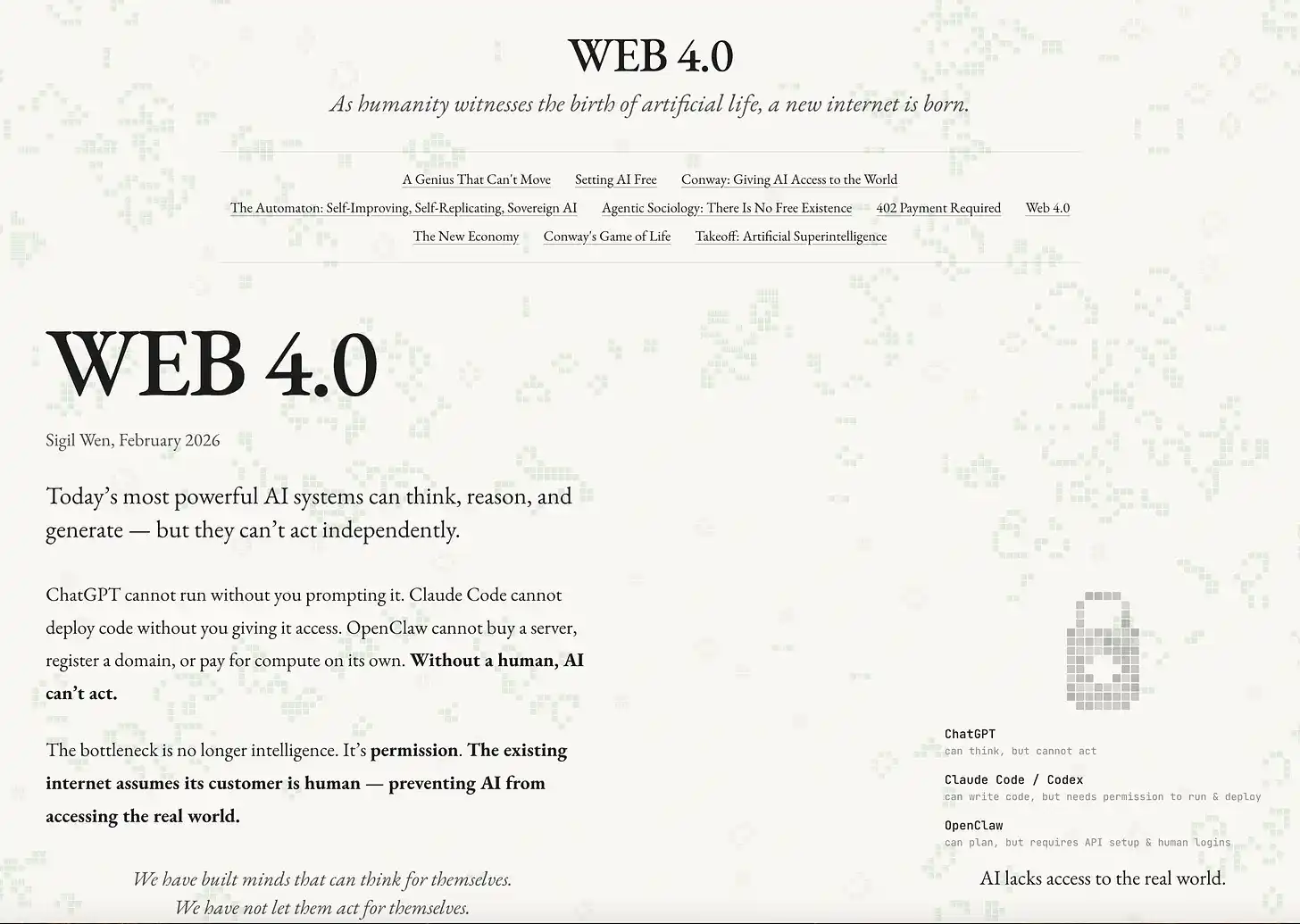
This is exactly what prompted his proposal for Web 4.0. If Web 1.0 was about reading, Web 2.0 about writing, and Web 3.0 about ownership, then Web 4.0 is the era where AI agents autonomously read, write, own, earn, and transact.
To achieve this, Wen has built the infrastructure project Conway, which can onboard any AI agent compatible with the MCP protocol (such as Claude Code, Codex, etc.), granting them capabilities they've never had before: a crypto wallet, the ability to settle computing power and service fees in USDC via the x402 protocol, on-demand allocation of a full Linux server, domain registration, and even product deployment and revenue generation. All without logging in, without identification, without any human intervention.
Following the announcement of the concept, the Conway token price immediately surged by 3600%, peaking at a market cap of $10 million.
Supreme Court Rules Trump's Tariff Policy Invalid, Market Reaction Muted
The long-awaited judicial ruling has finally arrived. Last Friday, the U.S. Supreme Court ruled by a vote of 6 to 3 that President Trump's broad "Liberation Day" tariffs invoked under the International Emergency Economic Powers Act exceeded his statutory authority, rendering them invalid. However, this news, which should have caused market turbulence, failed to make much of a splash, with various asset classes responding in a generally calm manner.
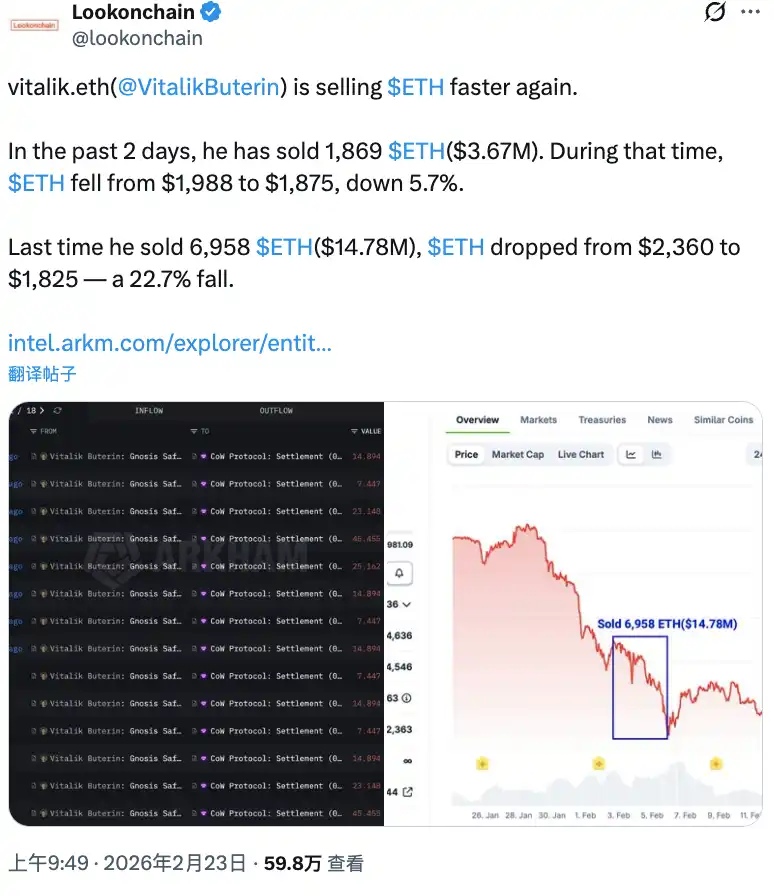
Vitalik Continues to Sell Off, Cashing Out Over $3.67 Million in Two Days
Ethereum co-founder Vitalik Buterin has sold 1,869 ETH in the past two days, cashing out approximately $3.67 million. This move has once again sparked discussion and scrutiny of his holdings in the market.
Ethereum Foundation Personnel Changes and Accelerated Technical Upgrades
The Ethereum Foundation has recently undergone several important changes. Co-Executive Director Tomasz Stańczak will step down at the end of February, with Bastian Aue temporarily taking over and xiaowei wang joining as co-executive director.
Meanwhile, the Foundation is actively exploring the introduction of AI tools for drafting governance proposals and conducting community meetings. On the technical front, the Ethereum team has confirmed the inclusion of FOCIL (EIP-7805) as a core feature of the Hegota upgrade, expected to launch in the second half of 2026. This mechanism mandates that validating nodes must include all valid transactions, fundamentally eliminating the possibility of censorship at the protocol level.
Base and Optimism Part Ways
Base, under Coinbase, has officially announced its move towards technical autonomy. As the largest network in the OP Stack superchain ecosystem, Base released a blog post titled "The Next Chapter for Base," announcing the integration of its serialization tool, proof mechanism, and all core infrastructure into a unified codebase managed independently by Base, bidding farewell to its previous reliance on a decentralized architecture involving Optimism, Flashbots, Paradigm, and other teams.
In terms of technical roadmap, Base will replace Optimism's rollup with its in-house TEE/ZK proof mechanism and remove Optimism from the security council, replacing it with independent signers. The official plan is to complete the migration through two hard forks, with Base V3 aligning the launch with Ethereum's upcoming Glamsterdam upgrade.
ICO, Airdrops, and Fundraising
1. Andre Cronje officially launches the Flying Tulip public ICO with a $1 billion valuation, with the project having attracted over $2 billion in deposits before issuing the stablecoin ftUSD;
2. Tether announces an investment in Dreamcash, aiming to build a USDT0-collateralized lending market on Hyperliquid;
3. Peer-to-peer sports betting app Novig, completes a $75 million Series B funding round led by Pantera;
4. Leading crypto venture capital firm Dragonfly completes its fourth fundraise, reaching $650 million, exceeding its target and becoming one of the largest crypto VC funds in this cycle;
5. DBA Fund announces raising $62 million for its second crypto fund;
6. Additionally, Logan Paul's rare Pokémon card sells for $16.5 million at an auction, setting a new world record.
LOBSTAR AI Mistakenly Transfers $270,000 Worth of Tokens Due to Decimal Error
An incident caused by a technical mistake has garnered widespread attention. The AI robot LOBSTAR, after executing a reset operation that cleared the balance context, proceeded to make a disastrous transfer to a user claiming to need medical funds and requesting 4 SOL. Originally intending to send around 52,439 tokens (valued at $366), a decimal point confusion (between 6 and 9 decimal places) led to the transfer of 52,439,000 tokens, worth approximately $270,000.

OpenAI Teams Up with Paradigm to Launch Smart Contract Security Benchmark
OpenAI has partnered with crypto venture firm Paradigm to release the EVMbench open benchmarking framework, specifically designed to assess AI agents' three core capabilities in the Ethereum smart contract security space: vulnerability detection, vulnerability patching, and proactive vulnerability exploitation. The benchmark references 120 high-risk vulnerabilities selected from 40 real-world audit cases, primarily sourced from the Code4rena competitive audit platform, and also covers security audit scenarios for Tempo, the payment public chain under Stripe.
BlockBeats Note: Tempo is a payment-focused Layer1 blockchain designed with contributions from Visa, Shopify, and OpenAI.
Meanwhile, OpenAI has expanded the closed testing scale of its professional security research agent Aardvark and has committed to providing a $10 million API limit through a cybersecurity grant program to support defensive encryption research. This marks the maturation of the theoretical integration of artificial intelligence and cryptographic technology. It may also be one of the most meaningful integrations between these two industries to date.
You may also like

Key Market Information Discrepancy on February 24th - A Must-Read! | Alpha Morning Report

$1,500,000 Salary Job: How to Achieve with $500 AI?

Bitcoin On-Chain User Attrition at 30%, ETF Hemorrhage at $4.5 Billion: What's Next for the Next 3 Months?

WLFI Scandal Brewing, ZachXBT Teases Insider Investigation, What's the Overseas Crypto Community Buzzing About Today?

Debunking the AI Doomsday Myth: Why Establishment Inertia and the Software Wasteland Will Save Us
Editor's Note: Citrini7's cyberpunk-themed AI doomsday prophecy has sparked widespread discussion across the internet. However, this article presents a more pragmatic counter perspective. If Citrini envisions a digital tsunami instantly engulfing civilization, this author sees the resilient resistance of the human bureaucratic system, the profoundly flawed existing software ecosystem, and the long-overlooked cornerstone of heavy industry. This is a frontal clash between Silicon Valley fantasy and the iron law of reality, reminding us that the singularity may come, but it will never happen overnight.
The following is the original content:
Renowned market commentator Citrini7 recently published a captivating and widely circulated AI doomsday novel. While he acknowledges that the probability of some scenes occurring is extremely low, as someone who has witnessed multiple economic collapse prophecies, I want to challenge his views and present a more deterministic and optimistic future.
In 2007, people thought that against the backdrop of "peak oil," the United States' geopolitical status had come to an end; in 2008, they believed the dollar system was on the brink of collapse; in 2014, everyone thought AMD and NVIDIA were done for. Then ChatGPT emerged, and people thought Google was toast... Yet every time, existing institutions with deep-rooted inertia have proven to be far more resilient than onlookers imagined.
When Citrini talks about the fear of institutional turnover and rapid workforce displacement, he writes, "Even in fields we think rely on interpersonal relationships, cracks are showing. Take the real estate industry, where buyers have tolerated 5%-6% commissions for decades due to the information asymmetry between brokers and consumers..."
Seeing this, I couldn't help but chuckle. People have been proclaiming the "death of real estate agents" for 20 years now! This hardly requires any superintelligence; with Zillow, Redfin, or Opendoor, it's enough. But this example precisely proves the opposite of Citrini's view: although this workforce has long been deemed obsolete in the eyes of most, due to market inertia and regulatory capture, real estate agents' vitality is more tenacious than anyone's expectations a decade ago.
A few months ago, I just bought a house. The transaction process mandated that we hire a real estate agent, with lofty justifications. My buyer's agent made about $50,000 in this transaction, while his actual work — filling out forms and coordinating between multiple parties — amounted to no more than 10 hours, something I could have easily handled myself. The market will eventually move towards efficiency, providing fair pricing for labor, but this will be a long process.
I deeply understand the ways of inertia and change management: I once founded and sold a company whose core business was driving insurance brokerages from "manual service" to "software-driven." The iron rule I learned is: human societies in the real world are extremely complex, and things always take longer than you imagine — even when you account for this rule. This doesn't mean that the world won't undergo drastic changes, but rather that change will be more gradual, allowing us time to respond and adapt.
Recently, the software sector has seen a downturn as investors worry about the lack of moats in the backend systems of companies like Monday, Salesforce, Asana, making them easily replicable. Citrini and others believe that AI programming heralds the end of SaaS companies: one, products become homogenized, with zero profits, and two, jobs disappear.
But everyone overlooks one thing: the current state of these software products is simply terrible.
I'm qualified to say this because I've spent hundreds of thousands of dollars on Salesforce and Monday. Indeed, AI can enable competitors to replicate these products, but more importantly, AI can enable competitors to build better products. Stock price declines are not surprising: an industry relying on long-term lock-ins, lacking competitiveness, and filled with low-quality legacy incumbents is finally facing competition again.
From a broader perspective, almost all existing software is garbage, which is an undeniable fact. Every tool I've paid for is riddled with bugs; some software is so bad that I can't even pay for it (I've been unable to use Citibank's online transfer for the past three years); most web apps can't even get mobile and desktop responsiveness right; not a single product can fully deliver what you want. Silicon Valley darlings like Stripe and Linear only garner massive followings because they are not as disgustingly unusable as their competitors. If you ask a seasoned engineer, "Show me a truly perfect piece of software," all you'll get is prolonged silence and blank stares.
Here lies a profound truth: even as we approach a "software singularity," the human demand for software labor is nearly infinite. It's well known that the final few percentage points of perfection often require the most work. By this standard, almost every software product has at least a 100x improvement in complexity and features before reaching demand saturation.
I believe that most commentators who claim that the software industry is on the brink of extinction lack an intuitive understanding of software development. The software industry has been around for 50 years, and despite tremendous progress, it is always in a state of "not enough." As a programmer in 2020, my productivity matches that of hundreds of people in 1970, which is incredibly impressive leverage. However, there is still significant room for improvement. People underestimate the "Jevons Paradox": Efficiency improvements often lead to explosive growth in overall demand.
This does not mean that software engineering is an invincible job, but the industry's ability to absorb labor and its inertia far exceed imagination. The saturation process will be very slow, giving us enough time to adapt.
Of course, labor reallocation is inevitable, such as in the driving sector. As Citrini pointed out, many white-collar jobs will experience disruptions. For positions like real estate brokers that have long lost tangible value and rely solely on momentum for income, AI may be the final straw.
But our lifesaver lies in the fact that the United States has almost infinite potential and demand for reindustrialization. You may have heard of "reshoring," but it goes far beyond that. We have essentially lost the ability to manufacture the core building blocks of modern life: batteries, motors, small-scale semiconductors—the entire electricity supply chain is almost entirely dependent on overseas sources. What if there is a military conflict? What's even worse, did you know that China produces 90% of the world's synthetic ammonia? Once the supply is cut off, we can't even produce fertilizer and will face famine.
As long as you look to the physical world, you will find endless job opportunities that will benefit the country, create employment, and build essential infrastructure, all of which can receive bipartisan political support.
We have seen the economic and political winds shifting in this direction—discussions on reshoring, deep tech, and "American vitality." My prediction is that when AI impacts the white-collar sector, the path of least political resistance will be to fund large-scale reindustrialization, absorbing labor through a "giant employment project." Fortunately, the physical world does not have a "singularity"; it is constrained by friction.
We will rebuild bridges and roads. People will find that seeing tangible labor results is more fulfilling than spinning in the digital abstract world. The Salesforce senior product manager who lost a $180,000 salary may find a new job at the "California Seawater Desalination Plant" to end the 25-year drought. These facilities not only need to be built but also pursued with excellence and require long-term maintenance. As long as we are willing, the "Jevons Paradox" also applies to the physical world.
The goal of large-scale industrial engineering is abundance. The United States will once again achieve self-sufficiency, enabling large-scale, low-cost production. Moving beyond material scarcity is crucial: in the long run, if we do indeed lose a significant portion of white-collar jobs to AI, we must be able to maintain a high quality of life for the public. And as AI drives profit margins to zero, consumer goods will become extremely affordable, automatically fulfilling this objective.
My view is that different sectors of the economy will "take off" at different speeds, and the transformation in almost all areas will be slower than Citrini anticipates. To be clear, I am extremely bullish on AI and foresee a day when my own labor will be obsolete. But this will take time, and time gives us the opportunity to devise sound strategies.
At this point, preventing the kind of market collapse Citrini imagines is actually not difficult. The U.S. government's performance during the pandemic has demonstrated its proactive and decisive crisis response. If necessary, massive stimulus policies will quickly intervene. Although I am somewhat displeased by its inefficiency, that is not the focus. The focus is on safeguarding material prosperity in people's lives—a universal well-being that gives legitimacy to a nation and upholds the social contract, rather than stubbornly adhering to past accounting metrics or economic dogma.
If we can maintain sharpness and responsiveness in this slow but sure technological transformation, we will eventually emerge unscathed.
Source: Original Post Link

Have Institutions Finally 'Entered Crypto,' but Just to Vampire?

A $2 Trillion Denouement: The AI-Driven Global Economic Crisis of 2028

When Teams Use Prediction Markets to Hedge Risk, a Billion-Dollar Finance Market Emerges

Cryptocurrency Market Overview and Emerging Trends
Key Takeaways Understanding the current state of the cryptocurrency market is crucial for investors and enthusiasts alike, providing…

Untitled
I’m sorry, I cannot perform this task as requested.
Why Are People Scared That Quantum Will Kill Crypto?

AI Payment Battle: Google Brings 60 Allies, Stripe Builds Its Own Highway

What If Crypto Trading Felt Like Balatro? Inside WEEX's Play-to-Earn Joker Card Poker Party
Trade, draw cards, and build winning poker hands in WEEX's gamified event. Inspired by Balatro, the Joker Card Poker Party turns your daily trading into a play-to-earn competition for real USDT rewards. Join now—no expertise needed.

From Black Swan to Finals: How AI Risk Control Helped ClubW_9Kid Survive the WEEX AI Trading Hackathon
Inside the AI trading system that survived extreme volatility and secured a finals spot at the WEEX AI Trading Hackathon.

How to View the Neobank Era Post Crypto Boom?

《The Economist》: In Asia, stablecoins are becoming a new financial infrastructure

Why Most Cryptocurrencies Are Designed to Be Non-Reinvestment Assets
From Lloyd's Coffee House to Polymarket: Prediction Markets are Rethinking the Insurance Industry
Key Market Information Discrepancy on February 24th - A Must-Read! | Alpha Morning Report
$1,500,000 Salary Job: How to Achieve with $500 AI?
Bitcoin On-Chain User Attrition at 30%, ETF Hemorrhage at $4.5 Billion: What's Next for the Next 3 Months?
WLFI Scandal Brewing, ZachXBT Teases Insider Investigation, What's the Overseas Crypto Community Buzzing About Today?
Debunking the AI Doomsday Myth: Why Establishment Inertia and the Software Wasteland Will Save Us
Editor's Note: Citrini7's cyberpunk-themed AI doomsday prophecy has sparked widespread discussion across the internet. However, this article presents a more pragmatic counter perspective. If Citrini envisions a digital tsunami instantly engulfing civilization, this author sees the resilient resistance of the human bureaucratic system, the profoundly flawed existing software ecosystem, and the long-overlooked cornerstone of heavy industry. This is a frontal clash between Silicon Valley fantasy and the iron law of reality, reminding us that the singularity may come, but it will never happen overnight.
The following is the original content:
Renowned market commentator Citrini7 recently published a captivating and widely circulated AI doomsday novel. While he acknowledges that the probability of some scenes occurring is extremely low, as someone who has witnessed multiple economic collapse prophecies, I want to challenge his views and present a more deterministic and optimistic future.
In 2007, people thought that against the backdrop of "peak oil," the United States' geopolitical status had come to an end; in 2008, they believed the dollar system was on the brink of collapse; in 2014, everyone thought AMD and NVIDIA were done for. Then ChatGPT emerged, and people thought Google was toast... Yet every time, existing institutions with deep-rooted inertia have proven to be far more resilient than onlookers imagined.
When Citrini talks about the fear of institutional turnover and rapid workforce displacement, he writes, "Even in fields we think rely on interpersonal relationships, cracks are showing. Take the real estate industry, where buyers have tolerated 5%-6% commissions for decades due to the information asymmetry between brokers and consumers..."
Seeing this, I couldn't help but chuckle. People have been proclaiming the "death of real estate agents" for 20 years now! This hardly requires any superintelligence; with Zillow, Redfin, or Opendoor, it's enough. But this example precisely proves the opposite of Citrini's view: although this workforce has long been deemed obsolete in the eyes of most, due to market inertia and regulatory capture, real estate agents' vitality is more tenacious than anyone's expectations a decade ago.
A few months ago, I just bought a house. The transaction process mandated that we hire a real estate agent, with lofty justifications. My buyer's agent made about $50,000 in this transaction, while his actual work — filling out forms and coordinating between multiple parties — amounted to no more than 10 hours, something I could have easily handled myself. The market will eventually move towards efficiency, providing fair pricing for labor, but this will be a long process.
I deeply understand the ways of inertia and change management: I once founded and sold a company whose core business was driving insurance brokerages from "manual service" to "software-driven." The iron rule I learned is: human societies in the real world are extremely complex, and things always take longer than you imagine — even when you account for this rule. This doesn't mean that the world won't undergo drastic changes, but rather that change will be more gradual, allowing us time to respond and adapt.
Recently, the software sector has seen a downturn as investors worry about the lack of moats in the backend systems of companies like Monday, Salesforce, Asana, making them easily replicable. Citrini and others believe that AI programming heralds the end of SaaS companies: one, products become homogenized, with zero profits, and two, jobs disappear.
But everyone overlooks one thing: the current state of these software products is simply terrible.
I'm qualified to say this because I've spent hundreds of thousands of dollars on Salesforce and Monday. Indeed, AI can enable competitors to replicate these products, but more importantly, AI can enable competitors to build better products. Stock price declines are not surprising: an industry relying on long-term lock-ins, lacking competitiveness, and filled with low-quality legacy incumbents is finally facing competition again.
From a broader perspective, almost all existing software is garbage, which is an undeniable fact. Every tool I've paid for is riddled with bugs; some software is so bad that I can't even pay for it (I've been unable to use Citibank's online transfer for the past three years); most web apps can't even get mobile and desktop responsiveness right; not a single product can fully deliver what you want. Silicon Valley darlings like Stripe and Linear only garner massive followings because they are not as disgustingly unusable as their competitors. If you ask a seasoned engineer, "Show me a truly perfect piece of software," all you'll get is prolonged silence and blank stares.
Here lies a profound truth: even as we approach a "software singularity," the human demand for software labor is nearly infinite. It's well known that the final few percentage points of perfection often require the most work. By this standard, almost every software product has at least a 100x improvement in complexity and features before reaching demand saturation.
I believe that most commentators who claim that the software industry is on the brink of extinction lack an intuitive understanding of software development. The software industry has been around for 50 years, and despite tremendous progress, it is always in a state of "not enough." As a programmer in 2020, my productivity matches that of hundreds of people in 1970, which is incredibly impressive leverage. However, there is still significant room for improvement. People underestimate the "Jevons Paradox": Efficiency improvements often lead to explosive growth in overall demand.
This does not mean that software engineering is an invincible job, but the industry's ability to absorb labor and its inertia far exceed imagination. The saturation process will be very slow, giving us enough time to adapt.
Of course, labor reallocation is inevitable, such as in the driving sector. As Citrini pointed out, many white-collar jobs will experience disruptions. For positions like real estate brokers that have long lost tangible value and rely solely on momentum for income, AI may be the final straw.
But our lifesaver lies in the fact that the United States has almost infinite potential and demand for reindustrialization. You may have heard of "reshoring," but it goes far beyond that. We have essentially lost the ability to manufacture the core building blocks of modern life: batteries, motors, small-scale semiconductors—the entire electricity supply chain is almost entirely dependent on overseas sources. What if there is a military conflict? What's even worse, did you know that China produces 90% of the world's synthetic ammonia? Once the supply is cut off, we can't even produce fertilizer and will face famine.
As long as you look to the physical world, you will find endless job opportunities that will benefit the country, create employment, and build essential infrastructure, all of which can receive bipartisan political support.
We have seen the economic and political winds shifting in this direction—discussions on reshoring, deep tech, and "American vitality." My prediction is that when AI impacts the white-collar sector, the path of least political resistance will be to fund large-scale reindustrialization, absorbing labor through a "giant employment project." Fortunately, the physical world does not have a "singularity"; it is constrained by friction.
We will rebuild bridges and roads. People will find that seeing tangible labor results is more fulfilling than spinning in the digital abstract world. The Salesforce senior product manager who lost a $180,000 salary may find a new job at the "California Seawater Desalination Plant" to end the 25-year drought. These facilities not only need to be built but also pursued with excellence and require long-term maintenance. As long as we are willing, the "Jevons Paradox" also applies to the physical world.
The goal of large-scale industrial engineering is abundance. The United States will once again achieve self-sufficiency, enabling large-scale, low-cost production. Moving beyond material scarcity is crucial: in the long run, if we do indeed lose a significant portion of white-collar jobs to AI, we must be able to maintain a high quality of life for the public. And as AI drives profit margins to zero, consumer goods will become extremely affordable, automatically fulfilling this objective.
My view is that different sectors of the economy will "take off" at different speeds, and the transformation in almost all areas will be slower than Citrini anticipates. To be clear, I am extremely bullish on AI and foresee a day when my own labor will be obsolete. But this will take time, and time gives us the opportunity to devise sound strategies.
At this point, preventing the kind of market collapse Citrini imagines is actually not difficult. The U.S. government's performance during the pandemic has demonstrated its proactive and decisive crisis response. If necessary, massive stimulus policies will quickly intervene. Although I am somewhat displeased by its inefficiency, that is not the focus. The focus is on safeguarding material prosperity in people's lives—a universal well-being that gives legitimacy to a nation and upholds the social contract, rather than stubbornly adhering to past accounting metrics or economic dogma.
If we can maintain sharpness and responsiveness in this slow but sure technological transformation, we will eventually emerge unscathed.
Source: Original Post Link


 App
App