
 Buy Crypto
- Markets
 Futures
- Spot
- Copy Trade
- Earn
- More
Solv Origin: Establishes "Three-Step" Strategy to Propel the Bitcoin Financial Ecosystem into a Trillion-Dollar Industry

Original Author: RyanChow
“Only Bitcoin Never Disappoints.”
The 16-year history of the Crypto industry is the history of Bitcoin's value being continuously reinterpreted, driving the industry to new heights. In each of the four cycles so far, there have been people claiming that Bitcoin lacks innovation and cannot represent the cutting-edge trend of the industry, and each cycle has seen people predict that some new entrant will replace or even surpass Bitcoin. However, at the end of each cycle, it is Bitcoin that, with its spirit of restraint, focus, and elegant simplicity, continues to inspire new products and models, shattering the ice of conservatism and skepticism, steadfastly and dramatically expanding the territory of crypto, leading the industry and market's major trends.
The reason Bitcoin has always stood strong is precisely because it carries the value attribute of "digital hard money," has the most robust global consensus, and is actively participating in the global financial system in a more positive manner. Therefore, in an industry that pursues ultimate innovation, Bitcoin is instead the most stable and long-lasting "mainstay."
Today, Bitcoin's innovation wave is entering a brand new acceleration phase. The financialization revolution driven by Bitcoin is quietly taking shape, and the rise of Bitcoin Finance represents a new trend where Bitcoin is evolving from a passive store of value asset to deeper financial applications. Solv is committed to standing at the forefront of this trend, driving Bitcoin Finance to grow into a trillion-dollar decentralized financial infrastructure, empowering a broader range of users and ecosystem development.
Retracing the Development Journey of Bitcoin Finance: From the Fringe to the Mainstream
The rise of BTCFi did not happen overnight but has undergone an evolution through three key stages, gradually transitioning from an edge exploration to a mainstream narrative.
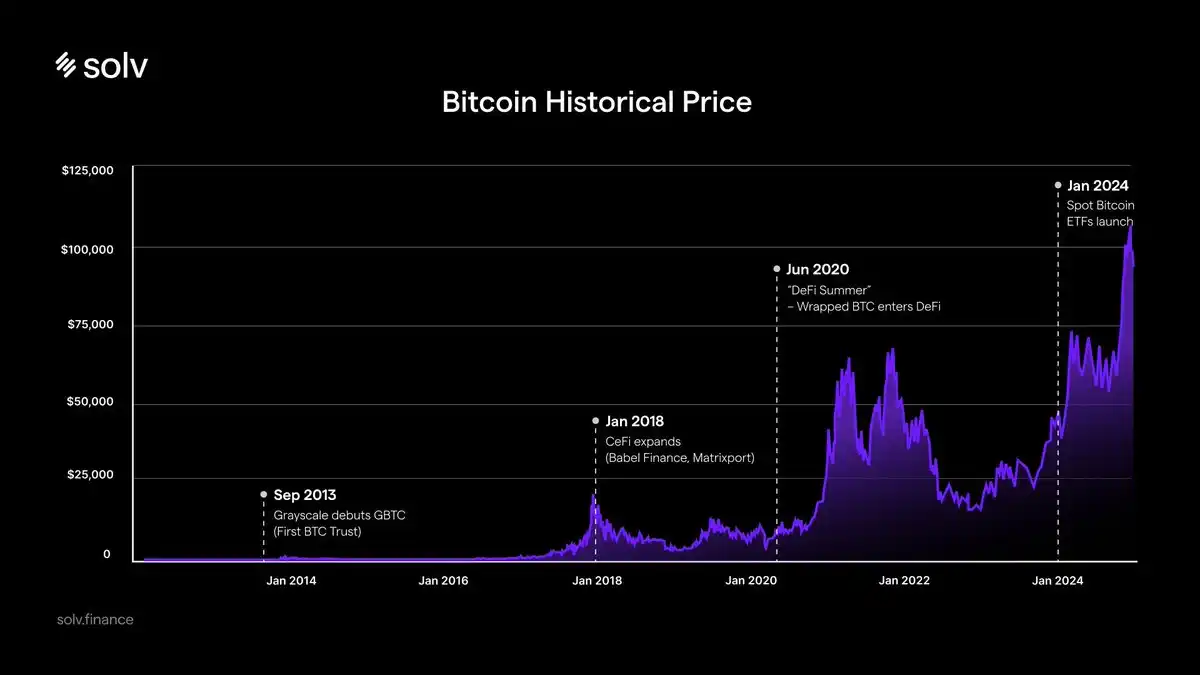
The First Wave of TradFi Integrating Bitcoin in Early Exploration (2013 to Present): In September 2013, DCG created the Grayscale Bitcoin Trust Fund (GBTC). Essentially, this is a Bitcoin custody and securitization service, primarily intended to connect with the operational system familiar to traditional institutions, significantly reducing the barrier for investors to enter the BTC market. The premium/discount mechanism of GBTC and its arbitrage opportunities further stimulated institutional demand for BTC. The long journey from GBTC to BTC ETF reflects the ongoing game between regulation and innovation, marking the gradual acceptance of Bitcoin by traditional finance. The practice in this wave turned BTCFi into a small narrative of hundreds of millions of dollars in 2018 and took the first steps in establishing its presence.
The Second Wave: The Rise and Challenge of CeFi (2018-present): During the 2017-2018 bull market, centralized platforms such as exchanges quickly rose to prominence, with the financial needs of early BTC holders (especially miners) playing a significant role. Not only did major exchanges engage in various BTCFi businesses, but specialized BTCFi service platforms such as PayPal, Matrixport, and Genesis also emerged. These platforms offered services such as collateralized lending and hedging to meet the needs of miners and institutions, driving the financialization of BTC. Although the 2022 CeFi crisis dealt a heavy blow to the CeFi ecosystem, it also prompted industry-wide reflection, strengthened risk management and regulatory compliance, and elevated BTCFi to a multi-billion-dollar mid-size track.
The Third Wave: The Innovation and Potential of DeFi (2020-present): The "DeFi Summer" of 2020 was the most impactful event in the crypto industry following Bitcoin and Ethereum. DeFi introduced a new paradigm for creating and operating financial services, offering a significant amount of creative space. Due to the functional limitations of Bitcoin's script language, most functionally complex DeFi protocols are built on smart contract blockchains such as Ethereum. However, given Bitcoin's significant user base, the DeFi community has been working to bring BTC value into the DeFi ecosystem, leading to the emergence of services like WBTC and renBTC. The higher transparency, ease of operation, and richer yield opportunities in DeFi attracted many users. DeFi's composability also brought new possibilities to BTCFi, such as decentralized lending and derivative trading based on BTC.
By 2024, the practices of these three waves of BTCFi overlapped and resonated with each other, driving explosive growth in BTCFi and transforming it into a multi-billion-dollar track amidst significant favorable external changes.
So, can BTCFi continue to grow and evolve into a trillion-dollar market? This requires us to understand the driving forces behind the 2024 BTCFi explosion.
The Explosive Growth of BTCFi: Overlapping Resonance of Three Forces
The explosive growth of BTCFi in 2024 is actually the result of the overlapping resonance of TradFi, CeFi, and DeFi. This growth is not accidental but rather the result of long-term evolution and accumulation in multiple areas, driven by market demand, technological innovation, and ecosystem expansion.
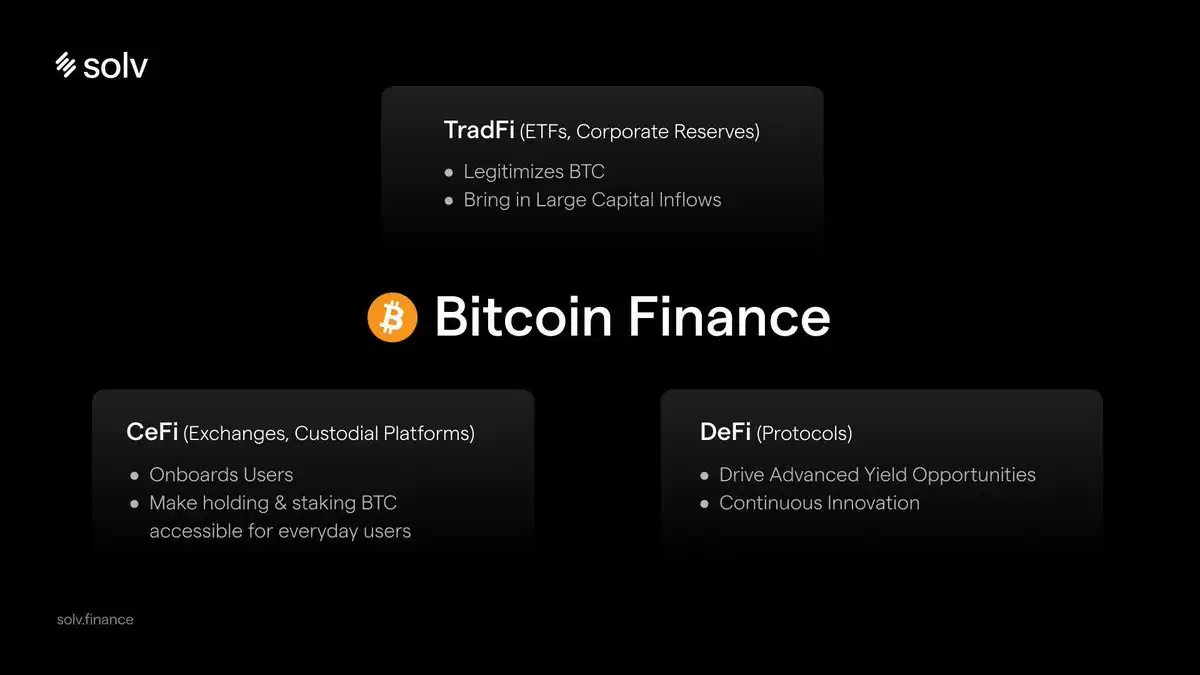
First, the Driving Force Behind DeFi Expansion.
In 2023, the crypto market rebounded from the low of 2022, injecting new vitality into the entire industry. The DeFi community, as a core force of crypto innovation, naturally hoped to quickly recover the growth momentum that was interrupted by the market crash. However, at this stage, the primary resources and scenarios in the Ethereum ecosystem had already been fully developed, and the DeFi community urgently needed to find a new direction for growth. Faced with greater liquidity demands and a more diverse asset base, the value of BTC began to be reevaluated. As the cryptocurrency with the largest market capitalization, Bitcoin possesses an unparalleled asset scale and market foundation. Its transparent, censorship-resistant nature aligns closely with the core principles of DeFi, making it a key pillar for the next stage of DeFi expansion.
Financial innovation around BTC began to advance at a faster pace. From early Bitcoin wrapped assets like WBTC, renBTC, to decentralized lending combined with Layer 2 scaling solutions, and further to Staking and liquidity pools integrated with BTC, the application scenarios of BTC in DeFi gradually became richer. Meanwhile, the trend of BRC20, BRC420, and other on-chain innovations also attracted a significant amount of user attention. These users hoped to more efficiently integrate the value of Bitcoin into these emerging areas. It is this market demand that has driven the continuous expansion of BTC in the DeFi field, laying a solid foundation for its rapid growth.
Furthermore, the advantages of DeFi in transparency and efficiency further magnified the appeal of BTCFi. Users not only enjoy more convenient and flexible financial services but also have access to high-yield opportunities related to BTC in a decentralized manner. The composability between DeFi protocols has also brought greater innovation space, allowing developers to create new derivative trading, lending protocols, and yield optimization tools based on BTC. These innovations have synergistically fueled the explosion of BTCFi.
Second, the Demand for CeFi Asset Activation.
CeFi platforms have played a significant role in the rise of BTCFi, with their unique user base and platform advantages providing powerful momentum for the financialization of Bitcoin. Exchanges and professional financial service platforms have rapidly promoted BTCFi in the CeFi field through the activation of platform assets and innovative financial products.
Firstly, CeFi platforms introduced Bitcoin to more application scenarios by issuing Wrapped BTC (such as Binance's BTCB and Coinbase's wrapped BTC products). These Wrapped BTC assets have increased the liquidity and usability of Bitcoin in other blockchain ecosystems, thereby activating a large amount of deposited assets on CeFi platforms. This mechanism not only increases the utilization of Bitcoin but also provides users with more investment choices and profit opportunities, effectively enhancing user participation and platform stickiness.
Secondly, CeFi platforms are also constantly exploring new BTC financial products and services to meet the growing market demand. From the early days of BTC-backed lending services to the current more complex derivative trading, yield optimization products, and structured financial solutions, CeFi platforms are continuously enriching their service offerings, providing personalized BTC financial solutions to individual and institutional investors. These products not only meet the diverse needs of miners, long-term holders, and institutional investors but also lower the entry barriers for retail users.
Additionally, improvements in compliance and risk management on CeFi platforms have further enhanced their attractiveness to users. Particularly, following the market crisis of 2022, the industry's focus on transparency and security significantly increased. CeFi platforms regained users' trust through stricter audits and robust operations. This trust has laid a solid foundation for the long-term growth of the platform's BTCFi business.
Through asset activation and innovative products, CeFi platforms have successfully propelled the financialization of Bitcoin to new heights, contributing significantly to the explosive growth of BTCFi.
Thirdly, TradFi's Soaring Progress.
TradFi has played a pioneering and key role in driving the development of BTCFi. From the approval of BTC ETFs to MicroStrategy's large-scale Bitcoin holdings, the continued advancement of traditional financial institutions and enterprises has provided strong endorsement for the financialization of Bitcoin, attracting more institutional investors into the market.
The successful approval of the 2024 BTC ETF was a milestone event. The launch of the ETF significantly lowered the barrier for traditional institutions and individual investors to access Bitcoin, allowing more investors to include Bitcoin in their portfolios through a compliant, secure, and convenient manner. This not only brought more liquidity to the market but also enhanced the acceptance of Bitcoin as an asset class, further solidifying BTC's position in the global financial system. The success of the ETF also laid the foundation for BTCFi's development, such as driving the launch of more BTC-based financial products like options, futures, and fixed income products.
MicroStrategy's demonstration effect triggered corporate interest in Bitcoin asset allocation. Since 2020, MicroStrategy has treated Bitcoin as its strategic reserve asset, not only enhancing the company's asset return but also gaining widespread market attention through this decision. MicroStrategy's successful case has inspired other traditional enterprises to follow suit, attracting more funds into the BTC market. This corporate participation has injected new momentum into BTCFi's market expansion and innovation.
Looking ahead, the possibility of BTC being included in a country's strategic reserve assets has further expanded the market's imagination. If major global economies like the United States officially include Bitcoin in their strategic reserves, it will not only ignite market enthusiasm but also potentially completely transform Bitcoin's global positioning, shifting it from "digital gold" to a "global strategic asset." This transformation will open up new development paths for BTCFi, attract a wider range of institutional investors, and spark more complex and diverse financial services innovation.
In 2024, these three forces converged and resonated, propelling BTCFi to a billion-dollar scale. So, what will be the next journey for BTCFi?
Redefining Solv: The Key Bridge Connecting the Tri-Force of BTCFi
Established in 2020, Solv Protocol initially focused on infrastructure innovation for digital bonds and on-chain funds. However, with the rapid rise of BTCFi, Solv has gradually evolved into a key player in the BTCFi space, collaborating with numerous partners to build an open and progressively decentralized Bitcoin financial network.
Solv's core concept is "connection."
We believe that the future of BTCFi relies not only on breakthroughs from individual projects but also on the deep integration and resonance of the three forces: TradFi, CeFi, and DeFi. Solv's vision is to be a core driving force of this trend, fostering collaboration and continuous financial infrastructure innovation through an open partnership model. This facilitates synergy and integration among various ecosystems, building a more secure, convenient, and transparent BTCFi infrastructure. Ultimately, this allows every user to easily participate in the BTCFi wave.
Solv does not aim to be an island but a bridge.
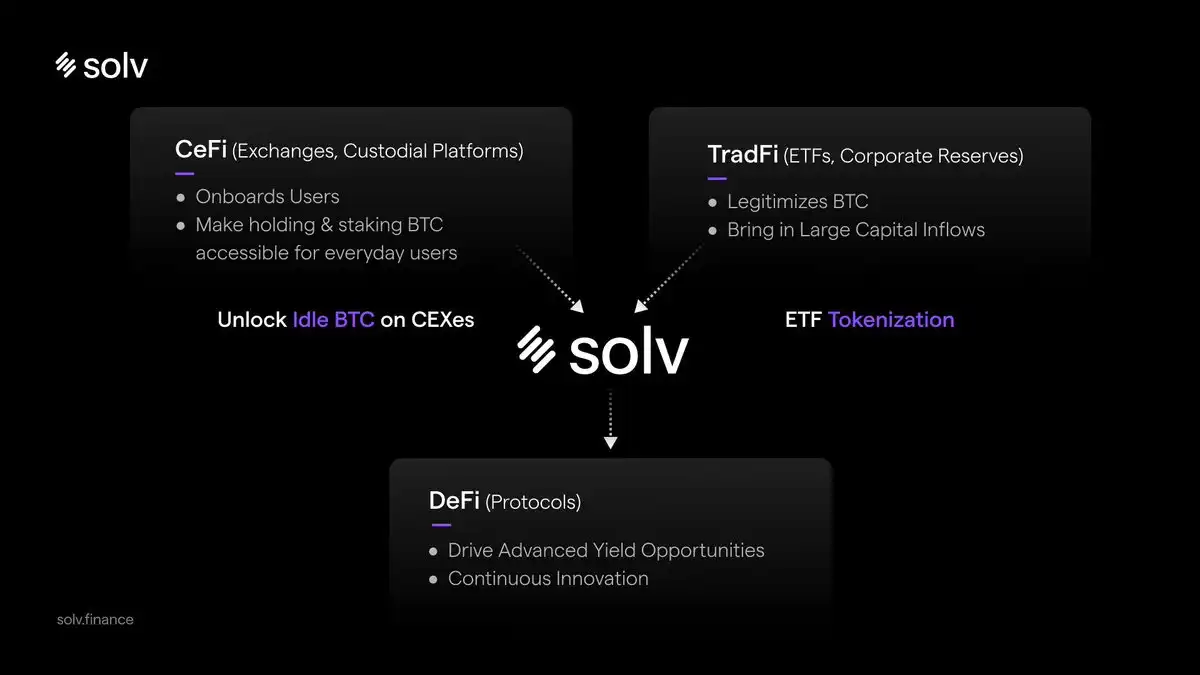
Solv recognizes that the rapid development of BTCFi stems from the overlay resonance of TradFi, DeFi, and CeFi. However, this overlay resonance has not fully realized its potential due to significant damping factors. These issues include:
· TradFi provides robust financial support and a global perspective but lacks smooth integration with decentralized ecosystems;
· DeFi boasts high innovation and openness but presents technical and cognitive barriers to ordinary users;
· CeFi excels in user experience but still needs continuous improvement in transparency and trust mechanisms.
Therefore, the key to success lies in strengthening this resonance effect and allowing these three forces to complement each other. To achieve this, Solv's goal is to build bridges among these three, eliminate barriers, create a seamlessly connected ecosystem, and unlock the full potential of BTCFi.
To achieve this goal, Solv has outlined a clear "three-step" strategy aimed at progressively consolidating DeFi infrastructure, integrating CeFi capabilities, and ultimately connecting TradFi to create a comprehensive BTCFi ecosystem.
Step One: Building on DeFi, Enhancing Innovation, and Optimizing User Experience
DeFi is the cornerstone of Solv's rise and the main battlefield of BTCFi innovation. In the Bitcoin financial field, with the surge of Bitcoin Layer2 and the hot development of wrapped assets, the form of yield has presented a variety of forms but in a relatively disordered manner. Solv was the first to propose the concept of a staking abstraction layer, unifying and standardizing the diverse on-chain Bitcoin asset yields, establishing a set of standardized staking and LST (Liquidity Staking Token) asset models, providing users with a one-stop diversified yield channel and a simple and intuitive operating experience. Currently, Solv has collaborated with Babylon, Ethena, Core DAO, and Jupiter to launch four different LST products. It has not only tokenized staking and restaking yields but also successfully tokenized trading strategy yields and funding rate yields, further enriching users' yield options.
The core charm and greatest advantage of DeFi lie in the openness of its ecosystem and the composability of protocols. Built around the core asset SolvBTC, Solv has established a broad ecosystem covering 15 mainstream blockchains and over 50 DeFi protocols, almost encompassing all high-quality on-chain yield sources. As of now, Solv's Bitcoin reserves have exceeded 25,000 coins, making it one of the largest on-chain Bitcoin reserves.
Step Two: Integrating CeFi, Expanding User Base, Streamlining Processes
CeFi platforms play a crucial role in the BTCFi ecosystem, especially in attracting mainstream users with irreplaceable advantages. In contrast to many people's views, Solv believes that CeFi in crypto is not a "transitional" modality but a mainstream business model that will exist long-term and continue to evolve. The reason is that crypto asset creation, management, and trading are increasingly complex and specialized, requiring professional division of labor. Therefore, as the industry scales up, it inevitably needs professional intermediaries to help ordinary users simplify operations, share responsibilities, and risks. Specifically in the BTCFi field, many Bitcoin holders actually prefer CeFi services. Therefore, Solv has a long-term strategic approach to connecting with CeFi.
Solv is currently establishing strategic partnerships with top CEXs platforms such as Binance, OKX, Bybit, etc., to streamline the process of Bitcoin staking and cross-chain liquidity through the integration of SolvBTC and its LST product line. Users can directly complete BTC wrapping, staking, and cross-chain asset management in a familiar operation interface without the need for complex on-chain interaction experiences.
In addition, Solv will collaborate with these platforms to launch exclusive products and services for BTCFi, such as BTC-based yield enhancement plans and staking reward projects, to help more users easily enjoy the benefits of DeFi, while promoting the natural transition of CeFi users to DeFi users, expanding the adoption of the entire BTCFi ecosystem.
Step Three: Connecting TradFi to Unlock Bitcoin's Potential in the Real World Economy
Solv will further drive the tokenization of BTC ETFs and actively collaborate with more traditional financial institutions to bridge the gap between traditional finance and DeFi.
By introducing traditional assets such as BTC ETFs in a programmable digital asset form into the on-chain ecosystem, Bitcoin will no longer just be a "store of value," but will instead become a key hub driving cross-market liquidity. This step not only provides traditional investors with more flexible asset allocation tools but also injects deeper liquidity and capital efficiency into the DeFi ecosystem, helping Bitcoin become a core asset in the global financial system.
Advancing BTCFi into a Trillion-Dollar Industry
Our three-step strategy is not only Solv's own growth path but also a long-term vision for the future. We always believe that only by connecting TradFi, DeFi, and CeFi, maintaining a focus on technological innovation and outstanding user experience, can we truly build an open, efficient, and sustainable BTCFi ecosystem.
The realization of this vision requires the collective efforts of the entire industry and Solv's continuous self-transcendence. In the future, we look forward to collaborating with more ecosystem partners to jointly drive the development of BTCFi, allowing the value of Bitcoin to benefit every user and enabling BTCFi to grow into a trillion-dollar industry.
"Original Article Link"
You may also like

22x Subsidy to 1 USD Revenue: How Long Can the TAO Growth Myth Last?

Use the Claude Wisely, One Piece is Enough

Netflix is Set to Bring FTX's Story to the Screen: Portraying History or Glamorizing a Scam?

People unable to buy Anthropic have driven its shadow stock up 16x

LALIGA Match Report: Vinícius scores as 10-man Real Madrid secure a 3-2 comeback victory in Madrid derby
In the early hours of March 23, 2026, Round 29 of LALIGA delivered a headline clash at the Santiago Bernabéu. Real Madrid hosted their local rivals, Atlético de Madrid, in a high-stakes encounter. Under referee José Munuera, the match unfolded at a fierce pace, packed with physical duels and momentum swings. After a five-goal thriller, Real Madrid held firm for a 3–2 home win, taking all three points. They remain second on 69 points, now four behind leaders Barcelona.
From a numbers standpoint, Real Madrid stayed composed under pressure, completing 526 passes with a 52.4% share of possession. Atlético struck first in the 33rd minute through Lookman. After the break, Real Madrid flipped the game: Vinícius converted a penalty to level, then Valverde fired them ahead. Molina pulled Atlético back on level terms, but Vinícius stepped up again in the 72nd minute to seal the win. Late drama followed as Valverde saw red, forcing Real Madrid to defend deep with ten men through the final stretch. Atlético's aggressive approach—12 fouls and 4 yellow cards—kept the pressure on, but they couldn’t stop the comeback.
WEEX Insights: As the official LALIGA partner in the Hong Kong and Taiwan regions, WEEX sees this win as a masterclass in control under pressure. Even after a red card and constant attacks, Real Madrid stayed sharp and executed with precision. That same discipline—staying calm in volatile moments and acting with clarity—reflects the core trading mindset WEEX stands for. LALIGA fan campaigns are coming soon—celebrate the game with WEEX.
About WEEX
Founded in 2018, WEEX has developed into a global crypto exchange with over 6.2 million users across more than 150 countries. The platform emphasizes security, liquidity, and usability, providing over 1,200 spot trading pairs and offering up to 400x leverage in crypto futures trading. In addition to the traditional spot and derivatives markets, WEEX is expanding rapidly in the AI era — delivering real-time AI news, empowering users with AI trading tools, and exploring innovative trade-to-earn models that make intelligent trading more accessible to everyone. Its 1,000 BTC Protection Fund further strengthens asset safety and transparency, while features such as copy trading and advanced trading tools allow users to follow professional traders and experience a more efficient, intelligent trading journey.
Follow WEEX on social media
X: @WEEX_Official
Instagram: @WEEX Exchange
Tiktok: @weex_global
Youtube: @WEEX_Official
Discord: WEEX Community
Telegram: WeexGlobalGroup

LALIGA Match Report: Araujo seals 1–0 win as Barça tighten grip on top spot
In the early hours of March 22 (Beijing Time), Barça edged Rayo Vallecano 1–0 at Camp Nou in a key Round 29 clash. The hard-earned win lifts Barça to 73 points, strengthening their hold on first place.
Barça controlled the game with 61% possession and a sharp 89% passing accuracy (460 passes). Rayo pushed back with intensity, earning 9 corners, but Barça's defense stayed solid. Yellow cards for Raphinha, Yamal, and Cubarsí highlighted the physical edge of the match. Second-half subs like Rashford and Olmo added fresh energy to help see out the result. Rayo remain 14th on 32 points.
WEEX Insights: As the Official LALIGA Partner in HK & TW, WEEX sees Barça’s 89% passing accuracy as a clear example of high execution with minimal error. Staying precise under pressure and finding the breakthrough reflects the same disciplined approach used in rational trading.
LALIGA interactive campaigns are coming soon—stay tuned with WEEX ⚽️
About WEEX
Founded in 2018, WEEX has developed into a global crypto exchange with over 6.2 million users across more than 150 countries. The platform emphasizes security, liquidity, and usability, providing over 1,200 spot trading pairs and offering up to 400x leverage in crypto futures trading. In addition to the traditional spot and derivatives markets, WEEX is expanding rapidly in the AI era — delivering real-time AI news, empowering users with AI trading tools, and exploring innovative trade-to-earn models that make intelligent trading more accessible to everyone. Its 1,000 BTC Protection Fund further strengthens asset safety and transparency, while features such as copy trading and advanced trading tools allow users to follow professional traders and experience a more efficient, intelligent trading journey.
Follow WEEX on social media
X: @WEEX_Official
Instagram: @WEEX Exchange
Tiktok: @weex_global
Youtube: @WEEX_Official
Discord: WEEX Community
Telegram: WeexGlobalGroup
These days, even hackers are losing money
Arm Chips In-House: Rewire News Brief

IOSG: Stablecoin Reshaping Asia Cross-Border Payments? Strategic Landscape and Investment Opportunities Analysis

\$73 Billion OpenAI Aims for IPO: Drops Sora, Snubs Disney, Puts Microsoft in Risk Factors

The Chip Industry's Most Secure Middleman Just Took a Very Risky Turn

CZ's Latest Interview: My Experience is Replicable, Writing a Book to Inspire Young Entrepreneurs

Morning News | Invesco acquires a $900 million on-chain fund from Superstate; ParaFi has raised $125 million for its new fund; Solana Foundation launches developer platform SDP

What is the background of this new fund that the two major prediction market platforms have rarely joined forces to create?

SIREN, another leveraged scam

Token has become extremely popular, and the blockchain is very sad

Tether's major shareholder invests £12 million to support the "British version of Trump" in the cryptocurrency sector

Huang Renxun's Latest Podcast: Will NVIDIA Reach $1 Trillion? Will the Number of Programmers Increase Instead of Decrease? How to Deal with AI Anxiety?
22x Subsidy to 1 USD Revenue: How Long Can the TAO Growth Myth Last?
Use the Claude Wisely, One Piece is Enough
Netflix is Set to Bring FTX's Story to the Screen: Portraying History or Glamorizing a Scam?
People unable to buy Anthropic have driven its shadow stock up 16x
LALIGA Match Report: Vinícius scores as 10-man Real Madrid secure a 3-2 comeback victory in Madrid derby
In the early hours of March 23, 2026, Round 29 of LALIGA delivered a headline clash at the Santiago Bernabéu. Real Madrid hosted their local rivals, Atlético de Madrid, in a high-stakes encounter. Under referee José Munuera, the match unfolded at a fierce pace, packed with physical duels and momentum swings. After a five-goal thriller, Real Madrid held firm for a 3–2 home win, taking all three points. They remain second on 69 points, now four behind leaders Barcelona.
From a numbers standpoint, Real Madrid stayed composed under pressure, completing 526 passes with a 52.4% share of possession. Atlético struck first in the 33rd minute through Lookman. After the break, Real Madrid flipped the game: Vinícius converted a penalty to level, then Valverde fired them ahead. Molina pulled Atlético back on level terms, but Vinícius stepped up again in the 72nd minute to seal the win. Late drama followed as Valverde saw red, forcing Real Madrid to defend deep with ten men through the final stretch. Atlético's aggressive approach—12 fouls and 4 yellow cards—kept the pressure on, but they couldn’t stop the comeback.
WEEX Insights: As the official LALIGA partner in the Hong Kong and Taiwan regions, WEEX sees this win as a masterclass in control under pressure. Even after a red card and constant attacks, Real Madrid stayed sharp and executed with precision. That same discipline—staying calm in volatile moments and acting with clarity—reflects the core trading mindset WEEX stands for. LALIGA fan campaigns are coming soon—celebrate the game with WEEX.
About WEEX
Founded in 2018, WEEX has developed into a global crypto exchange with over 6.2 million users across more than 150 countries. The platform emphasizes security, liquidity, and usability, providing over 1,200 spot trading pairs and offering up to 400x leverage in crypto futures trading. In addition to the traditional spot and derivatives markets, WEEX is expanding rapidly in the AI era — delivering real-time AI news, empowering users with AI trading tools, and exploring innovative trade-to-earn models that make intelligent trading more accessible to everyone. Its 1,000 BTC Protection Fund further strengthens asset safety and transparency, while features such as copy trading and advanced trading tools allow users to follow professional traders and experience a more efficient, intelligent trading journey.
Follow WEEX on social media
X: @WEEX_Official
Instagram: @WEEX Exchange
Tiktok: @weex_global
Youtube: @WEEX_Official
Discord: WEEX Community
Telegram: WeexGlobalGroup
LALIGA Match Report: Araujo seals 1–0 win as Barça tighten grip on top spot
In the early hours of March 22 (Beijing Time), Barça edged Rayo Vallecano 1–0 at Camp Nou in a key Round 29 clash. The hard-earned win lifts Barça to 73 points, strengthening their hold on first place.
Barça controlled the game with 61% possession and a sharp 89% passing accuracy (460 passes). Rayo pushed back with intensity, earning 9 corners, but Barça's defense stayed solid. Yellow cards for Raphinha, Yamal, and Cubarsí highlighted the physical edge of the match. Second-half subs like Rashford and Olmo added fresh energy to help see out the result. Rayo remain 14th on 32 points.
WEEX Insights: As the Official LALIGA Partner in HK & TW, WEEX sees Barça’s 89% passing accuracy as a clear example of high execution with minimal error. Staying precise under pressure and finding the breakthrough reflects the same disciplined approach used in rational trading.
LALIGA interactive campaigns are coming soon—stay tuned with WEEX ⚽️
About WEEX
Founded in 2018, WEEX has developed into a global crypto exchange with over 6.2 million users across more than 150 countries. The platform emphasizes security, liquidity, and usability, providing over 1,200 spot trading pairs and offering up to 400x leverage in crypto futures trading. In addition to the traditional spot and derivatives markets, WEEX is expanding rapidly in the AI era — delivering real-time AI news, empowering users with AI trading tools, and exploring innovative trade-to-earn models that make intelligent trading more accessible to everyone. Its 1,000 BTC Protection Fund further strengthens asset safety and transparency, while features such as copy trading and advanced trading tools allow users to follow professional traders and experience a more efficient, intelligent trading journey.
Follow WEEX on social media
X: @WEEX_Official
Instagram: @WEEX Exchange
Tiktok: @weex_global
Youtube: @WEEX_Official
Discord: WEEX Community
Telegram: WeexGlobalGroup


 App
App