
Sam Altman's Latest Article: Fully Committed to AI Agent, Believing It Will Reshape the World Economy


Original Article Title: Three Observations
Original Article Author: Sam Altman
Original Article Compilation, Editing: AIGC Open Community
At 5 am this morning, Sam Altman, Co-Founder and CEO of OpenAI, published a deep article titled "Three Observations" on his personal blog.
The article mainly puts forward 3 observations about the AI world: the intelligence level of an AI model is roughly equal to the logarithm of the resources used to train and run it;
The cost of using AI at a specific level roughly decreases by a factor of 10 every 12 months, and lower prices lead to more usage; the societal and economic value created by linearly increasing intelligence is super-exponentially growing.
The article also emphasizes that OpenAI is fully deploying AI Agents, these thousands of intelligent entities will eventually be widely used, becoming virtual colleagues in various business scenarios. The performance of junior Agents may be somewhat lacking, but they will still permeate various fields reshaping the world economy.
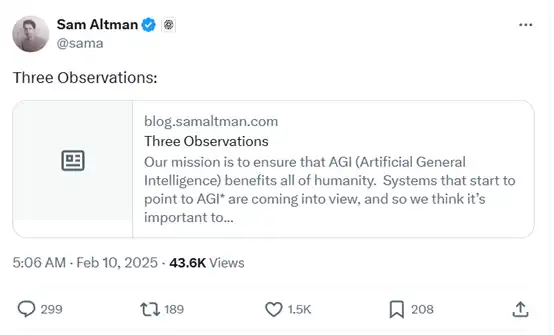
The following is the original content:
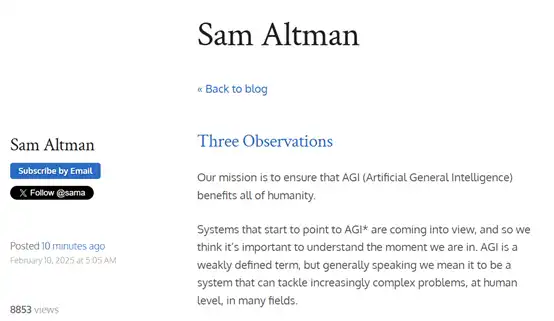
Our mission is to ensure that General AI (AGI) can benefit all of humanity.
The beginnings of systems pointing towards AGI are already visible; therefore, we feel it is necessary to understand the moment we are in. AGI is a somewhat ambiguous term, but generally, we define it as a system capable of solving increasingly complex problems at a human level across numerous domains.
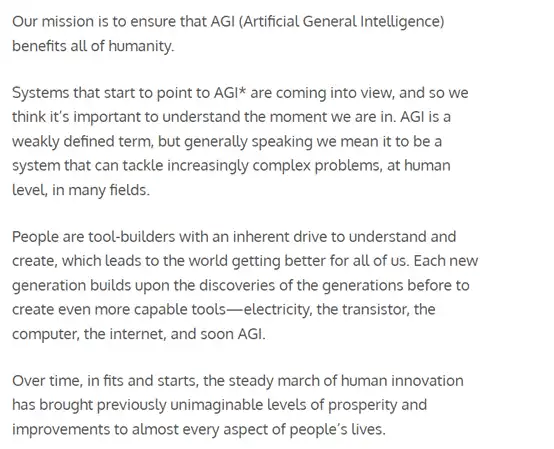
Humans are tool builders, inherently driven by exploration and creation, making the world progressively better. Each generation progresses on the discoveries of its predecessors, creating more powerful tools—electricity, transistors, computers, the internet, and the upcoming AGI.
In a sense, AGI is just another tool in the progression ladder collectively built by humans. But in another sense, the emergence of AGI marks a whole new beginning, making it hard not to feel like "this time it really is different." The economic growth in front of us looks astounding, and we can even envision a world that can cure all diseases, give people more time with family, and unleash creativity to its fullest.
Perhaps within a decade, everyone on Earth will have capabilities exceeding those of today's most influential people.
We continue to witness rapid progress in AI development. Here are three observations about the AI economy:
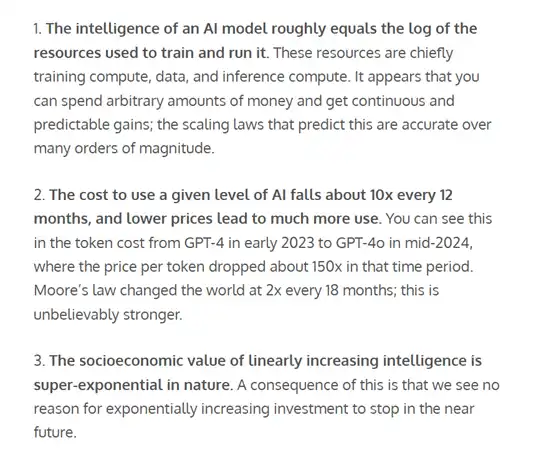
1. The intelligence level of an AI model is roughly equal to the logarithm of the resources used to train and run it. These resources mainly include training computational power, data, and inference computational power. It seems that as long as you are willing to invest any amount of funds, you can achieve continuous and predictable returns. The law of the scale of these returns is accurate across multiple orders of magnitude.
2. The cost of using AI at a certain level decreases by approximately 10 times every 12 months, and lower prices lead to more usage. You can see this in the token cost change from early 2023's GPT-4 to mid-2024's GPT-4o, where the price per token decreased by about 150 times over this year and a half.
Moore's Law doubled performance every 18 months, changing the world; however, the rate at which AI costs are dropping is even more incredible.
3. The socioeconomic value created by linear growth in intelligence is super-exponentially increasing. This result suggests that there is no immediate reason to expect that investment in exponential growth will stop in the near term.
If these three observations continue to hold true, their impact on society will be enormous.
We are now introducing AI Agents that will eventually be widely used like virtual colleagues.
Let's take the example of a software engineering Agent, which we consider particularly important. Imagine that this Agent can eventually perform tasks most senior company software engineers with several years of experience can accomplish (tasks that can take up to several days). It may not come up with the greatest new ideas, requires significant human supervision and guidance, and excels in some aspects while may perform poorly in others.
But still, it can be envisioned as a real yet relatively junior virtual colleague. Now imagine having 1000 of such Agents. Or 1 million. Then imagine having such Agents in every knowledge work domain.
In a sense, AI may be economically similar to the transistor—a significant scientific discovery that can be massively scaled and permeate into every corner of the economy. We may not focus too much on transistors or transistor companies, but we will expect our computers, TVs, cars, toys, etc., to perform miraculous feats.
The world will not change overnight, it never has. In the short term, life will still be largely the same, with people in 2025 spending most of their time much like they did in 2024. We will still fall in love, start families, argue online, go hiking, etc.
But the future will come at us in an undeniable way, with massive long-term societal and economic changes. We will find new things to do, new ways to help each other, and new forms of competition, but these may be very different from today's jobs.
Autonomy, volition, and determination may become extremely important. Making the right decisions about what to do and how to navigate a changing world will be of immense value; resilience and adaptability will be skills worth cultivating. AGI will be the most potent lever of human intent, enabling individuals to have a greater impact than ever before, rather than a lesser one.
We expect the impact of AGI to be uneven. While some industries might see little change, scientific progress may accelerate beyond today, with this AGI impact outweighing everything else.
The prices of many goods may ultimately plummet (currently, cognitive and energy costs limit many things), while luxury goods and some inherently scarce resources (like land) may see more dramatic price increases.
From a technological standpoint, the path forward seems fairly clear. However, public policy and collective opinion are critical in how AGI is integrated into society. One reason we're launching products early is to give society and tech time to co-evolve.
AI will permeate every sector of the economy and society, with everything expected to become smarter. Many anticipate the need to afford people more control over tech than ever before, including more open sourcing, and accepting the need to balance security with personal empowerment.
While we never want to act recklessly, and there may be some unwelcome significant decisions and constraints related to AGI safety, directionally, as we get closer to AGI, we believe a trend toward more individual empowerment is critical. Another possible road we can see is AI being used by authoritarian governments to control their populations through extensive surveillance and autonomy deprivation.
Ensuring broad distribution of the benefits of AGI is crucial. Historical impacts of technological progress suggest that most of the metrics we care about (health outcomes, economic prosperity, etc.) tend to improve on average and in the long run, but increasing equality does not seem to be technology-driven, and achieving this properly may require new ideas.
In particular, the power balance between capital and labor may be disrupted, which may require early intervention. We are open to some seemingly strange ideas, such as allocating a certain "computational budget" to every person on Earth so they can harness significant AI capabilities. However, we can also see many ways to achieve the desired effects through continuously lowering the cost of intelligence.
By 2035, everyone should be able to access intelligence capabilities equivalent to the total intelligence of all people in 2025; everyone should be able to access unlimited wisdom and leverage it in any way they can imagine. Today, many talented individuals around the world do not have sufficient resources to fully express themselves. If we can change this, the world will create tremendous value, bringing enormous benefits to all of us.
You may also like

Latest research from 13 top universities including Cornell University: The current state, challenges, and misconceptions of the fusion of Crypto and AI
Deconstructing Anthropic: The Best AI Company, Possibly Also a Type of Organizational Invention
Apollo and Blackstone Reportedly Back $35 Billion Anthropic Chip Financing as Deal Details Remain Unclear
On June 9, according to currently available news alerts, Apollo and Blackstone Group participated in a $35 billion financing for an Anthropic “chip project.” Based on the original wording of the report, the funding has already been raised, but public information remains limited. The financing structure, use of proceeds, project entity, and whether Apollo and Blackstone participated through equity, debt, or project financing have not yet been disclosed.

Humanity Protocol Security Incident Escalates: More Than $31 Million Stolen From Related Addresses as Attacker Continues Selling H for ETH
On June 9, according to monitoring by Onchain Lens, more than $31 million has been stolen from addresses linked to Humanity Protocol, and the attack is still ongoing, with the hacker continuously swapping H tokens for ETH. Project founder Terence Kwok later confirmed the security incident on X, saying the issue involved a private key leak.

Bloomberg: As Bitcoin Weakens, Stablecoins and RWA Continue to Drive Expansion in Crypto Businesses
In June, Bloomberg reported that despite Bitcoin falling below $60,000 last week, wiping out about $235 billion in market value within seven days, and dropping close to 50% from last year’s peak, some core businesses in the crypto industry are still expanding, mainly in stablecoins, real-world asset tokenization (RWA), payments, and infrastructure. The report also noted that overall altcoin activity has contracted significantly: altcoin market capitalization has fallen from a peak of about $431 billion in November 2021 to around $170 billion, and among the tens of millions of tokens issued in recent years, fewer than 1,700 still maintain meaningful trading activity.

Galaxy Deep Research Report: How Hyperliquid's HIP-4 Upgrade Changes the Landscape of Prediction Markets?
Binance Research: RWA Market Expected to Expand Nearly 6x from Early 2025, with Public Equities and Onchain Payments Heating Up Together
In June, Binance Research said in its monthly market report that the real-world asset (RWA) market is expected to grow by about 589% from the beginning of 2025. Bond- and money market fund-related RWA expanded by about $6.5 billion, up 83% year over year, while publicly traded equity RWAs grew by about 422%. The report also noted that monthly crypto debit card transaction volume exceeded $747 million in May, up 48.6% year to date.

Japan to Assess a Framework for Yen Stablecoins and Crypto ETFs as Asia’s Compliant Payments Narrative Heats Up
Recently, according to the original report, Japan is considering the launch of yen stablecoins and cryptocurrency ETFs. Public information remains limited at this stage, and there is still no complete policy text, regulatory draft, or clear implementation timeline, so this is better characterized as a “policy discussion” rather than formal implementation. The original wording also noted that advancing stablecoin regulation in Asia is driving XRP usage and supporting growth in the XRPL ecosystem. However, based on currently available public information, there is not enough evidence to directly establish a clear causal relationship between this round of discussion in Japan and XRP or XRPL.

ZachXBT: Humanity private key leak and abnormal surge in H token should be viewed separately
On June 9, according to related disclosures, on-chain investigator ZachXBT posted an update on Humanity’s roughly $31 million security incident, saying that after further analyzing fund flows, he currently tends to believe the project team was not involved in an “inside job” or a self-staged attack. According to him, the official explanation about the private key leak was broadly accurate, but before the token unlock, the price of H had been artificially pushed higher, and the hacker later took advantage of that market environment; therefore, the private key leak and the earlier abnormal price pumping should be regarded as two separate and independent events. This reframing has shifted the market’s understanding of the nature of the incident. Earlier discussion around Humanity had focused on whether the team directly participated in the attack or used the security incident to cover up internal operations. ZachXBT’s latest remarks shift the focus from “whether it was self-theft” to “whether there were pre-unlock market structure issues.” He also questioned whether the team may have.

Morning Report | OpenAI has submitted an S-1 registration statement draft to the U.S. SEC; Morpho completes $175 million financing

Morning Report | BitMine increased its holdings by 126,971 ETH last week; trader Eugene announced his exit from the crypto market

Wang Chuan: How can one not feel anxious after the neighbor Old Wang made thirty times profit by investing in storage stocks? (Seven) - A quarter-century cycle
Cryptocurrency CEXs are flocking to sell US stocks, and traditional brokerages are facing an "uninvited guest."
$75 billion in foreign capital has fled, and South Korean retail investors have absorbed it all using leverage

Japan’s Three Megabanks Plan Joint Stablecoin Issuance in Fiscal 2026
MUFG, SMBC, and Mizuho reportedly plan to jointly issue fiat-pegged stablecoins in fiscal 2026, signaling Japan’s growing push into bank-led digital payment infrastructure.

Humanity Discloses H Token Dual-Chain Attack Details, With Losses on Ethereum and BSC Exceeding $36 Million
Humanity said the H token attack across Ethereum and BSC caused more than $36 million in losses after leaked ProxyAdmin keys enabled malicious contract upgrades and token minting.
White House Discusses CLARITY Act With Law Enforcement Ahead of Senate Vote
The White House discussed the CLARITY Act with law enforcement ahead of a Senate vote, focusing on illicit finance risks and developer protections.

Bitcoin Trading Guide 2026: Strategies for Experienced Traders
Latest research from 13 top universities including Cornell University: The current state, challenges, and misconceptions of the fusion of Crypto and AI
Deconstructing Anthropic: The Best AI Company, Possibly Also a Type of Organizational Invention
Apollo and Blackstone Reportedly Back $35 Billion Anthropic Chip Financing as Deal Details Remain Unclear
On June 9, according to currently available news alerts, Apollo and Blackstone Group participated in a $35 billion financing for an Anthropic “chip project.” Based on the original wording of the report, the funding has already been raised, but public information remains limited. The financing structure, use of proceeds, project entity, and whether Apollo and Blackstone participated through equity, debt, or project financing have not yet been disclosed.
Humanity Protocol Security Incident Escalates: More Than $31 Million Stolen From Related Addresses as Attacker Continues Selling H for ETH
On June 9, according to monitoring by Onchain Lens, more than $31 million has been stolen from addresses linked to Humanity Protocol, and the attack is still ongoing, with the hacker continuously swapping H tokens for ETH. Project founder Terence Kwok later confirmed the security incident on X, saying the issue involved a private key leak.
Bloomberg: As Bitcoin Weakens, Stablecoins and RWA Continue to Drive Expansion in Crypto Businesses
In June, Bloomberg reported that despite Bitcoin falling below $60,000 last week, wiping out about $235 billion in market value within seven days, and dropping close to 50% from last year’s peak, some core businesses in the crypto industry are still expanding, mainly in stablecoins, real-world asset tokenization (RWA), payments, and infrastructure. The report also noted that overall altcoin activity has contracted significantly: altcoin market capitalization has fallen from a peak of about $431 billion in November 2021 to around $170 billion, and among the tens of millions of tokens issued in recent years, fewer than 1,700 still maintain meaningful trading activity.
Galaxy Deep Research Report: How Hyperliquid's HIP-4 Upgrade Changes the Landscape of Prediction Markets?


