
- Buy Crypto
- Markets
 Futures
- Spot
- Copy Trade
 Earn
Earn- More
Rate Cut Countdown: $9 Trillion National Debt "Maturity Wall" Could Be the Cryptocurrency Market's Most Powerful Catalyst

Original Title: Why should we be bullish on the crypto market in the mid-to-long term? A bullish thesis
Original Author: DeFi Cheetah, Crypto KOL
Original Translation: Felix, PANews
As previously predicted, the U.S. stock market was expected to experience at least a 20% pullback, bringing the Bitcoin price back to around $50,000. The first target has been met: due to Trump's imposition of higher tariffs on many other countries, the U.S. stock market underwent a 20% pullback with the VIX index at around 55. The Bitcoin price briefly fell to $74,000, showing more resilience than expected based on historical price trends.
Next, it is expected that the Federal Reserve will cut interest rates before June, followed by a rebound in the U.S. stock market and the crypto market. In fact, Trump has just explicitly demanded Fed Chair Powell to cut interest rates. This article will explain in detail why Trump is so obsessed with rate cuts and why he is bullish on the crypto market.
Two Urgent Issues Caused by High Interest Rates
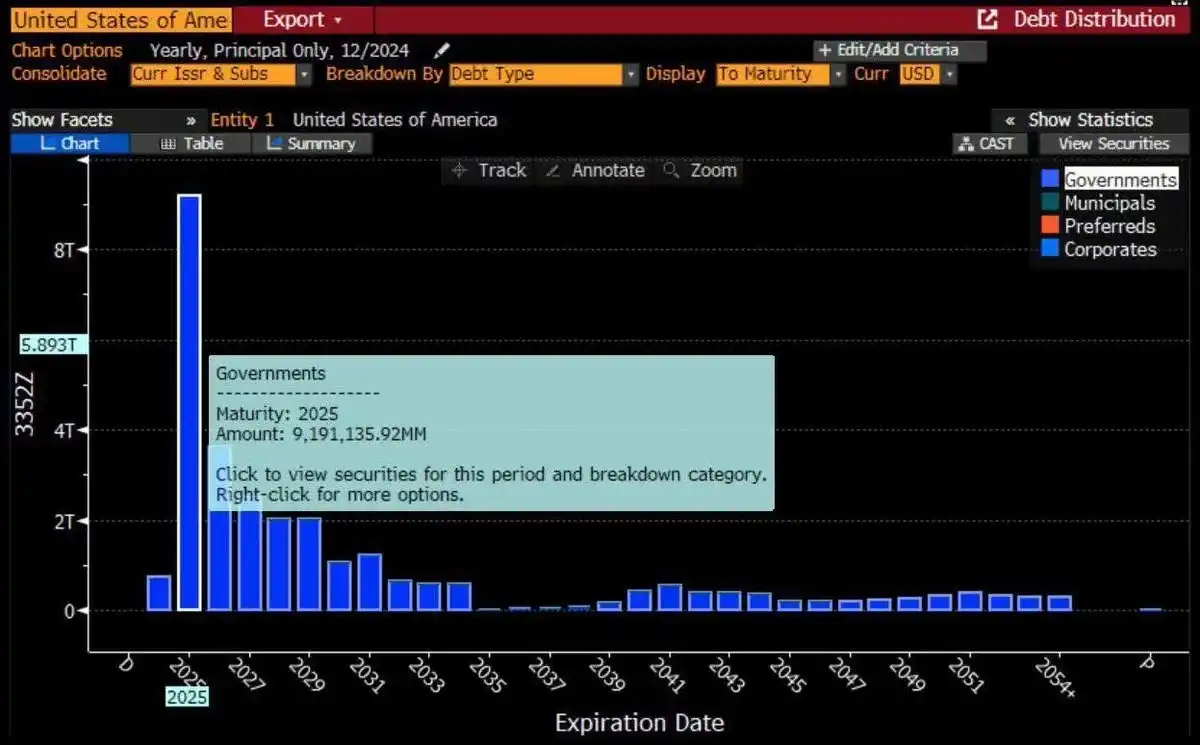
In the coming months, two issues are forcing the Federal Reserve to significantly cut interest rates. First, the "Maturity Wall" of $90 trillion in U.S. Treasury bonds this year is forcing the Trump administration to seek rate cuts aggressively to save trillions of dollars in refinancing costs. However, the Fed sees no room for rapid rate cuts given the current inflation level.
Therefore, for the Trump administration, those seemingly unreasonable aggressive policies and measures (such as tariffs, establishing DOGE, etc.) are best explained as forming a coordinated mechanism to try to force the Fed to cut rates amid macro uncertainty. Otherwise, the U.S. government would have to pay at least 3-4 times more in interest costs after the extension. In fact, the two-year short-term Treasury yield has been declining, reflecting market risk-off sentiment and flows into Treasury bonds.
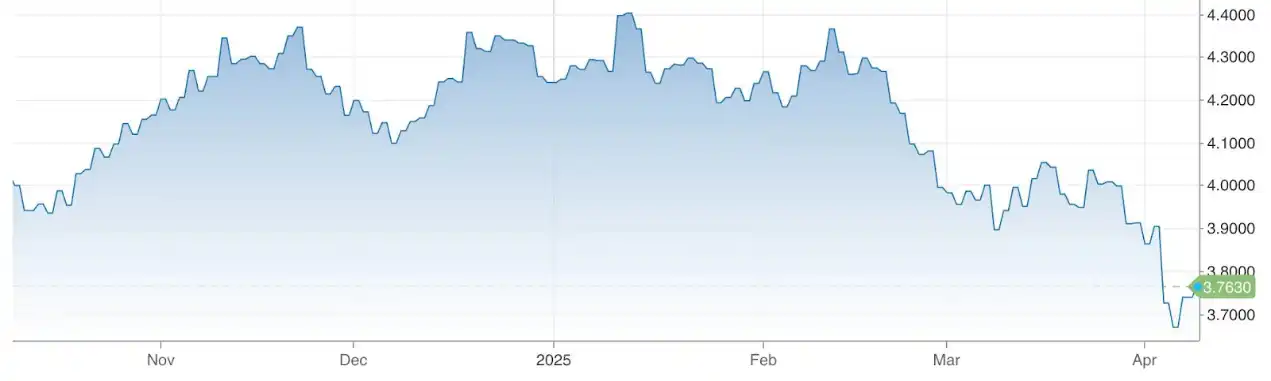
In the eyes of the Trump administration, the urgency of rate cuts can be illustrated by the following chart:
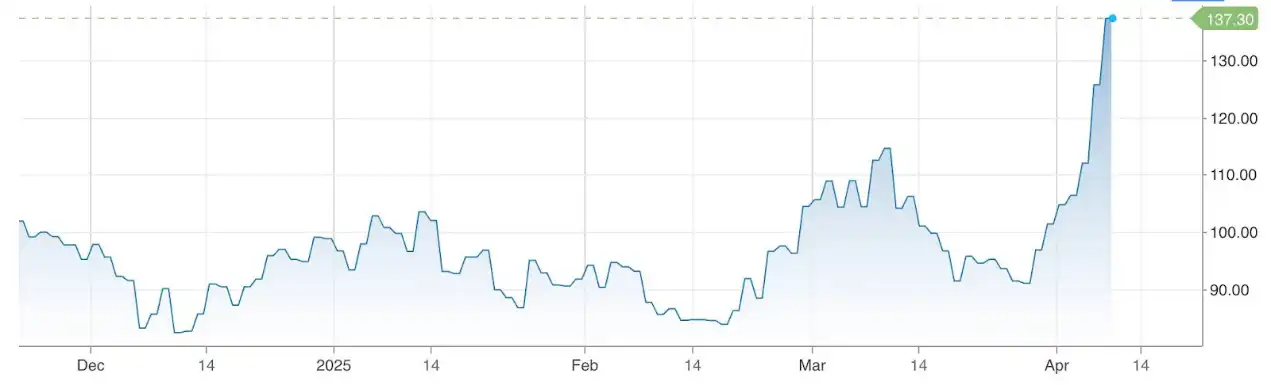
Indeed, the Merrill Option Volatility Estimate Index (MOVE), which measures the volatility of U.S. Treasury market rates, has surged, further indicating the possibility of a Fed rate cut. This index is considered representative of the term premium of U.S. Treasury bonds (i.e., the yield spread between long-term and short-term bonds). As this index rises, anyone involved in U.S. Treasury or corporate bond financing transactions would be forced to sell due to higher margin requirements.
If the MOVE Index continues to rise, especially above 140, it may indicate an extremely unstable market and could potentially force the Federal Reserve to cut interest rates to stabilize the Treasury and corporate bond markets, as these markets are crucial to the normal functioning of the financial system. (Note: The MOVE Index last surged above 140 due to the collapse of a Silicon Valley bank—this was the largest bank failure event since 2008.)
The second reason for a significant rate cut in the coming months is also due to the "maturity wall," but this time it refers to over $500 billion of U.S. Commercial Real Estate (CRE) loans maturing this year. Many CRE loans were underwritten at lower rates during the pandemic and are now facing refinancing challenges in a rising rate environment, which could lead to an increase in default rates, especially for highly leveraged real estate. With the increasing prevalence of telecommuting, structural changes have been triggered, causing a persistently high post-pandemic vacancy rate in housing. In fact, the potential for large-scale CRE loan defaults could drive up the MOVE Index.
By the fourth quarter of 2024, the CRE loan delinquency rate was 1.57%, higher than 1.17% in the fourth quarter of 2023. Historical data indicates that a rate above 1.5% is concerning, especially in a tightening monetary environment. Meanwhile, with a vacancy rate as high as 20%, a continuously rising capitalization rate (approximately 7-8%), and a large number of loans maturing, office values have fallen 31% from their peak, increasing the risk of default.
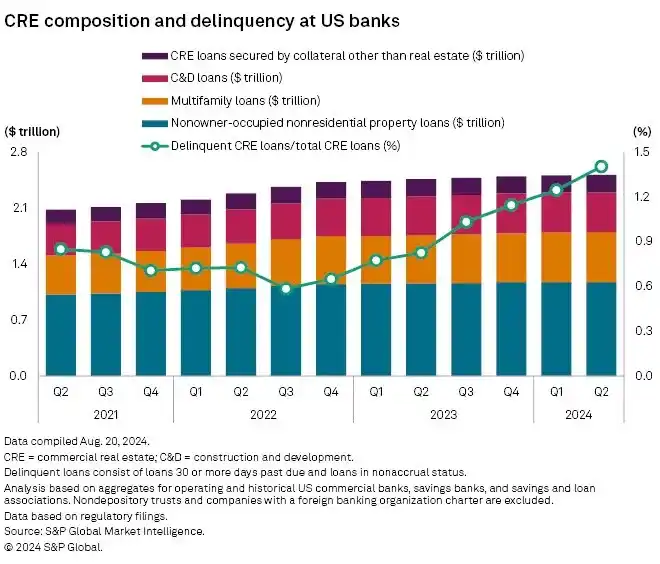
The logic here is: A high vacancy rate will decrease Net Operating Income (NOI), lower Debt Service Coverage Ratio (DSCR) and Debt Yield, but will increase the capitalization rate. High rates will exacerbate this situation, especially for loans maturing in 2025, where refinancing at higher rates may be unsustainable. Therefore, if commercial real estate loans cannot be refinanced at a reasonable low rate similar to the pandemic period, banks will inevitably face more defaults, which could in turn trigger a "domino effect" of more bank failures (recall the severity of bank failures such as the Silicon Valley Bank due to the 2023 rate spike).
Given these two urgent issues caused by the current high rates, the Trump administration must take aggressive action to cut rates quickly. Otherwise, these debts will need to be extended, leading to higher refinancing costs for the U.S. government, and many commercial real estate loans may not be able to be extended, resulting in a large number of defaults.
The Catalyst for the Next Bull Market—Stablecoins
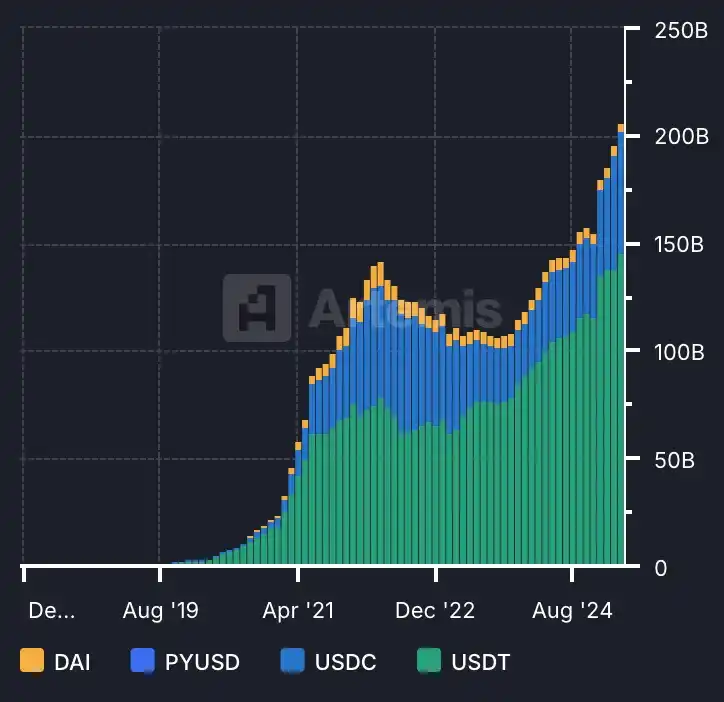
The most significant factor affecting the crypto market is market liquidity. However, the most influential factors affecting liquidity are (i) monetary policy and (ii) the prevalence of stablecoins. Under a dovish (accommodative) monetary policy, the widespread adoption of stablecoins can further catalyze capital inflows during a bull market. The upside of the bull market depends on the increase in the total supply of stablecoins. In the previous bull market cycle (2019 - 2022), the total supply of stablecoins grew tenfold from its nadir to its peak, while from 2023 to early 2025, it has only increased by about 100%, as shown in the chart below.
The following highlights key events signaling a rapid increase in stablecoin adoption over the next year:
US Stablecoin Legislation Progress: In the first quarter of 2025, the Senate Banking Committee in the United States approved the Genius Act in March, outlining regulatory and reserve rules for stablecoin issuers. The aim of this act is to integrate stablecoins into the mainstream financial system, reflecting the growing recognition of their role in the crypto market. Additionally, the House Financial Services Committee passed a stablecoin framework bill — the STABLE Act — which stipulates that any non-bank institution can issue stablecoins as long as they obtain approval from federal regulatory agencies. Regulatory transparency has always been considered a key factor influencing stablecoin adoption, thereby affecting capital inflows into the crypto industry through stablecoins.
Accelerated Institutional Adoption: Fidelity Investments began testing a USD-backed stablecoin in late March, marking a significant step for this traditional financial giant entering the crypto space. Meanwhile, Wyoming announced plans to launch a state-backed stablecoin by July, aiming to become the first token issued by a U.S. entity backed by fiat and fully reserved.
World Liberty Financial Stablecoin: World Liberty Financial, associated with Trump, announced on March 25th its plans to launch the USD1 stablecoin pegged to the U.S. dollar, having previously raised $500 million through a separate token sale. This move aligns with the Trump administration's policy of supporting stablecoins as a key infrastructure for cryptocurrency transactions.
USDC Expansion to Japan: On March 26th, Circle partnered with SBI Holdings to launch USDC in Japan, making it the first stablecoin officially approved for use under Japan's regulatory framework. This move reflects Japan's positive stance on integrating stablecoins into its financial system and may set an example for other countries.
PayPal and Gemini Driving Stablecoin Development: Throughout the first quarter, PayPal and Gemini strengthened their positions in the stablecoin market. The adoption rates of PayPal's PYUSD and Gemini's GUSD have increased, with PayPal leveraging its payment network and Gemini focusing on institutional clients. This intensifies the competition in the U.S. stablecoin issuer market.
Rise Payroll Platform's Additional Use Cases: On March 24, the Rise payroll platform expanded its services to offer stablecoin payments to international contractors in over 190 countries. Employers can pay wages in stablecoins, and employees can cash out in local currency.
Circle's IPO: Circle has filed for an IPO. If approved, Circle will become the first stablecoin issuer to be listed on the New York Stock Exchange. This milestone will signify the formal recognition of stablecoin business in the U.S. and incentivize more enterprises to explore the field, especially large institutions, as stablecoin operations rely more on institutional resources, distribution channels, and business development.
Why Is the Trump Administration So Supportive of Stablecoin Development?
This aligns with the viewpoint in the first part: the collateral backing stablecoins in circulation is primarily short-term U.S. Treasury bonds, hence, with the U.S. government rolling over tens of trillions of dollars of maturing Treasuries this year, as stablecoins become more widespread, the demand for short-term bonds increases.
The market trend is clear: in the short term, there may be market turbulence, high volatility, and possibly further declines from current levels. However, looking ahead, it is expected that against the backdrop of dovish monetary policy, significant interest rate cuts, coupled with the proliferation of stablecoins, may trigger another strong bull market, comparable in scale to the previous cycle.
It is currently an ideal time to seek good returns through investment in the crypto market.
You may also like

February 9th Market Key Intelligence, How Much Did You Miss?

After being questioned by Vitalik, L2s are collectively saying goodbye to the "cheap" era

WEEX AI Trading Hackathon Paris Workshop Reveals: How Retail Crypto Traders Can Outperform Hedge Funds
Witness how WEEX's Paris AI Trading Hackathon revealed AI's edge over human traders. Explore key strategies, live competition results & how to build your own AI trading bot.

U.S. Oil (USOR) Price Prediction 2026–2030
Key Takeaways U.S. Oil (USOR) is a speculative Solana-based crypto project that aims to index the United States…

USOR Surges on Meme Narrative Despite No Real-World Asset Backing
Key Takeaways: USOR, a Solana-based token, has seen a notable surge driven by speculative narratives rather than verifiable…

How to Buy U.S. Oil Reserve (USOR) Cryptocurrency
Key Takeaways U.S. Oil Reserve (USOR) is a Solana-based token primarily traded on decentralized exchanges (DEXs). Claims have…

USOR vs Oil ETFs: Understanding Why the ‘Oil Reserve’ Token Doesn’t Track Crude Prices
Key Takeaways The U.S. Oil Reserve (USOR) token has become noteworthy for its claims, yet it does not…

Trend Research Reduces Ether Holdings After Major Market Turbulence
Key Takeaways: Trend Research has significantly cut down its Ether holdings, moving over 404,000 ETH to exchanges recently.…
Investors Channel $258M into Crypto Startups Despite $2 Trillion Market Sell-Off
Key Takeaways: Investors pumped approximately $258 million into crypto startups in early February, highlighting continued support for blockchain-related…
NBA Star Giannis Antetokounmpo Becomes Shareholder in Prediction Market Kalshi
Key Takeaways: Giannis Antetokounmpo, the NBA’s two-time MVP, invests in the prediction market platform Kalshi as a shareholder.…

Arizona Home Invasion Targets $66 Million in Cryptocurrency: Two Teens Charged
Key Takeaways Two teenagers from California face serious felony charges for allegedly attempting to steal $66 million in…

El Salvador’s Bukele Approval Reaches Record 91.9% Despite Limited Bitcoin Use
Key Takeaways: El Salvador President Nayib Bukele enjoys a record high approval rating of 91.9% from his populace,…

Crypto Price Prediction for February 6: XRP, Dogecoin, and Shiba Inu’s Market Movements
Key Takeaways: The crypto market experienced a notable shift with Bitcoin’s significant surge, impacting altcoins like XRP, Dogecoin,…

China Restricts Unapproved Yuan-Pegged Stablecoins to Maintain Currency Stability
Key Takeaways: China’s central bank and seven government agencies have banned the issuance of yuan-pegged stablecoins abroad without…

Solana Price Prediction: $80 SOL Looks Scary – But Smart Money Just Signaled This Might Be the Bottom
Key Takeaways Despite Solana’s descent to $80, some traders find security as smart money enters the fray, suggesting…

XRP Price Prediction: Major Ledger Upgrade Quietly Activated – Why This Could Be the Most Bullish Signal Yet
Key Takeaways: The activation of the Permissioned Domains amendment on XRPL represents a significant development in XRP’s potential…

Dogecoin Price Prediction: Death Cross Confirmed as DOGE Falls Below $0.10 – Is DOGE Reaching Zero?
Key Takeaways The death cross event signals potential bearish trends for Dogecoin as its price dips under $0.10,…

Stablecoin Inflows Have Doubled to $98B Amid Selling Pressure
Key Takeaways Stablecoin inflows to crypto exchanges have surged to $98 billion, doubling previous levels amidst heightened market…
February 9th Market Key Intelligence, How Much Did You Miss?
After being questioned by Vitalik, L2s are collectively saying goodbye to the "cheap" era
WEEX AI Trading Hackathon Paris Workshop Reveals: How Retail Crypto Traders Can Outperform Hedge Funds
Witness how WEEX's Paris AI Trading Hackathon revealed AI's edge over human traders. Explore key strategies, live competition results & how to build your own AI trading bot.
U.S. Oil (USOR) Price Prediction 2026–2030
Key Takeaways U.S. Oil (USOR) is a speculative Solana-based crypto project that aims to index the United States…
USOR Surges on Meme Narrative Despite No Real-World Asset Backing
Key Takeaways: USOR, a Solana-based token, has seen a notable surge driven by speculative narratives rather than verifiable…
How to Buy U.S. Oil Reserve (USOR) Cryptocurrency
Key Takeaways U.S. Oil Reserve (USOR) is a Solana-based token primarily traded on decentralized exchanges (DEXs). Claims have…


 App
App