
Jupiter Empire Expansion History: Is Vertical Integration the Endgame of the Cryptocurrency Industry?



Original Article Title: Jupiter Crypto Conglomerate
Original Article Author: Marco Manoppo, Investor at Primitive Ventures
Original Article Translation: Ashley, BlockBeats
Editor's Note: Jupiter announced several major initiatives at the Catstanbul Summit, including acquisitions, AI funding, token buyback and burn, as well as the launch of the fully interoperable chain network Jupnet, showcasing its vertical integration ambitions. This article analyzes its business strategy and discusses how in a permissionless crypto environment, brand, community, and user experience determine value capture, revealing the inevitable trend towards integration in applications.
The following is the original content (slightly reorganized for readability):
Last month, Jupiter made a series of major announcements at its flagship event, Catstanbul. To summarize—there was a wealth of information. There was the Burning Cat, acquisition announcements, and most importantly: Jupiter publicly acknowledged that its ambitions extend beyond the current ecosystem. In today's article, we will dissect Jupiter's latest business strategy and discuss why over a sufficiently long period, every crypto application that controls users will ultimately choose vertical integration to maximize value capture. Let's delve into it.
TL;DR
Acquisitions
Jupiter acquired a majority stake in Moonshot, a popular mobile trading app that generated $35 million in fee revenue following the Trump Meme Coin craze. At the same time, Jupiter also completed a full acquisition of Solana DeFi asset management tool Sonar Watch.
Funding Support
Jupiter is partnering with Shaw from ElizaOS to allocate $10 million in support of AI developers launching through Jupiter Launchpad.
Token Buyback
50% of Jupiter's protocol transaction fees will be used for JUP token buybacks.
Token Burn
3 billion JUP tokens (approximately $3.6 billion) have been burned to reduce supply and decrease the protocol's fully diluted valuation (FDV).
Jupnet
The Jupiter project is set to launch Jupnet, a fully interconnected network designed to integrate the entire crypto ecosystem into a single decentralized ledger, maximizing convenience for users and developers.
Truth be told, this is one of the strongest product roadmaps and new project announcements I've seen in recent quarters. The Jupiter team's execution is top-notch, from their extremely detailed communication (Meow basically posts long threads on Twitter every day) to the high level of transparency they maintain with the community, demonstrating outstanding execution capabilities.
Here's a typical example:
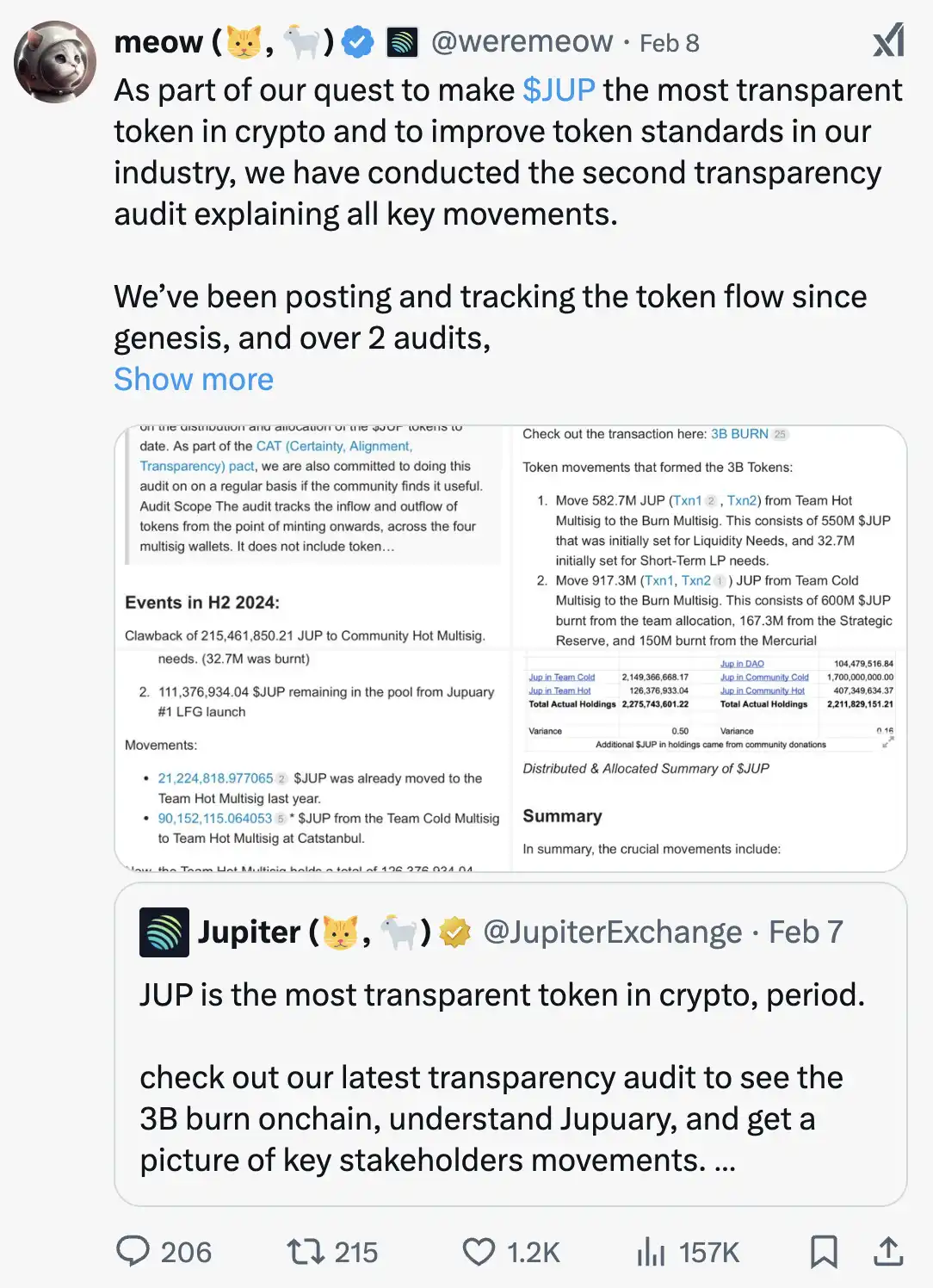
Jupiter recently released a transparency audit report, detailing the team's key fund flows. "We have been publicly tracking token movement since Genesis and have audited all token flows (excluding 1 JUP) twice, consolidating tokens into certified wallets."
Read that last sentence again. For any crypto protocol that has completed its TGE, making the best effort to track ownership of every token is crucial. Similarly, public companies clearly document the ownership structure of their shares. In the crypto space, tracking ownership is relatively more challenging due to the permissionless nature of blockchain, but there are still tools that can help teams achieve a high degree of accuracy in tracking.
Meanwhile, Uniswap…
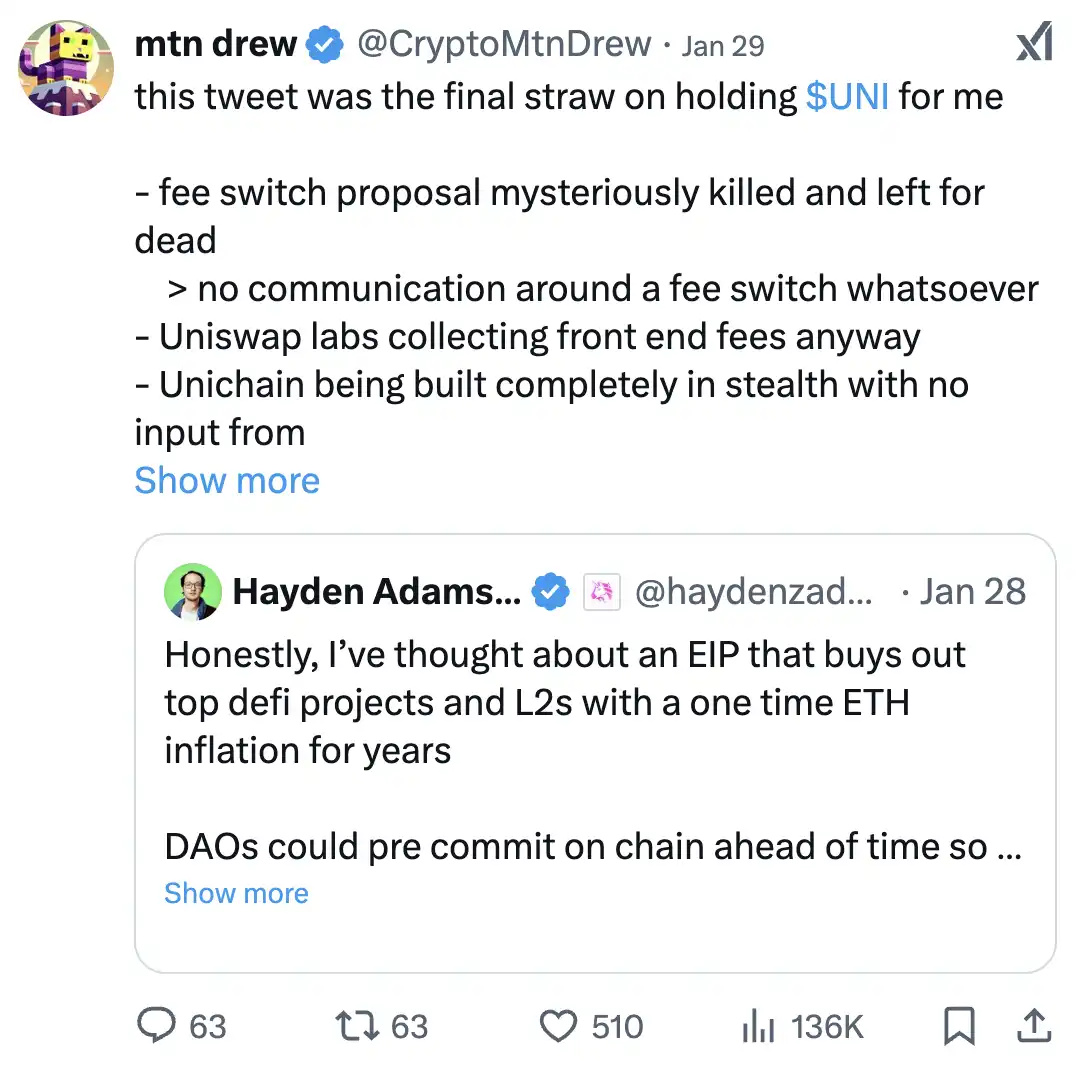
Given enough time, every app will integrate vertically
The key point of today's article is this: the business strategy in the crypto world fundamentally differs from the business models in traditional permissioned environments.
Outside the crypto industry, enterprises typically build a "moat" through regulatory barriers, long-term B2B contracts, proprietary innovation, and so on.
However, in the crypto industry, this kind of "moat" largely ceases to exist because the permissionless nature of blockchain allows anyone to build on existing products, and users can almost always opt for alternatives.
Therefore, what truly matters is branding, user experience, and community, as with the industry's maturation, we will see more and more experienced entrepreneurs enter the crypto race, building on existing infrastructure and launching vampire attacks on existing industry giants.
Ironically, this mirrors exactly what Deepseek is currently doing with OpenAI.
Ultimately, in the cryptocurrency space, the "moat" will evolve into the following three points:
· Brand → Users trust you
· Genuine Community → Users want to be part of your organization and enjoy true ownership (via revenue sharing)
· User Experience → Users love your product
Aggregation Strategy in Permissionless Environments Is Wise
Prior to Jupiter's success, many were skeptical of the aggregation model, especially in the EVM ecosystem where the model didn't shine. For example, 1inch failed to surpass Uniswap in market value because most users still preferred using Uniswap directly (too lazy to switch) or opted for other MEV-friendly DEXs like CoW Swap.
However, in the Solana ecosystem, Jupiter managed to convince users that it offered the best trading experience, successfully aggregated traffic, and captured value.
Frankly, I'm not sure when this shift occurred. I remember during the 2020-2021 DeFi Summer, I used both Orca and Raydium while also trying early versions of Jupiter. If I recall correctly, by the end of DeFi Summer, the user experience of Orca and Raydium had become quite poor, reasons being:
· Lack of a unified token standard (e.g., multiple bridged versions of USDC)
· UI lag
This poor user experience could still be seen a year later.
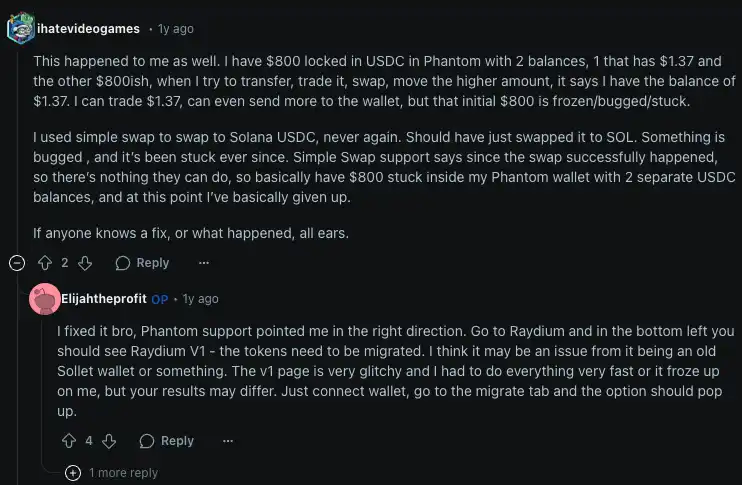
Jupiter used to display the best trade path to prove its exchange rate was optimal. In hindsight, this was a very astute move as there wasn't a clear DEX market winner in the Solana ecosystem at the time. Even though Raydium had the highest market share, its market dominance was nowhere near Uniswap on Ethereum.
Exemplary Business Strategy and Operations
In simple terms, Jupiter excels in its core business—providing Solana users with the best token swap experience. Many protocols in the EVM ecosystem have attempted a similar strategy, but few have succeeded. Additionally, the Jupiter team was initially formed by Racoon Dev led by Meow, which means that during the bear market, they were able to sustain operations with a few engineers in low-cost emerging markets, minimizing fund consumption.
Not all successful startups need the "sexy startup angle"; many successful crypto entrepreneurs initially operated development studios. This "traditional service-oriented business" can teach extremely efficient cost management practices and show founders how to strategically tap into market opportunities.
By 2024, this savvy business operation capability was fully demonstrated in the Jupiter team.
In just 12 months, Jupiter acquired 5 teams:
· Moonshot: Acquired this platform focused on mobile meme trading
· SonarWatch: Acquired on-chain asset management tool
· Ultimate Wallet: Acquired self-custody wallet
· Coinhall: Acquired decentralized exchange terminal
· SolanaFM: Acquired blockchain explorer

Forgive my bluntness, but this is truly a genius-level move. Some of the acquired projects faced fierce competition and market challenges, making them excellent acquisition targets. Moreover, I have no insider information, but I wouldn't be surprised if these acquisitions were mainly done through the JUP token. Considering JUP's current FDV, the Jupiter team undoubtedly expanded its footprint at a low cost and onboarded a group of excellent developers.
Conclusion
This idea is not new. Nascent's Dan Elitzer wrote an article titled "The Inevitability of UNIchain" in 2022, with the core point being: "As applications scale, control over block space becomes increasingly important... The solution is to build a dedicated chain or Rollup managed by validators invested in the application's success."
My view is similar but more straightforward—this is an embodiment of human nature in capitalist business society: optimizing value capture, vertical integration.
The crypto industry is still operated by humans, and we still can't shake off our innate desire to control the value chain. Let's be realistic here.
You may also like

Meet the new WEEX trial fund—your gateway to greater profits

WEEX Labs Lands at Dutch Blockchain Week: A Disruptive Crypto × AI Conversation Sets Sail in Amsterdam

SK Hynix Reportedly Plans U.S. ADR Listing as Early as August, With SEC Approval Possible in Late June
SK Hynix may pursue a U.S. ADR listing as early as August, with SEC approval reportedly possible in late June amid strong AI chip supply chain demand.

SpaceX vs Tesla vs xAI: Which Elon Musk Trade Has the Biggest Upside in 2026?

OpenAI Reveals It Has Confidentially Submitted an S-1 to the SEC, Keeping the Door Open for a Future IPO
On June 9, according to an OpenAI announcement, the company recently confidentially submitted a draft S-1 registration statement to the U.S. Securities and Exchange Commission (SEC), beginning the preliminary compliance process for a potential initial public offering. OpenAI said it chose to disclose this proactively because it expected the news might leak; however, the company has not yet set a specific listing timeline, and related arrangements may still take some time.

Latest research from 13 top universities including Cornell University: The current state, challenges, and misconceptions of the fusion of Crypto and AI
Deconstructing Anthropic: The Best AI Company, Possibly Also a Type of Organizational Invention
Apollo and Blackstone Reportedly Back $35 Billion Anthropic Chip Financing as Deal Details Remain Unclear
On June 9, according to currently available news alerts, Apollo and Blackstone Group participated in a $35 billion financing for an Anthropic “chip project.” Based on the original wording of the report, the funding has already been raised, but public information remains limited. The financing structure, use of proceeds, project entity, and whether Apollo and Blackstone participated through equity, debt, or project financing have not yet been disclosed.

Humanity Protocol Security Incident Escalates: More Than $31 Million Stolen From Related Addresses as Attacker Continues Selling H for ETH
On June 9, according to monitoring by Onchain Lens, more than $31 million has been stolen from addresses linked to Humanity Protocol, and the attack is still ongoing, with the hacker continuously swapping H tokens for ETH. Project founder Terence Kwok later confirmed the security incident on X, saying the issue involved a private key leak.

Bloomberg: As Bitcoin Weakens, Stablecoins and RWA Continue to Drive Expansion in Crypto Businesses
In June, Bloomberg reported that despite Bitcoin falling below $60,000 last week, wiping out about $235 billion in market value within seven days, and dropping close to 50% from last year’s peak, some core businesses in the crypto industry are still expanding, mainly in stablecoins, real-world asset tokenization (RWA), payments, and infrastructure. The report also noted that overall altcoin activity has contracted significantly: altcoin market capitalization has fallen from a peak of about $431 billion in November 2021 to around $170 billion, and among the tens of millions of tokens issued in recent years, fewer than 1,700 still maintain meaningful trading activity.

Galaxy Deep Research Report: How Hyperliquid's HIP-4 Upgrade Changes the Landscape of Prediction Markets?
Binance Research: RWA Market Expected to Expand Nearly 6x from Early 2025, with Public Equities and Onchain Payments Heating Up Together
In June, Binance Research said in its monthly market report that the real-world asset (RWA) market is expected to grow by about 589% from the beginning of 2025. Bond- and money market fund-related RWA expanded by about $6.5 billion, up 83% year over year, while publicly traded equity RWAs grew by about 422%. The report also noted that monthly crypto debit card transaction volume exceeded $747 million in May, up 48.6% year to date.

Japan to Assess a Framework for Yen Stablecoins and Crypto ETFs as Asia’s Compliant Payments Narrative Heats Up
Recently, according to the original report, Japan is considering the launch of yen stablecoins and cryptocurrency ETFs. Public information remains limited at this stage, and there is still no complete policy text, regulatory draft, or clear implementation timeline, so this is better characterized as a “policy discussion” rather than formal implementation. The original wording also noted that advancing stablecoin regulation in Asia is driving XRP usage and supporting growth in the XRPL ecosystem. However, based on currently available public information, there is not enough evidence to directly establish a clear causal relationship between this round of discussion in Japan and XRP or XRPL.

ZachXBT: Humanity private key leak and abnormal surge in H token should be viewed separately
On June 9, according to related disclosures, on-chain investigator ZachXBT posted an update on Humanity’s roughly $31 million security incident, saying that after further analyzing fund flows, he currently tends to believe the project team was not involved in an “inside job” or a self-staged attack. According to him, the official explanation about the private key leak was broadly accurate, but before the token unlock, the price of H had been artificially pushed higher, and the hacker later took advantage of that market environment; therefore, the private key leak and the earlier abnormal price pumping should be regarded as two separate and independent events. This reframing has shifted the market’s understanding of the nature of the incident. Earlier discussion around Humanity had focused on whether the team directly participated in the attack or used the security incident to cover up internal operations. ZachXBT’s latest remarks shift the focus from “whether it was self-theft” to “whether there were pre-unlock market structure issues.” He also questioned whether the team may have.

Morning Report | OpenAI has submitted an S-1 registration statement draft to the U.S. SEC; Morpho completes $175 million financing

Morning Report | BitMine increased its holdings by 126,971 ETH last week; trader Eugene announced his exit from the crypto market

Wang Chuan: How can one not feel anxious after the neighbor Old Wang made thirty times profit by investing in storage stocks? (Seven) - A quarter-century cycle
Cryptocurrency CEXs are flocking to sell US stocks, and traditional brokerages are facing an "uninvited guest."
Meet the new WEEX trial fund—your gateway to greater profits
WEEX Labs Lands at Dutch Blockchain Week: A Disruptive Crypto × AI Conversation Sets Sail in Amsterdam
SK Hynix Reportedly Plans U.S. ADR Listing as Early as August, With SEC Approval Possible in Late June
SK Hynix may pursue a U.S. ADR listing as early as August, with SEC approval reportedly possible in late June amid strong AI chip supply chain demand.
SpaceX vs Tesla vs xAI: Which Elon Musk Trade Has the Biggest Upside in 2026?
OpenAI Reveals It Has Confidentially Submitted an S-1 to the SEC, Keeping the Door Open for a Future IPO
On June 9, according to an OpenAI announcement, the company recently confidentially submitted a draft S-1 registration statement to the U.S. Securities and Exchange Commission (SEC), beginning the preliminary compliance process for a potential initial public offering. OpenAI said it chose to disclose this proactively because it expected the news might leak; however, the company has not yet set a specific listing timeline, and related arrangements may still take some time.
Latest research from 13 top universities including Cornell University: The current state, challenges, and misconceptions of the fusion of Crypto and AI


