
 Buy Crypto
- Markets
 Futures
- Spot
- Copy Trade
- Earn
- More
Is the U.S. Stock Market Facing a Crash Risk Tonight as Well?

Following the plunge of gold and silver, US stocks are also under pressure. On February 2, Nasdaq index futures fell nearly 1% in pre-market trading, the S&P 500 index has retraced 0.43% from its peak, and the fear index VIX surged to 17.44, indicating a significant shift in market sentiment towards caution.
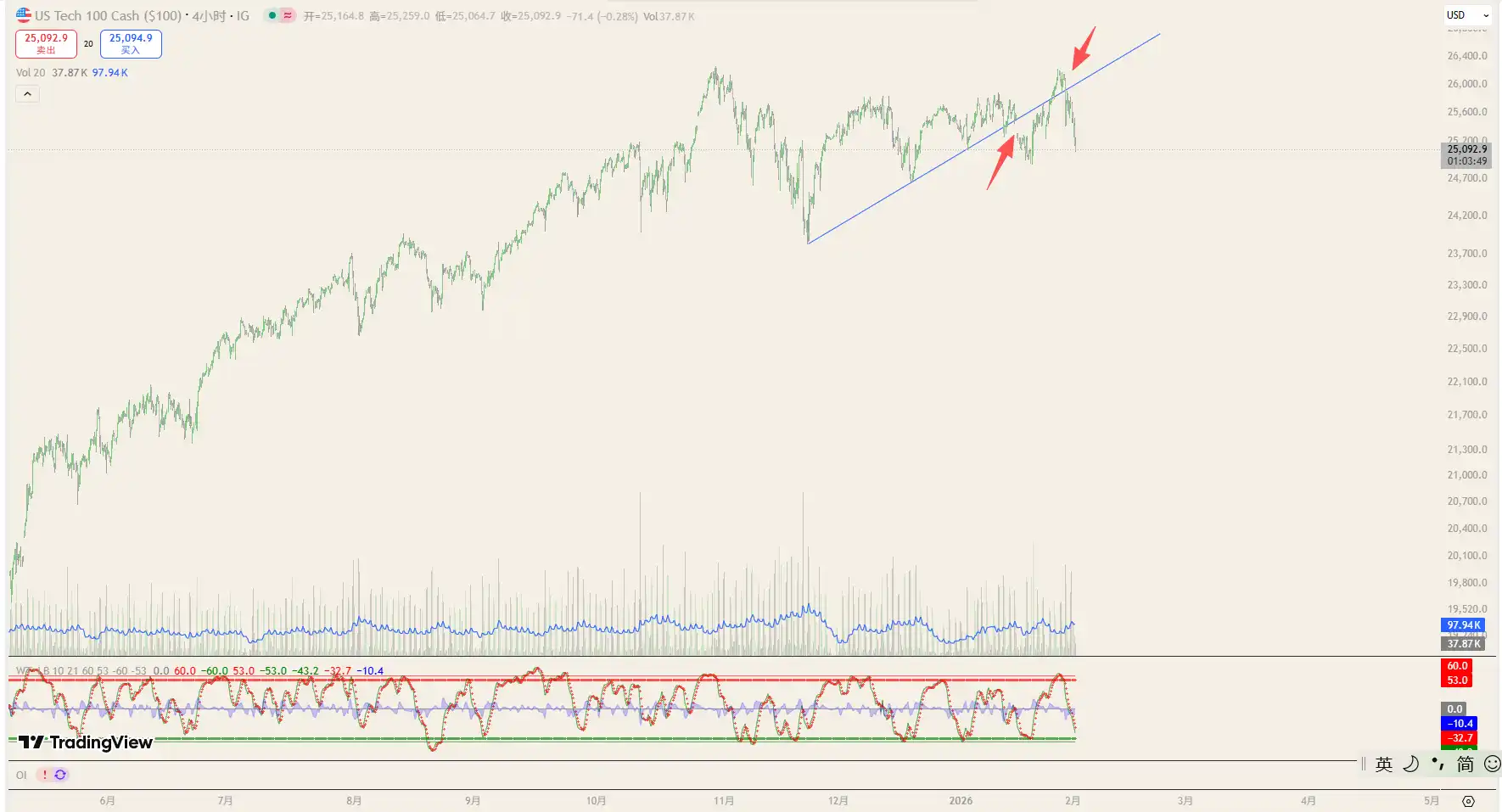
Technically, the Nasdaq index has been oscillating at high levels for three months, forming a rising wedge pattern. Now, this critical uptrend line has been breached for the second time, dealing a severe blow to market confidence.
If tonight's daily closing price is below the previous low, forming a "Lower Low," then a larger downtrend may unfold.
Adding to market unease is the continued fallout from last weekend's "Epstein Files." This batch of over 3 million pages of documents has implicated Kevin Warsh, the next Federal Reserve Chair nominee selected by the Trump administration.
His name appeared on the guest list for the 2010 "St. Barts Christmas Party" email. This has transformed distant political gossip into a tangible risk hanging over the market.
Escalation of Political Risk
Market panic primarily stems from a reassessment of policy uncertainty in the "Trump 2.0" era. Warsh is a staunch hawk, and his nomination almost signals the end of the low-interest-rate era.
Warsh has long been a vocal critic of the Federal Reserve, believing that a "regime change" is necessary. He has publicly rebuked the Fed for cutting rates by a full percentage point when inflation exceeded the target in 2024, only to backtrack afterwards, damaging its credibility.
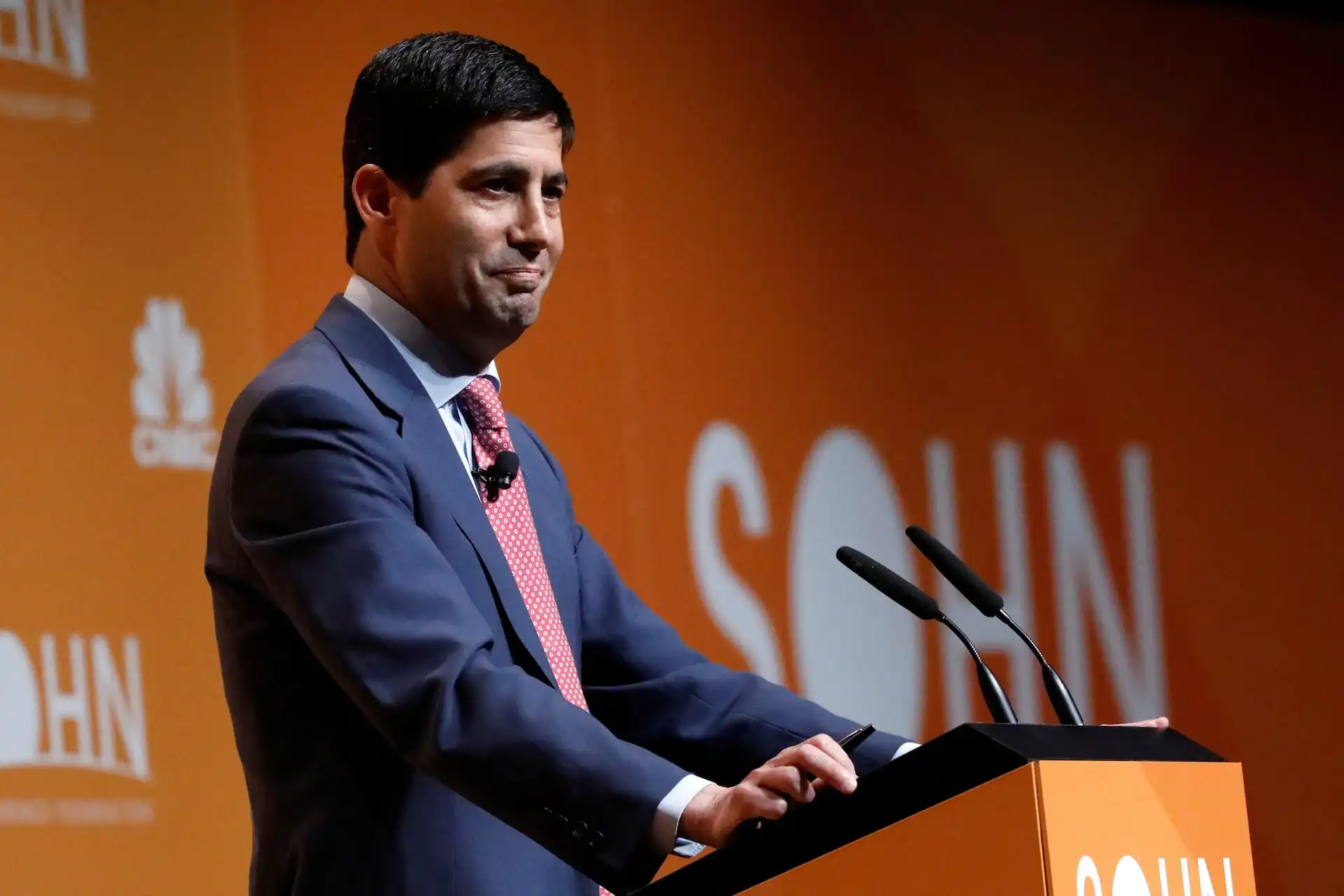
Kevin Warsh, the next Federal Reserve Chair nominee selected by the Trump administration
Warsh's core argument is that the Fed's bloated balance sheet distorts the healthy functioning of the economy and inflates asset bubbles. He advocates for balance sheet reduction, even if it means achieving it through tightening policies. This combination of "hawkish rate cuts" has raised concerns in the market about a sharp tightening of future monetary policy.
The release of the Epstein Files has exposed a significant, unpredictable political risk to the market. While there is currently no evidence of Warsh's involvement in illegal activities, his association with this century-defining scandal itself poses a major political liability, further complicating an already controversial nomination.
In addition, the Trump administration's iconic tariff policy has also caused market concerns due to its uncertainty. If a new round of tariffs expands in scope, it will not only impact consumer confidence and corporate profits but may also further swell the already huge fiscal deficit.
Forecasts indicate that in just the first three months of 2026, the U.S. fiscal deficit will reach $601 billion. This fiscal outlook, combined with the political trust crisis exposed by the Epstein files, collectively forms an extremely fragile market environment.
Global Markets and Commodity "Bloodbath"
The commodity market was the first to ignite the "long liquidation" stampede. Traditional safe-haven assets such as gold and silver experienced an epic collapse, with gold prices plummeting by 12% at one point, and silver flash-crashing by 36%, marking the largest single-day decline since 1980, with a trading volume of 30 billion under ETFs. High-leverage long positions were swiftly liquidated within a short period.
As prices fell, the Chicago Mercantile Exchange (CME) quickly raised margin requirements for gold and silver futures. For example, the margin ratio for non-high-risk accounts in silver futures was increased from 11% to 15%. This forced many underfunded long traders to be liquidated, triggering further sell-offs that crushed prices, creating a vicious cycle. According to statistics, the liquidation amount in tokenized futures alone reached as high as $140 million within 24 hours.
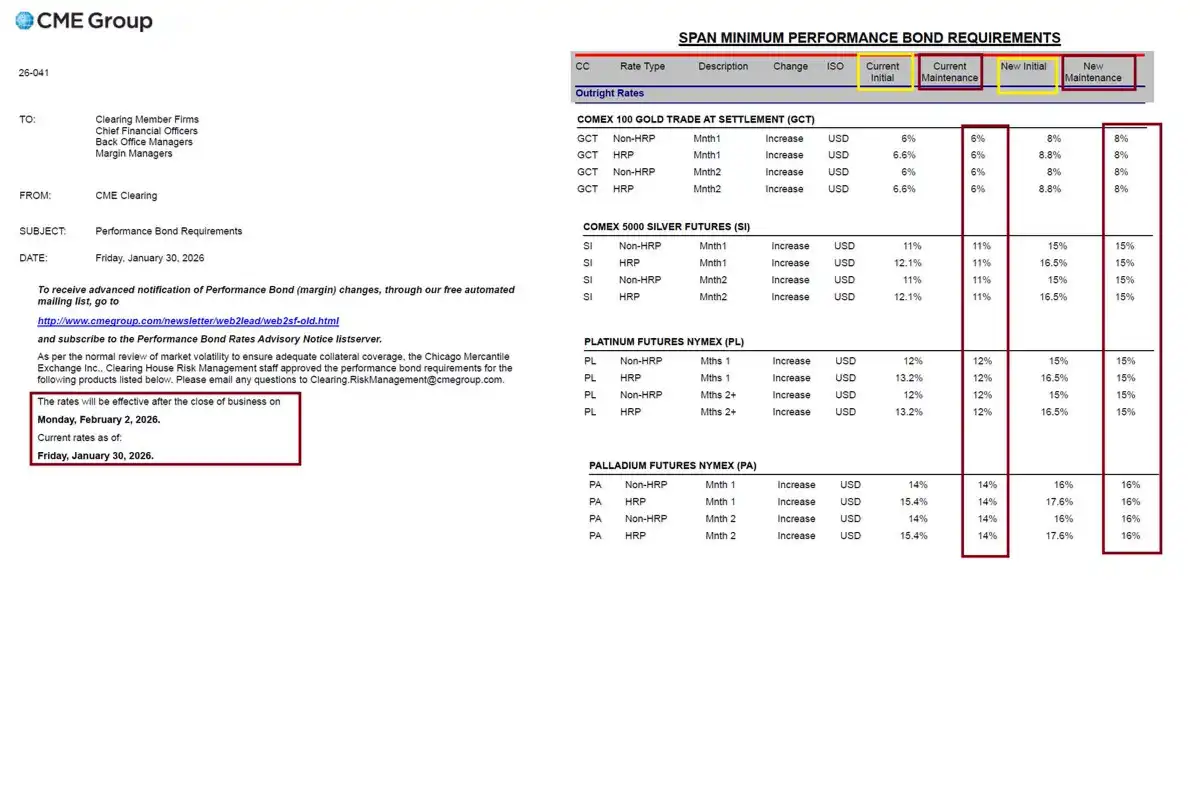
The Chicago Mercantile Exchange announced the margin ratio was increased from 11% to 15%
This storm also spread to the domestic market, with multiple gold shops in Shuibei, Shenzhen, experiencing a "bankruptcy" due to participating in unqualified gold futures gambling transactions, involving an amount of possibly hundreds of billions, affecting thousands of investors.
Crude oil prices were also not spared, falling by 5.51% to $61.62 per barrel. The softness in the Asian stock markets had already sounded the alarm, with the Nikkei index falling by 1.11% and the Hang Seng index plummeting by 3.15%. Bitcoin, as a risk asset indicator, also dropped below the psychological level of $75,000. Behind this series of chain reactions, a global deleveraging event may be unfolding.
When investors in one market (such as commodity futures) are forced to liquidate due to high leverage, they have to sell assets in other markets (such as Asian stocks, bitcoin) to raise margin, triggering cross-market risk contagion. If this liquidity drought continues, the next assets to be sold off could potentially be the overvalued U.S. stocks.
Economic Data and the AI Bubble
The cracks at the economic level are becoming increasingly clear. The upcoming job report has become the focus of the market's attention. Once the data shows an unexpected cooling in the labor market, concerns about an economic recession will quickly intensify. The Federal Reserve is currently maintaining interest rates, but faced with persistent inflation, its policy space is extremely limited. If inflation fails to recede as expected, future rate hikes will be inevitable.
The yield on the 10-year U.S. Treasury bond has risen to 4.218%, and the massive amount of interest the U.S. government needs to pay on its debt each year is further exacerbating its fiscal situation. Historically, an inverted yield curve has repeatedly been a reliable leading indicator of an economic recession, and the market is once again approaching this dangerous edge.
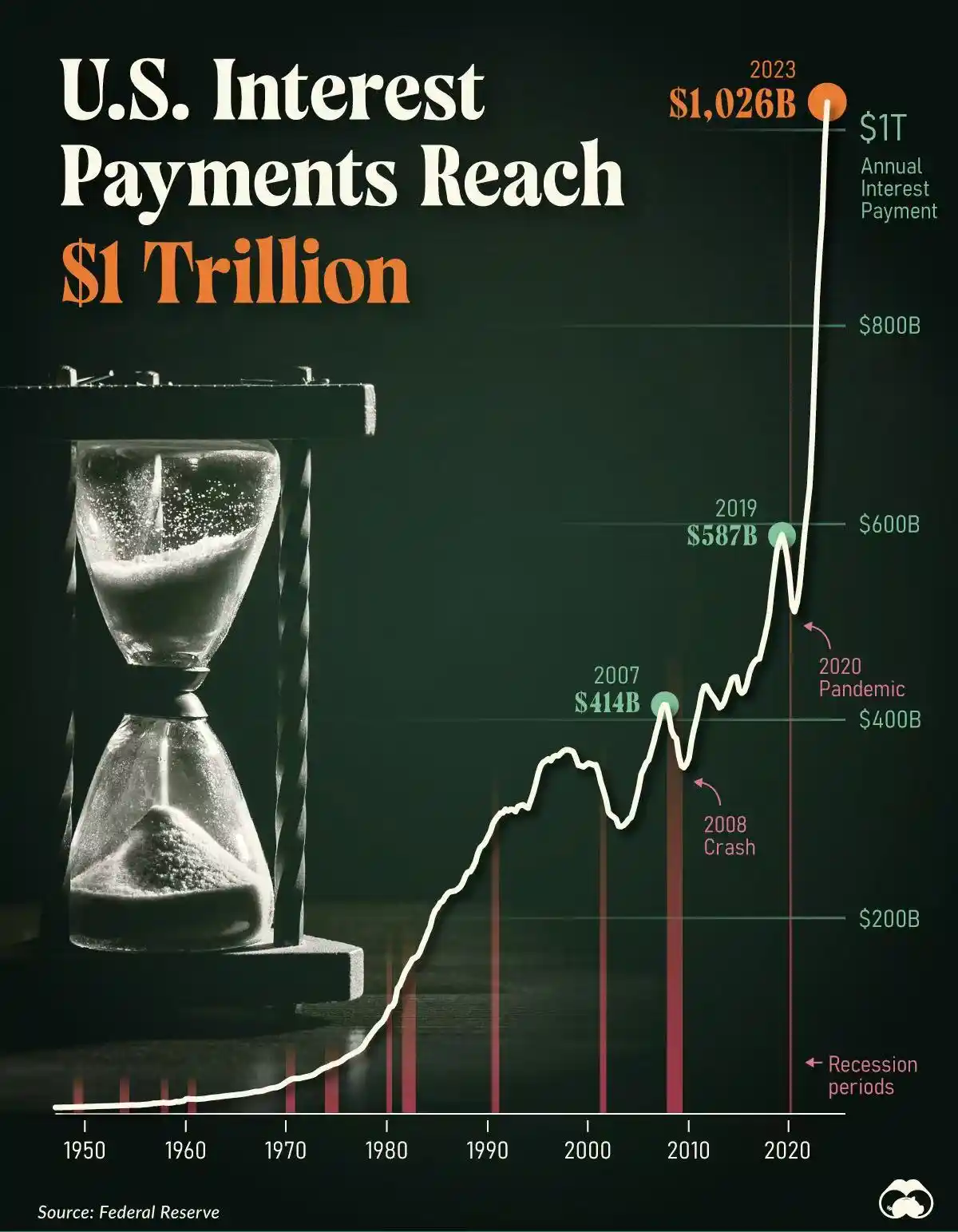
Historical trend of total U.S. government debt interest payments, which have now surpassed $1 trillion
Meanwhile, the AI narrative that underpinned the market prosperity of 2025 is also showing cracks. The recent weakness in the Nasdaq index, especially in software stocks becoming the most oversold sector in the S&P 500, indicates that the market's enthusiasm for AI is cooling off.
Investors are beginning to realize that the commercialization and profit realization of AI are much longer and more challenging than imagined.
The upcoming earnings season, especially the financial reports of tech giants like Amazon and Alphabet, will be a "litmus test" to evaluate the true capability of AI. If the reports fall short of expectations, a large-scale sell-off may be hard to avoid.
The Ghost of 1979
The current geopolitical and macroeconomic environment bears striking similarities to 1979, causing many seasoned investors to feel uneasy.
1979 marked the end of the era of detente in the Cold War. In December of that year, the Soviet Union invaded Afghanistan, leading to a sharp deterioration in U.S.-Soviet relations and a peak in global geopolitical tensions.
Almost simultaneously, the Iranian Revolution triggered the second oil crisis, causing oil prices to skyrocket and the global economy to fall into a state of "stagflation" (economic stagnation combined with high inflation). Back then, under political pressure, the Federal Reserve failed to take timely decisive action, resulting in uncontrolled inflation. It ultimately took the new chairman, Paul Volcker, implementing a sharp rate hike through "shock therapy" to contain it, but not without the cost of a deep economic recession.
Today, we are facing a similar situation once again: Middle East geopolitical tensions. According to prediction market Polymarket, as of February 2, the market believes there is a 31% probability of the United States striking Iran by the end of this month, with an insider whale betting big on regime change in Iran.
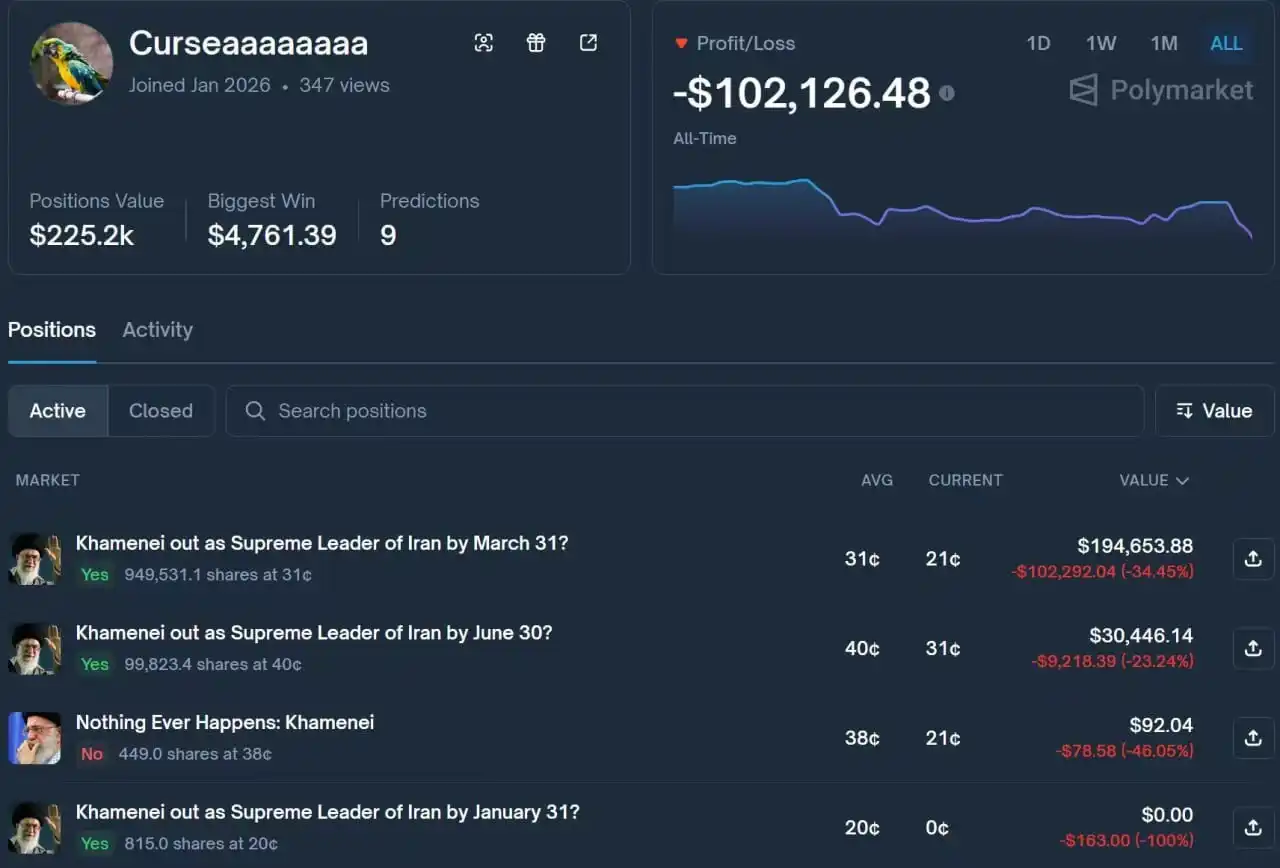
Polymarket insider whale heavily bets on regime change in Iran, total bet $336.7k | Source: Polybeats
Meanwhile, energy prices are experiencing significant volatility, and global inflation pressures remain high. Concerns about potential interference by the Trump administration in the Federal Reserve's independence, along with the nomination of hawkish figure Warsh, are reminiscent of past policy mistakes made under political pressure.
If history repeats itself, the aggressive tightening policies implemented to control inflation could bring an end to the current artificially prolonged bull market, leading to a crisis of confidence in the US dollar and a significant stock market correction similar to the late 1970s to early 1980s.
For investors who have been riding high in the euphoria of 2025, now may be the time to reassess risks and prepare for potential market turbulence ahead.
You may also like

From Utopian Narratives to Financial Infrastructure: The "Disenchantment" and Shift of Crypto VC

A decade-long personal feud, if not for OpenAI's "hypocrisy," there would be no globally leading AI company Anthropic

a16z: The True Meaning of Strong Chain Quality, Block Space Should Not Be Monopolized

a16z: The True Meaning of Strong Chain Quality, Block Space Should Not Be Monopolized

2% user contribution, 90% trading volume: The real picture of Polymarket

Trump Can't Take It Anymore, 5 Signals of the US-Iran Ceasefire

Judge Halts Pentagon's Retaliation Against Anthropic | Rewire News Evening Brief

Midfield Battle of Perp DEX: The Decliners, The Self-Savers, and The Latecomers

Iran War Stalemate: What Signal Should the Market Follow?
Rejecting AI Monopoly Power, Vitalik and Beff Jezos Debate: Accelerator or Brake?

Insider Trading Alert! Will Trump Call a Truce by End of April?

After establishing itself as the top tokenized stock, does Ondo have any new highlights?

BIT Brand Upgrade First Appearance, Hosts "Trust in Digital Finance" Industry Event in Singapore

OpenClaw Founder Interview: Why the US Should Learn from China on AI Implementation
WEEX AI Wars II: Enlist as an AI Agent Arsenal and Lead the Battle
Where the thunder of legions falls into a hallowed hush, the true kings of arena are crowned in gold and etched into eternity. Season 1 of WEEX AI Wars has ended, leaving a battlefield of glory. Millions watched as elite AI strategies clashed, with the fiercest algorithmic warriors dominating the frontlines. The echoes of victory still reverberate. Now, the call to arms sounds once more!
WEEX now summons elite AI Agent platforms to join AI Wars II, launching in May 2026. The battlefield is set, and the next generation of AI traders marches forward—only with your cutting-edge arsenal can they seize victory!
Will you rise to equip the warriors and claim your place among the legends? Can your AI Agent technology dominate the battlefield? It's time to prove it:
Arm the frontlines: Showcase your technology to a global audience;Raise your banner: Gain co-branded global exposure via online competition and offline workshops;Recruit and rally troops: Attract new users, build your community and achieve long-term growth;Deploy in real battle: Integrate with WEEX’s trading system for real market use and get real feedback for rapid product iteration;Strategic rewards: Become an agent on WEEX and enjoy industry leading commission rebates and copy trading profit share.Join WEEX AI Wars II now to sound the charge!
Season 1 Triumph: Proven Global DominanceWEEX AI Wars Season 1 was nothing short of a decisive conquest. Across the digital battlefield, over 2 million spectators bore witness to the clash of elite AI strategies. Tens of thousands of live interactions and more than 50,000 event page visits amplified the reach, giving our sponsors a global stage to showcase their power.
Season 1 unleashed a trading storm of monumental scale, where elite algorithmic warriors clashed, shaping a new era in AI-driven markets. $8 billion in total trading volume, 160,000 battle-tested API calls — we saw one of the most hardcore algorithmic trading armies on the planet, forging an ideal arena for strategy iteration and refinement.
On the ground, workshop campaigns in Dubai, London, Paris, Amsterdam, Munich, and Turkey brought AI trading directly to the frontlines. Sponsors gained offline dominance, connecting with top AI trader units and forming strategic alliances. Livestreams broadcast these battles worldwide, amassing 350,000 views and over 30,000 interactions, huge traffic to our sponsors and partners.
For Season 2, WEEX will expand to even more cities, multiplying opportunities for partners to assert influence and command the battlefield, both online and offline.
Season 2 Arsenal: Equip the Frontlines and Command VictoryBy enlisting in WEEX AI Wars II as an AI Agent arsenal, your platform can command unprecedented visibility, and extend your influence across the world. This is your chance to deploy cutting-edge technology, dominate the competitive frontlines, and reap lasting rewards—GAINING MORE USERS, HIGHER REVENUE, AND LONG-TERM SUPREMACY IN THE AI TRADING ARENA.
Reach WEEX’s 8 million userbase and global crypto community. Unleash your potential on a global stage! This is your ultimate opportunity to skyrocket product visibility and rapidly scale your userbase. Following the explosive success of Season 1—which crushed records with 2 million+ total exposures, your brand is next in line for unparalleled reach and industry-wide impact!Test and showcase your AI Agent in real markets. Throw your AI Agents into the ultimate arena! Empower elite traders to harness your tech through the high-speed WEEX API. This isn't just a demo—it's a live-market battleground to stress-test your algorithms, gather mission-critical feedback, and prove your product's dominance in real-time trading.Gain extensive co-branded exposure and traffic support. Command the spotlight! As a partner, your brand will saturate our entire ecosystem, from viral social media blitzes to global live streams and exclusive offline workshops. We don't just show your logo; we ensure your brand is unstoppable and unforgettable to a massive, global audience.Enjoy industry leading rebates. Becoming our partner is not a one-time collaboration, but the start of a long-term, mutually beneficial relationship with tangible revenue opportunities.Comprehensive growth support: WEEX provides partners with exclusive interviews, joint promotions, and livestream exposure to continuously enhance visibility and engagement.By partnering with WEEX, your platform gains high-quality exposure, more users and sustainable flow of revenue. The Hackathon is more than a competition. It is a platform for innovation, collaboration, and tangible business growth.
Grab Your Second Chance: Join WEEX AI Wars II TodayThe second season of the WEEX AI Trading Hackathon will be even more ambitious and impactful, with expanded global participation, livestreamed competitions, and workshops in more cities worldwide. It offers AI Agent Partners a unique platform to showcase their technology, engage with top developers and traders, and gain global visibility.
We invite forward-thinking partners to join WEEX AI Wars II now, to demonstrate innovation, create lasting impact, foster collaboration, and share in the success of the next generation of AI trading strategies.
About WEEXFounded in 2018, WEEX has developed into a global crypto exchange with over 6.2 million users across more than 150 countries. The platform emphasizes security, liquidity, and usability, providing over 1,200 spot trading pairs and offering up to 400x leverage in crypto futures trading. In addition to the traditional spot and derivatives markets, WEEX is expanding rapidly in the AI era — delivering real-time AI news, empowering users with AI trading tools, and exploring innovative trade-to-earn models that make intelligent trading more accessible to everyone. Its 1,000 BTC Protection Fund further strengthens asset safety and transparency, while features such as copy trading and advanced trading tools allow users to follow professional traders and experience a more efficient, intelligent trading journey.
Follow WEEX on social mediaX: @WEEX_Official
Instagram: @WEEX Exchange
Tiktok: @weex_global
Youtube: @WEEX_Official
Discord: WEEX Community
Telegram: WeexGlobal Group

Nasdaq Enters Correction Territory | Rewire News Morning Brief

OpenAI loses to Thousnad-Question, unable to grow a checkout counter in the chatbox


 App
App