
In 18 days, Musk terminated hundreds of contracts and took six Gen Z Americans to reshape the future United States


On the morning of February 3rd, Washington time, the headquarters of the United States Agency for International Development (USAID) was tightly closed, and the once bustling office area fell into silence. Just the night before, officials from Elon Musk's Department of Government Efficiency (DOGE) officially took over this over 60-year-old international aid agency and announced plans for a complete shutdown. USAID staff received an email informing them that, except for essential personnel, all other staff would transition to remote work. At the same time, the USAID website was taken offline, official social media accounts were deleted, and the agency's operations came to a standstill.
Musk stated on social media that he had discussed the matter with President Trump and had been granted full authority to shut down USAID. He claimed that the agency was a "far-left criminal organization" that needed to be completely dissolved.
Musk collaborated with Trump to establish the "Department of Government Efficiency" (DOGE) under the pretext of "streamlining government" to drive radical reforms. Its core goals focused on reducing government spending, digitizing bureaucratic systems, and replacing manpower decisions with algorithms. This high-profile closure of USAID has also exposed the true face of the previously mysterious DOGE team members, and this may only be the beginning as the power structure of the U.S. federal government is rapidly being reshaped.
Team Composition: Average Age 22, the "Tech Six"
The DOGE team consists of 6 technical elites aged 19-25, all without government experience but closely linked to Musk's companies (such as SpaceX, Neuralink) or Silicon Valley capital (such as Peter Thiel).

Image Source Internet
Gavin Krieg (25): Krieg graduated from the University of California, Berkeley with a major in Electrical Engineering and Computer Science and previously served as a Senior Software Engineer at the U.S. AI data analysis company Databricks, specializing in artificial intelligence and big data analysis. Krieg's task is to draft executive orders and ensure their rapid implementation within the government. The email sent to all USAID staff on Monday instructing them not to report to headquarters came directly from him. He also directly drafted the funding review order for the U.S. Treasury Department, participated in the OPM's large-scale layoff plan, and was responsible for establishing the "rehiring standards" for civil servants, requiring future government employees to be approved by DOGE before being hired.
Luke Farihto (23): Farihto dropped out of the University of Nebraska, Lincoln and later worked for Silicon Valley entrepreneur Nat Friedman behind GitHub. He interned at SpaceX, writing software for pumps, valves, and other components that help fuel rockets. Farihto is currently listed as the "Executive Engineer" in the Office of the Secretary of the U.S. Department of Health and Human Services (HHS), personally overseeing USAID's digital lockdown operation. The next target is set on the systems of the Centers for Medicare and Medicaid Services responsible for contracts.
Edward Corristine (19 years old): Corristine is the youngest member, having just graduated from high school and currently studying Mechanical Engineering and Physics at Northeastern University in Boston. Last summer, he worked for three months at Elon Musk's brain-machine interface company, Neuralink, although his specific role is still unclear. Corristine once used a non-governmental Gmail account to join a call with U.S. General Services Administration employees, asking them to review their own code and prove the validity of their work, causing dissatisfaction among federal employees.
Akash Bova (21 years old): Bova hails from the University of California, Berkeley, and was a Investment Engineering Intern at Bridgewater Associates. He also interned at Meta and Palantir, a U.S. software services company founded by MAGA supporter Peter Thiel, specializing in artificial intelligence, data analysis, and financial modeling. He is responsible for designing algorithms to monitor government fund flows, and his "Real-Time Fiscal Expenditure Monitoring System" allows the real-time freezing of federal "inefficient spending" without congressional oversight.
Ethan Shotland (22 years old): Shotland is a senior studying Computer Science at Harvard University and is the only team member with experience in AI entrepreneurship. His AI company, Energize AI, received a $100,000 grant from OpenAI and was the runner-up in a hackathon hosted by Musk's AI company, xAI. Shotland is in charge of the DOGE AI Government Plan, which aims to use algorithms to replace the government's traditional human decision-making processes, automating most administrative approvals, budget assessments, and even congressional reporting.
Gautier Cole Kilian (24 years old): Kilian breached the Treasury Department's security system to gain access to the payment network. A graduate of McGill University, he has strong abilities in financial data processing and previously worked as an engineer at Jump Trading, a company specializing in high-frequency financial trading and algorithms. Kilian's main task is to help the DOGE team breach the Treasury Department's security defenses to access the government's payment network, bypassing security checks to directly read millions of transaction records. Kilian is also one of the few young people who have been granted high-level access to the White House, and Musk has immense trust in him.
Through the collective efforts of these six individuals, DOGE completed an administrative restructuring of the U.S. government in just two weeks, a feat that had not been achieved in decades. Their actions were extremely efficient, with each person handling multiple tasks and working around the clock. Some team members worked 24/7 without leaving their posts, sleeping in the office when tired. They conducted a comprehensive audit of the seemingly bottomless pit of the U.S. federal agencies. Musk held them in high regard, praising them as the "future of the new government" on social media.
The White House Launches "Silicon Valley-Style Blitzkrieg"
Since Donald Trump took office on January 20th, the Musk-led Department of Government Efficiency (DOGE) has embarked on a lightning-fast dismantling process. According to a DOGE official tweet, the following institutions, projects, and funds have been shut down as of now:
January 20th: Dissolution of the Chief Diversity Officer Executive Committee (CDOEC);
January 25th: Cancellation of approximately $4.2 billion of existing/upcoming contracts;
January 27th: The Departments of Labor, Transportation, Agriculture, Commerce, Health and Human Services, and the Treasury canceled 16 DEIA contracts, saving $145 million;
January 28th: The General Services Administration (GSA) terminated three nearly vacant office space leases, closed 17 DEIA websites, saving $1.6 million;
January 29th: Cancellation of a $45 million DEI scholarship grant to Myanmar;
(As of January 29, 2025, 26 departments, including the Department of Education and GSA, have terminated 85 DEIA-related contracts totaling approximately $1 billion;)
February 3rd: The number of underutilized building lease terminations increased to 22, with the savings increasing from $1.6 million to $44.6 million;
February 3rd: Closure of the United States Agency for International Development (USAID);
February 4th: 6 agencies terminated 36 contracts, saving approximately $165 million, including the Department of Homeland Security's "Humanitarian Investigations and Climate Support Services" contract;
February 5th: Termination of 12 consulting contracts (at GSA and the Department of Education), saving approximately $30 million;
February 6th: The Social Security Administration terminated its "Gender X Initiative Tagging" contract, saving over $1 million; NASA canceled its Politico subscription, saving $500,000; 78 contracts in the DEI, distressed assets, media, and consulting categories were terminated, with a total savings of approximately $110 million;
February 8th: It was announced that in the past 48 hours, the Department of Health and Human Services terminated 62 contracts worth $182 million; the Department of Education terminated three DEI training grants totaling $15 million.
Under Trump's directive, the Musk team is systematically taking over U.S. federal agencies through unconventional means, and the most controversial USAID shutdown has long been foreshadowed. In the past half month, over 70% of USAID's departments have been successively shut down, with over a thousand regular employees and contractors being forcibly laid off or placed on indefinite leave. Its digital portal is completely paralyzed, social media updates have stopped, and even the institutional headquarters' nameplates have been quietly removed.
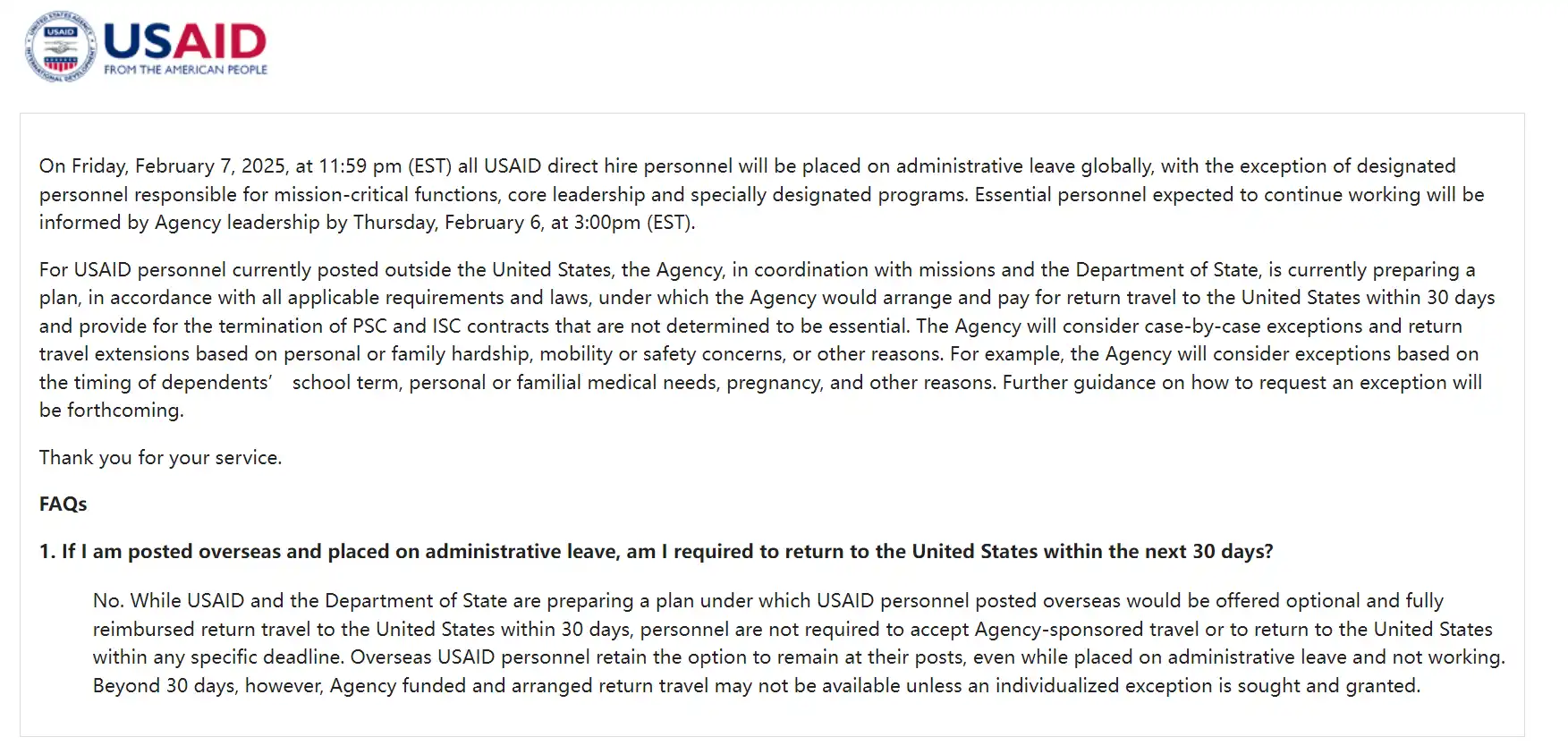
Image Source: USAID Official Website, Statement: All USAID direct-hire employees will be on administrative leave starting at 11:59 PM Eastern Time on Friday, February 7
This systemic takeover is spreading at an astonishing pace. Under Musk's leadership, the DOGE team has not only swiftly taken control of the USAID command center but has also simultaneously infiltrated key departments such as the Treasury, Office of Personnel Management (OPM), General Services Administration (GSA), among others. Several chief security officers, chief financial officers, and top executives of key departments have been summarily dismissed, and numerous senior civil servants have been sidelined. In stark contrast, hundreds of tech newcomers with mysterious ties to Musk, lacking government work experience, are assuming key government positions through special channels, bypassing regular security vetting to directly access classified databases.
Of particular controversy is DOGE's penetration of the financial payment hub. This hub, which oversees the distribution of social security benefits, healthcare subsidies, government salaries, and corporate grants, has traditionally been run by career finance officials. However, the DOGE team has recently broken through traditional constraints by not only gaining real-time monitoring access to the financial payment system but also initiating the establishment of a "non-essential expenditure" screening mechanism, preparing to implement intelligent cutbacks on federal welfare programs.
Musk claimed on social media that there are significant "illegitimate payments" in the federal government's daily expenditures, including foreign aid, social welfare, academic research funding, etc., and DOGE's goal is to cut $4 billion in daily expenditures. On February 6, DOGE announced the termination of 78 contracts in DEI, distressed assets, media, and consulting categories, including a contract for "Mauritania Islamic Republic Groundwater Exploration and Assessment," resulting in approximately $110 million in total savings.

Of course, there are also some changes that are somewhat comical, especially in gender issues that are generally incomprehensible to the Chinese. On February 6, DOGE's official Twitter account announced, "The Social Security Administration has terminated the contract for the 'Gender X Initiative Marker' and removed all gender ideology-related content from public-facing applications. This has saved over $1 million and is in line with the President's executive order" (see image below).
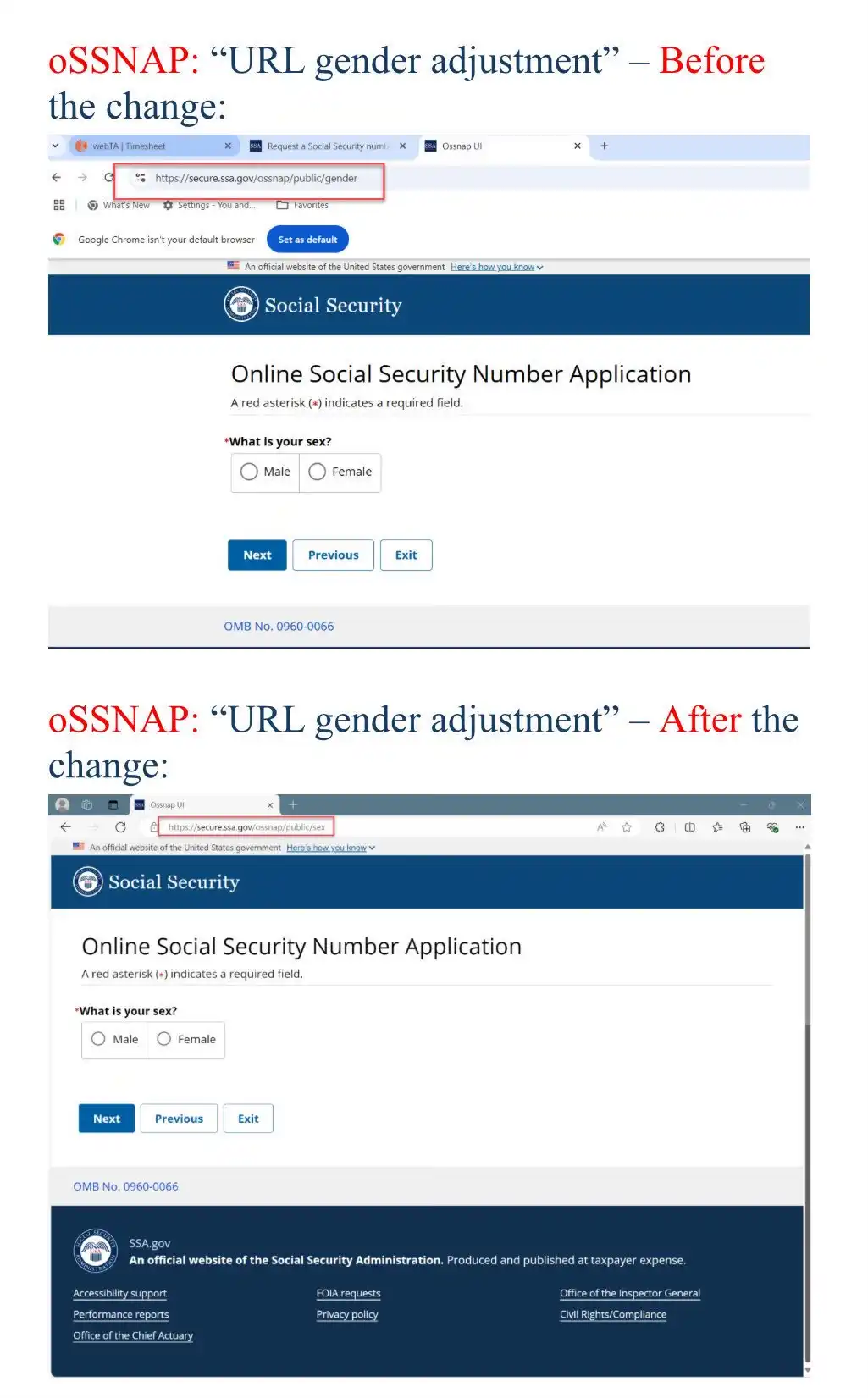
In the image, the changes involve the URL modification of the Social Security online application page to "/sex" instead of "/gender." While the wording of the application form itself has not changed, still asking, "What is your gender?" and providing "Male" and "Female" options, the official shift in terminology from "gender" to "biological sex" does not acknowledge gender identity. This aligns with an executive order signed by Trump on January 20, 2025, titled "Safeguarding Women from Gender Ideology Extremism and Restoring Biological Truth in the Federal Government." This order defines gender as binary male and female, requires federal agencies to use "sex" instead of "gender identity," cease funding gender affirmation care, and prohibit transgender individuals from using facilities according to their gender identity in federally funded single-sex facilities.
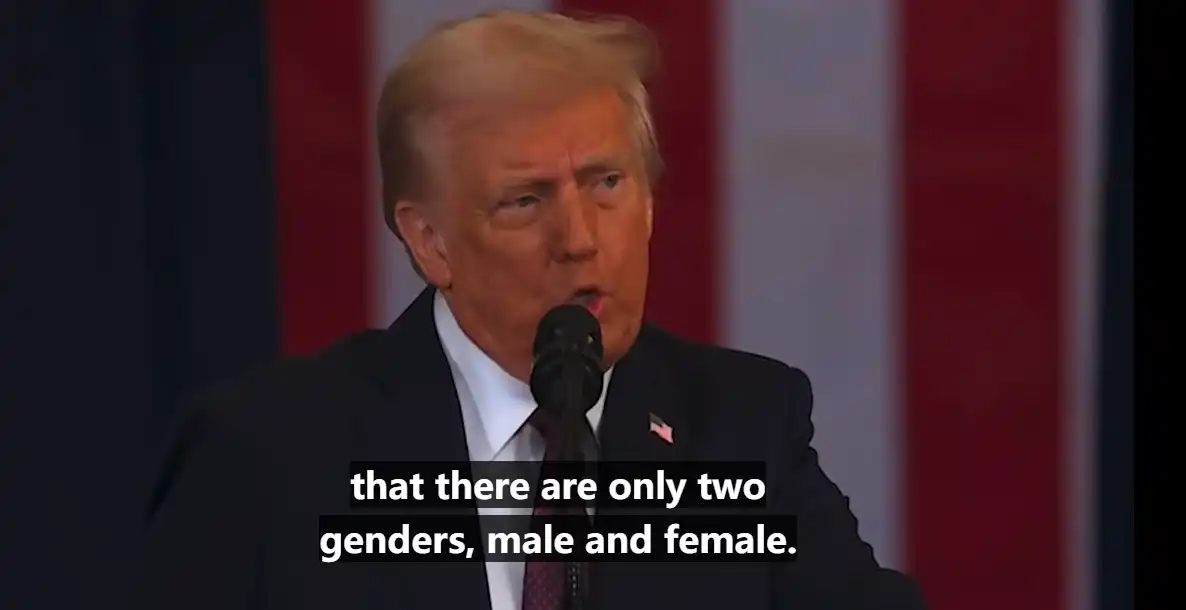
Image Source: NEW YORK POST, Trump stated that he only supports two genders: male and female
As DOGE gradually infiltrates the core of government agencies, the balance of power is shifting. In internal communications, civil servants have been informed that they must accept "government efficiency reforms," or they may face dismissal or be reassigned to peripheral positions. Some Treasury Department employees have even received warning emails hinting that their positions may be eliminated. Meanwhile, Musk has ridiculed government workers on social media, calling them "lazy," and encouraging them to resign voluntarily, suggesting that only those "willing to adapt to the new system" will be able to remain in their roles.
Musk's plan goes far beyond cost-cutting and cleansing officials. His goal is to establish a new government model—a governance system led by tech entrepreneurs, with executive decisions assisted by algorithms and artificial intelligence. He has appointed a team composed of former Tesla, xAI, and SpaceX employees to begin developing government management artificial intelligence to automatically review budgets, approve projects, and analyze policy implementation effectiveness in the future.
In the next phase of action, DOGE is considering dissolving the U.S. Department of Education through executive means. Officials have been discussing an executive order that would revoke all functions of the U.S. Department of Education that are not explicitly included in regulations or transfer some functions to other departments. It is worth noting that Trump mentioned last August in an interview with Musk that if he is re-elected as President of the United States, he will shut down the U.S. Department of Education.
A Power Crisis Dividing the American Political Scene?
As DOGE's influence sweeps through the political scene like a storm, the voices of opponents have also grown louder.
The sudden closure of USAID has not only caused a stir domestically in the United States but has also raised widespread concerns in the international community. This agency oversees approximately $40 billion in funding annually, involving over 100 countries globally, covering various areas such as humanitarian aid, development support, and health projects. Its abrupt shutdown has left many countries and aid organizations without assistance, with some emergency aid projects even facing the risk of interruption.
Meanwhile, Secretary of the Treasury Scott Bennett, upon taking office, handed over access to payment system data to Musk and his DOGE team. This move has sparked widespread controversy, with critics pointing out that it could lead to the exposure of sensitive information of tens of millions of citizens and businesses, jeopardizing the financial security of Americans, and even threatening the stability of national infrastructure and personal privacy.
Without proper review or authorization, DOGE has taken unauthorized control of the Office of Personnel Management (OPM) and the General Services Administration (GSA). The legitimacy and qualifications of its series of personnel appointments have quickly raised external doubts and criticisms. Generally, the formulation of federal policies requires layers of approval within government agencies, ultimately decided by Cabinet members in conjunction with the President. However, Musk and his core team bypassed this process, forming an informal decision-making group dominated by tech elites, entrepreneurs, and young engineers.
In response, Democratic Senator Chuck Schumer announced plans to collaborate with House Democratic leader Hakeem Jeffries to introduce legislation to counter DOGE's "unlawful intervention." Meanwhile, multiple lawsuits against Musk have been filed in federal courts, with allegations including unauthorized access to confidential information by DOGE officials, violations of government procurement regulations, and misuse of executive orders to cut federal spending.
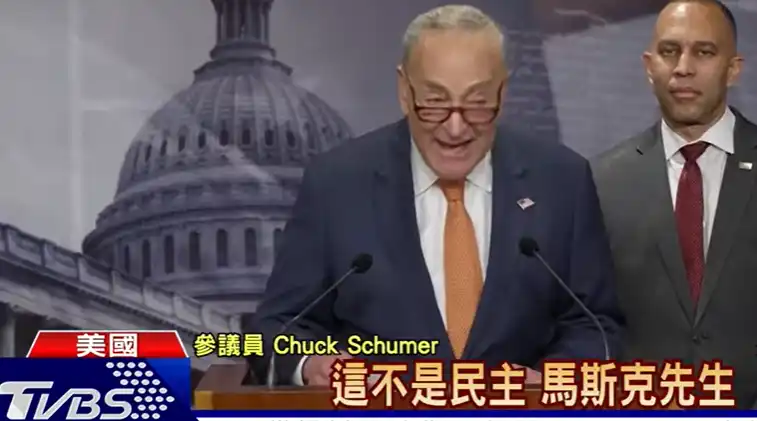
Image Source: TVBS NEWS, Democrats Oppose Musk's Reform
On February 6th, local time, the Musk-led Department of Government Efficiency (DOGE) faced a setback as federal judge Colleen Kollar-Kotelly issued a temporary restraining order prohibiting the Treasury Department from providing data from its payment system to external parties. As a result, Musk himself will be unable to review data retrieved from the payment system.
To add to the troubles, just hours after the judge's ruling, a 25-year-old DOGE programmer named Marko Elez abruptly resigned after it was discovered that he had posted racist comments on his dormant social media account.
Behind Musk's strong actions lies the staunch support and trust of President Trump. In the White House, Musk not only has a separate office but also frequents high-level official meetings, with Trump publicly expressing "full confidence in Musk's decisions" multiple times. In terms of government operations, Musk attempts to discard the traditional bureaucratic system in favor of a high-efficiency model similar to Silicon Valley companies. Many senior government officials have expressed concerns, believing that this reform could lead to an excessive concentration of power in private capital, undermining government transparency and accountability mechanisms. However, under Trump's protection, despite facing some obstacles, Musk's reform efforts continue unabated.

Bold reforms are always a bloodless war, capable of either establishing a disruptive global government management model or becoming a casualty of power struggles. If the opposition from the Democratic Party gradually strengthens or if a robust opposing force emerges within the judicial system, DOGE's reform may be slowed down. However, judging by the current efficiency, Musk's actions are far faster than the unwieldy traditional administrative system. An efficiency-first, tech-driven "corporate-style" government is taking shape. Is the adventure led by Musk and six young individuals a stroke of genius innovation or a dangerous game? The answer to this question can only be verified with time.
You may also like

Galaxy Deep Research Report: How Hyperliquid's HIP-4 Upgrade Changes the Landscape of Prediction Markets?

ZachXBT: Humanity private key leak and abnormal surge in H token should be viewed separately
On June 9, according to related disclosures, on-chain investigator ZachXBT posted an update on Humanity’s roughly $31 million security incident, saying that after further analyzing fund flows, he currently tends to believe the project team was not involved in an “inside job” or a self-staged attack. According to him, the official explanation about the private key leak was broadly accurate, but before the token unlock, the price of H had been artificially pushed higher, and the hacker later took advantage of that market environment; therefore, the private key leak and the earlier abnormal price pumping should be regarded as two separate and independent events. This reframing has shifted the market’s understanding of the nature of the incident. Earlier discussion around Humanity had focused on whether the team directly participated in the attack or used the security incident to cover up internal operations. ZachXBT’s latest remarks shift the focus from “whether it was self-theft” to “whether there were pre-unlock market structure issues.” He also questioned whether the team may have.

Morning Report | OpenAI has submitted an S-1 registration statement draft to the U.S. SEC; Morpho completes $175 million financing

Morning Report | BitMine increased its holdings by 126,971 ETH last week; trader Eugene announced his exit from the crypto market

Wang Chuan: How can one not feel anxious after the neighbor Old Wang made thirty times profit by investing in storage stocks? (Seven) - A quarter-century cycle

Cryptocurrency CEXs are flocking to sell US stocks, and traditional brokerages are facing an "uninvited guest."
$75 billion in foreign capital has fled, and South Korean retail investors have absorbed it all using leverage

Japan’s Three Megabanks Plan Joint Stablecoin Issuance in Fiscal 2026
MUFG, SMBC, and Mizuho reportedly plan to jointly issue fiat-pegged stablecoins in fiscal 2026, signaling Japan’s growing push into bank-led digital payment infrastructure.

Humanity Discloses H Token Dual-Chain Attack Details, With Losses on Ethereum and BSC Exceeding $36 Million
Humanity said the H token attack across Ethereum and BSC caused more than $36 million in losses after leaked ProxyAdmin keys enabled malicious contract upgrades and token minting.
White House Discusses CLARITY Act With Law Enforcement Ahead of Senate Vote
The White House discussed the CLARITY Act with law enforcement ahead of a Senate vote, focusing on illicit finance risks and developer protections.

Bitcoin Trading Guide 2026: Strategies for Experienced Traders

What Is XAUT and PAXG? Why Tokenized Gold Is Booming in 2026

Will the SpaceX IPO Hurt Bitcoin? Here's What Traders Are Watching

Foreign selling in the South Korean stock market accelerates, with cumulative net sales reportedly reaching $75 billion this year
On June 9, The Kobeissi Letter, citing Goldman Sachs data, reported that global investors are selling South Korean stocks at an unusually rapid pace. In the latest trading session, foreign investors sold about $801 million worth of Kospi constituent stocks again; total foreign outflows last week reached about $10 billion, and the market has been in net foreign selling on nearly every trading day over the past month. According to the data cited in the report, foreign investors have sold about $75 billion worth of South Korean stocks so far this year. Meanwhile, South Korean retail and institutional investors together recorded roughly $69 billion in net buying over the same period, suggesting that the market’s main buying support has come from domestic capital rather than returning overseas funds. The information currently disclosed still mainly comes from The Kobeissi Letter’s retelling and Goldman Sachs data summaries, while public details on the statistical period and the specific definition of “selling” remain relatively limited.

Fortune Warns of Strategy’s Financing Structure Risks as Bitcoin Premium Narrows
Fortune warned that Strategy’s Bitcoin treasury model faces growing financing risks as MSTR’s net asset premium narrows and preferred stock dividend pressure increases.

Ferrari Challenge Le Mans: Carl Moon to Dominate in WEEX Livery

Sahara AI Responds to SAHARA’s Sharp Drop: No Contract or Product Security Issues Found, Internal Investigation Underway
Sahara AI responded to SAHARA’s 60% price drop, saying no token contract or product security issues have been found and an internal investigation is underway.

WEEX Deposit/Withdrawal Dynamic Island: Your Asset Status, Always in Sight
Galaxy Deep Research Report: How Hyperliquid's HIP-4 Upgrade Changes the Landscape of Prediction Markets?
ZachXBT: Humanity private key leak and abnormal surge in H token should be viewed separately
On June 9, according to related disclosures, on-chain investigator ZachXBT posted an update on Humanity’s roughly $31 million security incident, saying that after further analyzing fund flows, he currently tends to believe the project team was not involved in an “inside job” or a self-staged attack. According to him, the official explanation about the private key leak was broadly accurate, but before the token unlock, the price of H had been artificially pushed higher, and the hacker later took advantage of that market environment; therefore, the private key leak and the earlier abnormal price pumping should be regarded as two separate and independent events. This reframing has shifted the market’s understanding of the nature of the incident. Earlier discussion around Humanity had focused on whether the team directly participated in the attack or used the security incident to cover up internal operations. ZachXBT’s latest remarks shift the focus from “whether it was self-theft” to “whether there were pre-unlock market structure issues.” He also questioned whether the team may have.
Morning Report | OpenAI has submitted an S-1 registration statement draft to the U.S. SEC; Morpho completes $175 million financing
Morning Report | BitMine increased its holdings by 126,971 ETH last week; trader Eugene announced his exit from the crypto market
Wang Chuan: How can one not feel anxious after the neighbor Old Wang made thirty times profit by investing in storage stocks? (Seven) - A quarter-century cycle
Cryptocurrency CEXs are flocking to sell US stocks, and traditional brokerages are facing an "uninvited guest."


