
 Buy Crypto
- Markets
 Futures
- Spot
- Copy Trade
- Earn
- More
How to Achieve 40% Annualized Returns Through Polymarket Arbitrage?


Original Title: Arbitrage in Polymarket. $30,000/month.
Original Author: @igor_mikerin
Translation: Peggy, BlockBeats
Editor's Note: As the U.S. election approaches, trading activity on prediction markets continues to heat up. On December 9, 2025, discussions on X Platform regarding Polymarket arbitrage focused on cross-platform price spreads, automated trading bots, and hidden risks. With frequent price disparities between Kalshi and Polymarket and increasing technical barriers, the prediction market is evolving from a "speculative venue" to a genuine arbitrage infrastructure.
Transient opportunities, thin liquidity, rule divergences, and black swan events remain key challenges. The author of this article showcases a live arbitrage structure to provide a clear reference for the intensifying arbitrage competition in the current prediction market.
Below is the original text:
Approximately a month ago, I noticed some arbitrage opportunities on Polymarket.com. However, the platform's liquidity was insufficient to further expand my position, so I was planning to return to stock trading. Nevertheless, I currently have around $60,000 invested in various Polymarket markets. Most of these trades will expire after the election, at which point I will close them all at once. Below, I will introduce each of these positions and provide some free code for those interested in exploring this market.
Arbitrage 1: Buy "Harris Elected President" and Simultaneously Buy All "Republican Wins Different Elector Margins" Outcomes
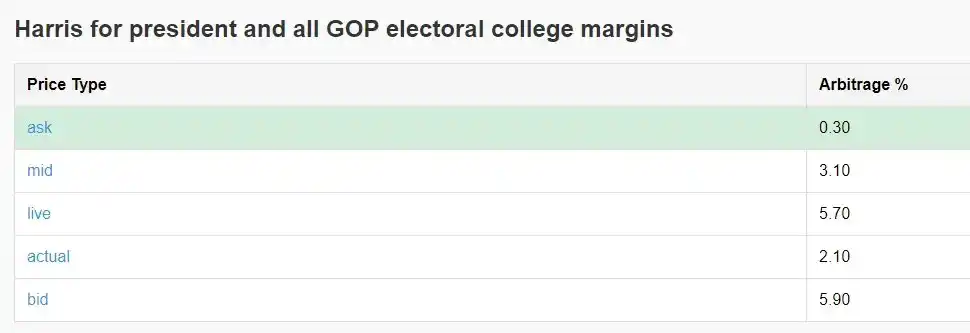
This strategy is quite straightforward: betting on Kamala Harris winning the presidential election while buying into all possible Republican winning margins in the Electoral College. Essentially, these two types of positions hedge each other. If the total price of both positions is less than 1, the price difference is the lockable arbitrage space. As of today, the arbitrage margin of this trade is 3.5%, with 41 days until the election. When annualized, this is roughly equivalent to a 41% annual return.
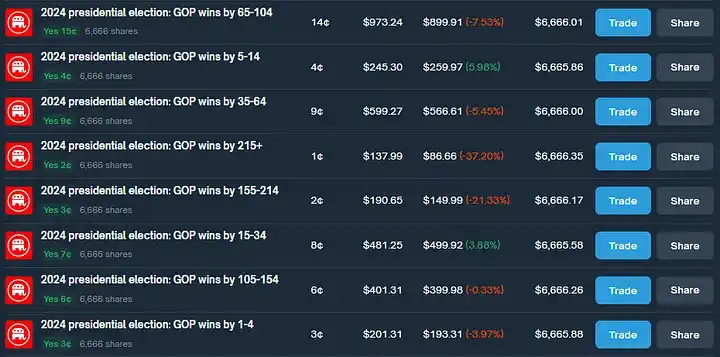
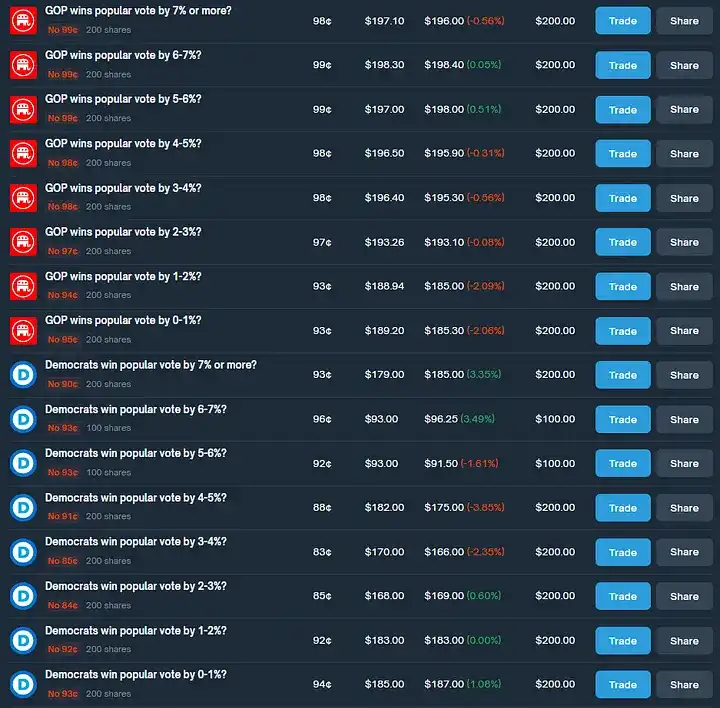
The following chart illustrates how I constructed this trade. You can see that I purchased nearly equal amounts of shares in almost all possible outcomes.
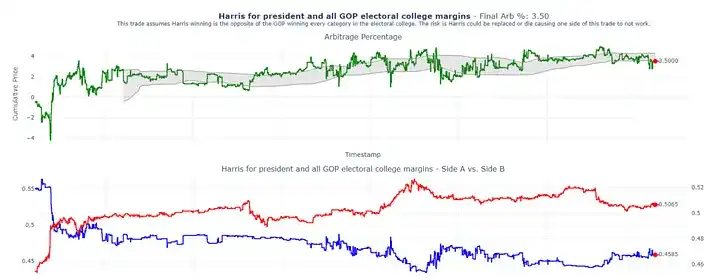
This is my position on Polymarket.com. You can see that I have essentially bought almost equal amounts of shares in each possible outcome.

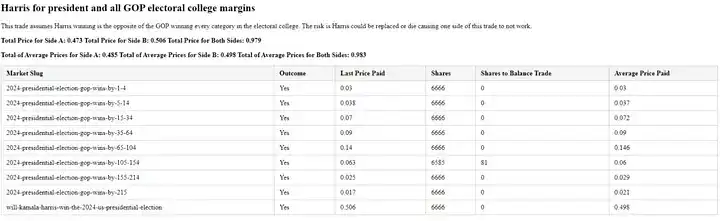
This is a real-time summary of the positions I have placed on Polymarket. The average cost of these positions is 0.983, meaning my expected return is 1 – 0.983 = 1.7%. The cost basis of my most recent trade was 0.979, corresponding to a 2.1% return.
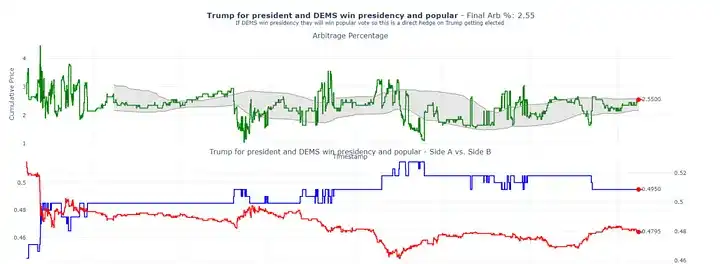
Arbitrage 2: Betting on Trump's election and hedging with "Democratic win the popular vote + win the presidency"
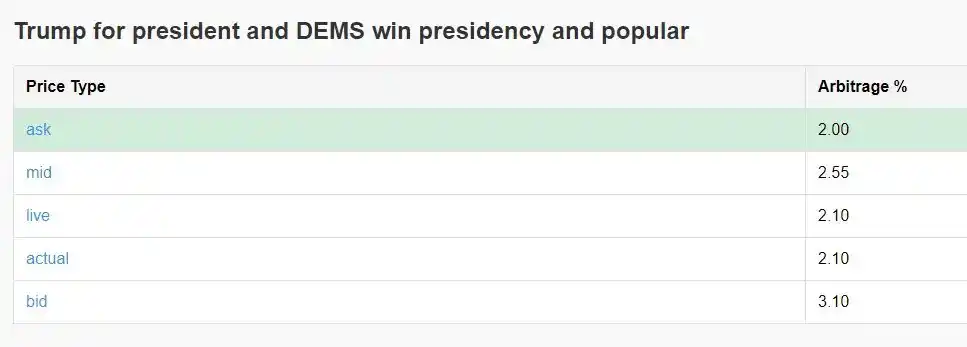
This strategy currently shows a 2.55% arbitrage opportunity. In this combination, we are betting on Trump's victory on one hand and hedging by betting on the Democratic Party winning both the popular vote and the presidency. While this is not a perfect hedge (as the Democratic Party could potentially win the presidency without winning the popular vote), according to my model, the probability of this scenario is extremely low. Therefore, I believe this hedge structure is robust.
Below are my actual trades, and you can see that I hold an equal amount on both sides of the bet.

Arbitrage 3: Buying "No" on all outcomes of the Democratic and Republican popular vote
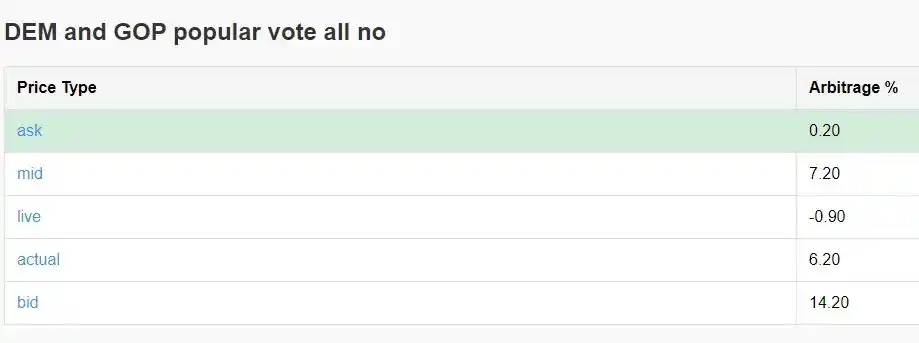
In this trade, I have bought the "No" option on all possible outcomes of the popular vote. Currently, the arbitrage opportunity for this trade is 6.65%.

Below are the trades I have placed. Except for one, all other trades will win on election day. Therefore, the total profit from all winning positions in these trades (excluding the single loss) must exceed the amount of that loss.
Be sure to read the rules carefully
An important note: Be sure to carefully read the rules of each market. Some positions may seem like arbitrage opportunities, but may hide significant risks. For example, if a candidate is assassinated, even if you think you have set up a "stable arbitrage," you may end up losing all your principal.
The Spread Is Crucial
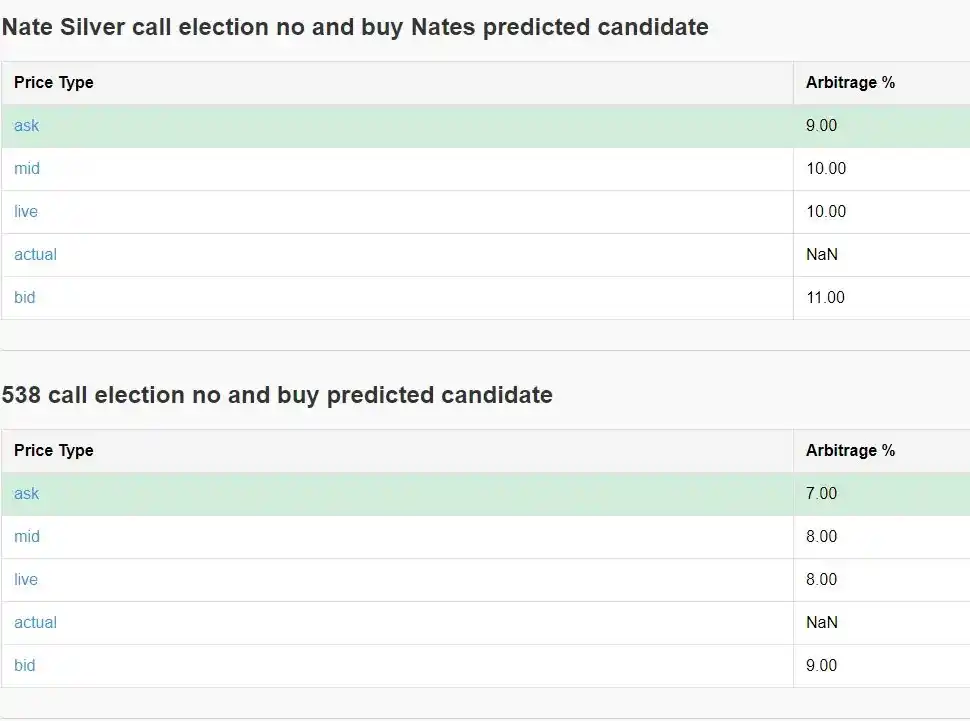
One of the biggest challenges I have encountered is market impact. Due to low platform liquidity, once I place an order, I often push the entire market's price in my direction. This can lead to discrepancies between the buy price, sell price, mid-price, real-time price, and actual execution price. Below are typical examples that have occurred in the aforementioned trades.
Good luck!
You may also like

a16z New Post: Predicting the Market, Entering the Fast Forward Phase

Arthur Hayes New Post: It's Now "No Trade" Time
a16z New Article: Predictive Markets Entering Fast-Forward Phase

a16z founder: In the age of Agents, what truly matters has changed

The President of Kyrgyzstan meets with Sun Yuchen, and TRON collaborates with Kyrgyzstan to build a new pattern of digital economy in Central Asia
46 minutes, $292 million stolen, DeFi faces development dilemma again

How to Earn Free USDT in 2026: No High Volume Required (WEEX Poker Party Guide)
Is Joker Crypto legit in 2026 or just another memecoin? Can You Really Earn Passive Income with Joker Crypto in 2026? Learn how Joker staking rewards work, how to earn NFT bonuses, expected APY ranges, gas-fee rebates, and how to avoid crypto scams before joining.

How to Get Free USDT Welcome Bonus in 2026: Earn Up to 700 USDT on WEEX
Legit Free Welcome Bonus 2026: Learn how to earn up to 700 USDT on WEEX with Auto Earn Boost Fest. Increase your balance, activate Auto Earn, and qualify automatically.

AI Agent Payments Just Got Real: Utexo × x402 Brings 50ms USDT Transactions to Internet Scale
Utexo integrates USDT into the x402 protocol, enabling 50ms instant payments embedded natively in HTTP requests. Explore how this breakthrough is rewriting the rules for AI agent payments, API monetization, and the machine-to-machine economy.

DWF Deep Report: AI in DeFi Outperforms Humans in Yield Optimization, but Complex Trades Still Lag Behind by 5 Times

What Separates Smart Money from the Crowd in Crypto? Insights from Freedom of Money
Most crypto traders lose money not because of bad luck, but because they misunderstand how the market really works. From Freedom of Money to the rise and fall of Sam Bankman-Fried, they highlight a key divide in crypto: those who build the market and those who chase it. This reading guide explores essential books that reveal how narrative, regulation, capital, and psychology shape long-term success in the crypto industry.

The Risk Management Core Team has just been ousted, and Aave is now facing a $200 million default.

The $293 million bug wasn't in the code; so, what's the deal with the "DVN Configuration Bug," which led to the largest hack of 2026?

a16z on Recruitment: How to Choose Between Crypto-Native and Traditional Talent?
The biggest DeFi heist of 2026, hackers easily took advantage of Aave

Will Robots Replace Humans? He Says No!
Binance Coin's Price Skyrockets 15x to All-Time High, Saved by Three Bull Market Lifelines




 App
App