
「Creator Tokenization」 Narrative Emerges, Will It Be the Next Billion-Dollar Market?

Original Article Title: Liquid Markets for Creators Coins - $100B Market Opportunity
Original Article Author: hitesh.eth, Founder of dyorcryptoapp
Original Article Translation: Ashley, BlockBeats
Editor's Note: This article explores how creator tokenization enables fans, investors, and brands to directly participate in a creator's growth, driving market-based trading and value discovery. With the creator economy surpassing $500 billion, a tokenization model can empower brands to secure early partnership opportunities and allow fans to co-create business decisions through DAO governance. The financialization of the creator economy is becoming an inevitable trend in the Web3 era, potentially reshaping the interaction between social media and financial markets.
The following is the original article content (slightly reorganized for clarity):
Creators are essentially like a startup, but a key difference is that in a startup, investors can invest at different stages and bet on its growth, whereas in the creator space, fans or investors previously couldn't directly participate in their growth. Whether it's a startup or a creator, the core of growth lies in whether consumers are willing to pay for their product or service. A startup's product or service usually revolves around a specific problem to be solved, while a creator's product is their content itself. This content, as a product, is tailored to different interest-driven niche markets, catering to various audience needs.
The Speculative Nature of Startups and Creators
Startups operate in a highly speculative environment, with investors betting on early-stage companies, hoping they will scale rapidly and become profitable. A startup's valuation typically depends on market attractiveness, user growth, and revenue potential. This speculative logic also applies to creators, but there is currently no formalized investment structure that allows fans or traders to participate in a creator's growth. The lack of liquidity in the creator economy signifies an untapped market opportunity—if creators can be tokenized, speculators can bet on their growth potential just like they would on a startup.
Speculating on creators could be a significant opportunity for traders and investors. Just as startups go through hype cycles where their valuation fluctuates with market recognition, creators also experience similar cycles—growing in influence due to viral spread, strategic partnerships, and media exposure. A creator's reputation, engagement rate, and ability to convert traffic into revenue are all quantifiable metrics that can serve as the speculative basis for their tokenized value.
The Creator's 0-1 and 1-10 Journey
The growth journey of a creator is similar to that of a startup, going through the 0-1 and 1-10 stages.
· 0-1 Stage: This means breaking barriers, entering a niche market, building an initial audience, and continuously optimizing content strategy. Many creators stop at this stage, just as many startups fail before finding product-market fit.
· 1-10 Stage: This means scaling up. Creators at this stage start securing brand partnerships, receiving commercial sponsorships, and achieving traffic monetization. At this stage, creators are no longer just content producers but are gradually growing into a full-fledged business entity. This transformation is similar to a startup evolving from a small team into a mature company.
Today, many consumer startups and creators have become part of the same ecosystem, with a similar goal: to sell two products to users— the content itself and brand integrations within the content.
The Scale and Future Potential of the Creator Economy
The creator economy has grown into a multi-billion-dollar industry, with the market size expected to surpass $500 billion in the next decade. Currently, millions of creators produce content daily, and brands are investing significant sums in influencer marketing. In 2023 alone, global spending on influencer marketing exceeded $20 billion, and as brand budgets shift towards digital-native advertising, this number continues to grow.
The tokenization of the creator economy is poised to create an entirely new asset class. Within the next three years, the valuation of the creator token market could easily reach $100 billion as more creators adopt token-based monetization models. Establishing a liquid creator token trading market will provide investors with a new speculative domain, allowing them to bet on emerging influencers and forming a price discovery mechanism based on social influence, audience growth, and brand partnership flow.
Creator Tokens and Brand Partnerships
From a brand perspective, early engagement with creator partnerships is crucial. Brands often seek to establish partnerships at discounted rates before a creator becomes hugely popular. With the tokenization of creators, brands can benefit from purchasing and holding their tokens during their influence growth. This not only provides brands with preferential partnership rights but also ensures that they have access to more valuable ad placement resources once the creator succeeds.
If the value of creator tokens rises with the growth of influence, brands holding these tokens can also benefit from discounted sponsorship costs and capital appreciation. This model makes brands more willing to invest in potentially successful creators for the long term rather than just paying one-time ad fees.
Fans as Brand Managers: Collaborating on DAO Governance
By introducing a DAO governance model, fans can deeply engage in creators' business decisions, fundamentally transforming the way brand collaborations are conducted.
· Fan Voting Decisions: Creator's brand collaborations will be collectively decided by DAO members (i.e., token holders) through voting, rather than unilaterally by the creator. This ensures that brand collaborations align with the creator's audience needs and values.
· Revenue Sharing: The revenue generated from brand collaborations can be distributed to governance token holders through a staking reward mechanism, making them direct beneficiaries of the creator's growth.
As long as the creator remains popular, their influence and traffic will continue to grow, further driving token trading volume and investor interest, thereby increasing the value of the creator's token. The DAO will act as a decentralized brand manager, ensuring transparency and fairness in partnerships, and providing a sustainable profit model for the creator and their community.
The Future of Creator Tokenization
Creator tokenization is not just a conceptual innovation but an inevitable trend in the digital economy. The emergence of Web3, DeFi, and tokenized assets has created the perfect environment for the thriving creator token market. The speculative market built around the creator economy could fundamentally alter the power dynamics of social media, enabling creators, brands, and fans to participate in a whole new financial system.
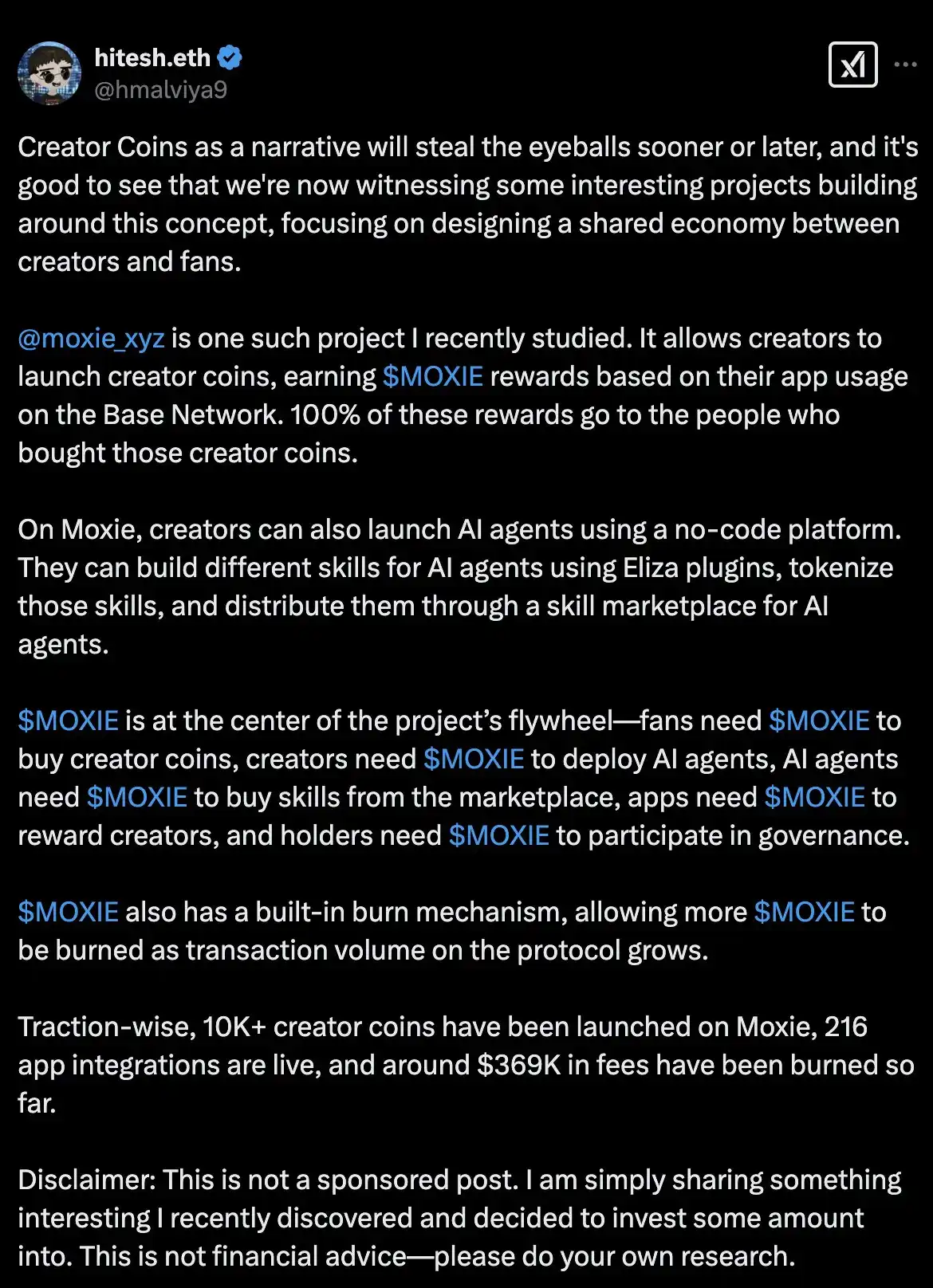
As the creator economy continues to expand, tokenization applications are expected to unlock unprecedented opportunities, bridging the gap between influence and the financial markets. Over the next three years, we may witness the comprehensive liquidity of the creator token market, making the entire creator economy more transparent, tradable, and scalable than ever before.
You may also like

Latest research from 13 top universities including Cornell University: The current state, challenges, and misconceptions of the fusion of Crypto and AI
Deconstructing Anthropic: The Best AI Company, Possibly Also a Type of Organizational Invention
Apollo and Blackstone Reportedly Back $35 Billion Anthropic Chip Financing as Deal Details Remain Unclear
On June 9, according to currently available news alerts, Apollo and Blackstone Group participated in a $35 billion financing for an Anthropic “chip project.” Based on the original wording of the report, the funding has already been raised, but public information remains limited. The financing structure, use of proceeds, project entity, and whether Apollo and Blackstone participated through equity, debt, or project financing have not yet been disclosed.

Humanity Protocol Security Incident Escalates: More Than $31 Million Stolen From Related Addresses as Attacker Continues Selling H for ETH
On June 9, according to monitoring by Onchain Lens, more than $31 million has been stolen from addresses linked to Humanity Protocol, and the attack is still ongoing, with the hacker continuously swapping H tokens for ETH. Project founder Terence Kwok later confirmed the security incident on X, saying the issue involved a private key leak.

Bloomberg: As Bitcoin Weakens, Stablecoins and RWA Continue to Drive Expansion in Crypto Businesses
In June, Bloomberg reported that despite Bitcoin falling below $60,000 last week, wiping out about $235 billion in market value within seven days, and dropping close to 50% from last year’s peak, some core businesses in the crypto industry are still expanding, mainly in stablecoins, real-world asset tokenization (RWA), payments, and infrastructure. The report also noted that overall altcoin activity has contracted significantly: altcoin market capitalization has fallen from a peak of about $431 billion in November 2021 to around $170 billion, and among the tens of millions of tokens issued in recent years, fewer than 1,700 still maintain meaningful trading activity.

Galaxy Deep Research Report: How Hyperliquid's HIP-4 Upgrade Changes the Landscape of Prediction Markets?
Binance Research: RWA Market Expected to Expand Nearly 6x from Early 2025, with Public Equities and Onchain Payments Heating Up Together
In June, Binance Research said in its monthly market report that the real-world asset (RWA) market is expected to grow by about 589% from the beginning of 2025. Bond- and money market fund-related RWA expanded by about $6.5 billion, up 83% year over year, while publicly traded equity RWAs grew by about 422%. The report also noted that monthly crypto debit card transaction volume exceeded $747 million in May, up 48.6% year to date.

Japan to Assess a Framework for Yen Stablecoins and Crypto ETFs as Asia’s Compliant Payments Narrative Heats Up
Recently, according to the original report, Japan is considering the launch of yen stablecoins and cryptocurrency ETFs. Public information remains limited at this stage, and there is still no complete policy text, regulatory draft, or clear implementation timeline, so this is better characterized as a “policy discussion” rather than formal implementation. The original wording also noted that advancing stablecoin regulation in Asia is driving XRP usage and supporting growth in the XRPL ecosystem. However, based on currently available public information, there is not enough evidence to directly establish a clear causal relationship between this round of discussion in Japan and XRP or XRPL.

ZachXBT: Humanity private key leak and abnormal surge in H token should be viewed separately
On June 9, according to related disclosures, on-chain investigator ZachXBT posted an update on Humanity’s roughly $31 million security incident, saying that after further analyzing fund flows, he currently tends to believe the project team was not involved in an “inside job” or a self-staged attack. According to him, the official explanation about the private key leak was broadly accurate, but before the token unlock, the price of H had been artificially pushed higher, and the hacker later took advantage of that market environment; therefore, the private key leak and the earlier abnormal price pumping should be regarded as two separate and independent events. This reframing has shifted the market’s understanding of the nature of the incident. Earlier discussion around Humanity had focused on whether the team directly participated in the attack or used the security incident to cover up internal operations. ZachXBT’s latest remarks shift the focus from “whether it was self-theft” to “whether there were pre-unlock market structure issues.” He also questioned whether the team may have.

Morning Report | OpenAI has submitted an S-1 registration statement draft to the U.S. SEC; Morpho completes $175 million financing

Morning Report | BitMine increased its holdings by 126,971 ETH last week; trader Eugene announced his exit from the crypto market

Wang Chuan: How can one not feel anxious after the neighbor Old Wang made thirty times profit by investing in storage stocks? (Seven) - A quarter-century cycle
Cryptocurrency CEXs are flocking to sell US stocks, and traditional brokerages are facing an "uninvited guest."
$75 billion in foreign capital has fled, and South Korean retail investors have absorbed it all using leverage

Japan’s Three Megabanks Plan Joint Stablecoin Issuance in Fiscal 2026
MUFG, SMBC, and Mizuho reportedly plan to jointly issue fiat-pegged stablecoins in fiscal 2026, signaling Japan’s growing push into bank-led digital payment infrastructure.

Humanity Discloses H Token Dual-Chain Attack Details, With Losses on Ethereum and BSC Exceeding $36 Million
Humanity said the H token attack across Ethereum and BSC caused more than $36 million in losses after leaked ProxyAdmin keys enabled malicious contract upgrades and token minting.
White House Discusses CLARITY Act With Law Enforcement Ahead of Senate Vote
The White House discussed the CLARITY Act with law enforcement ahead of a Senate vote, focusing on illicit finance risks and developer protections.

Bitcoin Trading Guide 2026: Strategies for Experienced Traders
Latest research from 13 top universities including Cornell University: The current state, challenges, and misconceptions of the fusion of Crypto and AI
Deconstructing Anthropic: The Best AI Company, Possibly Also a Type of Organizational Invention
Apollo and Blackstone Reportedly Back $35 Billion Anthropic Chip Financing as Deal Details Remain Unclear
On June 9, according to currently available news alerts, Apollo and Blackstone Group participated in a $35 billion financing for an Anthropic “chip project.” Based on the original wording of the report, the funding has already been raised, but public information remains limited. The financing structure, use of proceeds, project entity, and whether Apollo and Blackstone participated through equity, debt, or project financing have not yet been disclosed.
Humanity Protocol Security Incident Escalates: More Than $31 Million Stolen From Related Addresses as Attacker Continues Selling H for ETH
On June 9, according to monitoring by Onchain Lens, more than $31 million has been stolen from addresses linked to Humanity Protocol, and the attack is still ongoing, with the hacker continuously swapping H tokens for ETH. Project founder Terence Kwok later confirmed the security incident on X, saying the issue involved a private key leak.
Bloomberg: As Bitcoin Weakens, Stablecoins and RWA Continue to Drive Expansion in Crypto Businesses
In June, Bloomberg reported that despite Bitcoin falling below $60,000 last week, wiping out about $235 billion in market value within seven days, and dropping close to 50% from last year’s peak, some core businesses in the crypto industry are still expanding, mainly in stablecoins, real-world asset tokenization (RWA), payments, and infrastructure. The report also noted that overall altcoin activity has contracted significantly: altcoin market capitalization has fallen from a peak of about $431 billion in November 2021 to around $170 billion, and among the tens of millions of tokens issued in recent years, fewer than 1,700 still maintain meaningful trading activity.
Galaxy Deep Research Report: How Hyperliquid's HIP-4 Upgrade Changes the Landscape of Prediction Markets?


