
- Buy Crypto
- Markets
 Futures
- Spot
- Copy Trade
 Earn
Earn- More
「Crazier Than Cryptocurrency」: 10-Year Treasury Yield Records Largest Leap in 20 Years, Flash Crash Warns of Financial Crisis

Original Article Title: "A Historic Week Has Passed, Both US Stocks and Bitcoin Have Risen, But the Market Has Changed Completely!"
Original Article Author: Richard Bo, Wall Street View
US stock market volatility has rarely surpassed that of emerging markets and Bitcoin. At the same time, US Treasuries, which have always been seen as a safe asset, experienced sharp fluctuations, leading investors to start questioning the wisdom of holding US assets. UBS believes that once global risk-free rates experience volatility, it means that all markets will be disrupted. Analyst Ed Al-Hussainy bluntly pointed out, "I'm actually not worried about a recession, I'm worried about a financial crisis."
US stocks rebounded on Friday, suggesting a restoration of market risk appetite. However, investors have actually started questioning the safety of US assets, especially with the drastic fluctuations in US Treasuries, reigniting fears of a financial crisis on Wall Street.
Over the past week, the US 10-year Treasury yield saw its largest weekly jump in over 20 years, while US stocks experienced a rollercoaster ride of a dive followed by a surge. On the surface, the S&P 500 index rose by over 5% for the week, US bond yields returned to February levels, and Bitcoin closed higher, appearing as if everything was business as usual.
However, what is unsettling is the simultaneous decline this week in US stocks, US bonds, and the US dollar, a typical characteristic of emerging markets rather than a performance of the world's safest assets. Particularly with such a large fluctuation in US long-term bonds this week, a liquidity crisis seems imminent, prompting investors to question the wisdom of holding US assets. Bhanu Baweja, Chief Strategist at UBS Group, even stated:
This is too scary. We are redefining the global risk-free rate, and if the global risk-free rate experiences volatility, it will disrupt all markets.
Historically Rare: US Asset Volatility Surpasses that of Emerging Markets and Bitcoin
Trump's recent tariff policies have not only damaged confidence in the US economy but also shaken investors' trust in the US policy direction and US dollar assets. Even by Wall Street's long historical standards, this week has been a brutal trading week, with US stocks feeling like they are on a rollercoaster ride, and the movements of US bonds and the US dollar suggesting that the US safe haven status seems to be unsteady:
On Monday, due to the so-called tariff confusion, US stocks experienced a 15-minute seismic pulse, with the Nasdaq plummeting by 10% at one point and US Treasuries taking a nosedive.
On Tuesday, news of no tariff exemptions shattered hopes of a US stock rebound, with the Dow plunging over 2000 points at one point, the S&P erasing over a 4% gain to negative territory, and the US Treasury market experiencing a deleveraging sell-off.
On Wednesday, the US temporarily delayed some tariffs, with the three major US stock indices rising by nearly 8% at least, the S&P seeing its largest gain since 2008, US stock trading volume hitting a historic high of 30 billion shares. The 10-year US Treasury yield spiked and then retreated.
On Thursday, global investors fled from US assets, leading to a triple hit on US stocks, bonds, and the dollar. The Nasdaq plummeted over 4%, marking the dollar's largest daily drop in two years and pushing gold to a new high.
On Friday, the Federal Reserve hinted at intervention, prompting a rebound in US stocks. However, the downward trend of US bonds and the dollar served as a warning that the US's status as a safe haven may no longer be assured.
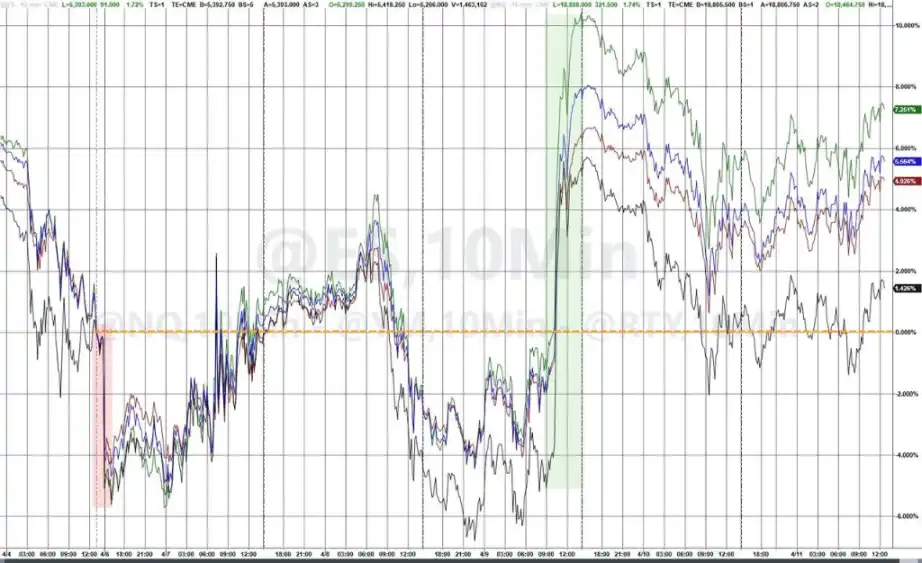
Andrea DiCenso, an investment manager at Loomis, Sayles & Company, stated, "Is the US market starting to behave like an emerging market? Undoubtedly, yes, that is exactly what we are seeing."
According to data, the volatility of US stock ETFs has even exceeded that of funds tracking emerging markets and has at times been higher than Bitcoin. This situation has rarely occurred except during the pandemic, the crisis in August of last year, and the Fed's aggressive rate hike period.
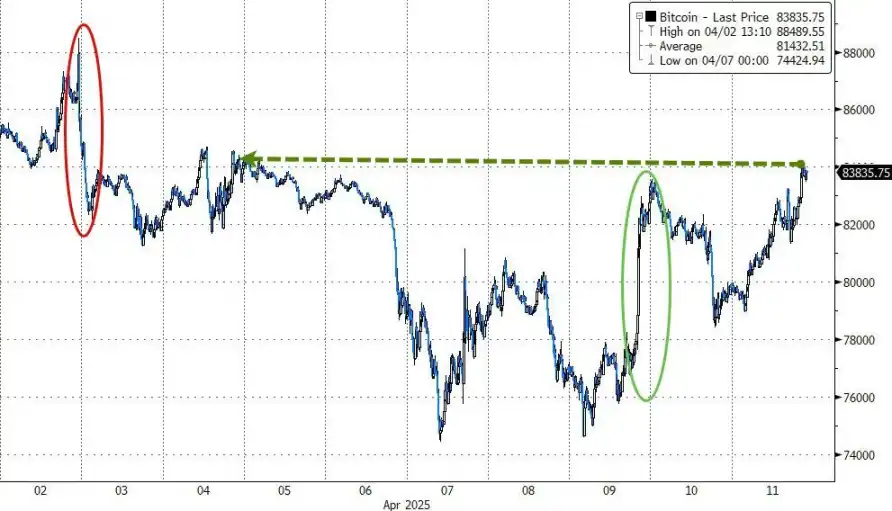
Neil Dutta from Renaissance Capital bluntly expressed in a client email, "The S&P 500 index is trading like a cryptocurrency, and that may not be a good thing."
Sharp Fluctuations in Risk-Free Rates Signal a Replay of the Financial Crisis
When the long-term bond market experiences sharp volatility, significant spreads, and low liquidity, it affects all other capital markets, especially exerting upward pressure on rates and US government debt, potentially evolving into a financial crisis if sustained over the long term.
US bond volatility surged this week, with the 20-year Treasury bond volatility rapidly catching up to the VIX stock volatility.
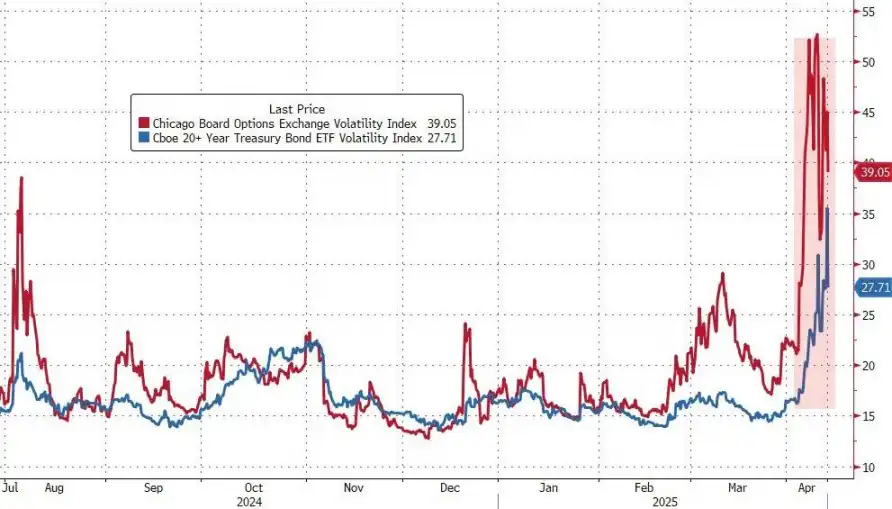
Although this week the decline in 30-year US bonds did not continue from last week, presenting a broadening trend, there were some cracks in the trading spread of the benchmark 30-year bond—which is a signal of the long-term decline in liquidity in the US Treasury yield curve. This week, the spread almost reached a full basis point, a level unseen since early 2023.
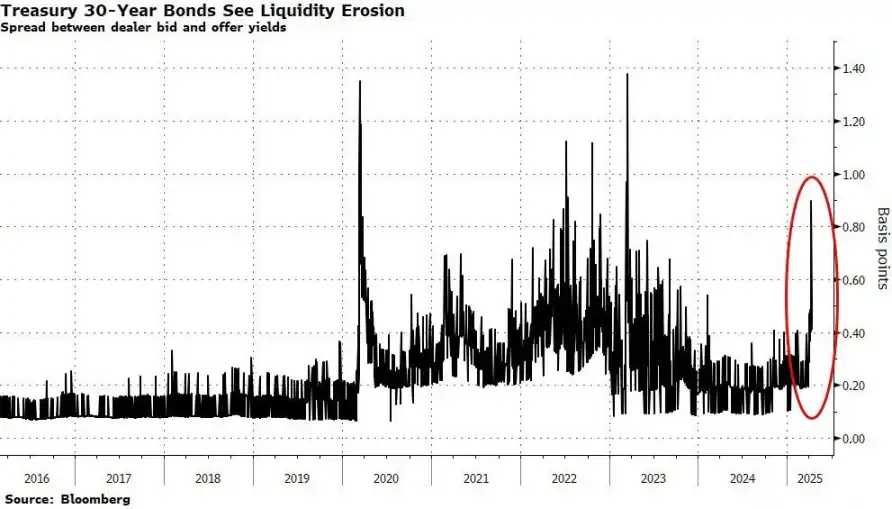
Confidence from regions outside the US in the quality of US stocks, fixed-income, and currency assets has been eroded. Fund strategist Nathan Thooft stated, "The question is whether this is a temporary shock or a long-term shift. We still believe the former. However, it cannot be denied that some large asset owners are seeking alternative safe-haven assets and diversified allocations."
Analyst Ed Al-Hussainy succinctly pointed out:
I'm actually not worried about a recession, I'm worried about a financial crisis.
Funds Flowing to Safe-Haven Assets, Wall Street Calls for Fed Intervention
Under the shadow of a financial crisis, global investors, after withdrawing from the U.S., have poured into safe-haven assets such as the European bond market, gold, the yen, and the Swiss franc to avoid broader turmoil.
This week, German bond yields remained largely unchanged, while U.S. 10-year bond yields surged over 50 basis points, marking the largest divergence between U.S. and German bond yields since 1989. In contrast, the U.S. dollar index fell below the key level of 100, posting its most severe two-week decline since November 2022, while the euro strengthened significantly, with the week's appreciation surpassing that of the yen.
Extreme volatility has brought unprecedented psychological pressure to investors and traders, prompting calls from Wall Street for Fed intervention. On Friday, JPMorgan CEO Jamie Dimon stated that he anticipates "turmoil" in the U.S. Treasury market.
Dimon said during an earnings call, "When you have a lot of volatile markets, very wide bid-offer spreads in Treasuries, low liquidity, it affects all other capital markets. That's the reason the Fed should intervene, not to help the banks."
Fortunately, Fed Governor Lael Brainard stated on Friday that if market conditions become disorderly, the Fed is "absolutely prepared" to help stabilize the financial markets. However, she emphasized:
"The markets are functioning well, and we haven't seen broad-based liquidity concerns."
You may also like

February 9th Market Key Intelligence, How Much Did You Miss?

After being questioned by Vitalik, L2s are collectively saying goodbye to the "cheap" era

WEEX AI Trading Hackathon Paris Workshop Reveals: How Retail Crypto Traders Can Outperform Hedge Funds
Witness how WEEX's Paris AI Trading Hackathon revealed AI's edge over human traders. Explore key strategies, live competition results & how to build your own AI trading bot.

U.S. Oil (USOR) Price Prediction 2026–2030
Key Takeaways U.S. Oil (USOR) is a speculative Solana-based crypto project that aims to index the United States…

USOR Surges on Meme Narrative Despite No Real-World Asset Backing
Key Takeaways: USOR, a Solana-based token, has seen a notable surge driven by speculative narratives rather than verifiable…

How to Buy U.S. Oil Reserve (USOR) Cryptocurrency
Key Takeaways U.S. Oil Reserve (USOR) is a Solana-based token primarily traded on decentralized exchanges (DEXs). Claims have…

USOR vs Oil ETFs: Understanding Why the ‘Oil Reserve’ Token Doesn’t Track Crude Prices
Key Takeaways The U.S. Oil Reserve (USOR) token has become noteworthy for its claims, yet it does not…

Trend Research Reduces Ether Holdings After Major Market Turbulence
Key Takeaways: Trend Research has significantly cut down its Ether holdings, moving over 404,000 ETH to exchanges recently.…
Investors Channel $258M into Crypto Startups Despite $2 Trillion Market Sell-Off
Key Takeaways: Investors pumped approximately $258 million into crypto startups in early February, highlighting continued support for blockchain-related…
NBA Star Giannis Antetokounmpo Becomes Shareholder in Prediction Market Kalshi
Key Takeaways: Giannis Antetokounmpo, the NBA’s two-time MVP, invests in the prediction market platform Kalshi as a shareholder.…

Arizona Home Invasion Targets $66 Million in Cryptocurrency: Two Teens Charged
Key Takeaways Two teenagers from California face serious felony charges for allegedly attempting to steal $66 million in…

El Salvador’s Bukele Approval Reaches Record 91.9% Despite Limited Bitcoin Use
Key Takeaways: El Salvador President Nayib Bukele enjoys a record high approval rating of 91.9% from his populace,…

Crypto Price Prediction for February 6: XRP, Dogecoin, and Shiba Inu’s Market Movements
Key Takeaways: The crypto market experienced a notable shift with Bitcoin’s significant surge, impacting altcoins like XRP, Dogecoin,…

China Restricts Unapproved Yuan-Pegged Stablecoins to Maintain Currency Stability
Key Takeaways: China’s central bank and seven government agencies have banned the issuance of yuan-pegged stablecoins abroad without…

Solana Price Prediction: $80 SOL Looks Scary – But Smart Money Just Signaled This Might Be the Bottom
Key Takeaways Despite Solana’s descent to $80, some traders find security as smart money enters the fray, suggesting…

XRP Price Prediction: Major Ledger Upgrade Quietly Activated – Why This Could Be the Most Bullish Signal Yet
Key Takeaways: The activation of the Permissioned Domains amendment on XRPL represents a significant development in XRP’s potential…

Dogecoin Price Prediction: Death Cross Confirmed as DOGE Falls Below $0.10 – Is DOGE Reaching Zero?
Key Takeaways The death cross event signals potential bearish trends for Dogecoin as its price dips under $0.10,…

Stablecoin Inflows Have Doubled to $98B Amid Selling Pressure
Key Takeaways Stablecoin inflows to crypto exchanges have surged to $98 billion, doubling previous levels amidst heightened market…
February 9th Market Key Intelligence, How Much Did You Miss?
After being questioned by Vitalik, L2s are collectively saying goodbye to the "cheap" era
WEEX AI Trading Hackathon Paris Workshop Reveals: How Retail Crypto Traders Can Outperform Hedge Funds
Witness how WEEX's Paris AI Trading Hackathon revealed AI's edge over human traders. Explore key strategies, live competition results & how to build your own AI trading bot.
U.S. Oil (USOR) Price Prediction 2026–2030
Key Takeaways U.S. Oil (USOR) is a speculative Solana-based crypto project that aims to index the United States…
USOR Surges on Meme Narrative Despite No Real-World Asset Backing
Key Takeaways: USOR, a Solana-based token, has seen a notable surge driven by speculative narratives rather than verifiable…
How to Buy U.S. Oil Reserve (USOR) Cryptocurrency
Key Takeaways U.S. Oil Reserve (USOR) is a Solana-based token primarily traded on decentralized exchanges (DEXs). Claims have…


 App
App