
 Buy Crypto
- Markets
 Futures
- Spot
- Copy Trade
- Earn
- More
Coinbase Pressure Mounts as Interest-Bearing Stablecoins Reach Key Decision Week

Original Title: Coinbase raises pressure as crypto bill moves to Senate markup
Original Authors: Emily Mason, Olga Kharif and Lydia Beyoud, Bloomberg
Translation: Peggy, BlockBeats
Editor's Note: As cryptocurrency regulation in the United States is gradually taking shape, the stablecoin "reward mechanism" has become a new focal point of controversy. Coinbase has warned that if Congress restricts platforms from offering stablecoin rewards to users in the upcoming market structure bill under consideration, it may withdraw its support for the bill.
On the surface, this is a dispute over a business incentive rule; in essence, it affects the boundary of interests between the crypto platform and the traditional banking system. The banking industry is concerned that stablecoin rewards could drain deposits, weakening the credit base; while platforms like Coinbase believe that this mechanism is related to the scale of stablecoins, the network effect of the US dollar, and industry competition fairness.
The following is the original text:
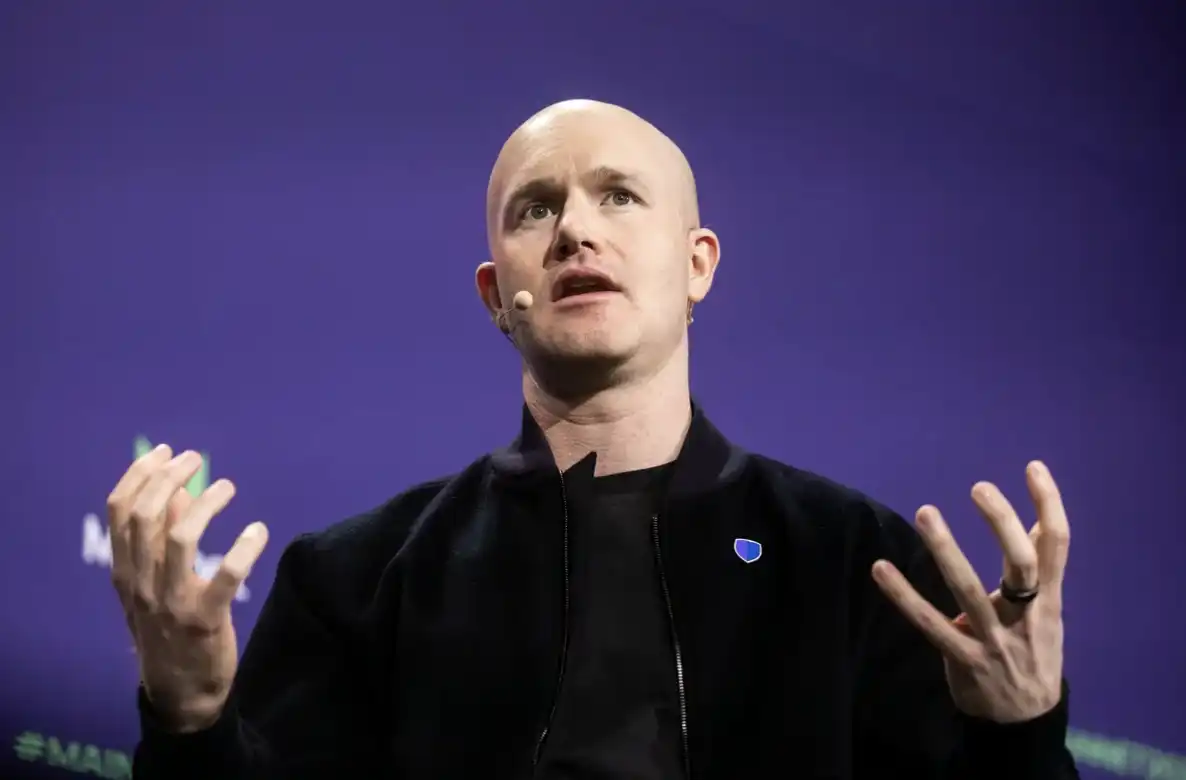
Coinbase's CEO Brian Armstrong
Coinbase Global Inc. is increasing pressure on U.S. lawmakers in an attempt to retain its ability to provide rewards to customers holding stablecoins. The company believes that if certain restrictions currently under discussion are included in a significant cryptocurrency bill expected to be released on Monday, this business will be at risk.
According to a person familiar with the company's thinking, if the bill text includes anything beyond "strengthened disclosure of reward-related information," the largest U.S. crypto exchange may reconsider whether to continue supporting the digital asset market structure bill. The bill is expected to enter the markup stage in at least one Senate committee on Thursday.
Coinbase did not respond to a request for comment.
Industry sources said that one option under consideration is to limit eligibility for rewards to regulated financial institutions. This approach has some support from the banking industry, as they believe that interest-bearing stablecoin accounts could "siphon off" deposits from the traditional banking system. Coinbase has applied for a national trust charter, which, if approved, could allow it to continue offering such rewards under the above rules. However, crypto-native companies are pushing to retain the "platform reward" model without a license and have warned that broader restrictions could disrupt the industry's competitive landscape.
The threat of "Support Withdrawal" is not insignificant. The cryptocurrency industry is the top industry in terms of corporate political spending during the 2023-2024 election cycle, funneling significant funds to favored candidates. Coinbase, led by co-founder and CEO Brian Armstrong, donated $1 million to Donald Trump's presidential inauguration and was also one of the companies funding the construction of a dining hall at the White House.
For Coinbase, the issue of incentives is crucial. The exchange shares part of the interest income generated from Circle Internet Group Inc.'s ref="/wiki/article/usd-coin-usdc-269">USDC stablecoin reserves with Circle. The USDC held on the Coinbase platform provides a stable source of income, especially crucial during bear markets. Coinbase also holds a small amount of Circle's stock; Circle is currently the largest compliant stablecoin issuer under a U.S. law passed in July.
For instance, Coinbase incentivizes users to hold USDC on the platform by offering a 3.5% reward for USDC in Coinbase One accounts. If market structure legislation prohibits such incentive measures, the stablecoin holdings on the platform may decrease, affecting Coinbase's overall stablecoin revenue. According to Bloomberg data, this revenue is expected to reach $1.3 billion by 2025.
Of course, the devil is in the details, and the impact is not yet fully clear, depending on the specific wording of the legislation. However, sources familiar with the matter have indicated that the legislation will include relevant references to incentives.
《GENIUS Act》
The second Trump administration swiftly brought a "positive" development to the digital asset industry, including the first federal-level stablecoin issuance regulatory framework passed in July, known as the "GENIUS Act." Following the signing of this act, a series of announcements from retailers to traditional financial institutions expressing intent to enter the stablecoin space have emerged. Even before the act officially became law, World Liberty Financial, co-founded by members of the Trump family, had already launched a proprietary stablecoin called USD1.
Despite government support to expedite the legislation, the "Stablecoin Reward" issue is eroding the bipartisan consensus of the market structure bill. Coinbase's warning of possible support withdrawal indicates that the escalating tension may slow down the legislative process and even result in the legislation not being completed this year. Bloomberg Intelligence analyst Nathan Dean suggests that if there is a lack of bipartisan support during the deliberation stage, the probability of passing relevant legislation in the first half of this year may drop to below 70%.
The "GENIUS Act" prohibits stablecoin issuers from paying users any form of interest or earnings solely for holding the token, but does not prohibit third-party distribution partners like Coinbase from offering rewards based on customer balances.
The banking industry strongly opposes exchanges providing stablecoin rewards, arguing that it would erode deposit sizes in the banking system and undermine community lending capacity.
The American Bankers Association wrote in a recent letter: "If billions of dollars are drawn away from community bank lending, small businesses, farmers, students, and homebuyers in towns like ours will be impacted. Cryptocurrency exchanges and their affiliated stablecoin firms are not designed to fill this lending gap and cannot offer FDIC-insured products, but they often conveniently omit this fact in their aggressive marketing."
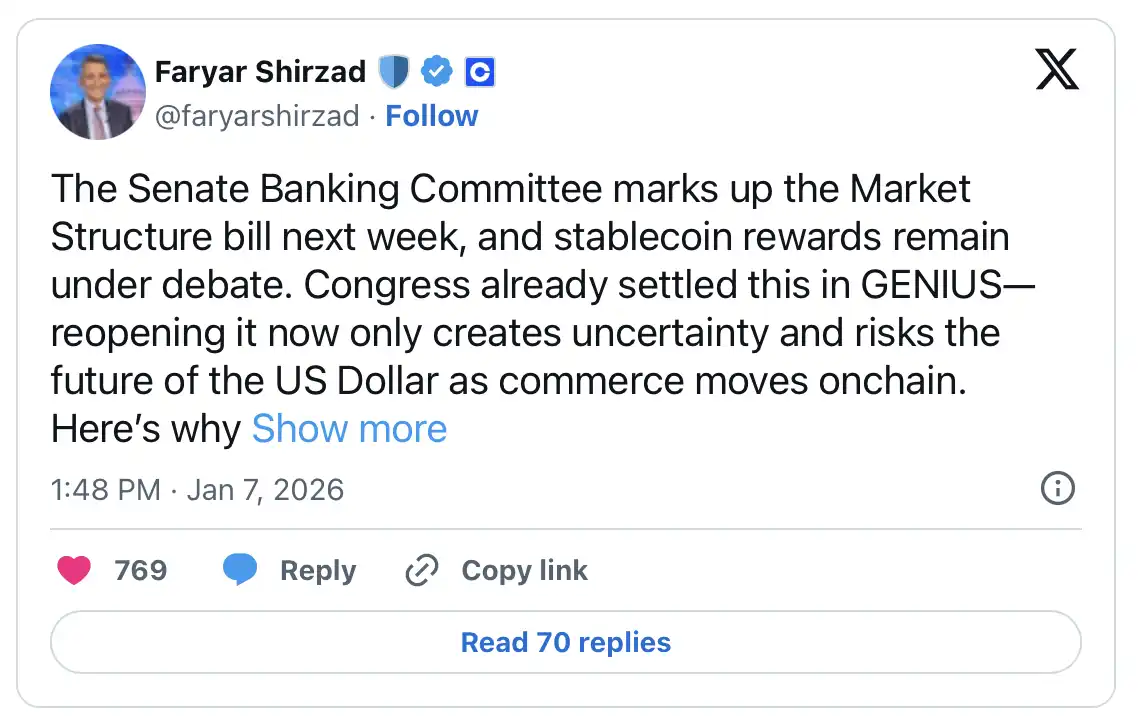
In contrast, the crypto industry portrays the banking sector's efforts as an attempt to overturn the consensus already reached in the "GENIUS Act." Coinbase's Chief Policy Officer Faryar Shirzad recently wrote on the X platform, emphasizing the importance of maintaining a reward mechanism linked to stablecoins to uphold the dollar's dominance. He also noted that China has recently announced plans to start paying interest on its central bank digital currency, the digital yuan.
This tension has put senators in a dilemma. Industry insiders and observers indicate that on one hand, the government is pushing for more legislation; on the other hand, they are forced to make a choice on an almost uncompromising issue.
Insiders suggest a possible middle ground: allowing only entities holding a banking charter or financial institutions to offer rewards to users based on stablecoin balances. The Office of the Comptroller of the Currency (OCC) recently conditionally approved five cryptocurrency companies to become national trust banks. However, these approvals have faced strong opposition from banking lobbying groups, which believe that cryptocurrency companies are stretching the boundaries of the "limited-purpose trust charter" and may pose a threat to the stability of the U.S. financial system. Given the existing approval precedents, allowing chartered companies to provide yield if included in the market structure bill may appease some participants in the crypto industry.
Nevertheless, some industry insiders believe that even if restrictions are imposed, it will only trigger a game of "whack-a-mole" – crypto firms will constantly seek new ways to reward users.
Payment giant Stripe's President of Technology and Business, William Gaybrick, stated in an interview last year: "There is no world where we can't reward consumers within an app. In a scenario where you hold stablecoin within an app, that app will always find some way to reward your behavior."
You may also like

Morning News | American Bitcoin's BTC holdings have surpassed 7,000; Midas completes $50 million Series A financing; Upbit's parent company Dunamu announces 2025 revenue

A plunge of over 97% continues to unlock, yet WLD has completed $65 million in over-the-counter financing: who is still footing the bill?

Potential Bitcoin Crash Below $60K May Delay Recovery to 2027
Key Takeaways: Bitcoin’s deep drawdown phase may extend recovery to the second quarter of 2027. Historical data shows…

BTC USD Price Drops Below $67K Amid Rising Treasury Yields
Key Takeaways: BTC USD slumped to $66,300, its first drop below $67K since March 9, driven by macroeconomic…

Second Bill Targets Insider Trading in Prediction Markets
Key Takeaways: The Public Integrity in Financial Prediction Markets Act of 2026 prohibits government officials from using insider…

India Apprehends Key Figure in Myanmar Crypto Fraud Complex
Key Takeaways: India’s Central Bureau of Investigation (CBI) arrested a key player in a scam that trafficked Indian…

Bitcoin and Profit Metrics: Will History Repeat Itself?
Key Takeaways: Historical patterns reveal that when Bitcoin’s supply in profit falls below 50%, significant price rallies ensue.…

Bitcoin ‘Compression’ Outcome Could Propel BTC Towards $80K: An Analyst’s Perspective
Key Takeaways: Bitcoin’s price is testing a critical $71,500 level, hinting at a possible rally to $80,000. Traders…
Data Points to Accelerating Ether Supply Crunch: Will ETH Price Follow?
Key Takeaways: As of now, 33.1% of Ethereum’s circulating supply is staked, resulting in a tighter liquid supply.…

XRP Risk-Reward Improves as Whale Accumulation Surges: Will the Price Mirror This Trend?
Key Takeaways: XRP’s Sharpe Ratio turned positive on March 26, 2026, indicating a potential for returns outweighing associated…

Cryptocurrency Price Predictions for March 27: BTC, ETH, BNB, XRP, SOL, DOGE, HYPE, ADA, BCH, and LINK
Key Takeaways: Bitcoin is struggling to maintain its position above the $66,000 threshold, amplifying concerns of a further…
Bitcoin ETFs Face Capital Outflow as Market Treads with Caution
Key Takeaways: Bitcoin ETFs experienced a $296 million outflow, ending a four-week inflow run. Total net assets for…

Crypto Market Predictions: BTC, ETH, BNB, XRP, SOL, DOGE, HYPE, ADA, BCH, LINK
Key Takeaways: Bitcoin struggles at the $72,000 level as bulls aim for $80,000, while resistance remains strong. Ethereum…

Bitcoin Returns to $71K as Oil Prices Plummet with Trump Halting Iran Strikes
Key Takeaways: Bitcoin rallies 5% to surpass $71,000 following Trump’s delay of US military action against Iran. Liquidations…

Ether Taker Volume Reaches Three-Year Peak: Can ETH Sidestep a 19% Price Drop?
Key Takeaways: An Ether on-chain indicator has surged to its highest in over three years, signaling potential stabilization…

Bitcoin Spot Volumes Reach 2023 Lows While BTC Rallies Stay News-Driven
Key Takeaways: Bitcoin’s price surged to $71,600 during a US market open, but the rise lacked consistent spot…
Unifying Ethereum: Tackling Fragmentation and Embracing Onchain Trading
Key Takeaways: Ethereum developers propose a groundbreaking ‘Economic Zone’ to address fragmentation in layer-2 networks. Onchain commodity trading…
Lummis Affirms CLARITY Act as DeFi’s Strongest Shield Yet
Key Takeaways: The CLARITY Act is touted by Senator Cynthia Lummis as providing unparalleled protections for DeFi developers.…
Morning News | American Bitcoin's BTC holdings have surpassed 7,000; Midas completes $50 million Series A financing; Upbit's parent company Dunamu announces 2025 revenue
A plunge of over 97% continues to unlock, yet WLD has completed $65 million in over-the-counter financing: who is still footing the bill?
Potential Bitcoin Crash Below $60K May Delay Recovery to 2027
Key Takeaways: Bitcoin’s deep drawdown phase may extend recovery to the second quarter of 2027. Historical data shows…
BTC USD Price Drops Below $67K Amid Rising Treasury Yields
Key Takeaways: BTC USD slumped to $66,300, its first drop below $67K since March 9, driven by macroeconomic…
Second Bill Targets Insider Trading in Prediction Markets
Key Takeaways: The Public Integrity in Financial Prediction Markets Act of 2026 prohibits government officials from using insider…
India Apprehends Key Figure in Myanmar Crypto Fraud Complex
Key Takeaways: India’s Central Bureau of Investigation (CBI) arrested a key player in a scam that trafficked Indian…


 App
App