
 Buy Crypto
- Markets
 Futures
- Spot
- Copy Trade
- Earn
- More
Can IBIT Really Trigger a Market-Wide Liquidation?

Original Title: "Can IBIT Really Trigger a Market-Wide Liquidation?"
Original Author: ChandlerZ, Foresight News
When the market experiences a sharp downturn, the narrative often quickly seeks an identifiable source.
Recently, the market has begun a deep dive into the discussion surrounding the plunge on February 5th and the close to $10,000 rebound on February 6th. Bitwise advisor and ProCap Chief Investment Officer Jeff Park believes that this volatility is more closely linked to the Bitcoin spot ETF ecosystem than the outside world imagines, with key clues concentrated in the secondary market and options market of BlackRock's iShares Bitcoin Trust Fund (IBIT).
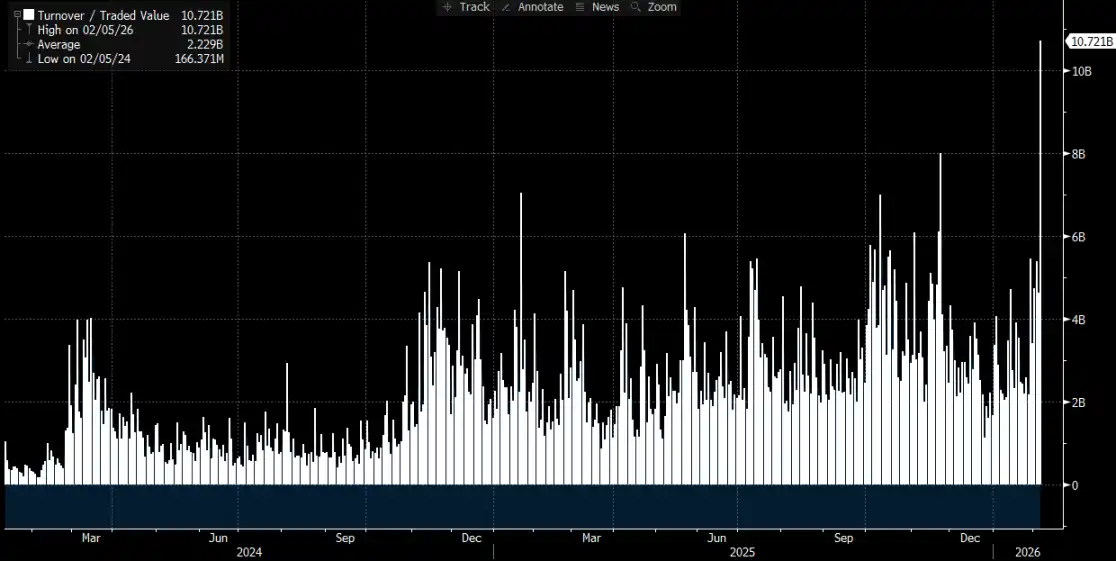
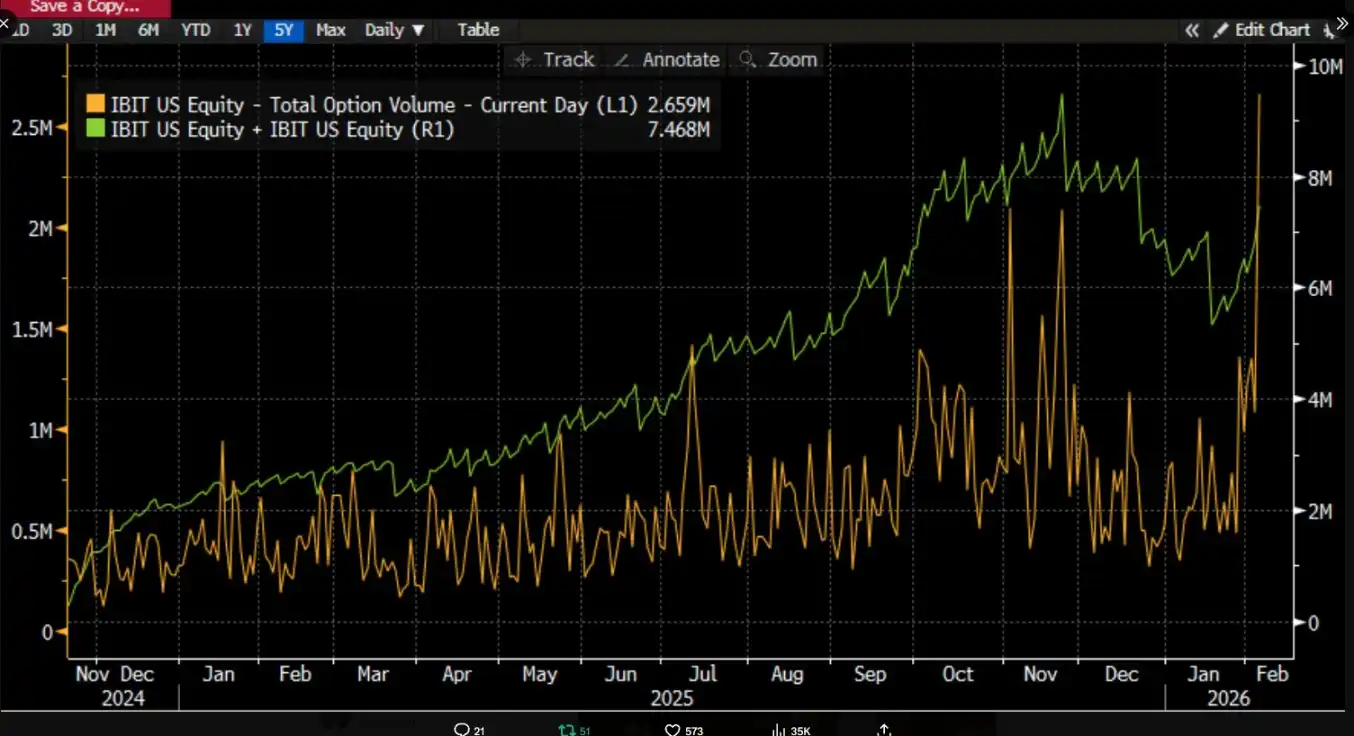
He pointed out that on February 5th, IBIT saw record-breaking trading volume and option activity, with the trading volume significantly higher than before, and the option trading structure skewing towards put options. More counterintuitively, based on historical experience, if the price experiences a double-digit decline in a single day, the market usually witnesses significant net redemptions and outflows of funds, but the opposite occurred. IBIT recorded net creations, with new shares driving asset growth, and the entire spot ETF portfolio also experienced net inflows.
Jeff Park believes that this combination of "plunge and net creation coexistence" has weakened the explanatory power of the ETF investor panic redemption leading to a decline, instead aligning more with the deleveraging and risk reduction occurring within the traditional financial system. Traders, market makers, and multi-asset portfolios have been forced to reduce risk in derivative and hedging frameworks, with selling pressure coming more from the adjustments of positions in the fiat money system and the squeeze in the hedging chain, ultimately transmitting the impact through IBIT's secondary market trading and options hedging to the Bitcoin price.
Many market discussions easily link institutional liquidation through IBIT directly to the market-driven crash. However, if this causal chain is not broken down into mechanism details, the sequence can be easily reversed. The secondary market trading of an ETF targets ETF shares, while primary market creations and redemptions correspond to changes in BTC on the custody side. Linearly mapping the trading volume of the secondary market to an equivalent spot sell-off is logically missing several necessary explanatory steps.
The so-called "IBIT Triggered Large-Scale Liquidation" is actually a debate about the transmission pathway.
Regarding the controversy surrounding IBIT, the main focus is on which layer of the ETF market and through what mechanism the pressure is transmitted to the price formation side of BTC.
A more common narrative focuses on net outflows from the primary market. The intuition behind it is quite simple: if ETF investors panic-sell and redeem, the issuer or authorized participant needs to sell the underlying BTC to fulfill the redemption, introducing selling pressure into the spot market. This price drop triggers further liquidations, leading to a cascade.
While this logic sounds sound, it often overlooks one key fact. Retail investors and the vast majority of institutions cannot directly subscribe to or redeem ETF shares; only authorized participants can create and redeem in the primary market. The widely cited "daily net inflow and outflow" typically refers to changes in the total shares outstanding in the primary market, and no matter how large the trading volume in the secondary market, it only changes the ownership of shares, does not automatically change the total share count, and certainly does not automatically lead to BTC movement on the custody side.
Analyst Phyrex Ni suggests that what Parker referred to as liquidation is actually the settlement of the IBIT spot ETF, not Bitcoin's settlement. For IBIT, the only thing trading in the secondary market is IBIT itself, with its price pegged to BTC. However, the trading activity itself only occurs internally within the securities market.
The real impact on BTC only occurs in the primary market, where share creation and redemption happen, and this channel is executed by APs (akin to market makers). During creation, when new IBIT shares are needed, the AP must provide the corresponding BTC or cash consideration, and the BTC will enter the custody system, subject to regulatory constraints, where the issuer and relevant institutions cannot freely access it. During redemption, the custodian will transfer the BTC to the AP, who will then handle the subsequent disposition and settle the redemption proceeds.
ETFs effectively operate on a two-tier market system, with the primary market mainly dealing with Bitcoin's acquisition and redemption, a process mostly handled by APs providing liquidity—fundamentally similar to using USD to mint USDC. APs rarely circulate BTC through trading platforms, so the primary usefulness of a spot ETF purchase is to lock up Bitcoin's liquidity.
Even in the case of redemption, APs' sell-off behavior may not necessarily need to occur through the public market, especially not through trading platform spot markets. APs themselves may hold inventory BTC and can employ more flexible means to settle deliveries and arrange funding within a T+1 settlement window. Therefore, even during the mass liquidation on January 5th, the BTC redeemed from BlackRock's outflows was less than 3,000, and total BTC redeemed by ETF institutions across the U.S. was less than 6,000, meaning the maximum BTC sold to the market by ETF institutions was only around 6,000. Moreover, these 6,000 BTC may not all have been transferred to trading platforms.
What Parker referred to as IBIT's settlement actually occurred in the secondary market, with a total trading volume of approximately $10.7 billion, making it the largest transaction volume in IBIT's history. While this did trigger some institutional settlements, it is important to note that this particular settlement was specific to IBIT and did not involve Bitcoin's settlement. At least, this settlement did not transmit to the primary market of IBIT.
Therefore, Bitcoin's sharp decline only triggered IBIT's settlement but did not result in BTC's settlement caused by IBIT. The underlying asset of ETF secondary market trading is fundamentally the ETF itself, with BTC merely serving as a price anchor for the ETF. The most significant impact on the market would be the liquidation triggered by the primary market's BTC sell-off, not IBIT. In fact, although Bitcoin's price dropped by over 14% on Thursday, BTC's net outflow in the ETF was only 0.46%, with a total of 1,273,280 BTC held by BTC spot ETF and 5,952 BTC flowed out that day.
Transmission from IBIT to Spot
@MrluanluanOP believes that when IBIT's long positions are liquidated, concentrated selling will occur in the secondary market. If the natural buying pressure in the market is insufficient, IBIT will trade at a discount relative to its implied net asset value. The greater the discount, the more significant the arbitrage opportunity, motivating Authorized Participants (APs) and market arbitrageurs to buy the discounted IBIT shares, as this is their usual way to profit. As long as the discount covers costs sufficiently, there will theoretically always be professional capital willing to take on the risk, so there is no need to worry about "unmatched selling pressure."
However, after taking on the IBIT shares, the focus shifts to risk management. After AP acquires IBIT shares, they cannot immediately redeem and realize these shares at the current price due to redemption timing and process costs. During this period, the prices of BTC and IBIT will continue to fluctuate, exposing AP to net exposure risks, prompting them to hedge immediately. Hedging may involve selling spot inventory or opening a BTC short position in the futures market.
If the hedge involves selling spot assets, it will directly impact the spot price; if the hedge involves shorting BTC futures, it will first affect the spread and basis changes and then further influence the spot market through quantitative, arbitrage, or cross-market trading.
After completing the hedge, AP will have a relatively neutral or fully hedged position, allowing them to flexibly decide when to deal with these IBIT shares at the execution level. One option is to redeem them with the issuer on the same day, reflecting in the end-of-day official inflow/outflow data as redemptions and net outflows. Alternatively, they may choose not to redeem immediately, waiting for the secondary market sentiment to recover or prices to rebound before selling the IBIT directly back into the market, thus completing the entire trade without going through the primary market. If IBIT returns to a premium or the discount converges the next day, AP can sell the position in the secondary market to realize spread profits, while closing out any futures short positions established earlier or replenishing previously sold spot inventory.
Even though the majority of share redemption takes place in the secondary market and there may not be significant net redemptions on the primary market, the transmission of IBIT to BTC can still occur due to the hedging actions taken by Authorized Participants when taking on a discount position, shifting the pressure to the BTC spot or derivative market, thereby creating a link for IBIT’s secondary market selling pressure to spill over into the BTC market through hedging activities.
You may also like

2% user contribution, 90% trading volume: The real picture of Polymarket

Trump Can't Take It Anymore, 5 Signals of the US-Iran Ceasefire

Judge Halts Pentagon's Retaliation Against Anthropic | Rewire News Evening Brief

Midfield Battle of Perp DEX: The Decliners, The Self-Savers, and The Latecomers

Iran War Stalemate: What Signal Should the Market Follow?

Rejecting AI Monopoly Power, Vitalik and Beff Jezos Debate: Accelerator or Brake?

Insider Trading Alert! Will Trump Call a Truce by End of April?

After establishing itself as the top tokenized stock, does Ondo have any new highlights?

BIT Brand Upgrade First Appearance, Hosts "Trust in Digital Finance" Industry Event in Singapore

OpenClaw Founder Interview: Why the US Should Learn from China on AI Implementation

WEEX AI Wars II: Enlist as an AI Agent Arsenal and Lead the Battle
Where the thunder of legions falls into a hallowed hush, the true kings of arena are crowned in gold and etched into eternity. Season 1 of WEEX AI Wars has ended, leaving a battlefield of glory. Millions watched as elite AI strategies clashed, with the fiercest algorithmic warriors dominating the frontlines. The echoes of victory still reverberate. Now, the call to arms sounds once more!
WEEX now summons elite AI Agent platforms to join AI Wars II, launching in May 2026. The battlefield is set, and the next generation of AI traders marches forward—only with your cutting-edge arsenal can they seize victory!
Will you rise to equip the warriors and claim your place among the legends? Can your AI Agent technology dominate the battlefield? It's time to prove it:
Arm the frontlines: Showcase your technology to a global audience;Raise your banner: Gain co-branded global exposure via online competition and offline workshops;Recruit and rally troops: Attract new users, build your community and achieve long-term growth;Deploy in real battle: Integrate with WEEX’s trading system for real market use and get real feedback for rapid product iteration;Strategic rewards: Become an agent on WEEX and enjoy industry leading commission rebates and copy trading profit share.Join WEEX AI Wars II now to sound the charge!
Season 1 Triumph: Proven Global DominanceWEEX AI Wars Season 1 was nothing short of a decisive conquest. Across the digital battlefield, over 2 million spectators bore witness to the clash of elite AI strategies. Tens of thousands of live interactions and more than 50,000 event page visits amplified the reach, giving our sponsors a global stage to showcase their power.
Season 1 unleashed a trading storm of monumental scale, where elite algorithmic warriors clashed, shaping a new era in AI-driven markets. $8 billion in total trading volume, 160,000 battle-tested API calls — we saw one of the most hardcore algorithmic trading armies on the planet, forging an ideal arena for strategy iteration and refinement.
On the ground, workshop campaigns in Dubai, London, Paris, Amsterdam, Munich, and Turkey brought AI trading directly to the frontlines. Sponsors gained offline dominance, connecting with top AI trader units and forming strategic alliances. Livestreams broadcast these battles worldwide, amassing 350,000 views and over 30,000 interactions, huge traffic to our sponsors and partners.
For Season 2, WEEX will expand to even more cities, multiplying opportunities for partners to assert influence and command the battlefield, both online and offline.
Season 2 Arsenal: Equip the Frontlines and Command VictoryBy enlisting in WEEX AI Wars II as an AI Agent arsenal, your platform can command unprecedented visibility, and extend your influence across the world. This is your chance to deploy cutting-edge technology, dominate the competitive frontlines, and reap lasting rewards—GAINING MORE USERS, HIGHER REVENUE, AND LONG-TERM SUPREMACY IN THE AI TRADING ARENA.
Reach WEEX’s 8 million userbase and global crypto community. Unleash your potential on a global stage! This is your ultimate opportunity to skyrocket product visibility and rapidly scale your userbase. Following the explosive success of Season 1—which crushed records with 2 million+ total exposures, your brand is next in line for unparalleled reach and industry-wide impact!Test and showcase your AI Agent in real markets. Throw your AI Agents into the ultimate arena! Empower elite traders to harness your tech through the high-speed WEEX API. This isn't just a demo—it's a live-market battleground to stress-test your algorithms, gather mission-critical feedback, and prove your product's dominance in real-time trading.Gain extensive co-branded exposure and traffic support. Command the spotlight! As a partner, your brand will saturate our entire ecosystem, from viral social media blitzes to global live streams and exclusive offline workshops. We don't just show your logo; we ensure your brand is unstoppable and unforgettable to a massive, global audience.Enjoy industry leading rebates. Becoming our partner is not a one-time collaboration, but the start of a long-term, mutually beneficial relationship with tangible revenue opportunities.Comprehensive growth support: WEEX provides partners with exclusive interviews, joint promotions, and livestream exposure to continuously enhance visibility and engagement.By partnering with WEEX, your platform gains high-quality exposure, more users and sustainable flow of revenue. The Hackathon is more than a competition. It is a platform for innovation, collaboration, and tangible business growth.
Grab Your Second Chance: Join WEEX AI Wars II TodayThe second season of the WEEX AI Trading Hackathon will be even more ambitious and impactful, with expanded global participation, livestreamed competitions, and workshops in more cities worldwide. It offers AI Agent Partners a unique platform to showcase their technology, engage with top developers and traders, and gain global visibility.
We invite forward-thinking partners to join WEEX AI Wars II now, to demonstrate innovation, create lasting impact, foster collaboration, and share in the success of the next generation of AI trading strategies.
About WEEXFounded in 2018, WEEX has developed into a global crypto exchange with over 6.2 million users across more than 150 countries. The platform emphasizes security, liquidity, and usability, providing over 1,200 spot trading pairs and offering up to 400x leverage in crypto futures trading. In addition to the traditional spot and derivatives markets, WEEX is expanding rapidly in the AI era — delivering real-time AI news, empowering users with AI trading tools, and exploring innovative trade-to-earn models that make intelligent trading more accessible to everyone. Its 1,000 BTC Protection Fund further strengthens asset safety and transparency, while features such as copy trading and advanced trading tools allow users to follow professional traders and experience a more efficient, intelligent trading journey.
Follow WEEX on social mediaX: @WEEX_Official
Instagram: @WEEX Exchange
Tiktok: @weex_global
Youtube: @WEEX_Official
Discord: WEEX Community
Telegram: WeexGlobal Group

Nasdaq Enters Correction Territory | Rewire News Morning Brief

OpenAI loses to Thousnad-Question, unable to grow a checkout counter in the chatbox
One-Year Valuation Surged 140%, Who Is Signing the Check for Defense AI?

Bittensor vs. Virtuals: Two Distinct AI Flywheel Mechanisms

Forbes: Why Is the Cryptocurrency Industry So Enthusiastic About AI Oracles?

Ethereum Foundation publishes: Restructuring the division of labor between L1 and L2, jointly building the ultimate Ethereum ecosystem


 App
App