
 Buy Crypto
- Markets
 Futures
- Spot
- Copy Trade
- Earn
- More
Bankless is starting to go wild with cash-outs, what stage of the market are we in right now?

Original Article Title: Local Tops: what makes the market go up and down
Original Article Author: mikeykremer, MessariCrypto Tech Lead
Original Article Translation: zhouzhou, BlockBeats
The following is the original content (slightly reorganized for readability):
Alpha Leak: The vile behavior of BanklessVC clearly indicates that we have entered the market's "exploitative PvP phase," so protect yourself and your gains. I suspect this cycle has topped out; it's just a natural pullback reflecting the crypto market's search for pain points to exploit, although this pain point could persist for some time.
Tokens like Virtuals, ai16z, and heyanon may create new highs in the rebound phase but also face narrative risk, so keep reassessing your market thesis.
Why Does the Market Rise?
The market rises due to new capital entering the market, which is quite evident. From now on, I will use the concept of the "wealth effect" to describe the process of new capital entering the market. We all hope that cryptocurrency can create real value in the world and share this growth through monetary expansion. Here are several ways to achieve this goal:
1. Creating Wealth through Innovation (Airdrops)
Airdrops have become a powerful value redistribution mechanism in the crypto market, capable of generating significant wealth effects that benefit a broad set of participants. For example, the September 2020 Uniswap airdrop set an industry standard, distributing 400 UNI tokens to over 250,000 addresses (worth about $1,400 at issuance), with a total value eventually exceeding $9 billion.
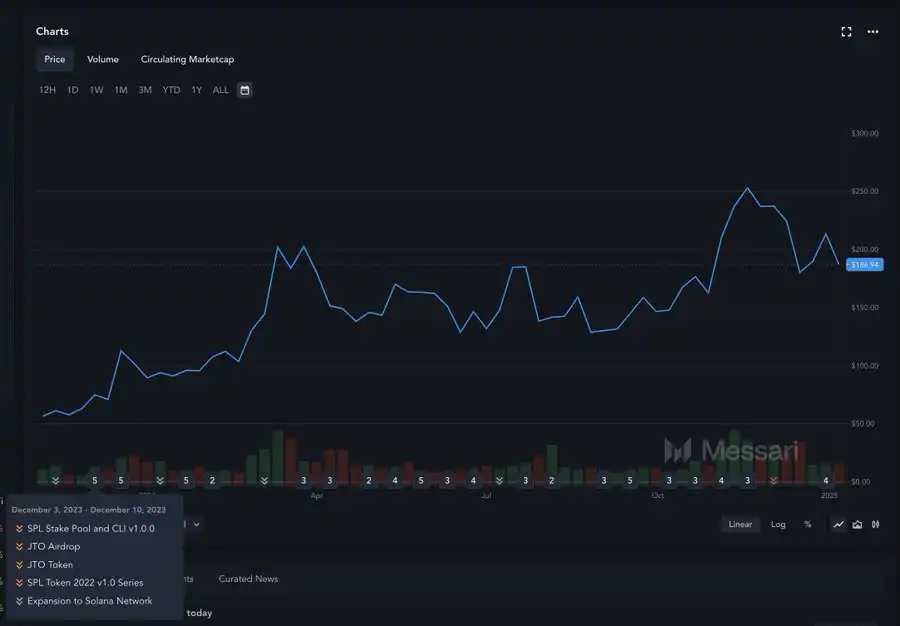
The December 2023 Jito airdrop was an early catalyst for the Solana meme coin bull run.
The Jito airdrop distributed 90 million JTO tokens, worth $165 million at issuance, with some users receiving rewards of up to $10,000 by simply transferring $40 worth of JitoSOL. The Jito airdrop fueled the growth in Solana's total value locked and increased on-chain activities. This wealth effect facilitated broader adoption and development of the Solana ecosystem, similar to how Uniswap's UNI token catalyzed the growth of DeFi.
The token distribution model of Jupiter further showcases the transformative potential of airdrops. They plan to distribute 7 billion JUP tokens, covering over 2.3 million eligible wallets, making it one of the most widely distributed airdrops in crypto history. Jupiter's airdrop strategy aims to expand its ecosystem through incentivizing long-term participation and governance involvement. These airdrops have demonstrated remarkable efficiency in broadening market participation.

The wealth effect extends beyond direct economic gains; these airdrops transform users into stakeholders, enabling them to engage in governance and protocol development. This transformation creates a virtuous cycle, as benefiting participants reinvest wealth back into the ecosystem, further driving market expansion and innovation.
These strategic allocations have proven to be powerful market catalysts, igniting broader bull market cycles in their respective fields. For example, Uniswap's airdrop triggered the DeFi summer of 2020, with its distribution fueling an innovation wave in decentralized finance. Similarly, the December 2023 Jito airdrop became a turning point for the Solana ecosystem, driving TVL growth and sparking unprecedented on-chain activity.
This surge in liquidity and market confidence laid the groundwork for the subsequent meme coin explosion, leading to significant market growth. These airdrops effectively acted as stimulus programs covering the entire ecosystem, creating a self-reinforcing cycle of investment and innovation that defined the era characteristics of their respective markets.
Wealth Accumulation (Margin Buyer)
When the market experiences strategic airdrops and other proactive catalyzing events, it attracts previously passive observers to enter with new capital and enthusiasm, forming a virtuous cycle of market expansion and innovation.

Airdrops evoke significant positive FOMO, driving both new and existing users to engage more deeply in the market.
Previously onlooker investors, upon witnessing successful airdrops and subsequent market momentum, begin to deploy capital, transitioning from spectators to active participants. This shift from fiat to crypto assets represents genuine new capital entering the ecosystem, rather than a simple transfer among existing participants.
Large financial institutions are increasingly facilitating this transition. Companies like BlackRock, Fidelity, and Franklin Templeton have launched products that bridge traditional finance with digital assets. The involvement of these institutions helps legitimize the market and provides a more accessible entry point for observing funds. This expansion creates a positive feedback environment where new entrants contribute to overall market growth.
Unlike a zero-sum trading environment, a market with active new participants has created a true wealth effect through expanded liquidity, increased development activities, and broader adoption. This positive feedback loop has attracted more cautious capital, further driving ecosystem growth.
3. Wealth Creation Through Leverage (Multiple Expansion)
During the peak of a bull market, leverage becomes the primary driver of price appreciation, signaling a shift in the market from value creation to value multiplication. As the market enters the price discovery phase, traders increasingly use leverage to amplify their positions, forming a self-reinforcing cycle of upward momentum.
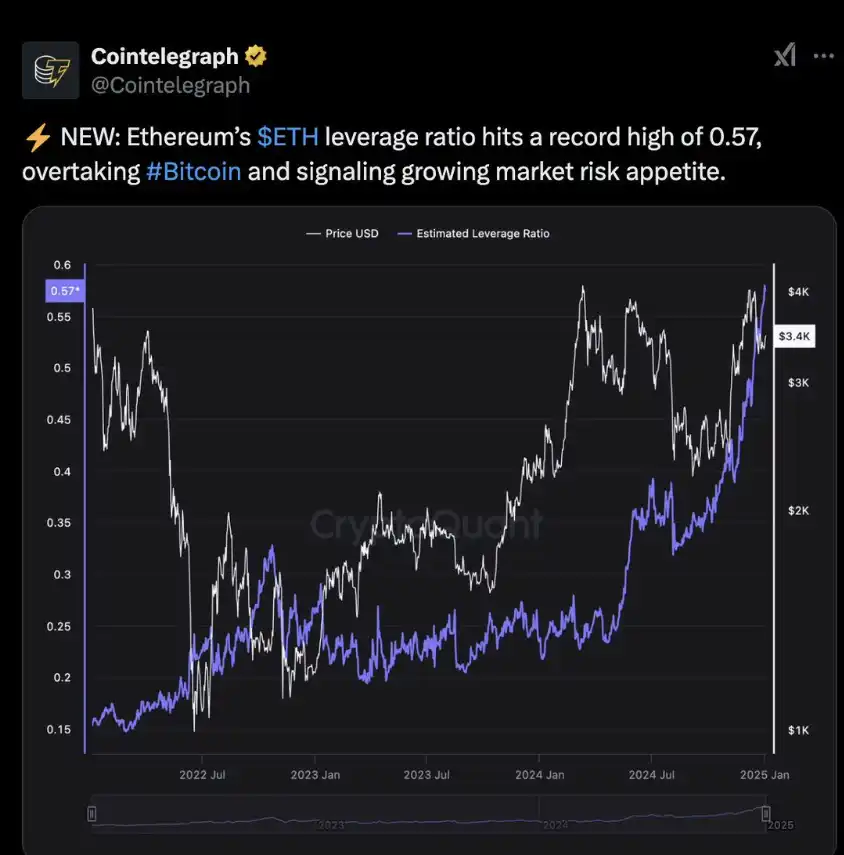
As Bitcoin enters the price discovery phase above its all-time high, leverage ratios expand significantly as traders seek to maximize their exposure. This sets off a chain reaction where borrowed stablecoins fuel further buying, driving up prices, and encouraging more leveraged positions. This multiplier effect accelerates price volatility.
The growing prevalence of leverage has also introduced systematic fragility to the market. As more traders take on leveraged positions, the possibility of cascading liquidations increases, especially when borrowing stablecoins becomes more expensive and harder to come by.
The rising cost of stablecoin borrowing is a key indicator that the market is entering its final stage. This marks the transition from organic growth to leverage-driven expansion, where the market no longer creates new value but merely multiplies existing value through debt.
At this stage, a high reliance on leverage puts the market in a precarious position. Sudden price fluctuations could trigger massive liquidations, leading to swift price corrections. This vulnerability indicates that the bull market is nearing its end as the market increasingly depends on borrowed funds rather than fundamental value creation.
What Causes the Market to Drop?
When funds exit the market, the market experiences a decline, as seen plainly. This is essentially the reversal of the wealth effect, where speculators capitalize on market sentiment, smart money exits to lock in profits, and foolish money incurs losses due to liquidations.
Wealth Extraction from the Market, You Are Here
Cryptocurrency ecosystems often go through cycles of value extraction, where savvy operators devise various strategies to extract funds from enthusiastic market participants. Unlike innovative value distribution, these strategies systematically drain liquidity from the market through various predatory mechanisms.
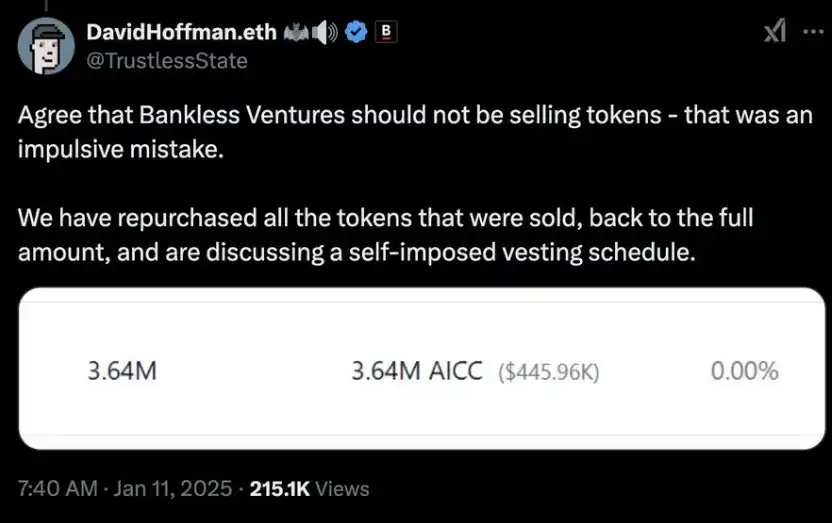
One of the most sickening points in the Bankless story is that they extracted thousands of SOL from the ecosystem with just 2 SOL.
The recent launch of the Aiccelerate DAO further demonstrates the evolution of this phenomenon. Despite the support of prominent advisors such as Bankless' founder and industry veterans, the project faced criticism upon launch as token recipients began selling without a lock-up period. Even well-known projects can become tools for rapid value extraction.
Celebrity tokens are also a prime example of this predatory behavior, with these projects using malicious smart contracts and organized selling to transfer wealth from retail buyers to insiders, ending the meme coin bull run cycle. Such value extraction events severely damage market confidence and hinder the entry of compliant participants.
These actions not only fail to establish a sustainable ecosystem but instead create a cycle of distrust, impeding the mature development of the entire cryptocurrency ecosystem.
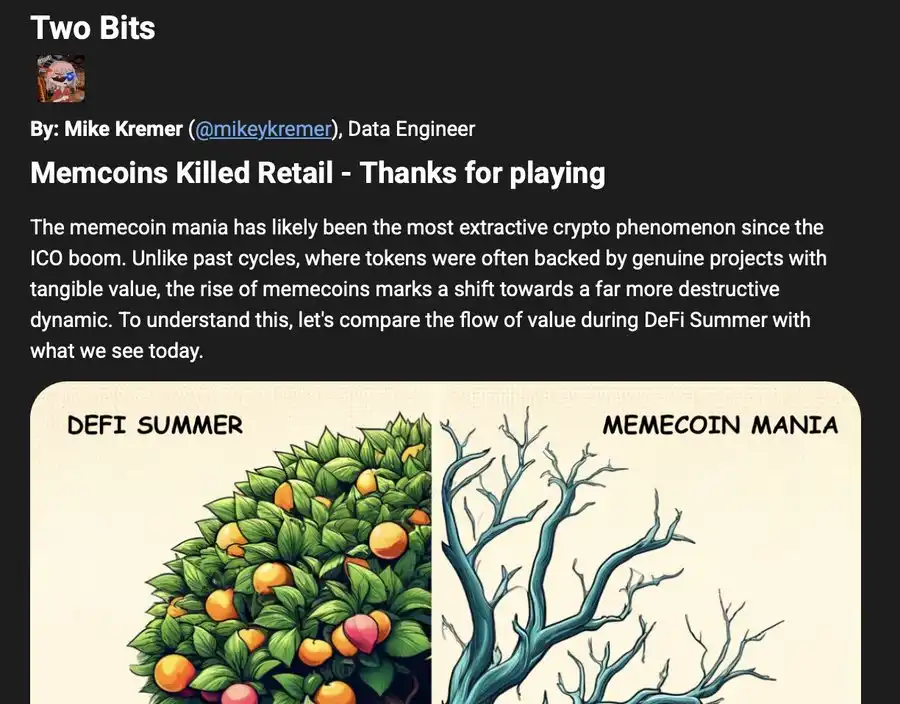
Instead of reinvesting profits in ecosystem development, these schemes systematically drain liquidity from the market. The extracted funds usually flow entirely out of the crypto ecosystem, reducing the overall available capital for legitimate projects and innovation.
From blatant scams to complex operations supported by reputable institutions, this trend is concerning. When well-known institutions engage in rapid value extraction, distinguishing between legitimate projects and elaborate scams becomes increasingly challenging for market participants.
2. Sellers Only

Were you surprised when Bored Ape Yacht Club (BAYC) peaked after 3 months?
As the market started to decline, a noticeable asymmetry emerged between seasoned players and retail participants. The former could quickly sense the market turning, while the latter remained immersed in an optimistic narrative. This phase was characterized not by the influx of new capital but by experienced traders systematically withdrawing liquidity.
Professional traders and investment firms, while reducing their exposure, still maintained an outwardly optimistic stance. Venture capital firms quietly cashed out through over-the-counter trades and strategic exits, preserving capital without impacting the market. This operation created an illusion of market stability, even as significant funds quietly exited the system.
"Smart money" also began retracting liquidity from DeFi protocols and trading platforms. This subtle but sustained liquidity drain made market conditions increasingly fragile, although this impact may not be immediately apparent to the casual observer.
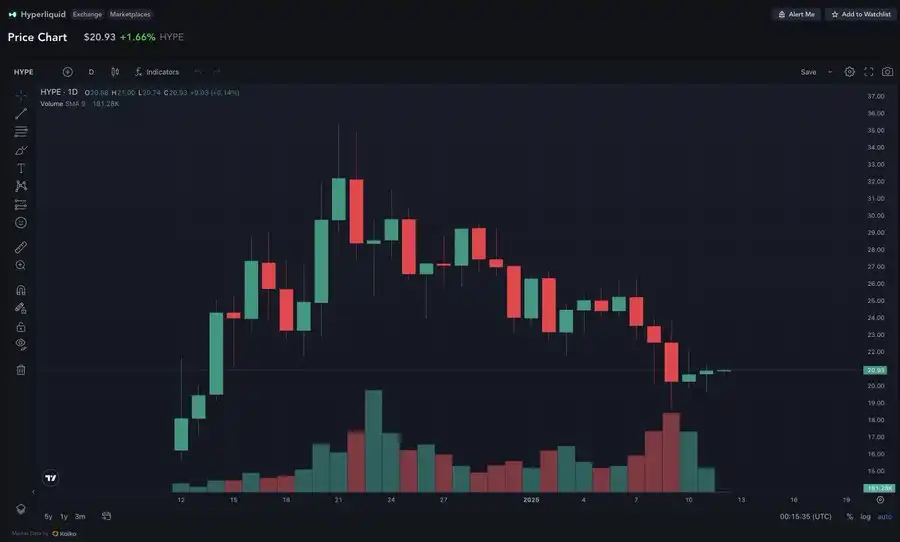
It appears that some smart money is exiting the market, exhibiting the psychology of denial: when seasoned players secure profits, retail investors often still believe that a dip is just a temporary buying opportunity.
This cognitive dissonance is reinforced in the following ways:
The echo chamber of social media maintains an optimistic narrative
Reliance on unrealized gains in a bull market
Misinterpretation of the "diamond hands" mentality
Most retail investors miss the optimal exit window, typically holding on even during an initial downturn, attempting to justify their decisions. By the time the downward trend becomes evident, much value has already been lost, and with the spread of panic, selling pressure intensifies.
The continued exodus of professional capital has worsened market conditions, with each subsequent sell order's impact on price becoming increasingly evident. This deterioration in market depth is often unnoticed until significant price swings expose the system's fragility.
In contrast to the favorable environment of new capital inflows during a bull market, this stage represents pure value destruction as capital systematically exits the crypto ecosystem, leaving remaining participants to endure escalating losses.
Leverage Implosion (Liquidation Cascade)
The final phase of market capitulation reveals the destructive impact of excessive leverage, echoing Warren Buffett's famous quote: "Only when the tide goes out do you discover who's been swimming naked." The most intense collapse in the crypto market vividly illustrates this principle.
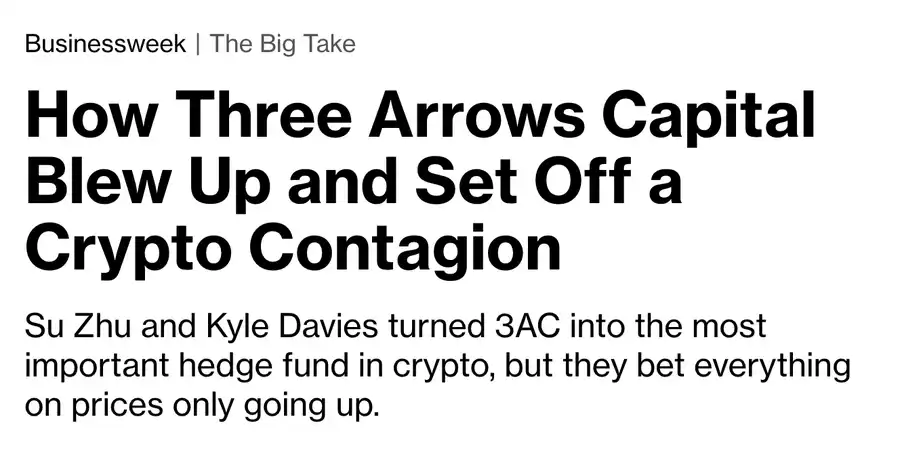
This collapse began in June 2022 with the bankruptcy of the 3AC $10 billion hedge fund. Their leveraged positions, including a $200 million exposure to LUNA and a significant holding in the Grayscale Bitcoin Trust, triggered a chain reaction of forced liquidations. The fund's failure exposed a complex interwoven network of loans, impacting over 20 institutions through its default.
FTX's collapse further exemplified the danger of hidden leverage. Alameda Research borrowed $100 billion from FTX's clients, creating an unsustainable leveraged structure that ultimately led to the closure of both institutions. The revelation that 40% of Alameda's $14.6 billion in assets was locked in illiquid FTT tokens further exposed the vulnerability of its leveraged positions.
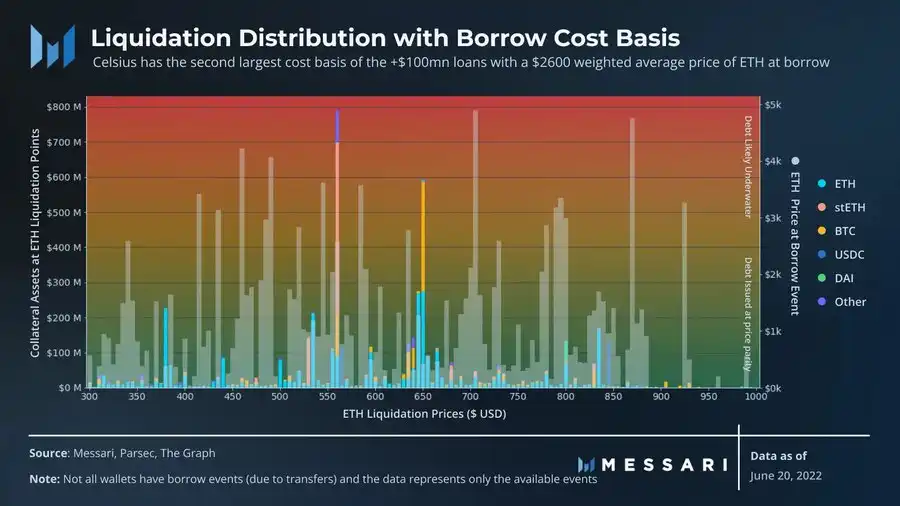
This crash triggered widespread market contagion. The collapse of 3AC led to multiple cryptocurrency lending platforms going bankrupt, including BlockFi, Voyager, and Celsius. Similarly, FTX's crash set off a domino effect in the industry, with many platforms freezing withdrawals and eventually filing for bankruptcy.
The chain liquidation revealed the true face of market depth. As leveraged positions were forcibly liquidated, asset prices plummeted, triggering further liquidations and creating a vicious cycle. This exposed that behind the market's apparent stability, there was more reliance on leverage rather than true liquidity.
As the tide receded, it revealed that many self-proclaimed savvy institutions were actually swimming naked, lacking proper risk management and being overleveraged. The interconnectedness of these positions meant that once failed, it could trigger a systemic crisis, exposing the vulnerability of the entire crypto ecosystem.
Outlook for the Future - Narrative Risk
The title of this article is somewhat provocative. My intuition tells me that this market correction is healthy, albeit painful, and the market will bounce back. My price targets, especially for Bitcoin, remain high — but I have taken my chips off the table, locking in the Bitcoin gains I am willing to carry into the next cycle. If this is indeed the end of the cycle, remember: no one ever went bankrupt from taking profits.
I have written multiple times (Article 1, Article 2, and Article 3) about the importance of following the market narrative to avoid being trapped by old coins. The longer the market downturn, the more the narrative will change. If the market fully recovers tomorrow morning, I expect virtual currencies, ai16z, and virtual currencies to continue to lead. But if the market takes longer to recover, then you should look to emerging coins to attract new fund inflows.
What I want to tell you is not to be biased towards the coins you hold or insist on holding them through these downturns (unless you truly have strong convictions). Even if they hit new highs, I dare to bet that you will lose out on a lot of potential gains by not timely converting to new coins.
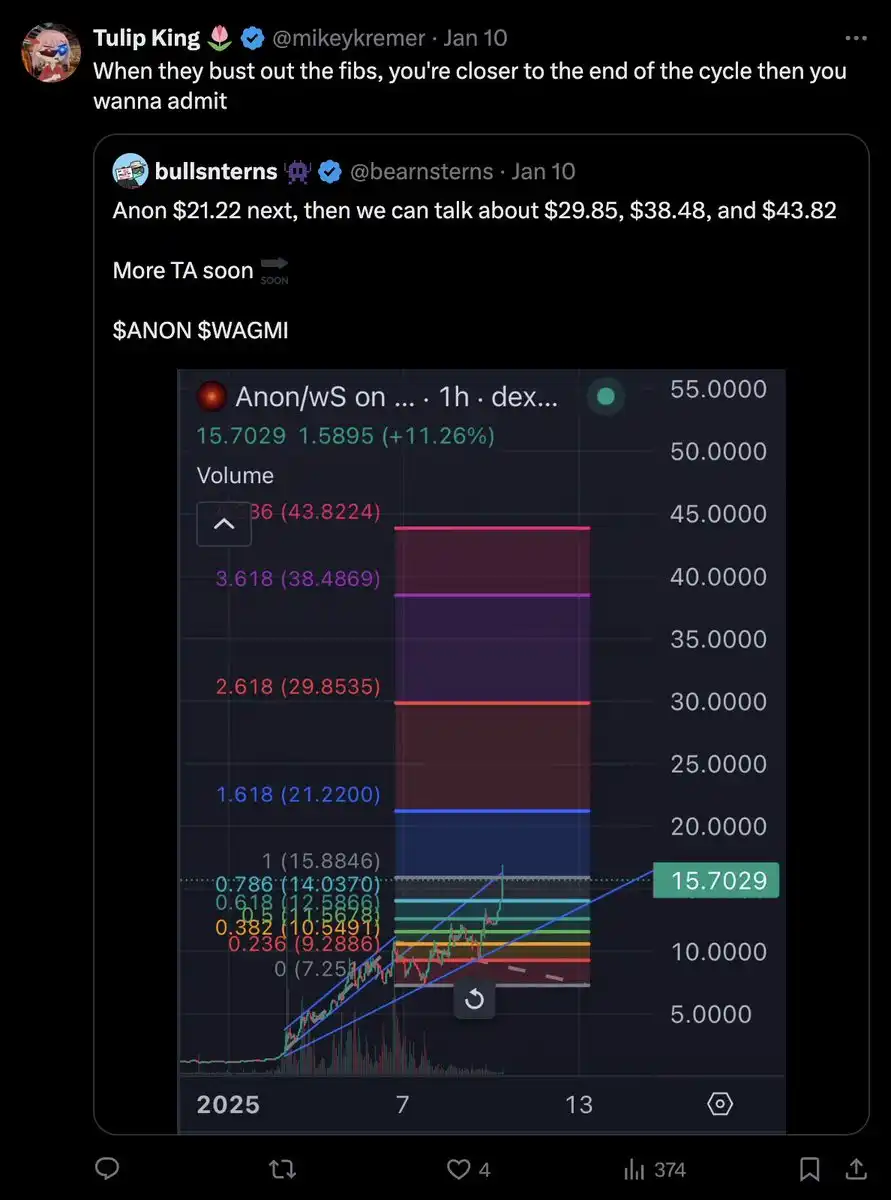
The sole reason anyone posts a Fibonacci chart is to convince themselves (and others) that they can sell at a higher price.
You may also like

LALIGA Match Report: Vinícius scores as 10-man Real Madrid secure a 3-2 comeback victory in Madrid derby
In the early hours of March 23, 2026, Round 29 of LALIGA delivered a headline clash at the Santiago Bernabéu. Real Madrid hosted their local rivals, Atlético de Madrid, in a high-stakes encounter. Under referee José Munuera, the match unfolded at a fierce pace, packed with physical duels and momentum swings. After a five-goal thriller, Real Madrid held firm for a 3–2 home win, taking all three points. They remain second on 69 points, now four behind leaders Barcelona.
From a numbers standpoint, Real Madrid stayed composed under pressure, completing 526 passes with a 52.4% share of possession. Atlético struck first in the 33rd minute through Lookman. After the break, Real Madrid flipped the game: Vinícius converted a penalty to level, then Valverde fired them ahead. Molina pulled Atlético back on level terms, but Vinícius stepped up again in the 72nd minute to seal the win. Late drama followed as Valverde saw red, forcing Real Madrid to defend deep with ten men through the final stretch. Atlético's aggressive approach—12 fouls and 4 yellow cards—kept the pressure on, but they couldn’t stop the comeback.
WEEX Insights: As the official LALIGA partner in the Hong Kong and Taiwan regions, WEEX sees this win as a masterclass in control under pressure. Even after a red card and constant attacks, Real Madrid stayed sharp and executed with precision. That same discipline—staying calm in volatile moments and acting with clarity—reflects the core trading mindset WEEX stands for. LALIGA fan campaigns are coming soon—celebrate the game with WEEX.
About WEEX
Founded in 2018, WEEX has developed into a global crypto exchange with over 6.2 million users across more than 150 countries. The platform emphasizes security, liquidity, and usability, providing over 1,200 spot trading pairs and offering up to 400x leverage in crypto futures trading. In addition to the traditional spot and derivatives markets, WEEX is expanding rapidly in the AI era — delivering real-time AI news, empowering users with AI trading tools, and exploring innovative trade-to-earn models that make intelligent trading more accessible to everyone. Its 1,000 BTC Protection Fund further strengthens asset safety and transparency, while features such as copy trading and advanced trading tools allow users to follow professional traders and experience a more efficient, intelligent trading journey.
Follow WEEX on social media
X: @WEEX_Official
Instagram: @WEEX Exchange
Tiktok: @weex_global
Youtube: @WEEX_Official
Discord: WEEX Community
Telegram: WeexGlobalGroup

LALIGA Match Report: Araujo seals 1–0 win as Barça tighten grip on top spot
In the early hours of March 22 (Beijing Time), Barça edged Rayo Vallecano 1–0 at Camp Nou in a key Round 29 clash. The hard-earned win lifts Barça to 73 points, strengthening their hold on first place.
Barça controlled the game with 61% possession and a sharp 89% passing accuracy (460 passes). Rayo pushed back with intensity, earning 9 corners, but Barça's defense stayed solid. Yellow cards for Raphinha, Yamal, and Cubarsí highlighted the physical edge of the match. Second-half subs like Rashford and Olmo added fresh energy to help see out the result. Rayo remain 14th on 32 points.
WEEX Insights: As the Official LALIGA Partner in HK & TW, WEEX sees Barça’s 89% passing accuracy as a clear example of high execution with minimal error. Staying precise under pressure and finding the breakthrough reflects the same disciplined approach used in rational trading.
LALIGA interactive campaigns are coming soon—stay tuned with WEEX ⚽️
About WEEX
Founded in 2018, WEEX has developed into a global crypto exchange with over 6.2 million users across more than 150 countries. The platform emphasizes security, liquidity, and usability, providing over 1,200 spot trading pairs and offering up to 400x leverage in crypto futures trading. In addition to the traditional spot and derivatives markets, WEEX is expanding rapidly in the AI era — delivering real-time AI news, empowering users with AI trading tools, and exploring innovative trade-to-earn models that make intelligent trading more accessible to everyone. Its 1,000 BTC Protection Fund further strengthens asset safety and transparency, while features such as copy trading and advanced trading tools allow users to follow professional traders and experience a more efficient, intelligent trading journey.
Follow WEEX on social media
X: @WEEX_Official
Instagram: @WEEX Exchange
Tiktok: @weex_global
Youtube: @WEEX_Official
Discord: WEEX Community
Telegram: WeexGlobalGroup

These days, even hackers are losing money
Arm Chips In-House: Rewire News Brief

IOSG: Stablecoin Reshaping Asia Cross-Border Payments? Strategic Landscape and Investment Opportunities Analysis

\$73 Billion OpenAI Aims for IPO: Drops Sora, Snubs Disney, Puts Microsoft in Risk Factors

The Chip Industry's Most Secure Middleman Just Took a Very Risky Turn

CZ's Latest Interview: My Experience is Replicable, Writing a Book to Inspire Young Entrepreneurs

Morning News | Invesco acquires a $900 million on-chain fund from Superstate; ParaFi has raised $125 million for its new fund; Solana Foundation launches developer platform SDP

What is the background of this new fund that the two major prediction market platforms have rarely joined forces to create?

SIREN, another leveraged scam

Token has become extremely popular, and the blockchain is very sad

Tether's major shareholder invests £12 million to support the "British version of Trump" in the cryptocurrency sector

Huang Renxun's Latest Podcast: Will NVIDIA Reach $1 Trillion? Will the Number of Programmers Increase Instead of Decrease? How to Deal with AI Anxiety?
Besides Resolv Hack, This DeFi Vulnerability Type Has Occurred Four Times

Trump Cries Peace, $1.5 Billion Dash | Rewire News Evening Brief
From x402 to MPP: Cloudflare's crucial vote, will it go to Coinbase or Stripe?

BlackRock CEO issues annual open letter: The wave of tokenization has arrived, and we will lead this trend
LALIGA Match Report: Vinícius scores as 10-man Real Madrid secure a 3-2 comeback victory in Madrid derby
In the early hours of March 23, 2026, Round 29 of LALIGA delivered a headline clash at the Santiago Bernabéu. Real Madrid hosted their local rivals, Atlético de Madrid, in a high-stakes encounter. Under referee José Munuera, the match unfolded at a fierce pace, packed with physical duels and momentum swings. After a five-goal thriller, Real Madrid held firm for a 3–2 home win, taking all three points. They remain second on 69 points, now four behind leaders Barcelona.
From a numbers standpoint, Real Madrid stayed composed under pressure, completing 526 passes with a 52.4% share of possession. Atlético struck first in the 33rd minute through Lookman. After the break, Real Madrid flipped the game: Vinícius converted a penalty to level, then Valverde fired them ahead. Molina pulled Atlético back on level terms, but Vinícius stepped up again in the 72nd minute to seal the win. Late drama followed as Valverde saw red, forcing Real Madrid to defend deep with ten men through the final stretch. Atlético's aggressive approach—12 fouls and 4 yellow cards—kept the pressure on, but they couldn’t stop the comeback.
WEEX Insights: As the official LALIGA partner in the Hong Kong and Taiwan regions, WEEX sees this win as a masterclass in control under pressure. Even after a red card and constant attacks, Real Madrid stayed sharp and executed with precision. That same discipline—staying calm in volatile moments and acting with clarity—reflects the core trading mindset WEEX stands for. LALIGA fan campaigns are coming soon—celebrate the game with WEEX.
About WEEX
Founded in 2018, WEEX has developed into a global crypto exchange with over 6.2 million users across more than 150 countries. The platform emphasizes security, liquidity, and usability, providing over 1,200 spot trading pairs and offering up to 400x leverage in crypto futures trading. In addition to the traditional spot and derivatives markets, WEEX is expanding rapidly in the AI era — delivering real-time AI news, empowering users with AI trading tools, and exploring innovative trade-to-earn models that make intelligent trading more accessible to everyone. Its 1,000 BTC Protection Fund further strengthens asset safety and transparency, while features such as copy trading and advanced trading tools allow users to follow professional traders and experience a more efficient, intelligent trading journey.
Follow WEEX on social media
X: @WEEX_Official
Instagram: @WEEX Exchange
Tiktok: @weex_global
Youtube: @WEEX_Official
Discord: WEEX Community
Telegram: WeexGlobalGroup
LALIGA Match Report: Araujo seals 1–0 win as Barça tighten grip on top spot
In the early hours of March 22 (Beijing Time), Barça edged Rayo Vallecano 1–0 at Camp Nou in a key Round 29 clash. The hard-earned win lifts Barça to 73 points, strengthening their hold on first place.
Barça controlled the game with 61% possession and a sharp 89% passing accuracy (460 passes). Rayo pushed back with intensity, earning 9 corners, but Barça's defense stayed solid. Yellow cards for Raphinha, Yamal, and Cubarsí highlighted the physical edge of the match. Second-half subs like Rashford and Olmo added fresh energy to help see out the result. Rayo remain 14th on 32 points.
WEEX Insights: As the Official LALIGA Partner in HK & TW, WEEX sees Barça’s 89% passing accuracy as a clear example of high execution with minimal error. Staying precise under pressure and finding the breakthrough reflects the same disciplined approach used in rational trading.
LALIGA interactive campaigns are coming soon—stay tuned with WEEX ⚽️
About WEEX
Founded in 2018, WEEX has developed into a global crypto exchange with over 6.2 million users across more than 150 countries. The platform emphasizes security, liquidity, and usability, providing over 1,200 spot trading pairs and offering up to 400x leverage in crypto futures trading. In addition to the traditional spot and derivatives markets, WEEX is expanding rapidly in the AI era — delivering real-time AI news, empowering users with AI trading tools, and exploring innovative trade-to-earn models that make intelligent trading more accessible to everyone. Its 1,000 BTC Protection Fund further strengthens asset safety and transparency, while features such as copy trading and advanced trading tools allow users to follow professional traders and experience a more efficient, intelligent trading journey.
Follow WEEX on social media
X: @WEEX_Official
Instagram: @WEEX Exchange
Tiktok: @weex_global
Youtube: @WEEX_Official
Discord: WEEX Community
Telegram: WeexGlobalGroup


 App
App