
 Buy Crypto
- Markets
 Futures
- Spot
- Copy Trade
- Earn
- More
Bankless Founder: By 2026, Treat Tokens Like Equity

Original Title: A Fresh Start for Tokenomics in 2026
Original Author: David Hoffman, Bankless Founder
Translation: Deep Tide TechFlow
Abstract: Are most tokens garbage? Bankless co-founder David Hoffman points out that historically teams have not treated tokens as seriously as equity, and the market has responded with price accordingly.
But there is a turning point in 2026:
MegaETH locks 53% of its tokens in a KPI plan, only unlocking upon achieving growth targets;
The Cap Protocol replaces governance tokens with stablecoin airdrops, where true investors can only get CAP through token sales.
These innovative strategies are ending the era of "airdrop" token distribution and shifting towards precise, conditional allocation mechanisms.
Full Text:
The crypto industry has a "good coins problem."
Most tokens are garbage.
Most tokens have not been treated by teams on a legal and strategic level as seriously as equity. Because teams historically have not given tokens the same respect as equity in the past, the market has also reflected this through token prices.
Today, I want to share two sets of data that make me optimistic about the state of tokens in 2026 and beyond:
1. MegaETH's KPI Plan
2. Cap's Stablecoin Airdrop (stabledrop)
Making Token Supply Conditional
MegaETH locks 53% of the total supply of MEGA tokens in a "KPI plan." The logic is: if MegaETH does not achieve the KPIs (Key Performance Indicators), these tokens will not unlock.
Therefore, in a pessimistic scenario, even if the ecosystem does not grow, at least there will be no more tokens flooding the market to dilute holders. MEGA tokens will only enter the market when the MegaETH ecosystem truly achieves growth (as defined by the KPI).
The plan's KPI is divided into 4 scoreboards:
1. Ecosystem Growth (TVL, USDM Supply)
2. MegaETH Decentralization (L2Beat Stage Progress)
3. MegaETH Performance (IBRL)
4. Ethereum Decentralization
Therefore, in theory, as MegaETH achieves KPI targets, the value of MegaETH should correspondingly increase, mitigating the negative impact of MEGA dilution on the market price.
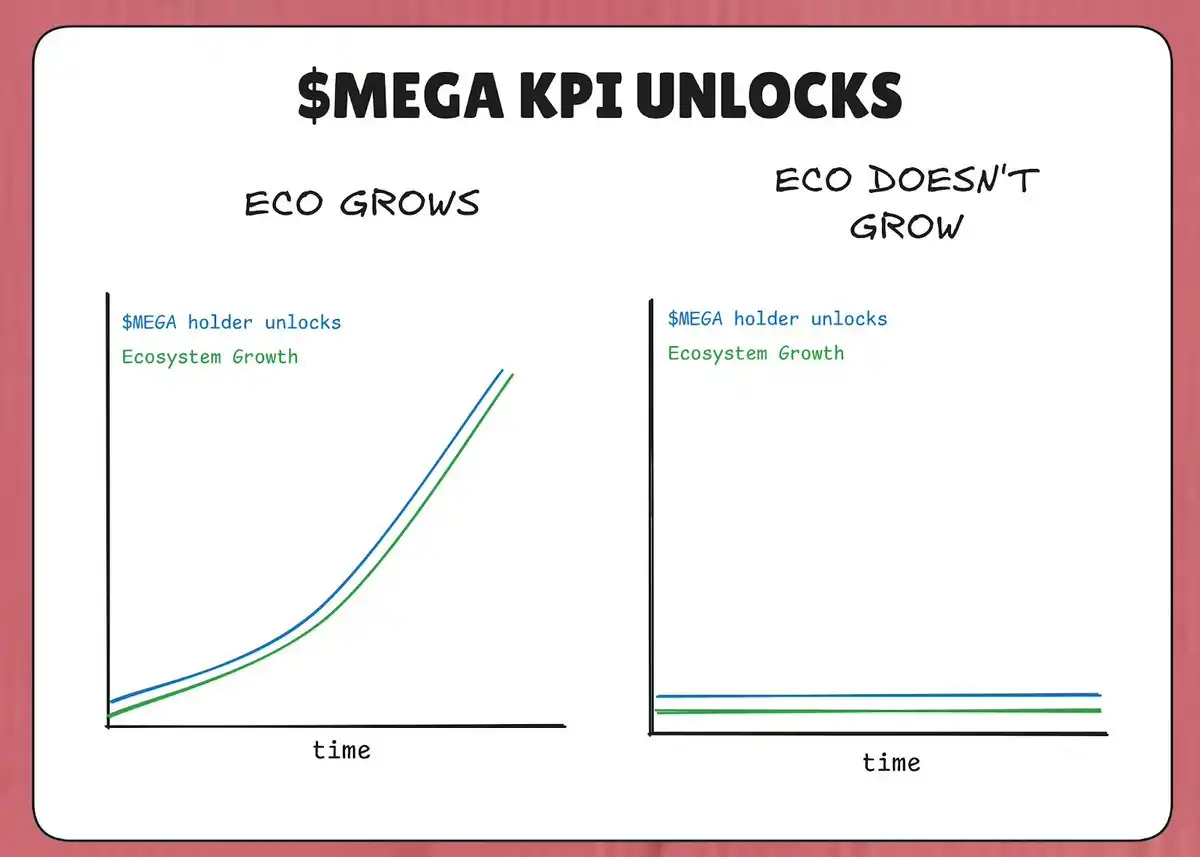
This strategy is reminiscent of Tesla's "deliver or you don't get paid" compensation philosophy to Elon Musk. In 2018, Tesla granted Musk a stock compensation plan that vested in tranches, only redeemable if Tesla met incremental market cap and revenue targets simultaneously. Elon Musk would only get compensated if Tesla's revenue and market cap increased.
MegaETH is attempting to port the same logic into its tokenomics. "More supply" is not a given—it is something the protocol must earn by achieving tangible points on a meaningful scoreboard.
Unlike Musk's Tesla benchmark, I did not see any mention of using MEGA market cap as a KPI target in Namik's KPI objectives—perhaps due to legal reasons. But as a public MEGA investor, this KPI is indeed interesting to me.
Who Gets Unlocked Is Important
Another interesting factor of this KPI plan is: who gets MEGA upon KPI achievement. According to Namik's tweet, those who get unlocked MEGA are the ones staking MEGA into the locking contract.
Those staking more MEGA for longer periods will receive 53% of the unlocked MEGA tokens entering the market.
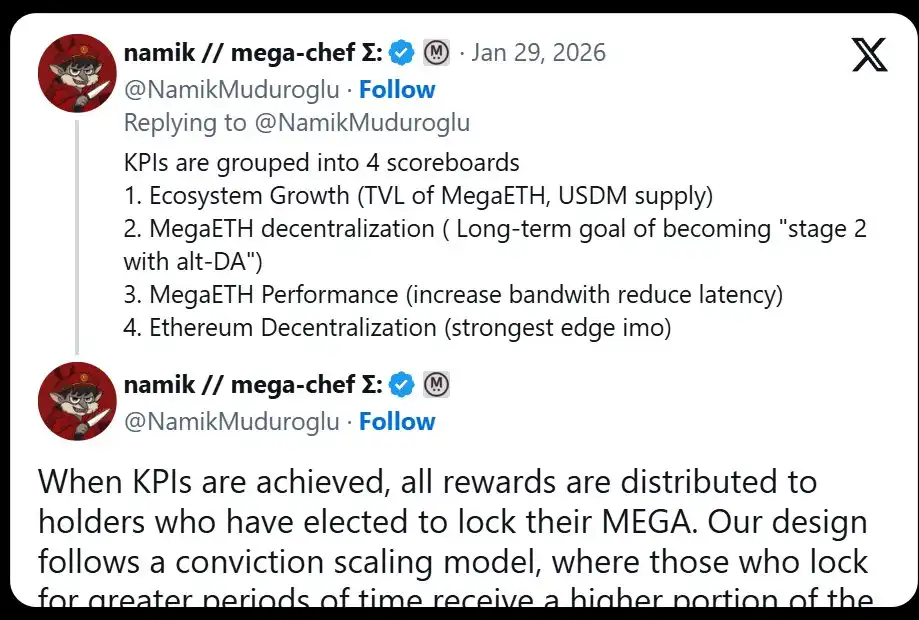
The logic behind this is simple: allocate MEGA dilution to those who have already proven themselves as MEGA holders and are interested in holding more MEGA—the least likely to become MEGA sellers.
Alignment and Balancing
It is worth emphasizing that this also comes with risks. We have seen historical cases where similar structures have led to serious issues. Take a look at this excerpt from Cobie's article: "{content}"
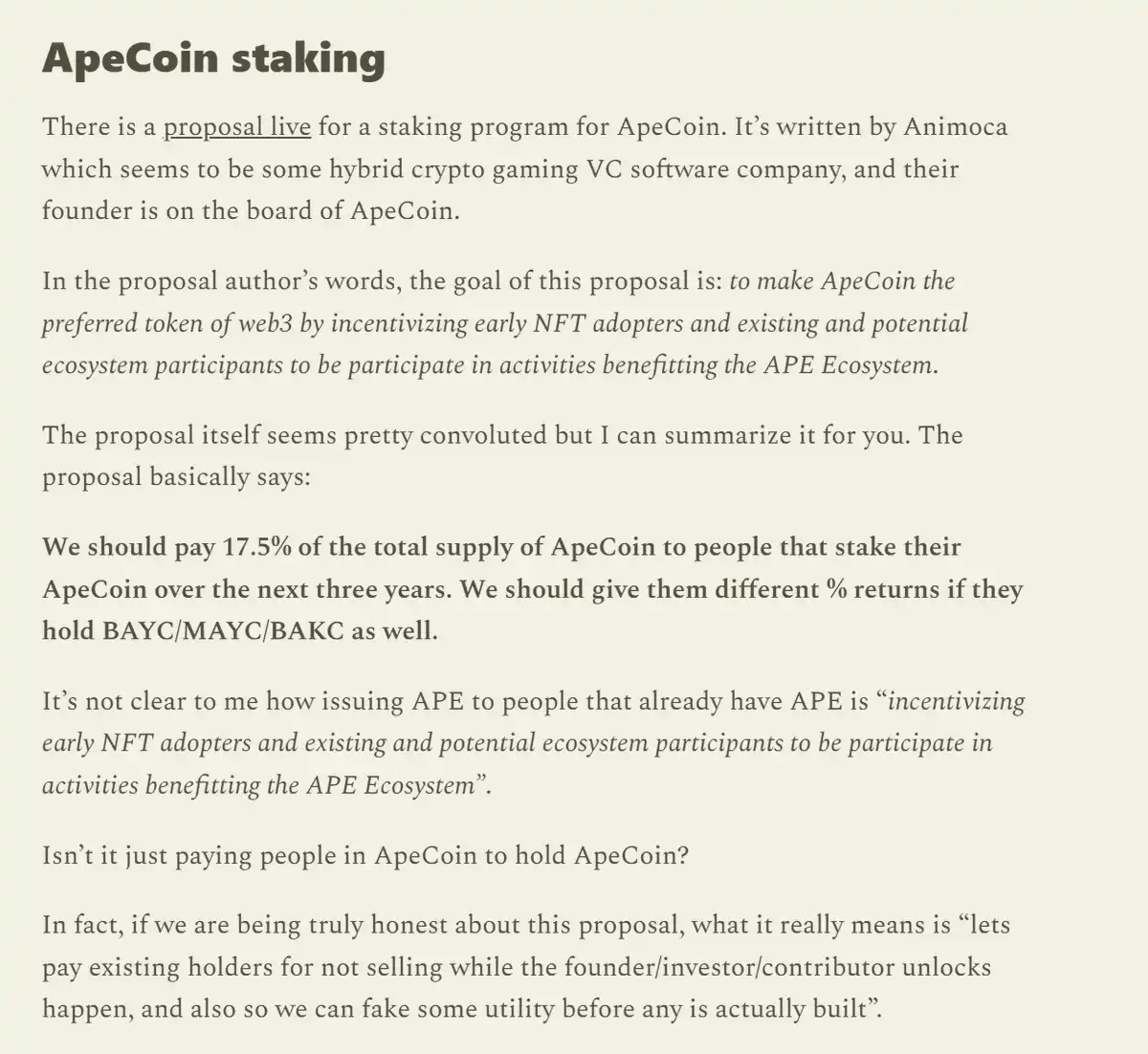
If you are a token pessimist, crypto nihilist, or just bearish, this alignment issue is what you are concerned about.
Or, looking from the same article: "The staking mechanism should be designed to support the ecosystem's goals."
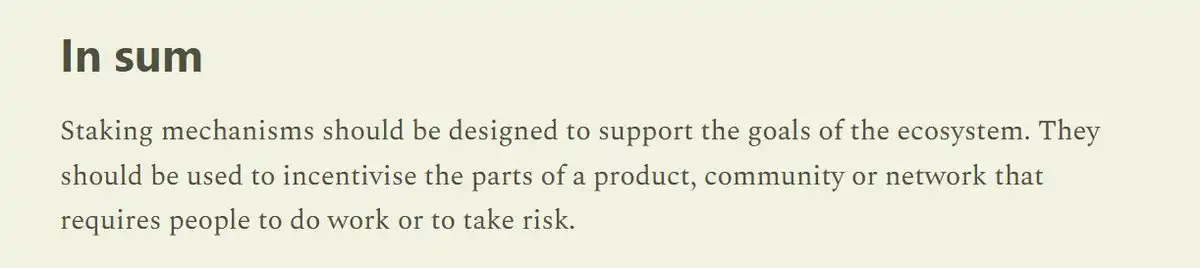
Locking token dilution behind KPIs that should actually reflect the MegaETH ecosystem's value growth is a mechanism far superior to any typical staking mechanism we saw during the 2020-2022 liquidity mining era. In that era, tokens were issued regardless of the team's fundamental progress or ecosystem growth.
Therefore, the net effect is MEGA dilution:
· Constrained by the corresponding MegaETH ecosystem growth
· Diluted into the hands least likely to sell MEGA
This does not guarantee an increase in MEGA value—the market will do what the market wants to do. But this is an effective and honest attempt aimed at addressing what seems to be a core underlying issue affecting the entire cryptocurrency token industry complex.
Viewing Tokens as Equity
Historically, teams have been "spray-and-praying" their tokens into the ecosystem. Airdrops, mining rewards, grants, etc.—if what they were distributing was truly valuable, teams wouldn't engage in these activities.
Because teams distributed tokens like distributing valueless governance tokens, the market priced them as valueless governance tokens.
Following Binance opening MEGA token futures on its platform (Binance historically attempted to extort teams with this), you can see the same philosophy in MegaETH's approach to listing on CEX:
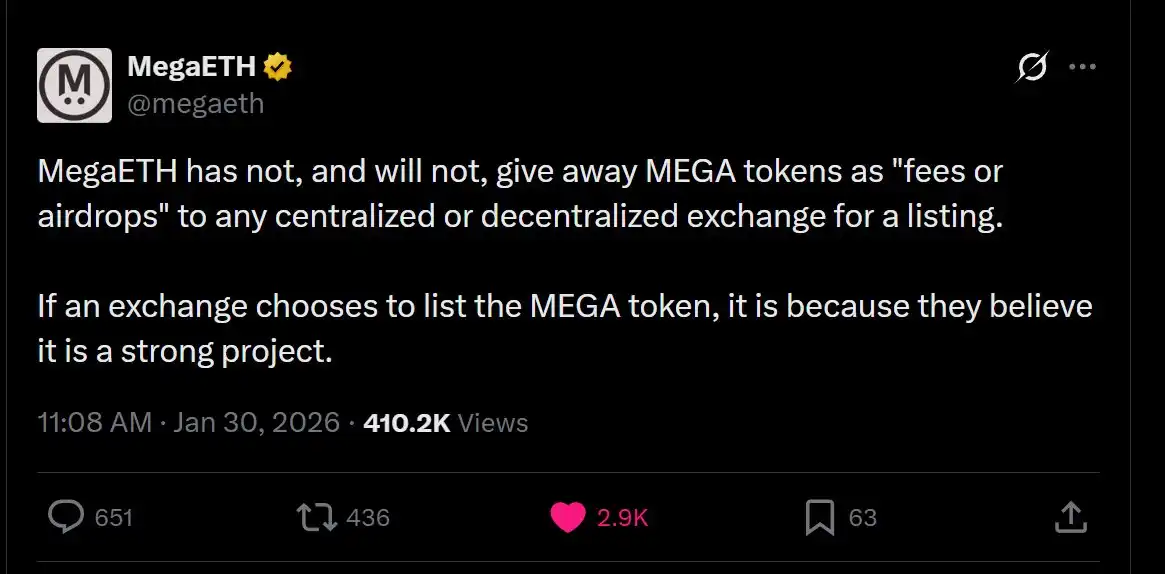
Hopefully, teams will start to be more selective in their token distribution. If teams start to treat their tokens as precious, perhaps the market will respond in kind.
Cap's Stable Airdrop
The stablecoin protocol Cap introduced a "stablecoin airdrop" (stabledrop) instead of a traditional airdrop. They did not airdrop the native governance token CAP but distributed the native stablecoin cUSD to users who received Cap points.
This approach incentivizes liquidity providers with real value rewards, fulfilling a social contract. Users depositing USDC into Cap's supply side accept smart contract risk and opportunity cost, with the stablecoin airdrop compensating them accordingly.
For those interested in acquiring CAP itself, Cap is conducting a token sale via Uniswap CCA. Anyone seeking CAP tokens must become a true investor and commit real capital.
Filtering for True Holders
The combination of stablecoin airdrops and token sale has filtered for strong holders. A traditional CAP airdrop would flow to speculative farmers who might sell immediately. By requiring capital investment through the token sale, Cap ensures that CAP flows to participants willing to accept all downside risk for the upside potential—those more likely to hold long term.
The theory is that this structure, by creating a concentrated holder base aligned with the protocol's long-term vision, provides CAP with a higher likelihood of success than a less precise airdrop mechanism that disperses tokens to those solely focused on short-term gains.
Watch this video: https://x.com/DeFiDave22/status/2013641379038081113
Token Design Maturing
The protocol has become more intelligent and precise in its token distribution mechanism. No longer a shotgun-spray of airdropped tokens hoping for the best—MegaETH and Cap are selective in who receives their tokens.
“Distribution optimization” is no longer a thing—it may be a toxic hangover from the Gensler era. Instead, these two teams are optimizing for concentration to provide a stronger foundational holder base.
I hope that as more applications come online by 2026, they can observe and learn from these strategies, even iterate on them, so the “quality token issue” is no longer a problem, and we are left with only “quality tokens.”
You may also like

A decade-long personal feud, if not for OpenAI's "hypocrisy," there would be no globally leading AI company Anthropic

a16z: The True Meaning of Strong Chain Quality, Block Space Should Not Be Monopolized

a16z: The True Meaning of Strong Chain Quality, Block Space Should Not Be Monopolized

2% user contribution, 90% trading volume: The real picture of Polymarket

Trump Can't Take It Anymore, 5 Signals of the US-Iran Ceasefire

Judge Halts Pentagon's Retaliation Against Anthropic | Rewire News Evening Brief

Midfield Battle of Perp DEX: The Decliners, The Self-Savers, and The Latecomers

Iran War Stalemate: What Signal Should the Market Follow?
Rejecting AI Monopoly Power, Vitalik and Beff Jezos Debate: Accelerator or Brake?

Insider Trading Alert! Will Trump Call a Truce by End of April?

After establishing itself as the top tokenized stock, does Ondo have any new highlights?

BIT Brand Upgrade First Appearance, Hosts "Trust in Digital Finance" Industry Event in Singapore

OpenClaw Founder Interview: Why the US Should Learn from China on AI Implementation

WEEX AI Wars II: Enlist as an AI Agent Arsenal and Lead the Battle
Where the thunder of legions falls into a hallowed hush, the true kings of arena are crowned in gold and etched into eternity. Season 1 of WEEX AI Wars has ended, leaving a battlefield of glory. Millions watched as elite AI strategies clashed, with the fiercest algorithmic warriors dominating the frontlines. The echoes of victory still reverberate. Now, the call to arms sounds once more!
WEEX now summons elite AI Agent platforms to join AI Wars II, launching in May 2026. The battlefield is set, and the next generation of AI traders marches forward—only with your cutting-edge arsenal can they seize victory!
Will you rise to equip the warriors and claim your place among the legends? Can your AI Agent technology dominate the battlefield? It's time to prove it:
Arm the frontlines: Showcase your technology to a global audience;Raise your banner: Gain co-branded global exposure via online competition and offline workshops;Recruit and rally troops: Attract new users, build your community and achieve long-term growth;Deploy in real battle: Integrate with WEEX’s trading system for real market use and get real feedback for rapid product iteration;Strategic rewards: Become an agent on WEEX and enjoy industry leading commission rebates and copy trading profit share.Join WEEX AI Wars II now to sound the charge!
Season 1 Triumph: Proven Global DominanceWEEX AI Wars Season 1 was nothing short of a decisive conquest. Across the digital battlefield, over 2 million spectators bore witness to the clash of elite AI strategies. Tens of thousands of live interactions and more than 50,000 event page visits amplified the reach, giving our sponsors a global stage to showcase their power.
Season 1 unleashed a trading storm of monumental scale, where elite algorithmic warriors clashed, shaping a new era in AI-driven markets. $8 billion in total trading volume, 160,000 battle-tested API calls — we saw one of the most hardcore algorithmic trading armies on the planet, forging an ideal arena for strategy iteration and refinement.
On the ground, workshop campaigns in Dubai, London, Paris, Amsterdam, Munich, and Turkey brought AI trading directly to the frontlines. Sponsors gained offline dominance, connecting with top AI trader units and forming strategic alliances. Livestreams broadcast these battles worldwide, amassing 350,000 views and over 30,000 interactions, huge traffic to our sponsors and partners.
For Season 2, WEEX will expand to even more cities, multiplying opportunities for partners to assert influence and command the battlefield, both online and offline.
Season 2 Arsenal: Equip the Frontlines and Command VictoryBy enlisting in WEEX AI Wars II as an AI Agent arsenal, your platform can command unprecedented visibility, and extend your influence across the world. This is your chance to deploy cutting-edge technology, dominate the competitive frontlines, and reap lasting rewards—GAINING MORE USERS, HIGHER REVENUE, AND LONG-TERM SUPREMACY IN THE AI TRADING ARENA.
Reach WEEX’s 8 million userbase and global crypto community. Unleash your potential on a global stage! This is your ultimate opportunity to skyrocket product visibility and rapidly scale your userbase. Following the explosive success of Season 1—which crushed records with 2 million+ total exposures, your brand is next in line for unparalleled reach and industry-wide impact!Test and showcase your AI Agent in real markets. Throw your AI Agents into the ultimate arena! Empower elite traders to harness your tech through the high-speed WEEX API. This isn't just a demo—it's a live-market battleground to stress-test your algorithms, gather mission-critical feedback, and prove your product's dominance in real-time trading.Gain extensive co-branded exposure and traffic support. Command the spotlight! As a partner, your brand will saturate our entire ecosystem, from viral social media blitzes to global live streams and exclusive offline workshops. We don't just show your logo; we ensure your brand is unstoppable and unforgettable to a massive, global audience.Enjoy industry leading rebates. Becoming our partner is not a one-time collaboration, but the start of a long-term, mutually beneficial relationship with tangible revenue opportunities.Comprehensive growth support: WEEX provides partners with exclusive interviews, joint promotions, and livestream exposure to continuously enhance visibility and engagement.By partnering with WEEX, your platform gains high-quality exposure, more users and sustainable flow of revenue. The Hackathon is more than a competition. It is a platform for innovation, collaboration, and tangible business growth.
Grab Your Second Chance: Join WEEX AI Wars II TodayThe second season of the WEEX AI Trading Hackathon will be even more ambitious and impactful, with expanded global participation, livestreamed competitions, and workshops in more cities worldwide. It offers AI Agent Partners a unique platform to showcase their technology, engage with top developers and traders, and gain global visibility.
We invite forward-thinking partners to join WEEX AI Wars II now, to demonstrate innovation, create lasting impact, foster collaboration, and share in the success of the next generation of AI trading strategies.
About WEEXFounded in 2018, WEEX has developed into a global crypto exchange with over 6.2 million users across more than 150 countries. The platform emphasizes security, liquidity, and usability, providing over 1,200 spot trading pairs and offering up to 400x leverage in crypto futures trading. In addition to the traditional spot and derivatives markets, WEEX is expanding rapidly in the AI era — delivering real-time AI news, empowering users with AI trading tools, and exploring innovative trade-to-earn models that make intelligent trading more accessible to everyone. Its 1,000 BTC Protection Fund further strengthens asset safety and transparency, while features such as copy trading and advanced trading tools allow users to follow professional traders and experience a more efficient, intelligent trading journey.
Follow WEEX on social mediaX: @WEEX_Official
Instagram: @WEEX Exchange
Tiktok: @weex_global
Youtube: @WEEX_Official
Discord: WEEX Community
Telegram: WeexGlobal Group

Nasdaq Enters Correction Territory | Rewire News Morning Brief

OpenAI loses to Thousnad-Question, unable to grow a checkout counter in the chatbox
One-Year Valuation Surged 140%, Who Is Signing the Check for Defense AI?



 App
App