
Analysis of the Prospects of Ethereum Protocol Technology Upgrade (2): The Surge

Original title: "Analysis of Ethereum Protocol Technology Upgrade Prospects (2): The Surge"
Original source: Ebunker Chinese
Since October this year, Ethereum co-founder Vitalik Buterin has published a series of articles on the future possibilities of the Ethereum protocol, covering the six parts of the Ethereum development roadmap: The Merge, The Surge, The Scourge, The Verge, The Purge and The Splurge.
We have previously interpreted the first part of the roadmap (The Merge). This article will continue to interpret the second part of the series, The Surge. In this article, Vitalik focuses on the scalability and long-term development of Ethereum. From the technical roadmap at this stage, we can gain insight into how Ethereum will transform into a protocol that can handle huge demands (TPS reaches 100,000+) while remaining decentralized and secure.
Ethereum's Core Vision
Essentially, Ethereum aims to be the base layer of the decentralized Internet. Ethereum supports complex decentralized applications through self-executing smart contract code, and this flexibility makes it the blockchain of choice for developers to build decentralized applications including DeFi, NFT, etc.
However, Ethereum has limitations in scalability. Ethereum L1 can only process about 15 to 30 transactions per second, which is a long way from traditional payment networks such as Visa. This leads to high gas fees during network congestion and limits Ethereum's ability to become a global scale infrastructure. This is exactly the problem that The Surge focuses on solving.
The main goals of The Surge are as follows:
-Ethereum L1+L2 reaches 100,000+ TPS;
-Maintain the decentralization and robustness of L1;
-At least some L2s fully inherit the core properties of Ethereum (trustless, open, censorship-resistant);
-Maximize interoperability between L2s: Ethereum should be like an ecosystem, not dozens of different blockchains.
Rollup-centric future
The Surge refers to Ethereum's plan to significantly increase scalability, primarily through L2 solutions. And rollup is a key component of this strategy. The rollup-centric roadmap proposes a simple division of labor: Ethereum L1 focuses on becoming a strong and decentralized base layer, while L2 takes on the task of helping the ecosystem scale.
Rollup packages transactions off-chain and then submits them back to the Ethereum mainnet, significantly increasing throughput while maintaining security and decentralization. In Vitalik's words, rollup can increase Ethereum's scalability to more than 100,000 TPS. This will be a transformative expansion because it allows Ethereum to handle global-scale applications without compromising the spirit of decentralization.
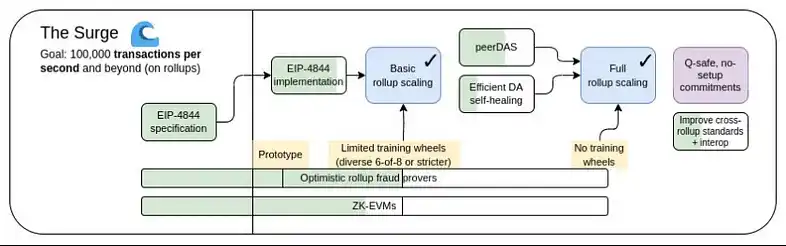
Vitalik emphasized that rollup is not just a temporary solution, but also a long-term expansion solution. Ethereum 2.0 has reduced energy consumption by transitioning from PoW to PoS via The Merge, and rollup is seen as the next major milestone as a long-term scaling solution.
This year, the rollup-centric roadmap has achieved important results: the data bandwidth of Ethereum L1 has increased significantly with the launch of EIP-4844 blobs, and multiple Ethereum Virtual Machine (EVM) rollups have entered the first phase. Each L2 exists as a shard with its own internal rules and logic, and the diversity and diversification of shard implementations are now a reality.
Data Availability Sampling (DAS) Further Development
Another key aspect of The Surge is Data Availability Sampling (DAS), a technology designed to solve the data availability problem. In a decentralized network like Ethereum, it is critical that all nodes can verify data without storing or downloading everything.
DAS allows nodes to verify data without accessing the full dataset, improving scalability and efficiency.
Vitalik highlighted two forms of DAS: PeerDAS and 2D DAS.
PeerDAS is expected to enhance the trust assumptions in rollups, making them more secure. 2D DAS performs random sampling not only within blobs, but also between blobs. Leveraging the linear properties of KZG commitments, the set of blobs in a block is expanded by a new set of virtual blobs that encode the same redundant information.
With DAS, Ethereum can handle larger amounts of data, enabling faster and cheaper rollups without compromising decentralization.
Further down the road, more work needs to be done to determine the ideal version of 2D DAS and prove its security properties.
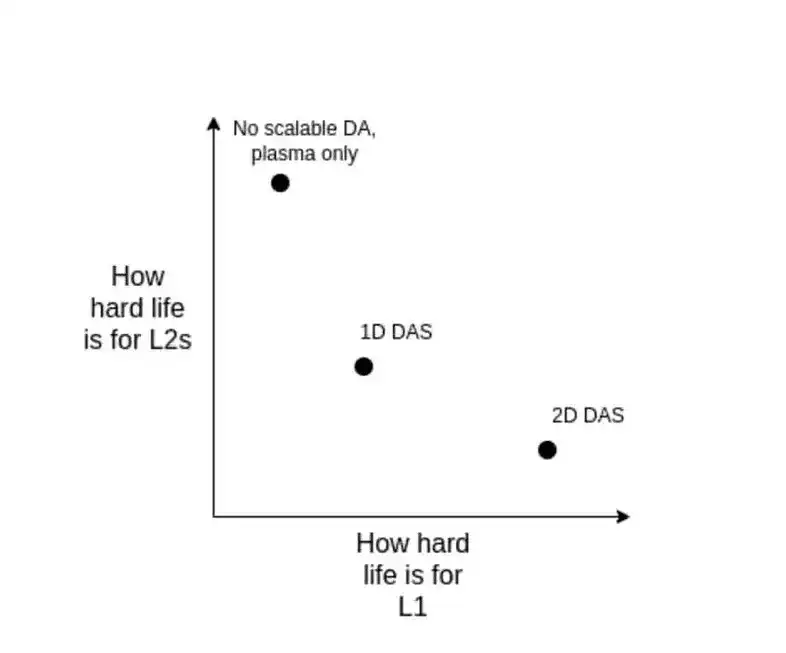
Vitalik believes that the long-term realistic path is:
(1) Implement an ideal 2D DAS;
(2) Stick with 1D DAS, sacrificing sampling bandwidth efficiency and accepting a lower data cap for simplicity and robustness;
(3) Abandon DA and fully embrace Plasma as the primary Layer2 architecture.
It is worth noting that this option exists even if the decision is to scale execution directly at the L1 layer. This is because if the L1 layer is to handle a large number of TPS, the L1 blocks will become very large, and the client will want an efficient way to verify its correctness, so it will have to use the same technology as rollup (such as ZK-EVM and DAS) on the L1 layer.
Plasma and other solutions
In addition to Rollup, Plasma, one of the early proposed off-chain expansion solutions, is also another L2 solution.
Plasma creates subchains that process transactions independently of the main Ethereum chain and submit summaries to the main network at regular intervals. For each block, the operator sends a Merkle branch to each user to prove the changed state of the user's assets. Users can withdraw their assets by providing a Merkle branch. Importantly, this branch does not have to be rooted at the latest state.
Therefore, even if there is a problem with data availability, users can still recover their assets by extracting the latest state available. If a user submits an invalid branch (for example, withdrawing assets that have already been sent to others, or the operator creates an asset out of thin air), the legal ownership of the assets can be determined through the on-chain challenge mechanism.
Although the development of Plasma lags behind rollup to some extent, Vitalik still sees it as part of Ethereum's broader scalability toolkit.
In addition, Vitalik also discussed improving data compression technology and cryptographic proofs in the article to further improve the efficiency of rollup and other L2 solutions. The idea is to compress as much data as possible while ensuring that all necessary information is still available for verification by Ethereum nodes. These technical improvements are likely to play a key role in Ethereum's efforts to achieve higher throughput.
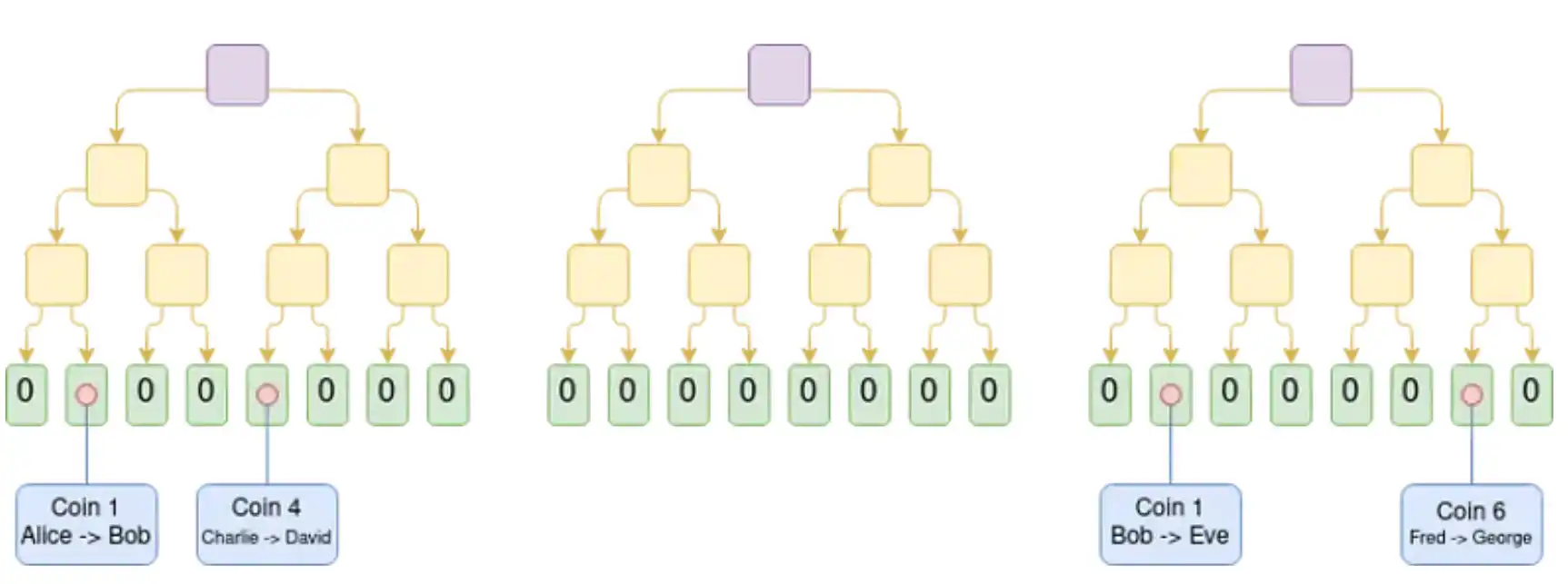
The above is a Plasma Cash chain, where the transaction spending Coin i is put into the i-th position in the tree. In this example, assuming that all previous trees are valid, it can be seen that Eve currently owns Coin 1, David owns Coin 4, and George owns Coin 6.
Earlier versions of Plasma could only handle payment use cases and could not be effectively generalized further. However, if each root is required to be verified with a SNARK, then Plasma becomes much more powerful. The process can be greatly simplified because most of the possible paths for operators to cheat are ruled out. At the same time, new paths are opened up, that is, in the case where the operator does not cheat, users can withdraw funds immediately without waiting for a week-long challenge period.
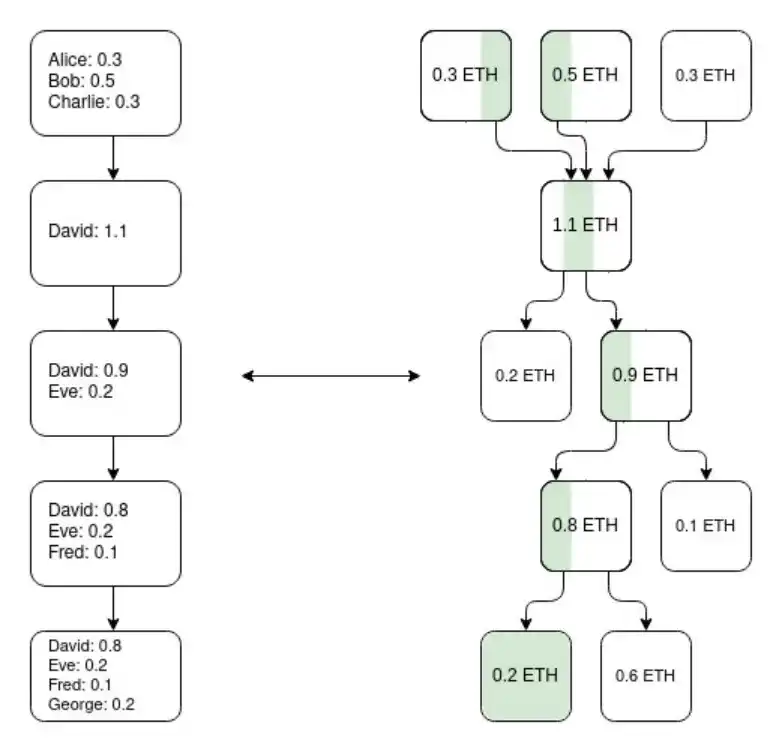
The above diagram shows one way (not the only way) to make an EVM plasma chain: use ZK-SNARK to build a parallel UTXO tree that reflects the balance changes made by the EVM, defining a unique mapping of the "same coin" at different times in history. Then the Plasma structure can be built on top of it.
Plasma performs quite well, which is also the key reason why everyone wants to design trick structures to overcome its security deficiencies.
Cross-L2 interoperability improvements
A major challenge facing the L2 ecosystem today is the weak cross-L2 interoperability. How to make using the L2 ecosystem feel like using a unified Ethereum ecosystem is an issue that urgently needs improvement.
There are many categories of cross-L2 interoperability improvements. In theory, Ethereum with Rollup at its core is similar to executing sharded L1. The current Ethereum L2 ecosystem is still far from the ideal state in practice:
Chain-specific addresses: The address should contain chain information (L1, Optimism, Arbitrum...). Once this is achieved, the cross-L2 sending process can be implemented by simply putting the address into the sending field, and the wallet can handle how to send it in the background (including using cross-chain protocols).
Chain-specific payment requests: It should be easy and standardized to create messages of the form "Send me X tokens of type Y on chain Z". This has two main application scenarios: payments between people or payments between people and merchant services; dApp requests for funds.
Cross-chain swaps and gas payments: There should be a standardized open protocol to express cross-chain operations. ERC-7683 and RIP-7755 are attempts in this area, although both have wider application than these specific use cases.
Light clients: Users should be able to actually verify the chain they are interacting with, rather than just trusting the RPC provider. For example, a16z crypto's Helios can do this (for Ethereum itself), but this trustlessness needs to be extended to L2. ERC-3668 (CCIP-read) is one strategy to achieve this.
Shared token bridge idea: Assuming a world where all L2s are proof-of-validity rollups and each slot is submitted to Ethereum, to transfer assets from one L2 to another in a native state, withdrawals and deposits are still required, which requires paying a lot of L1 gas fees.
One way to solve this problem is to create a shared minimalist Rollup whose only function is to maintain which L2 owns each type of token and how much balance each has, and allow these balances to be updated in batches through a series of cross-L2 send operations initiated by any L2. This will allow cross-L2 transfers without paying L1 gas fees for each transfer, and without using liquidity provider-based technologies such as ERC-7683.
Synchronous composability: allows synchronous calls to occur between a specific L2 and L1 or between multiple L2s. This helps improve the financial efficiency of DeFi protocols. The former can be achieved without any cross-L2 coordination; the latter requires shared ordering. Rollup-based technologies automatically apply to all of them.
Many of the examples above face the dilemma of when to standardize and which layers to standardize. If standardization is too early, a poor solution may be entrenched. If standardization is too late, unnecessary fragmentation may occur.
There is a consensus that in some cases, there is both a short-term solution with weaker properties but easier to implement, and a long-term solution that is "ultimately correct" but takes years to implement. These tasks are not just technical problems, they are also (perhaps even mainly) social problems that require L2 and wallets as well as L1 to cooperate.
Continue to expand Ethereum L1
Vitalik believes that it is very valuable to expand Ethereum L1 itself and ensure that it can continue to accommodate more and more use cases.
There are three strategies for L1 scaling, which can be pursued separately or in parallel:
(1) Improve the technology (e.g., client code, stateless clients, history expiration) to make L1 easier to verify, and then increase the gas limit;
(2) Reduce the cost of specific operations, increasing average capacity without increasing worst-case risk;
(3) Native Rollups (i.e., creating N parallel copies of the EVM).
These different techniques each have different trade-offs. For example, native rollups suffer from the same weaknesses in composability as ordinary rollups: a single transaction cannot be sent to execute operations synchronously across multiple rollups. Raising the gas limit would undermine other benefits that could be achieved by simplifying L1 verification, such as increasing the fraction of users running validating nodes and increasing the number of solo stakers. Depending on the implementation, making specific operations in the EVM cheaper may increase the overall complexity of the EVM.
Decentralization and Security
The balance between scalability and decentralization is one of Vitalik’s recurring themes. Many blockchain projects choose to sacrifice decentralization in exchange for higher throughput. For example, Solana can process thousands of transactions per second, but requires powerful hardware to run nodes, centralizing the network. Vitalik insists that even as Ethereum continues to scale, its commitment to decentralization must be maintained.
Rollups and DAS are seen as ways to increase Ethereum’s capacity while maintaining its decentralized nature. Unlike Solana or other high-performance blockchains, Ethereum’s scaling strategy ensures that anyone can run a node to secure the network in a truly decentralized way. This is critical to Ethereum’s vision of building a blockchain that can support a global, permissionless financial system.
With greater scalability comes greater responsibility in terms of security. As Ethereum moves toward a rollup-centric future, it becomes critical to ensure that these systems are trustless. Rollups rely on cryptographic proofs to guarantee that off-chain transactions are legitimate when submitted back to Ethereum. While these systems have proven to be effective, they are not without risk. Vitalik acknowledges that the maturity of these technologies requires rigorous testing and iteration, especially as they become more widely adopted.
The Surge Outlook
After The Surge, Vitalik envisioned Ethereum that was not only scalable but also remained fully decentralized, secure, and sustainable. This vision included not only scaling Layer 1 through rollups and DAS, but also building more efficient consensus algorithms, improving developer tooling, and fostering a thriving dApp ecosystem.
Ethereum’s roadmap is optimistic, but also full of challenges. Implementing rollups at scale, ensuring the security of L2 solutions, and preparing for a quantum future are all complex tasks. But if Ethereum can successfully overcome these obstacles, it will solidify its position as the core of Web3: a decentralized, user-controlled internet.
In the rapidly evolving blockchain space, Ethereum’s focus on scalability without sacrificing decentralization is unique. If The Surge succeeds, it could change the blockchain technology landscape again in the coming years.
You may also like

Champion's Final Bow: FC Barcelona vs Real Betis – Celebrate the Title with a Home Finale

Best Oil Trading Platform for Crypto Users in 2026
5 Futures Trading Strategies Smart Traders Use to Cut Crypto Fees and Boost Futures Returns

What Is TradFi? How Crypto Traders Can Now Access Crude Oil, Gold, and Global Markets

How WEEX Bridges Crypto and Football: A Deep Look at the LALIGA Partnership Inside the WEEX App
WEEX is not just a LALIGA sponsor. It’s a true partner. From iPhone Dynamic Island to LALIGA-themed app icons and smart posters, see how WEEX brings football passion into every trade — and builds a real bridge between crypto and sports.

FC Barcelona vs Real Madrid Preview: El Clásico – Can Barça Clinch the Title at Spotify Camp Nou?
FC Barcelona vs Real Madrid El Clásico match preview for May 11, 2026. Barça need just 1 point to win LALIGA. Can Madrid delay the trophy? Full preview inside.

At the Stripe conference, I saw the future of the AI economy

Miners welcome a new life

Seven Important Judgments by Claude Code's Founder at the Sequoia Conference

The payment moment of AI agents: Who will become the Stripe of the machine economy?

Morning Report | MoonPay acquires Solana's execution layer DFlow; Strategy releases Q1 financial report; Manta Network announces the termination of Manta staking program

Rented Tracks: What is this wave of stablecoin FX hot money really paying for?

Dialogue Velocity Eric: What is the stablecoin track that the CFO really wants?

Strategy should have said that selling coins is not ruled out

How MegaETH Achieved a TVL of 700m Within a Week of TGE? Analyzing the Packaging Strategy

Futures Trading Hours: Trade Cryptocurrency 24/7 and Earn Back Up to 45% in Trading Fees
Learn futures trading hours and the best time to trade crypto futures. Discover 24/7 market insights, peak trading sessions, and how to earn back up to 45% in fees.
Why is a16z Crypto raising another $2.2 billion to heavily invest in Web3?
Polymarket Underlying Algorithm Explained
Champion's Final Bow: FC Barcelona vs Real Betis – Celebrate the Title with a Home Finale
Best Oil Trading Platform for Crypto Users in 2026
5 Futures Trading Strategies Smart Traders Use to Cut Crypto Fees and Boost Futures Returns
What Is TradFi? How Crypto Traders Can Now Access Crude Oil, Gold, and Global Markets
How WEEX Bridges Crypto and Football: A Deep Look at the LALIGA Partnership Inside the WEEX App
WEEX is not just a LALIGA sponsor. It’s a true partner. From iPhone Dynamic Island to LALIGA-themed app icons and smart posters, see how WEEX brings football passion into every trade — and builds a real bridge between crypto and sports.
FC Barcelona vs Real Madrid Preview: El Clásico – Can Barça Clinch the Title at Spotify Camp Nou?
FC Barcelona vs Real Madrid El Clásico match preview for May 11, 2026. Barça need just 1 point to win LALIGA. Can Madrid delay the trophy? Full preview inside.


