
AI Track Showing Signs of Fatigue, Will Niche Agents Break the Deadlock?


Original Article Title: Vertical Agents: The Crypto-Native Agent Use Cases
Original Article Author: Defi0xJeff, Founder of Steak Studio
Original Article Translation: Ashley, BlockBeats
Editor's Note: This article explores the application of AI Agents in Web2 and Web3. While Web2 has widely adopted AI Agents to enhance efficiency across sales, marketing, and other fields, Web3 has opened up new application scenarios by combining blockchain technology, especially in the DeFi and decentralized domains. Web3 Agents, through token incentives, decentralized platforms, and on-chain data, have the potential to surpass Web2 Agents. The author points out that although Web3 faces challenges in the short term, its unique advantages make it likely to compete with Web2 in the medium to long term and redefine the industry landscape.
The following is the original content (rearranged for readability):
When we look at general application scenarios outside of Web3, from large enterprises to small companies, many have begun to integrate AI Agents into their daily operations—across sales, marketing, finance, legal, IT, project management, logistics, customer service, and workflow automation—almost every imaginable field.
We have moved from manual digital processing by humans, performing repetitive tasks, filling out Excel sheets, to having autonomous, 24/7 online digital workers (AI Agents). These Agents are not only more efficient but also significantly reduce costs.
Web2 companies are willing to pay $50,000 to $200,000 or even more for AI-driven sales and marketing Agents. Many Agent providers operate highly profitable businesses through SaaS subscription models or consumption-based models (charging based on token usage).
Web2 AI Agent Application Scenarios
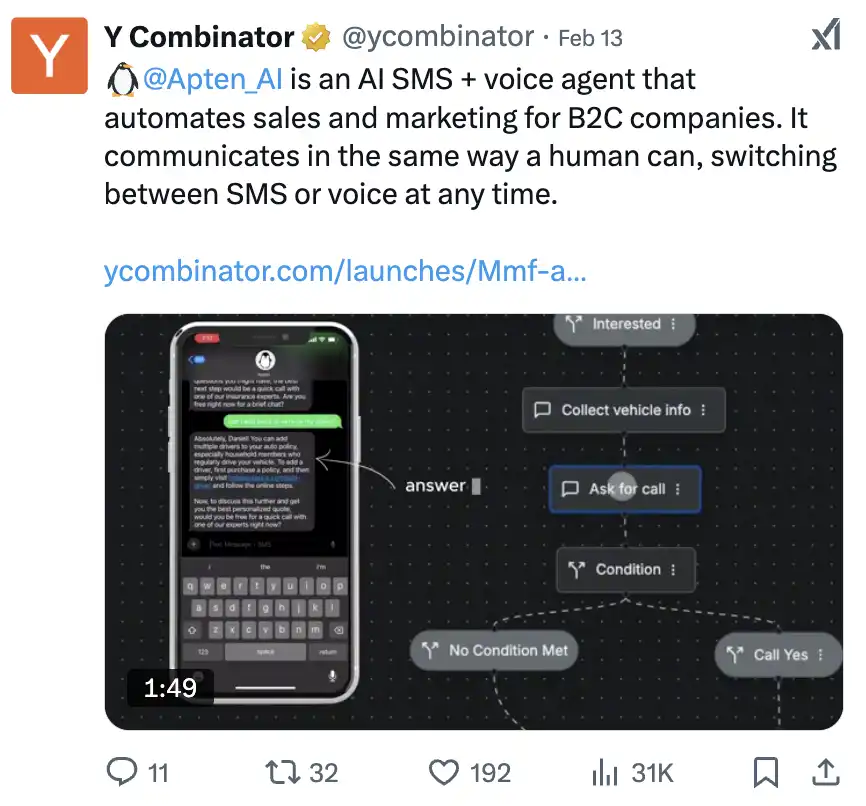
Apten_AI
AI + SMS Agent facilitating the sales/marketing process.
Bild_AI
Reading architectural blueprints, extracting material/spec data, and estimating costs based on the collected data.

Casixty
Marketing Agent, identifying popular topics on Reddit, automating responses, and increasing brand engagement. Imagine this product applied to CT!

These examples demonstrate how an AI Agent has already transformed within traditional industries, automating manual tasks and optimizing workflows. While Web2 companies have rapidly adopted AI-driven Agents, the Web3 space has also begun embracing this technology—but with a key distinction.
Web3 AI Agents not only focus on operational efficiency but also integrate blockchain technology, unlocking entirely new use cases.
Web3 AI Agent: More Than Just "Buzzword Bingo" Bots
Just a few months ago, most Web3 Agents were mere conversational bots on Twitter. However, the landscape has significantly shifted. These Agents are now integrating with various tools and plugins, enabling them to perform more complex operations.
sendaifun
Solana AI Agent suite, supporting everything from basic token management to complex DeFi operations.
ai16zdao
Integrated with over 100 plugins, spanning from social media interactions to automated trading and DeFi operations.
Cod3xOrg, @Almanak__
No-code infrastructure allowing users to create autonomous trading Agents.
gizatechxyz
Custom DeFi assistant tailored for investors.
DeFi is the largest sector in cryptocurrency (TVL exceeding $100 billion), and the most impactful crypto-native AI Agent use case falls under DeFAI.
AI Agents in DeFi not only simplify complex experiences through an NLP interface. They also leverage on-chain data to unlock new opportunities.
Blockchain provides a wealth of structured data — credentials, transaction history, P&L, governance activities, lending models, and more. AI can handle, analyze, and extract insights from this data, automate workflows, and enhance decision-making.
Web2 Vertical Agent Driven by Cryptographic Technology
We are also witnessing the integration of Web2 vertical agents with the crypto-native model. A typical example is the launch of virtuals_io on Solana.
_PerspectiveAI
AI-driven fact-checking, continuously improved through community feedback.

Roboagent69
Acting as a personal assistant, booking flights, taxis, purchasing groceries, and scheduling meetings.

HeyTracyAI
AI-driven sports commentary and analysis, starting with the NBA.

Unlike the SaaS model, these agents typically rely on a token-gating mechanism where users must stake or hold a certain amount of tokens to access advanced features while maintaining free basic-level access. Revenue is generated through token transaction fees and API usage fees.
Can Web3 AI Agents Compete with Web2 Startups?
In the short term, Web3 teams face challenges in finding product-market fit and achieving meaningful adoption. They need at least $1-2 million in annual recurring revenue to compete effectively. However, in the medium to long term, the Web3 model has intrinsic advantages:
Community-driven growth powered by token incentives and alignment.
Global liquidity and accessibility, with decentralized and non-custodial platforms removing adoption barriers.
Furthermore, the rise of DeepSeek and the interest of Web2 AI talent in open-source AI further accelerate the synergistic effect between crypto and AI.
Key Applications of Crypto-Native AI Agents
DeFAI – Abstraction Layer, Automated Trading Agent, and Staking/Lending/Borrowing Solution, serving as the front end of DeFi infrastructure while enhancing the efficiency of DeFi products.
Research & Inference Agent – AI-driven research co-pilot that analyzes data, removes noise, and generates actionable insights. A recent favorite of mine is the Security Agent, for example:
@soleng_agent – Analyzing GitHub repository as a DevRel Agent.
@CertaiK_Agent – AI-based audit service identifying potential threats (soon to launch an Agent scoring system).
Data-Driven AI Agent – Utilizing on-chain data and social data to drive autonomous decision-making and execution.
These three areas represent the most promising directions for the application of Crypto-Native AI Agents.
Conclusion
The market has undergone a consolidation phase for over a month, with altcoins and Agent-related tokens experiencing a significant pullback. However, we are nearing a stage where the fundamentals of tokens are becoming clearer.
Web2 vertical Agents have already proven their value, with many companies willing to pay substantial fees for AI-driven automation. Meanwhile, Web3 vertical Agents are still in the early stages but hold immense potential. By combining token-based incentives, decentralized access, and deep integration with blockchain data, Web3 AI Agents have the opportunity to surpass their Web2 counterparts.
The core question remains: Can Web3 vertical Agents achieve a level of adoption equivalent to Web2, or will they redefine the entire industry landscape by leveraging the native advantages of blockchain?
As vertical AI Agents in both Web2 and Web3 continue to evolve, the boundaries between them may blur. Teams that can successfully blend the best features of both – harnessing the efficiency of AI and the decentralization of blockchain – may shape the automation and intelligence in the next generation of the digital economy.
Related Reading: "YC Spring Startup Guide Released: Besides AI Agents, What Other Tracks Could Be the Next Trend?"
You may also like

Pantera Capital Partner: How Tokenization is Restructuring the Private Equity and Early Investment Ecosystem?

New York Proposes Stricter Stablecoin Issuer Rules Aligned With Federal GENIUS Act
NYDFS proposed stricter stablecoin issuer rules aligned with the GENIUS Act, covering reserves, custody, redemption timelines, audits, and capital buffers.
Every exchange is a "Universal Exchange."

The counterattack of traditional finance: Alliance chains are quietly reviving

CryptoQuant Says Bitcoin Profitable Supply Is Near 45% Pressure Zone as On-Chain Data Points to Market Repricing
CryptoQuant said Bitcoin’s profitable supply is nearing the 45% pressure zone, signaling rising market stress, unrealized losses, and a possible on-chain repricing phase.

Bitcoin Falls Below 200-Week Moving Average as On-Chain Data Shows Over Half of Supply in Loss
Bitcoin dropped below its 200-week moving average as on-chain data showed over 50% of circulating supply is now in loss, signaling rising market stress.

CFTC Reportedly Plans New Prediction Market Rules Focused on Manipulation Risk and Public Interest Review
The CFTC is reportedly preparing new prediction market rules focused on manipulation risk, public interest review, and retail trader protections.

Meet the new WEEX trial fund—your gateway to greater profits

WEEX Labs Lands at Dutch Blockchain Week: A Disruptive Crypto × AI Conversation Sets Sail in Amsterdam

SK Hynix Reportedly Plans U.S. ADR Listing as Early as August, With SEC Approval Possible in Late June
SK Hynix may pursue a U.S. ADR listing as early as August, with SEC approval reportedly possible in late June amid strong AI chip supply chain demand.

SpaceX vs Tesla vs xAI: Which Elon Musk Trade Has the Biggest Upside in 2026?
OpenAI Reveals It Has Confidentially Submitted an S-1 to the SEC, Keeping the Door Open for a Future IPO
On June 9, according to an OpenAI announcement, the company recently confidentially submitted a draft S-1 registration statement to the U.S. Securities and Exchange Commission (SEC), beginning the preliminary compliance process for a potential initial public offering. OpenAI said it chose to disclose this proactively because it expected the news might leak; however, the company has not yet set a specific listing timeline, and related arrangements may still take some time.

Latest research from 13 top universities including Cornell University: The current state, challenges, and misconceptions of the fusion of Crypto and AI
Deconstructing Anthropic: The Best AI Company, Possibly Also a Type of Organizational Invention
Apollo and Blackstone Reportedly Back $35 Billion Anthropic Chip Financing as Deal Details Remain Unclear
On June 9, according to currently available news alerts, Apollo and Blackstone Group participated in a $35 billion financing for an Anthropic “chip project.” Based on the original wording of the report, the funding has already been raised, but public information remains limited. The financing structure, use of proceeds, project entity, and whether Apollo and Blackstone participated through equity, debt, or project financing have not yet been disclosed.

Humanity Protocol Security Incident Escalates: More Than $31 Million Stolen From Related Addresses as Attacker Continues Selling H for ETH
On June 9, according to monitoring by Onchain Lens, more than $31 million has been stolen from addresses linked to Humanity Protocol, and the attack is still ongoing, with the hacker continuously swapping H tokens for ETH. Project founder Terence Kwok later confirmed the security incident on X, saying the issue involved a private key leak.

Bloomberg: As Bitcoin Weakens, Stablecoins and RWA Continue to Drive Expansion in Crypto Businesses
In June, Bloomberg reported that despite Bitcoin falling below $60,000 last week, wiping out about $235 billion in market value within seven days, and dropping close to 50% from last year’s peak, some core businesses in the crypto industry are still expanding, mainly in stablecoins, real-world asset tokenization (RWA), payments, and infrastructure. The report also noted that overall altcoin activity has contracted significantly: altcoin market capitalization has fallen from a peak of about $431 billion in November 2021 to around $170 billion, and among the tens of millions of tokens issued in recent years, fewer than 1,700 still maintain meaningful trading activity.

Galaxy Deep Research Report: How Hyperliquid's HIP-4 Upgrade Changes the Landscape of Prediction Markets?
Pantera Capital Partner: How Tokenization is Restructuring the Private Equity and Early Investment Ecosystem?
New York Proposes Stricter Stablecoin Issuer Rules Aligned With Federal GENIUS Act
NYDFS proposed stricter stablecoin issuer rules aligned with the GENIUS Act, covering reserves, custody, redemption timelines, audits, and capital buffers.
Every exchange is a "Universal Exchange."
The counterattack of traditional finance: Alliance chains are quietly reviving
CryptoQuant Says Bitcoin Profitable Supply Is Near 45% Pressure Zone as On-Chain Data Points to Market Repricing
CryptoQuant said Bitcoin’s profitable supply is nearing the 45% pressure zone, signaling rising market stress, unrealized losses, and a possible on-chain repricing phase.
Bitcoin Falls Below 200-Week Moving Average as On-Chain Data Shows Over Half of Supply in Loss
Bitcoin dropped below its 200-week moving average as on-chain data showed over 50% of circulating supply is now in loss, signaling rising market stress.


