
After Forty Years of Sanctions, How Iran Is Rebooting Financial Channels Through Crypto


Abstract: Under long-term high-intensity sanctions, Iran has gradually incorporated cryptocurrency into its national financial system to evade sanctions, sustain its proxy network, and build a parallel geopolitical financing path outside of traditional finance.
Original Article Title: The Axis of Illicit Finance: Iran's Crypto Strategy Explained Original Author: Jessica Davis, Insight Translation: Peggy, BlockBeats
Editor's Note: Under over four decades of high-intensity sanctions, Iran has been gradually squeezed out of the global financial network centered around the U.S. dollar and traditional banking system. This article traces Iran's evolution from oil embargoes and financial disconnection to the introduction of cryptocurrency using a timeline as a guide, demonstrating how sanctions objectively drive a restricted state to build a parallel financial system.
In Iran, cryptocurrency is no longer just a technological choice but has been integrated into a national-level toolkit for sanction evasion and geopolitical maneuvering. As this system intertwines with a broader alternative financial network, its impact has surpassed Iran itself, pointing to profound changes in sanction mechanisms, the global financial order, and the evolving security landscape.
Below is the original text:
This article marks the beginning of an eight-part series aimed at examining how Iran is increasingly relying on cryptocurrency to evade international sanctions. These changes occur against a backdrop of high turmoil: Iran's standoff with Israel in 2025, the continued activities of its regional proxy network, and a wave of protests triggered by corruption, economic hardship (exacerbated by sanctions), and political repression.
Understanding how and why Iran has embraced cryptocurrency in its sanctions evasion strategy is crucial for assessing how it will counter retaliatory measures in the future and the impact this will have on global security.
Iran's cryptocurrency activities are also part of a larger narrative. I refer to it as the "Axis of Illicit Finance": an emerging alternative financial system involving other sanctioned or Western-opposed countries such as Russia, Venezuela, and the DPRK, with China playing a key supporting role.
In the upcoming series of articles, I will gradually dissect how this system operates, who benefits from it, and why it is more worthy of attention now than ever before.
Iran's Sanction Background
Iran has long adopted a highly adaptive financial strategy to mitigate the impact of international sanctions and continuously support its regional proxy organizations. These measures include shadow shipping fleets, money service providers and shell company networks, and cash couriers. As sanctions increasingly constrict its access to the formal financial system, Iran and its affiliates are increasingly relying on cryptocurrency to circumvent regulations and channel funds to the "Axis of Resistance," which includes Hezbollah, Hamas, Ansarallah, and Iraqi militia groups.
While Iran's cryptocurrency-based financing infrastructure is still in development, its complexity and coverage are increasing, gradually integrating the traditional financial system with emerging digital mechanisms. At the same time, this system is also increasingly embedded in an alternative financial system shaped by Russia and North Korea (DPRK) and supported by China, with other countries (including Venezuela) also utilizing this system. Thus, cryptocurrency is likely to play an increasingly important role in Iran's efforts to resist sanctions and its ability to provide financial support to proxy forces across the region.
A Nation Shaped in One of the World's Strictest Sanction Regimes
Since the 1979 revolution, the Iranian economy has repeatedly faced the impact of international sanctions. These measures aimed to restrict Iran's access to US dollars and US financial institutions, while cutting off its connections with foreign banks that had correspondent relationships with US banks, thereby weakening its ability to engage in trade and international transactions. At certain times, the economic impact of sanctions was compounded by global oil price fluctuations.
In other instances, US and international sanctions prompted Iran to make concessions in negotiations aimed at limiting its nuclear capabilities and related developments. However, under conditions of "maximum pressure," these sanctions also stimulated the Iranian regime to intensify efforts to circumvent sanctions—both to strengthen its bargaining power and to alleviate domestic economic pressure. In recent years, these circumvention activities have increasingly involved cryptocurrency.
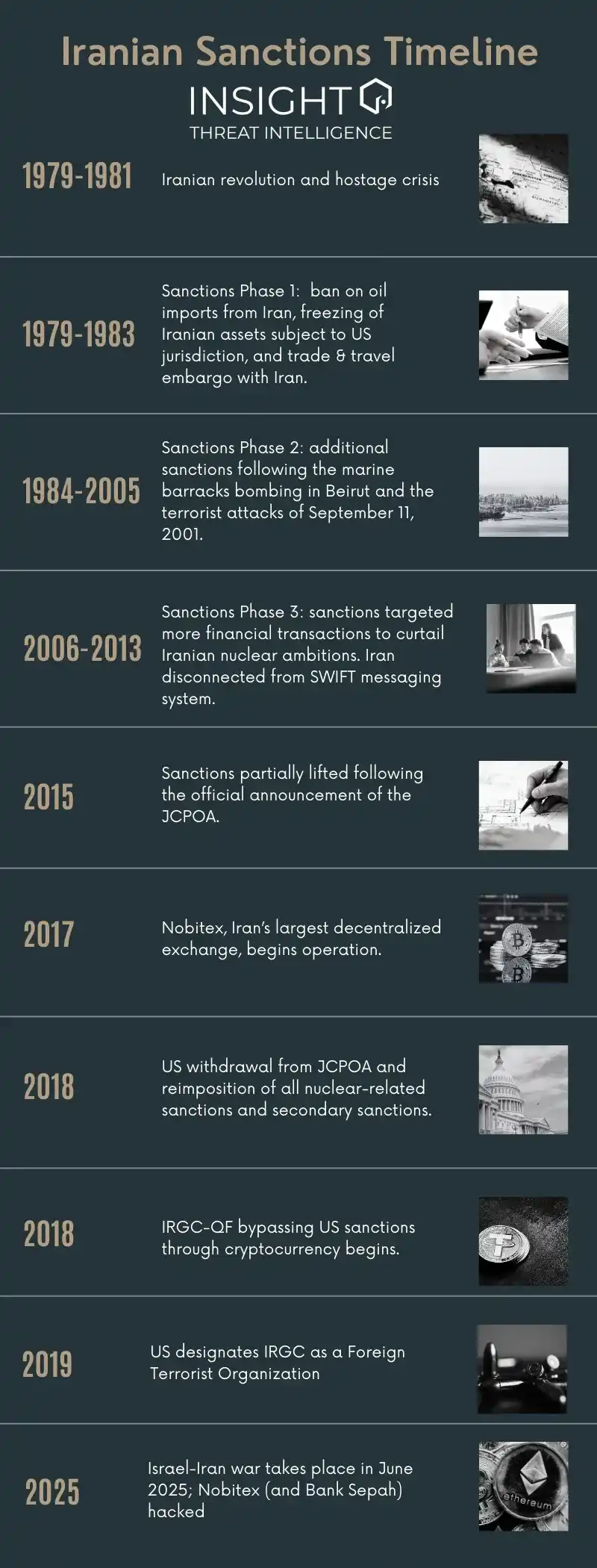
The Iranian sanctions timeline shows that over decades of high-intensity sanctions, Iran has gradually been "squeezed out" of the traditional financial system and has ultimately integrated cryptocurrency into its national toolkit for sanctions evasion, financing, and geopolitical gamesmanship. Specifically, following the 1979 Iranian Revolution and hostage crisis, the US imposed initial sanctions on Iran, prohibiting oil imports, freezing assets, and imposing trade and travel embargoes; between 1984 and 2005, sanctions escalated in the context of multiple terrorism-related events; from 2006 to 2013, sanctions shifted focus to the financial sector to curb Iran's nuclear program, leading to Iran's disconnection from the SWIFT system. Following the announcement of the Joint Comprehensive Plan of Action in 2015, sanctions were temporarily eased, but the US withdrew from the agreement in 2018, reimposing all nuclear-related and secondary sanctions. In the same year, Iran's largest decentralized exchange, Nobitex, began operations, and the Islamic Revolutionary Guard Corps' Qods Force started evading US sanctions through cryptocurrency. In 2019, the US designated the Islamic Revolutionary Guard Corps as a foreign terrorist organization. By June 2025, war broke out between Israel and Iran, Nobitex and Sepah Bank were subjected to hacking attacks, demonstrating the deep entanglement of sanctions, the financial system, and cryptocurrency infrastructure in geopolitical conflicts.
To fund its proxy forces and evade sanctions, Iran operates a parallel financial infrastructure consisting of informal money transfer mechanisms, bank accounts, and shell company networks. The purpose is to launder proceeds from oil sales and create "plausible deniability" regarding the source of oil. When conditions allow, this network intersects with the Western financial system, facilitating Iran's financial activities globally. For example, media reports indicate that two financial technology companies, Paysera and Wise, have unknowingly processed payments for this network. Over the past eight years, Iran has also integrated cryptocurrency capabilities into this shadow banking system.
Iran's significant cryptocurrency activity began in the mid-2010s when the country's first major cryptocurrency exchange, Nobitex, was established. By 2023, Nobitex has become Iran's largest cryptocurrency exchange; additionally, Iran has four other large-scale exchanges: Wallex.ir, Excoino, Aban Tether, and Bit24.cash. Nobitex is deeply embedded in Iran's traditional payment ecosystem, supporting real-time fund access and account verification. It serves as a full-fledged financial bridge, allowing users to bypass the international banking system, showcasing "how to integrate cryptocurrency channels with local banking infrastructure in a sanctioned jurisdiction to build a resilient, cross-border payment system."
Iranian citizens (sometimes including members of the regime) use cryptocurrency to move capital out of the country during geopolitical crises. Even when not for capital flight purposes, many Iranian people also invest in cryptocurrency to hedge against currency and overall economic volatility.
Iran's widespread adoption of cryptocurrency is not surprising: sanctions often drive adoption, especially in areas with high levels of income inequality. In fact, cryptocurrency adoption is influenced by factors such as economic instability and infrastructure availability, with higher adoption rates typically seen in countries with limited access to the traditional financial system.
Since 2018, Iran has started using cryptocurrency to evade U.S. sanctions. The Islamic Revolutionary Guard Corps (IRGC) is one of the key users, employing cryptocurrency to fund intelligence activities and its proxy network across the Middle East, supporting external intervention actions such as sabotage, asset destruction, and potentially even targeted assassinations.
At the national level, Iranian regime officials and the Islamic Revolutionary Guard Corps (IRGC) are using cryptocurrency to evade sanctions and access the international market. According to a blockchain analysis company, Nobitex and other Iranian exchanges use "advanced technology" to transfer funds, deliberately obscuring the source and destination of funds. For instance, Iran uses cryptocurrency transactions to pay for imported goods that cannot be processed through the traditional payment system, offsetting financial revenue losses due to sanctions. Additionally, Iran specifically uses cryptocurrency to legitimize import payments to circumvent sanctions and avoid using the U.S. dollar.
In addition to using cryptocurrency directly for transactions, Iran also leverages its surplus oil and energy resources to power Bitcoin mining, essentially converting energy into digital assets. Given Iran's extensive use of cryptocurrency and its connections to the international market through multiple blockchains, this approach has provided Iran with liquidity—usable both for purchasing goods and services and for funneling funds to proxy forces within its "Axis of Resistance." In fact, it is widely believed that the IRGC has engaged in large-scale Bitcoin mining activities.
Once acquiring cryptocurrency, Iran uses these funds to sponsor other illicit activities. This includes providing financial support to organizations within the "Axis of Resistance" that serve Iran's regional hegemonic objectives and potentially using virtual assets to fund overseas influence operations. To date, cryptocurrency transactions from the IRGC's Qods Force have flowed to groups such as Hezbollah, Hamas, and Ansarallah as part of their overall financing strategy. Cryptocurrency transactions may also benefit other organizations within the "Axis of Resistance."
Iran's embrace of cryptocurrency signifies its entry into a new phase of its long-standing efforts to confront and circumvent one of the most comprehensive global sanctions regimes. Initially a measure to maintain economic resilience, it has now become a key tool supporting Iran's broader foreign policy objectives, particularly in sustaining its proxy network across the Middle East. As Iran's cryptocurrency financing infrastructure matures and becomes increasingly intertwined with an emerging alternative financial system involving Russia, Venezuela, North Korea, and China, its influence extends far beyond Tehran. Subsequent articles in this series will further explore how Iran's proxy forces leverage these financial innovations, specific methods of fund transfer and concealment employed, and the expanding roles of China and Russia in supporting and driving Iran's alternative financial architecture.
You may also like

Citibank releases "2030 Asset Tokenization Market Outlook": 6 major trends may create a $8.2 trillion market

The trillion-dollar valuation test: Are the three major super IPOs a celebration for tech stocks or a nightmare for the crypto market?

Morning Report | Digital Asset completes $355 million financing led by a16z Crypto; Meta completes operational separation from Manus

a16z Crypto Partner: Cash flow is the moat

Cryptocurrency market makers collectively seek change as it becomes increasingly difficult to make money

How TradeXYZ, xStocks, and Alpaca break down the SpaceX IPO into three different strategies

$75 billion in risk asset redistribution: How will SpaceX's IPO affect U.S. stocks and Bitcoin?

Why Is BlackRock Investing $5 Billion in the SpaceX IPO?
Morning News | CME Group launches Nasdaq Cryptocurrency Index futures; Asset management giant Janus Henderson strategically invests in Ethena

Bitcoin Layer 2 Network Botanix: Why Did We Choose to Dissolve?

Why did Oracle deliver the strongest financial report in history, yet its stock price fell?
When the P2P illicit funds from ten years ago turned into 60,000 bitcoins
Dialogue with OmenX Founder: Why does the prediction market need an evolution from "spot" to "derivatives"?
Galaxy in-depth report: Is Solana still worth paying attention to?
Young people in South Korea make a "final effort" in the epic bull market
The pricing controversy of Trade.xyz exposes the fatal weakness of Pre-IPO perpetual contracts

How much longer can Ethereum's last big buyer hold on?

World Cup 2026 Coming – WEEX Celebrates with $1M Prize Pool & Michael Owen Live
Citibank releases "2030 Asset Tokenization Market Outlook": 6 major trends may create a $8.2 trillion market
The trillion-dollar valuation test: Are the three major super IPOs a celebration for tech stocks or a nightmare for the crypto market?
Morning Report | Digital Asset completes $355 million financing led by a16z Crypto; Meta completes operational separation from Manus
a16z Crypto Partner: Cash flow is the moat
Cryptocurrency market makers collectively seek change as it becomes increasingly difficult to make money
How TradeXYZ, xStocks, and Alpaca break down the SpaceX IPO into three different strategies


