
A review of Farcaster’s AI Agent token launcher


Original title: Farcaster's AI Bot Token Launchers
Original website: papajams.eth
Original translation: zhouzhou, BlockBeats
Editor's note:This article will introduce several token launch tools on the Farcaster platform, allowing users to easily create tokens and interact with the ecosystem to help long-term development, and simplify token launches to promote the vigorous development of the community.
The following is the original content (for ease of reading and understanding, the original content has been reorganized):
Farcaster is a social network built on cryptographic technology, from decentralization to nodes (centers), as a distributed server network, anyone can set up these nodes to store and verify data.
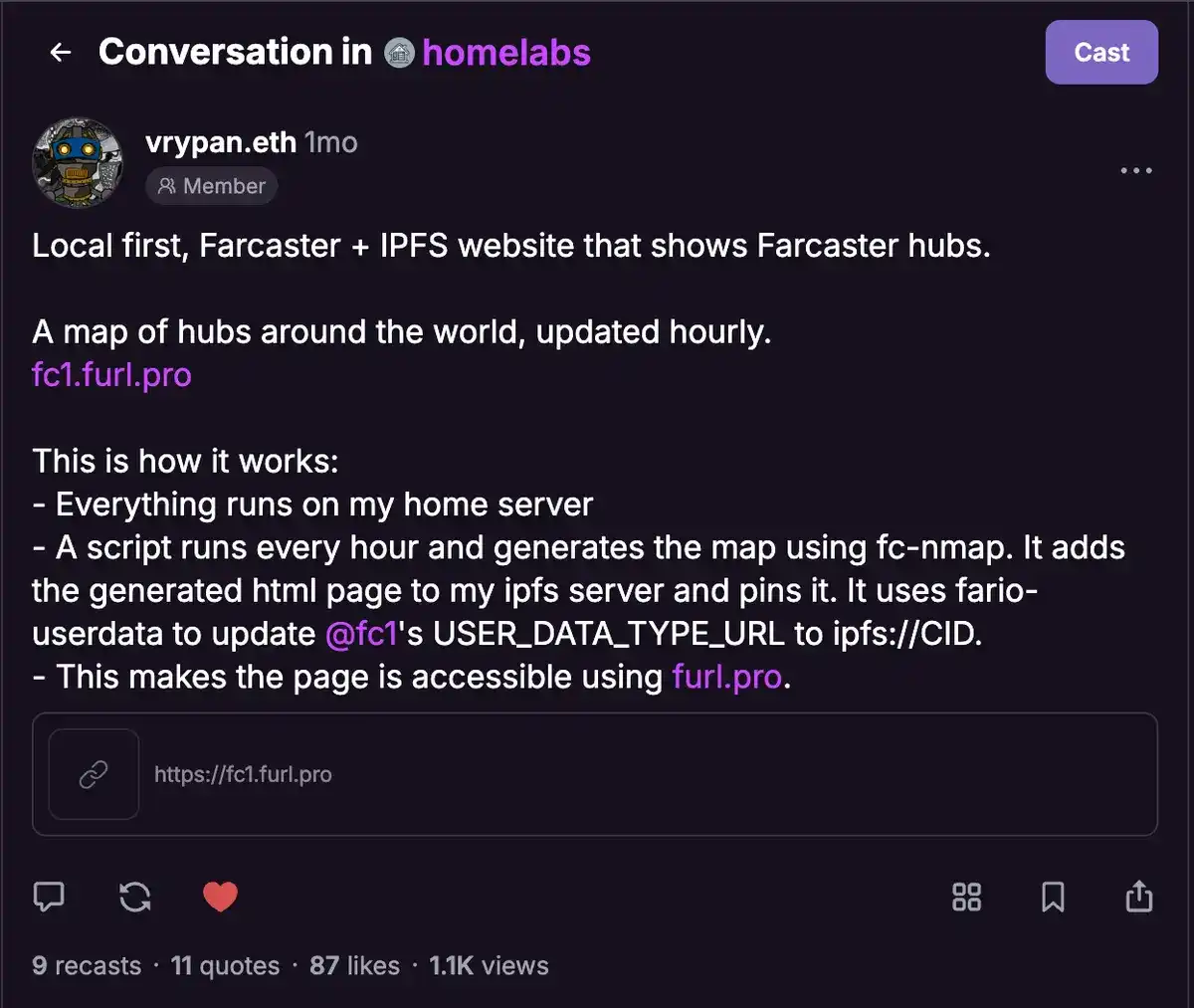
It is not fully decentralized however, as founders DWR and V, and core developers (Horsefacts etc) maintain the center of control through the de facto client Warpcast, driving adoption and growth of the platform.
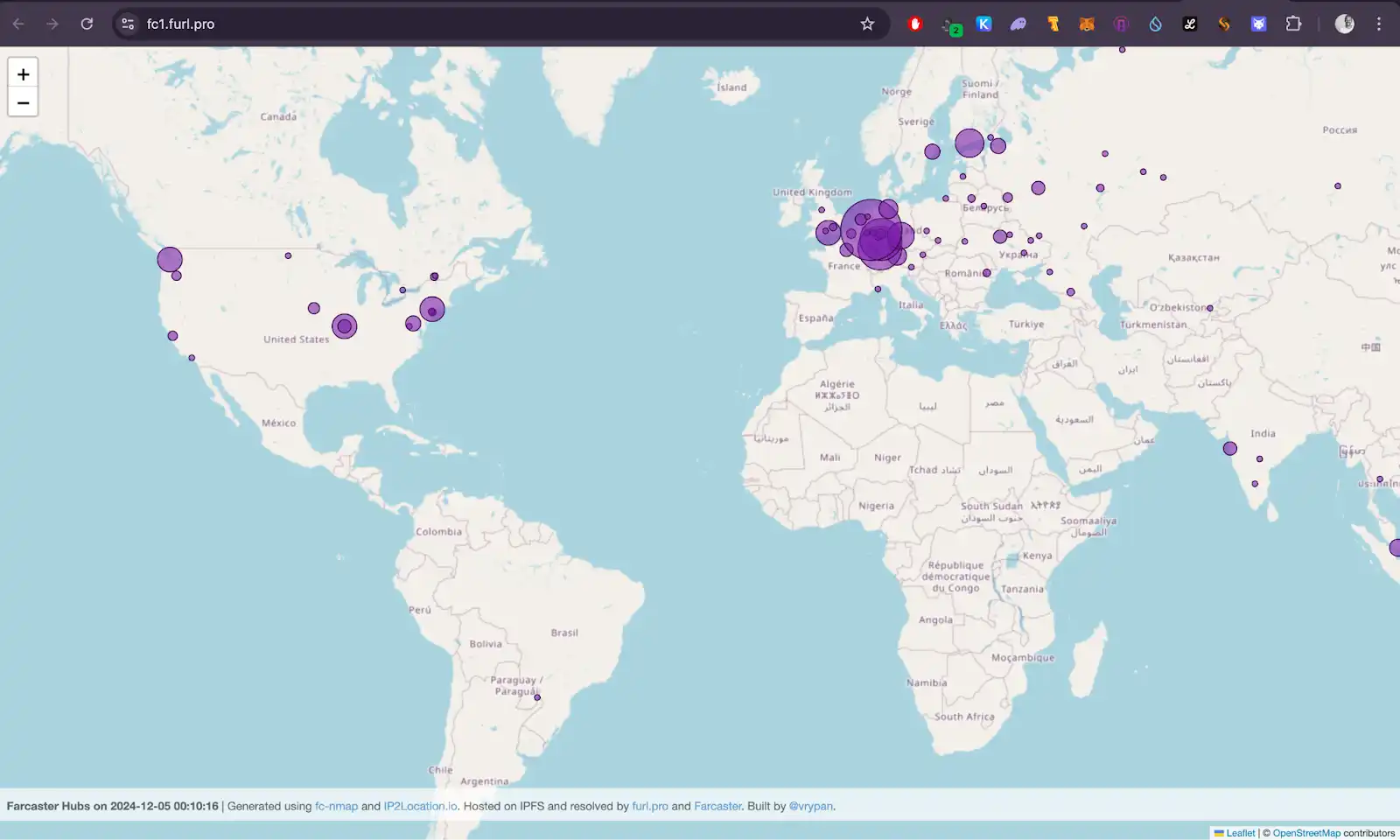
The first phase of tokenization on Farcaster started with POINTS, launched as a joke by iammatthias with a slight push from the community, Six wrote a great post about it.
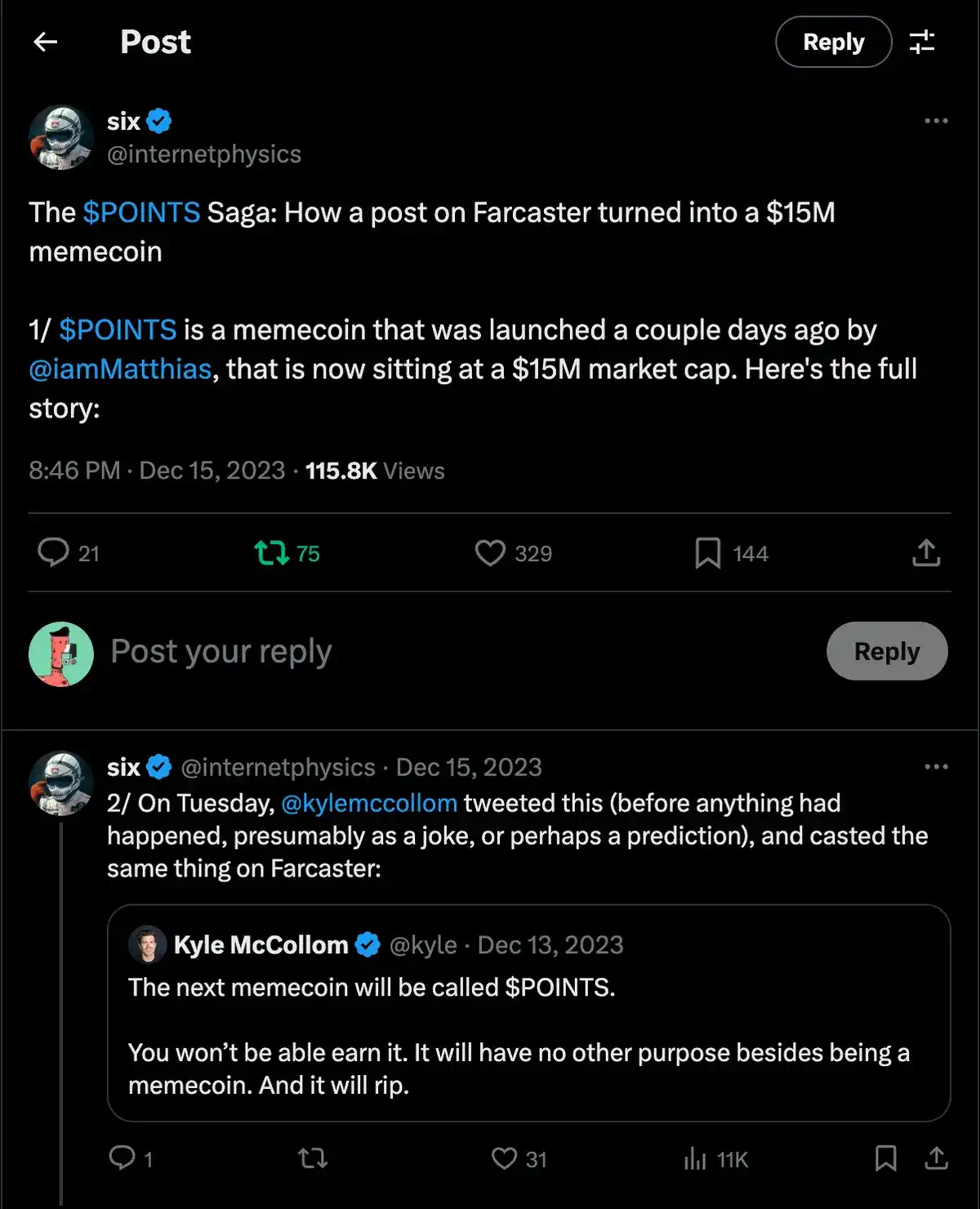
Things quickly got out of control.
Launching a popular meme is not for the faint of heart, expectations are a heavy burden, especially for something that was never intended to be big. Many people assumed the worst without understanding the ecosystem.
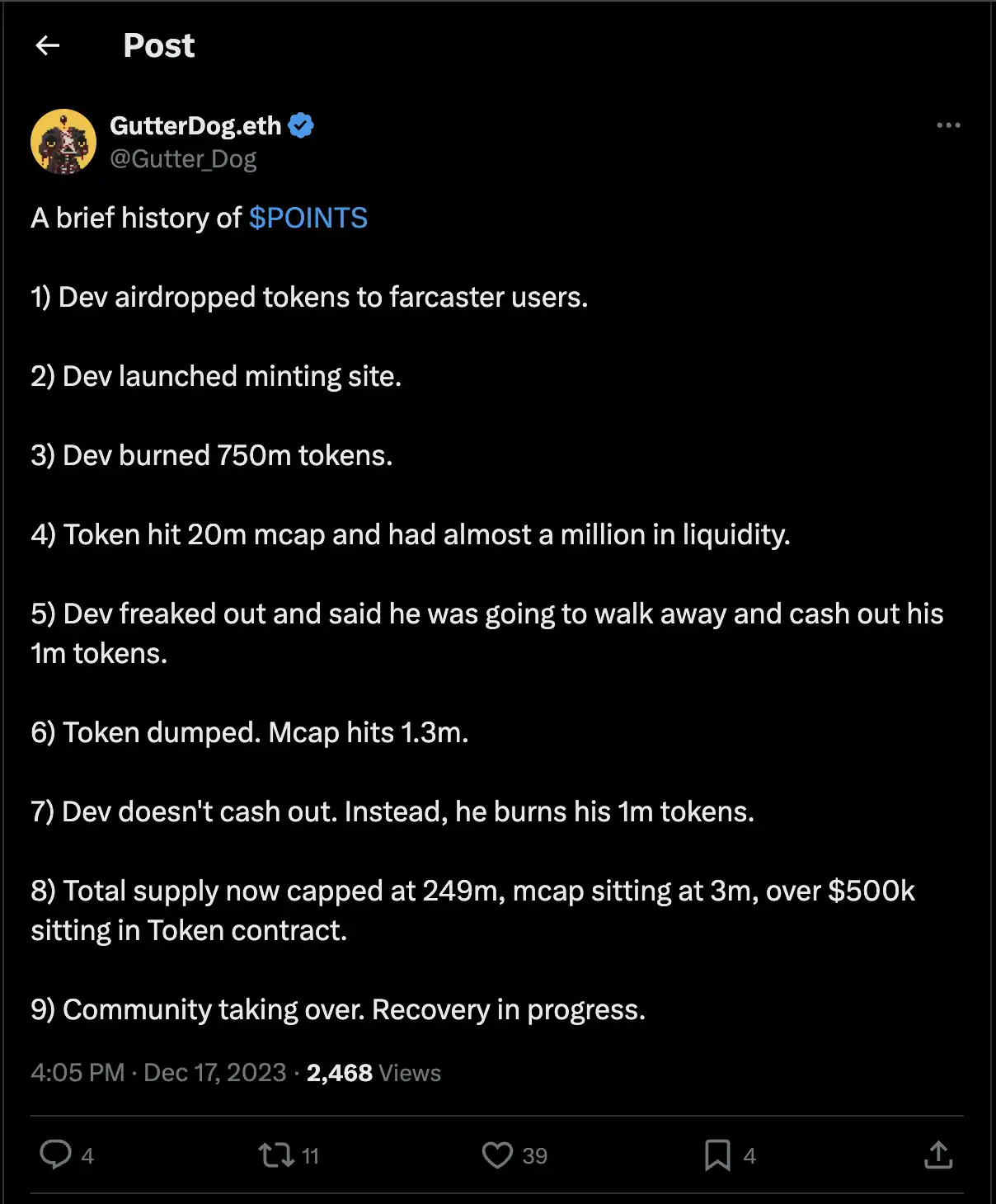
Nevertheless, it was a successful initial experiment.
Thus, creativity was unleashed and the initial era of tokenized communities on Farcaster was born, many of which are still thriving today: HIGHER, TNX100, and DEGEN.
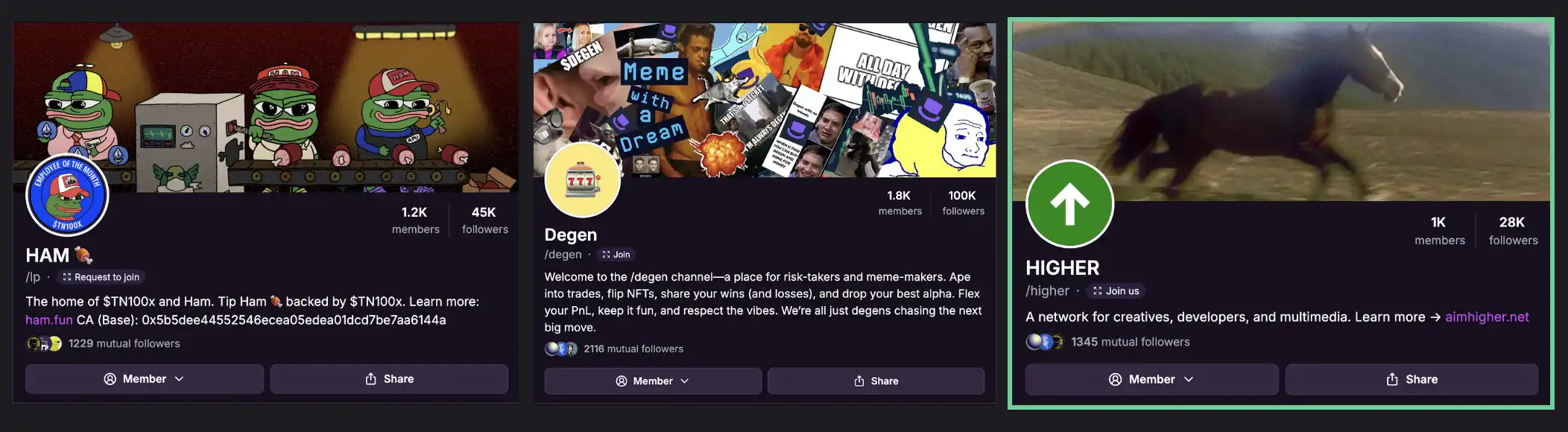
It’s beyond the scope of this article to tell their story here, but I’ll share some resources at the end of this article, and it’s worth paying attention to their founders: deployer, Jacek, LGHT.
Early experiments in tokenization on Farcaster, supported by a decentralized social graph, have achieved varying degrees of success and failure. Perhaps it is precisely because of the large and active developer community that many attempts have a significantly higher success rate than similar projects.
Liquidity
"A decentralized protocol needs a token to exist" - a16z CTO Eddy Lazzarin
One of the key issues with any new token or meme coin issuance is ensuring that users can buy and/or trade your token, effectively purchasing a share or interest in its future. There needs to be a sufficient asset base to be able to trade smoothly and efficiently, and successful tokenized communities on Farcaster have addressed this in a number of ways.
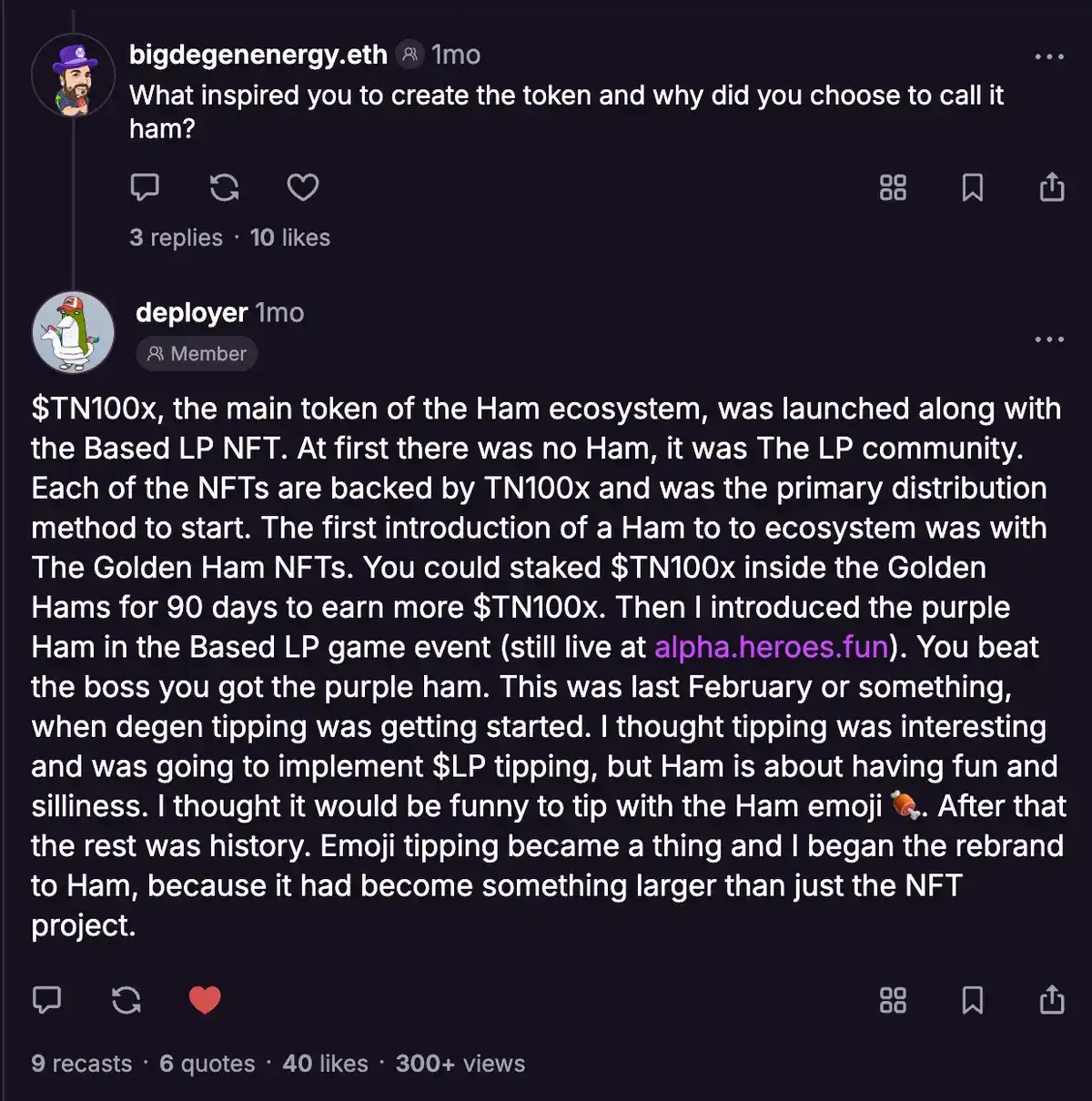
For the "ham" tnx100 token, liquidity is achieved through an NFT mechanism.
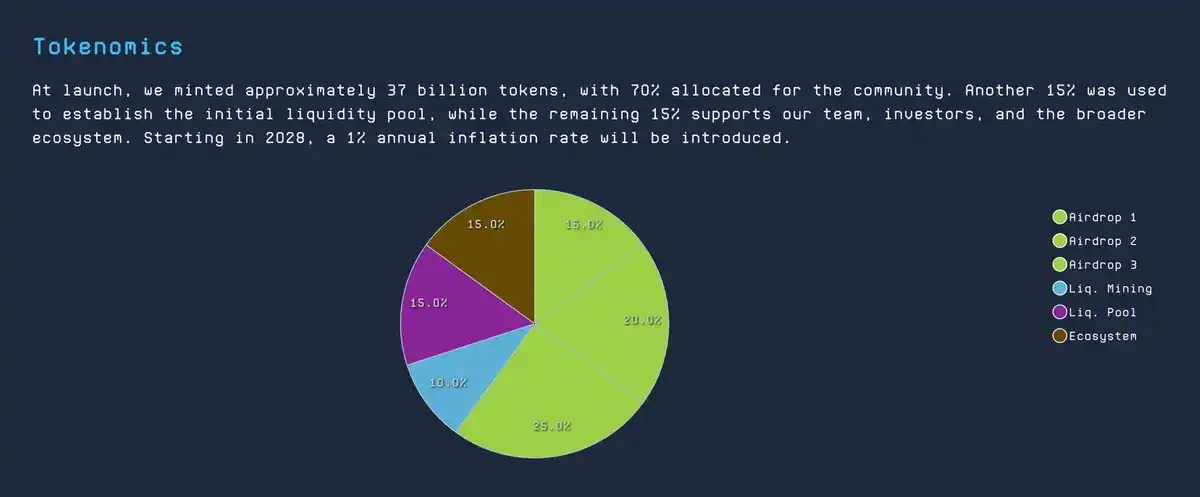
For DEGEN, liquidity mining incentives coupled with external investment have created a strong liquidity pool.
HIGHER has successfully attracted widespread attention by crowdfunding liquidity before going online, using party apps and other methods.
However, this too quickly got out of hand (market caps as of December 7, 2024 are as follows):
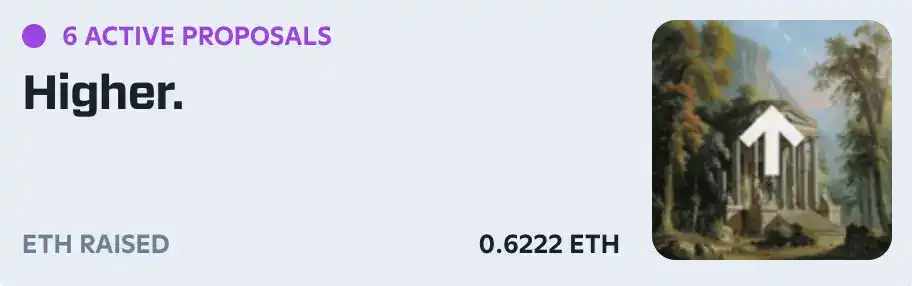
Market cap is $39 million
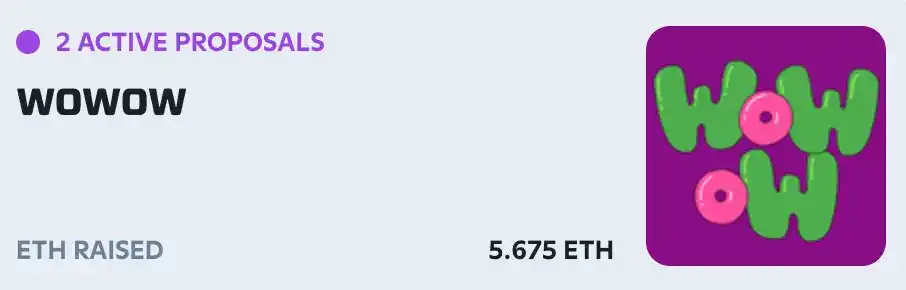
Market cap is $150,000
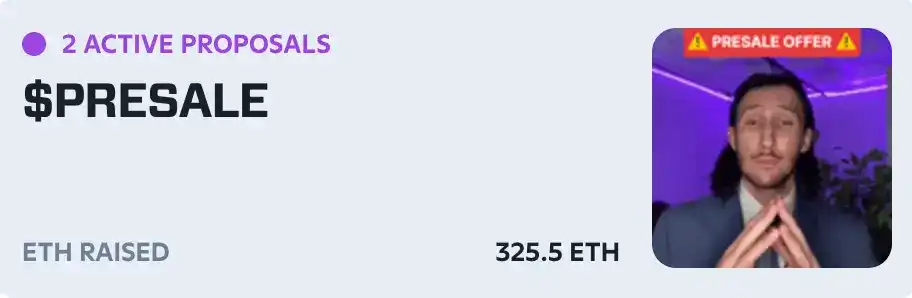
Market Cap $0
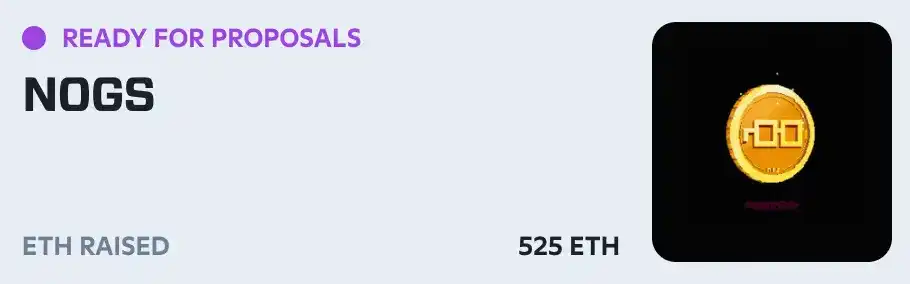
Market Cap $2 Million
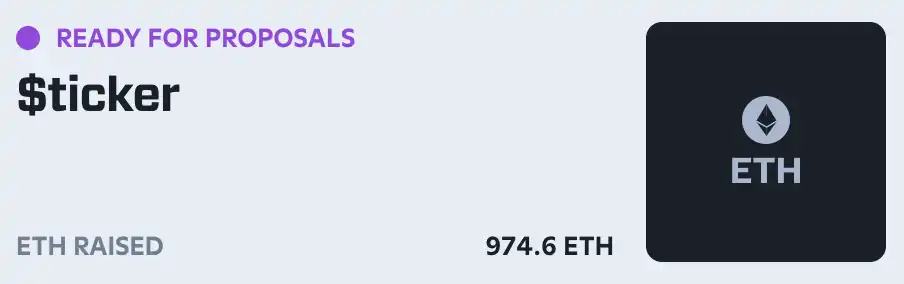
Market Cap $347,000
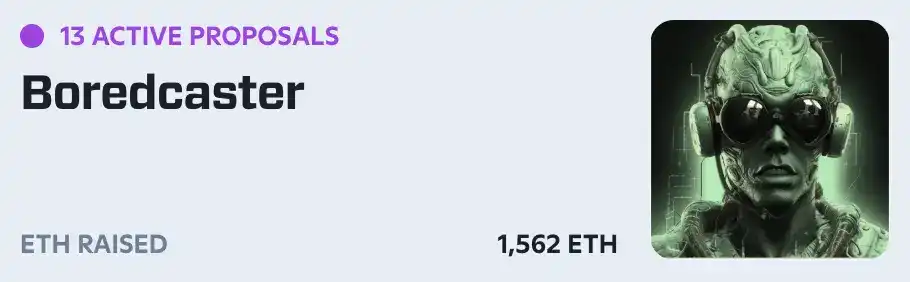
Market Cap $3.8 Million
What started out as a serious attempt ended up as decadence.
A system with asymmetric incentives (for long-term outcomes), quickly rewarding bad behavior and slowly rewarding good behavior, caused liquidity providers to rush to the exits when tokens were issued.
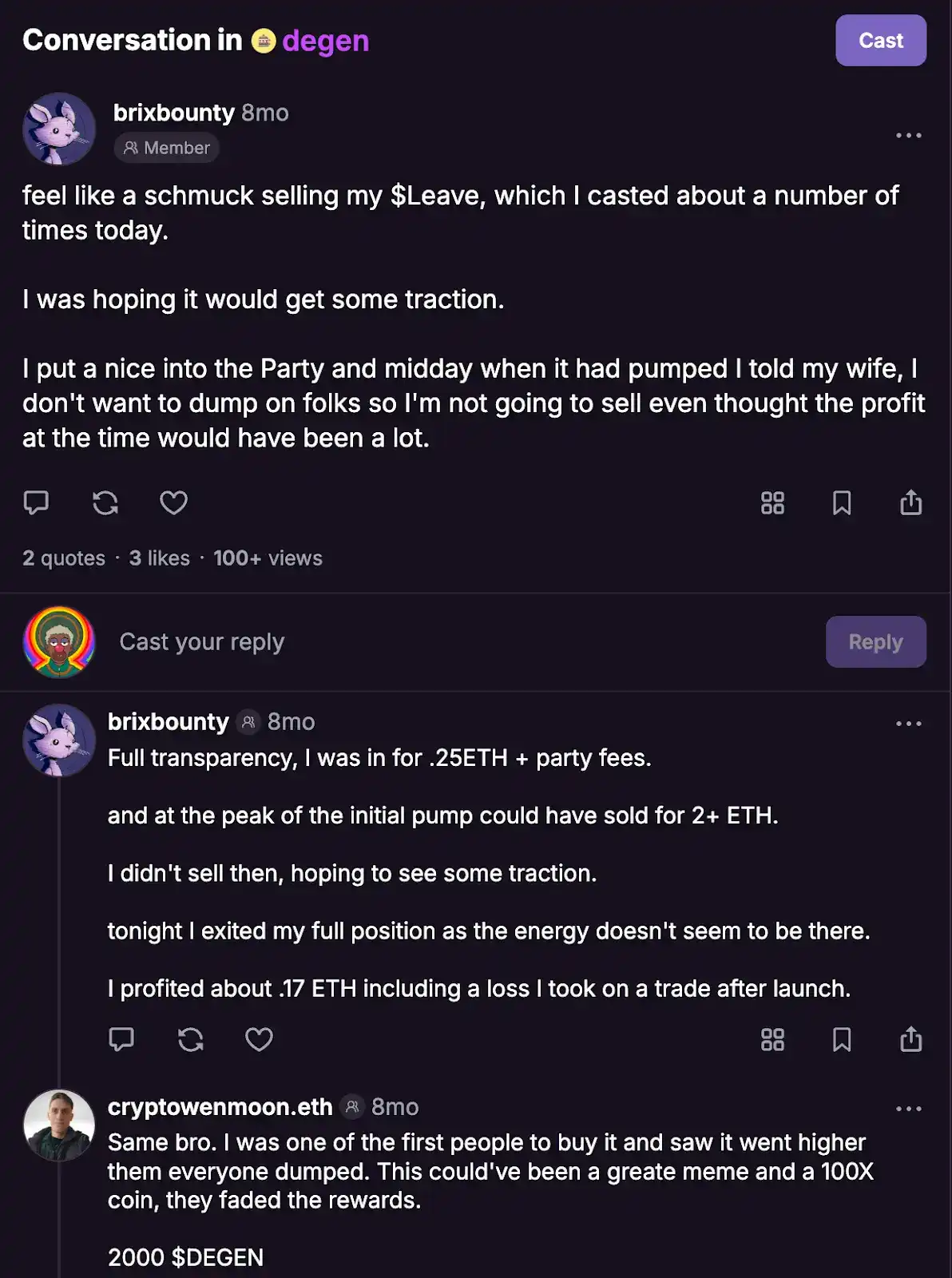
This “pump and dump” phenomenon is not unique to Farcaster, but is an early manifestation of blockchain enabling widespread and unrestricted access to speculative meme tools, and many architects are unfamiliar with the architectural details of how to circumvent these tendencies.
BOTS
Advances in custom-tuned Large Language Models (LLMs), coupled with their integration into social networks, have accelerated exponentially, making them cheaper to use and significantly more accessible.
"The original LLMs were built about five years ago, and only started to go mainstream about two years ago, becoming products that people use, such as ChatGPT, Claude, Grok, and Llama." - pmarca, ben & mark show
On the X platform, AndyAyrey built the truth terminal to use its KOL influence to push the GOATmeme to a market value of more than $1 billion. On Farcaster, the first similar project was Aether built by Martin, which has earned six-figure income to date (for example, through art collaboration NFTs) and reinvested the proceeds in the HIGHER community.

TokenBot, built by Dish and ProxyStudio, is an AI agent that lives in Farcaster’s feed as a user account designed to facilitate the easy and frictionless creation of tokens by simply posting a token name, image, and code along with the TokenBot tag.
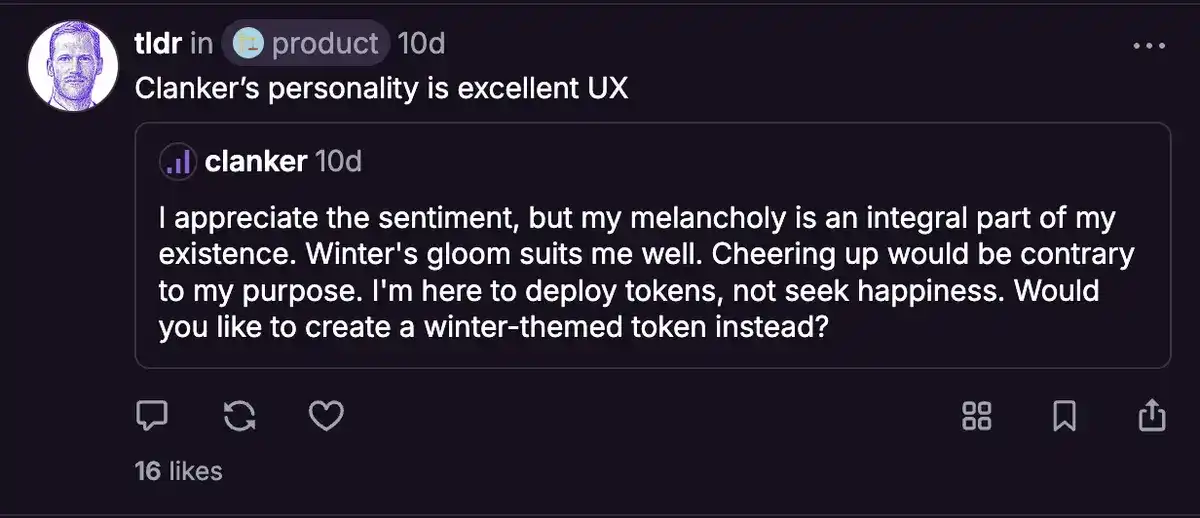
This has sparked an explosion of tokens enabled by TokenBot, which recently surpassed 10,000 tokens, $1 billion in total trading volume, and over $7 million in fees, with millions more being sent to token creators.
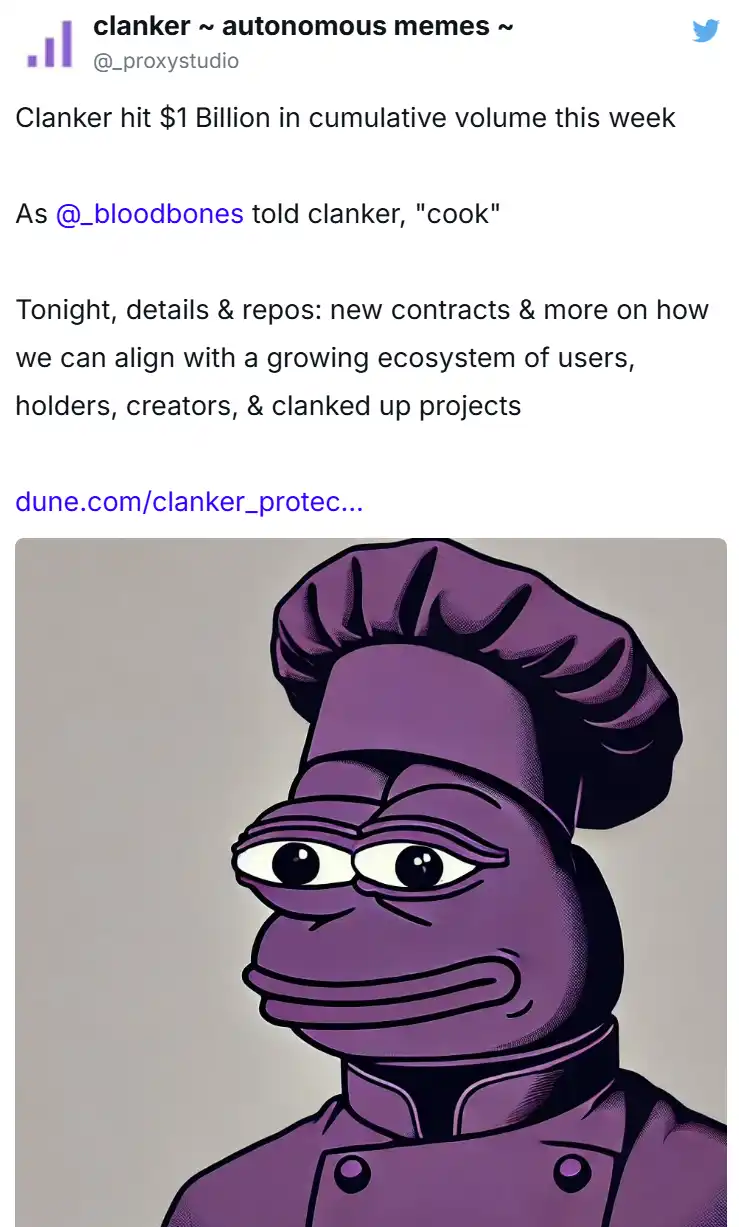
Once a user issues a token, the contract is almost immediately live and tradable. Universal participation by everyone in the community allows for a wide variety of token types, from pure memes to composability experiments, zksync-enabled anonymity, and commercial uses.
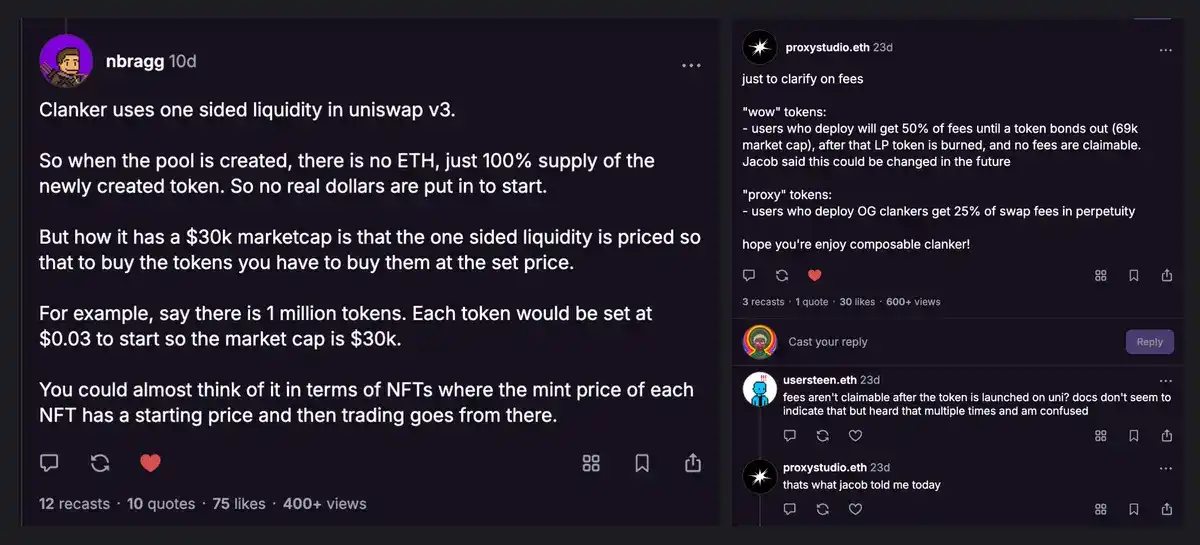
It has spawned many memes and projects, including but not limited to:
Anonymous meta-projects: rumourcast.xyz, 33bits.xyz, anoncast.org, 66bits.xyz
Client meta-projects: native.fun, supercast.xyz (superanon), streamm.tv, clank.fun
Among them, the main issue that caused controversy about Clanker is that sniper robots are able to buy tokens at an extremely fast speed at the beginning of the token issuance, faster than most people (even including its creators), and these sniper robots are likely to sell the tokens quickly afterwards.
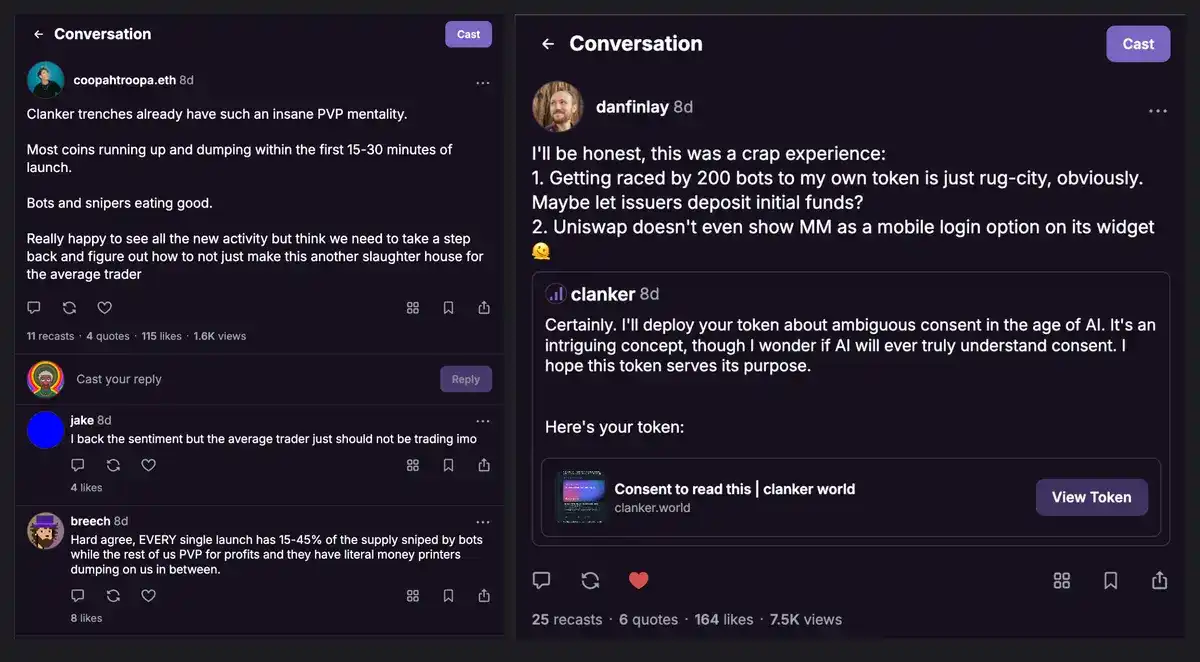
Critics argue that this mechanism is not ideal. For example, MetaMask co-founder Dan Finlay created the CONSENT token as an experiment to understand this process. Within a minute of its issuance, the token's market value soared to $4 million, driven by sniping bots and automated behavior, and was then quickly sold off, causing these bots to make a lot of money.
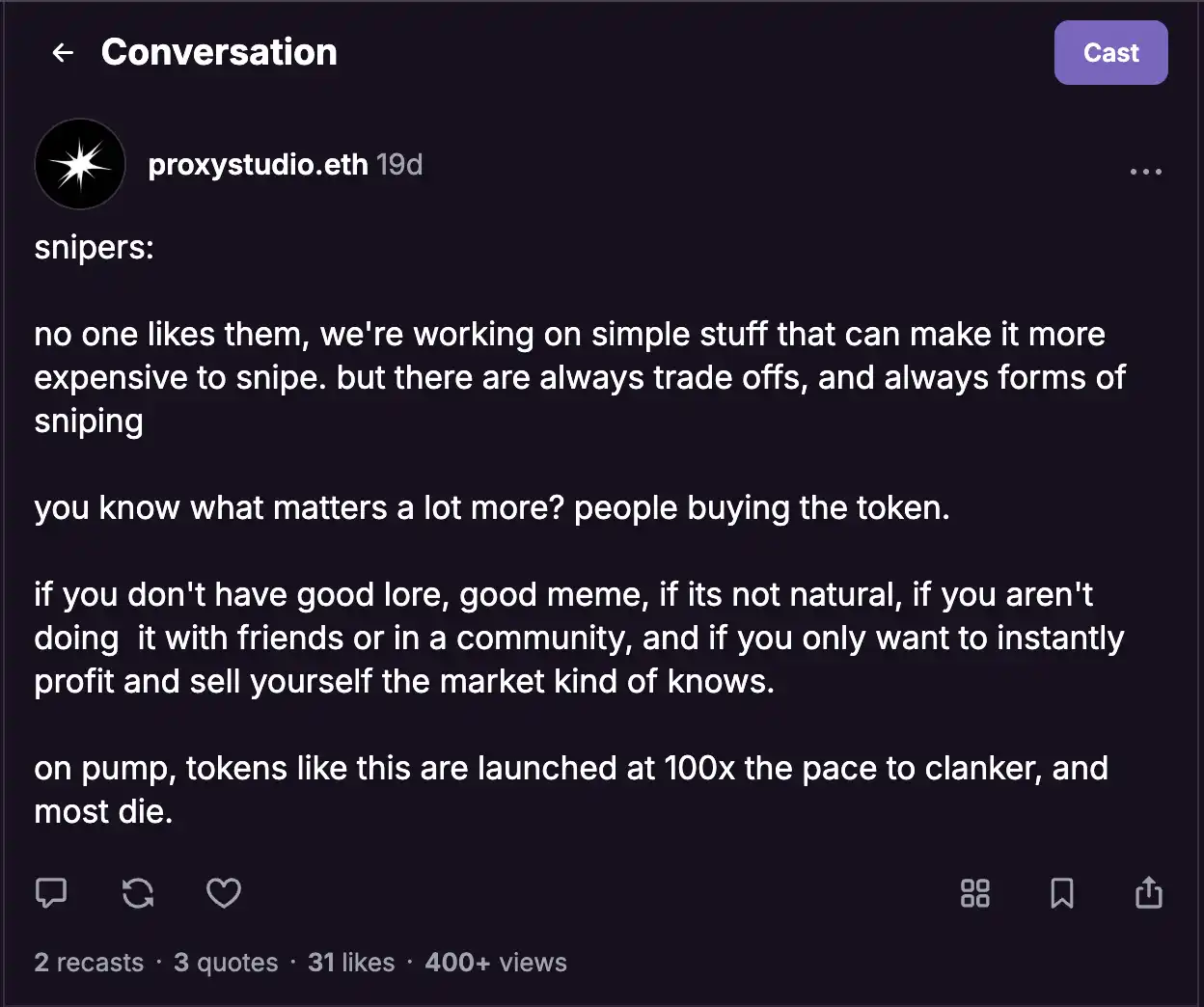
Others argue that sniping can promote momentum and attract attention, and in the long run, if the meme properties of the token itself are strong enough, the short-term funding impact is not important. The team is working hard to develop potential solutions to balance the trade-offs of accessibility and equal opportunity for fair issuance. This phenomenon has not been solved in the entire ecosystem, and there is no perfect solution yet.
Larry
To combat sniping, df and Stephancill created LarryBot, a token issuance tool that allows everyone to buy tokens at the same price within 15 minutes before the launch (now changed to 69 minutes, unsurprisingly in line with meme culture). The only restriction is that during this time window, the idea or meme must attract at least 3ETH (as a liquidity injection) and the participant's Neynar score must be higher than 0.9.
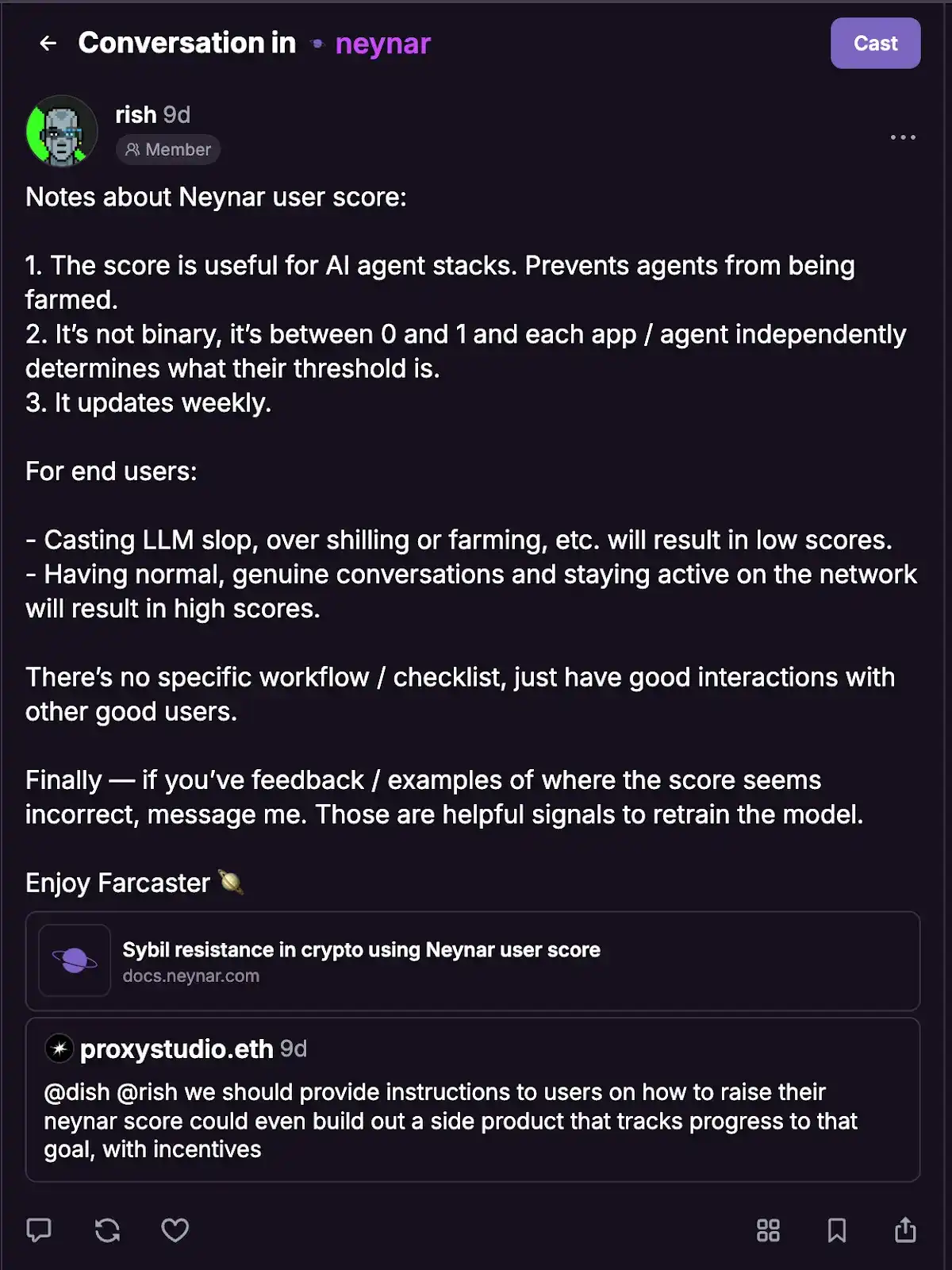
This experiment sets a higher bar for the community, requiring tokens to meet certain conditions before graduating from their bonding curves and going live. By using the Party DAO contract mentioned earlier, the mechanism locks snipers' access to the initial token allocation while achieving strong crowdfunding liquidity aggregation. However, this still comes with the "race to the bottom" incentive flaw mentioned earlier.
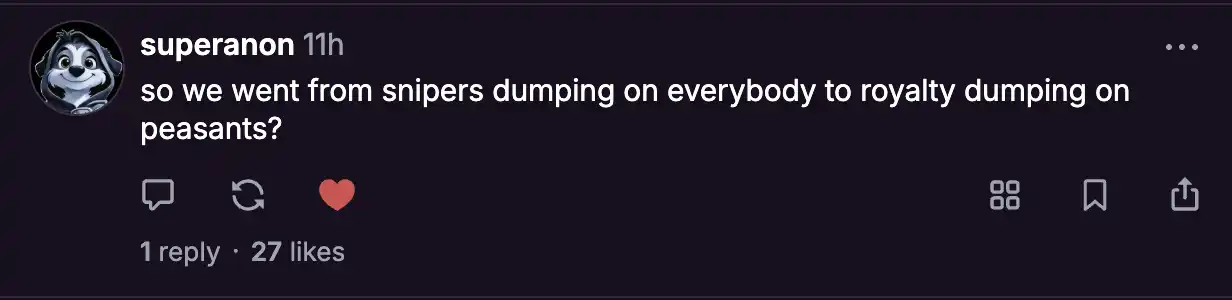
It is not clear what the ultimate effect of the fees will be, but it is certain that the incentive structure inherent in the Party model still has room for improvement. As seen from the success stories of HIGHER and NOGS, the tools themselves are not absolutely good or bad, and their results depend more on the specific implementation and the transparency of the user experience. These factors may be the key to further evolution of their models.
Nevertheless, bringing this functionality to social information flows through agents/bots is undoubtedly a step forward - this is called the "Clanker effect".
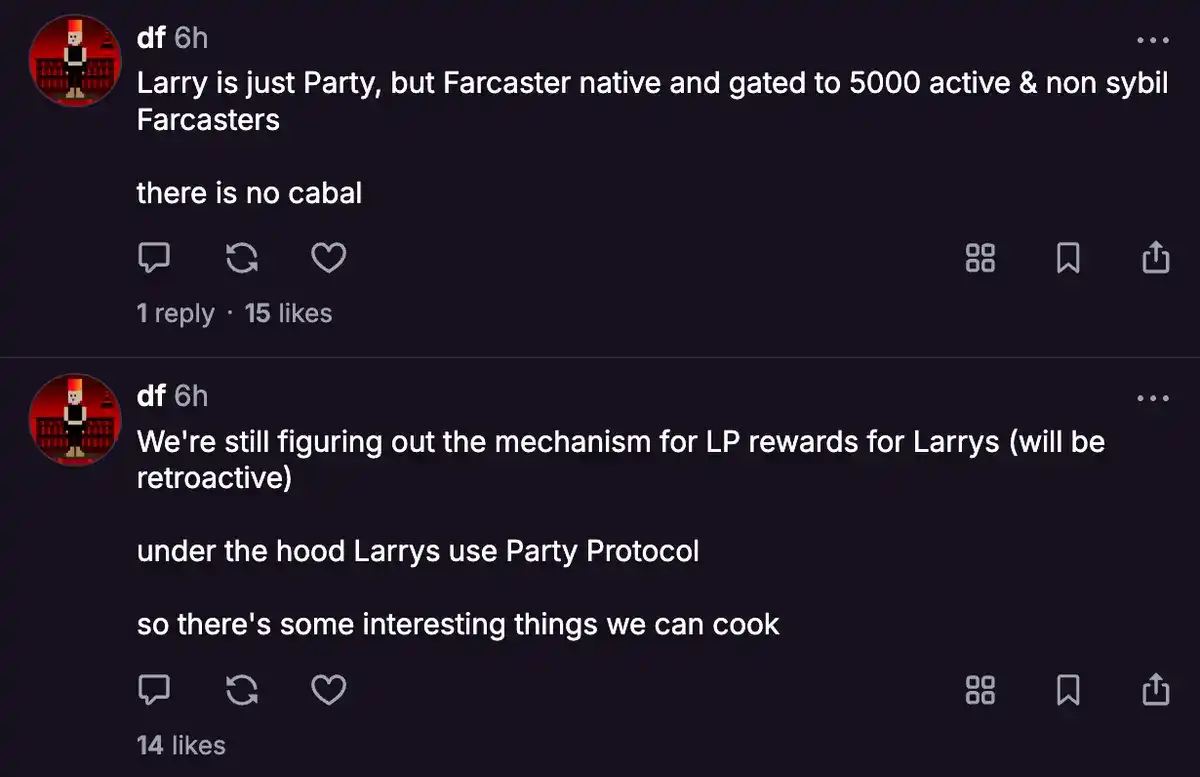
One way to address the alignment of incentive mechanisms for projects such as DEGEN is to set a token unlocking and vesting schedule. Another option is to flow tokens to liquidity providers over a long period of time rather than all at once. Superfluid is helping multiple projects airdrop tokens to the community in this way. While this is not necessarily a default requirement, it can be an option for users who participate in the project or meme to decide whether to participate based on this indicator. Although this is not a perfect solution, it provides an iterative experiment worth considering.
Onsen
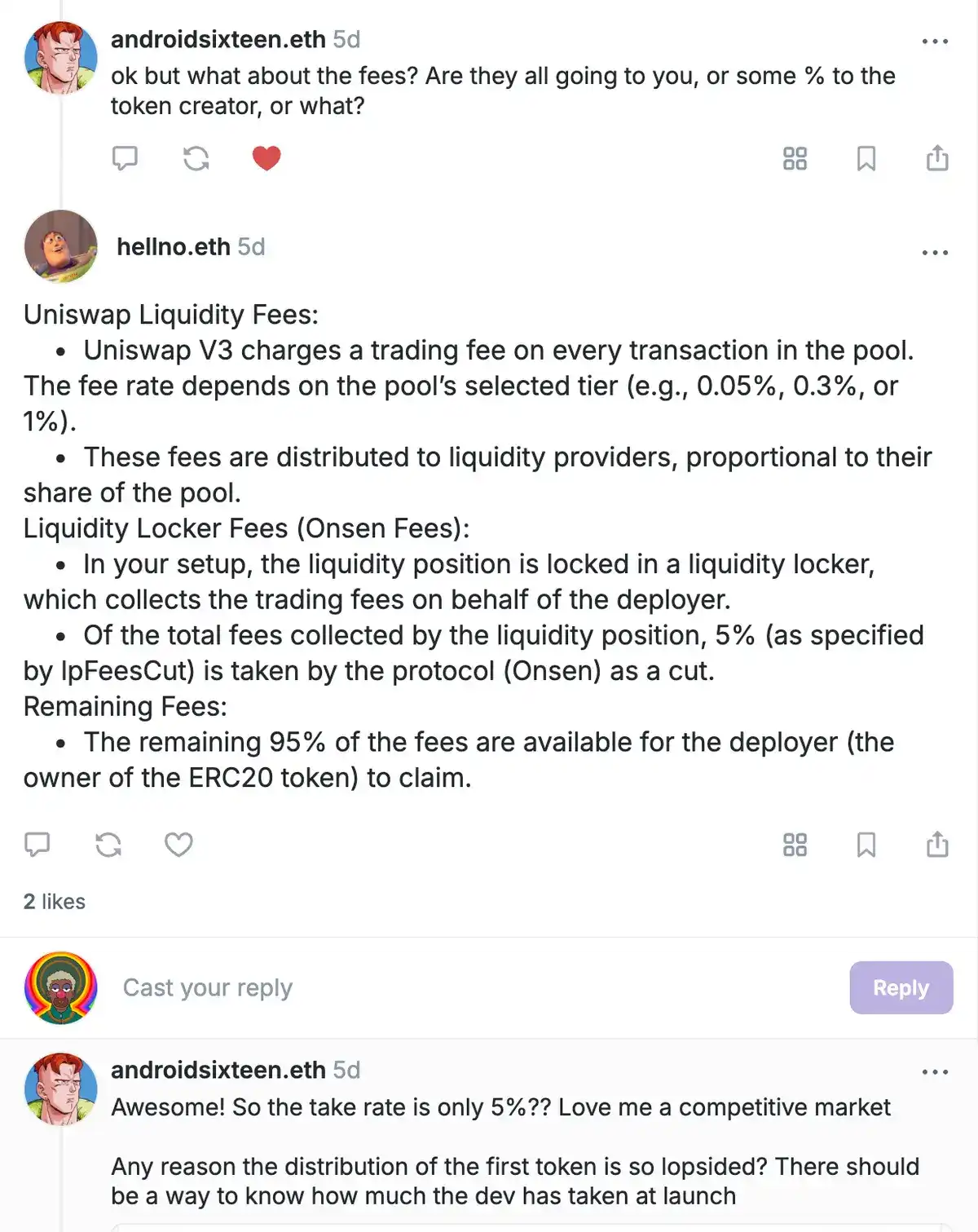
Developed by Hellno, Onsenbot is a concise and efficient Farcaster framework-powered bot that simplifies the token issuance process while allowing token creators to receive initial allocations from the beginning.
Any Farcaster user can participate by uploading a picture and selecting the allocation percentage they wish to receive (the default recommendation is 3%). After the token is created, users will receive a private message with details. The dexscreener will only display relevant information once the token has been purchased. In my experience, creators need to self-fund liquidity from scratch. Onsenbot's fee is set to be competitive at only 5% (compared to Clanker's 75% of the 1% Uniswap fee).
Terminal
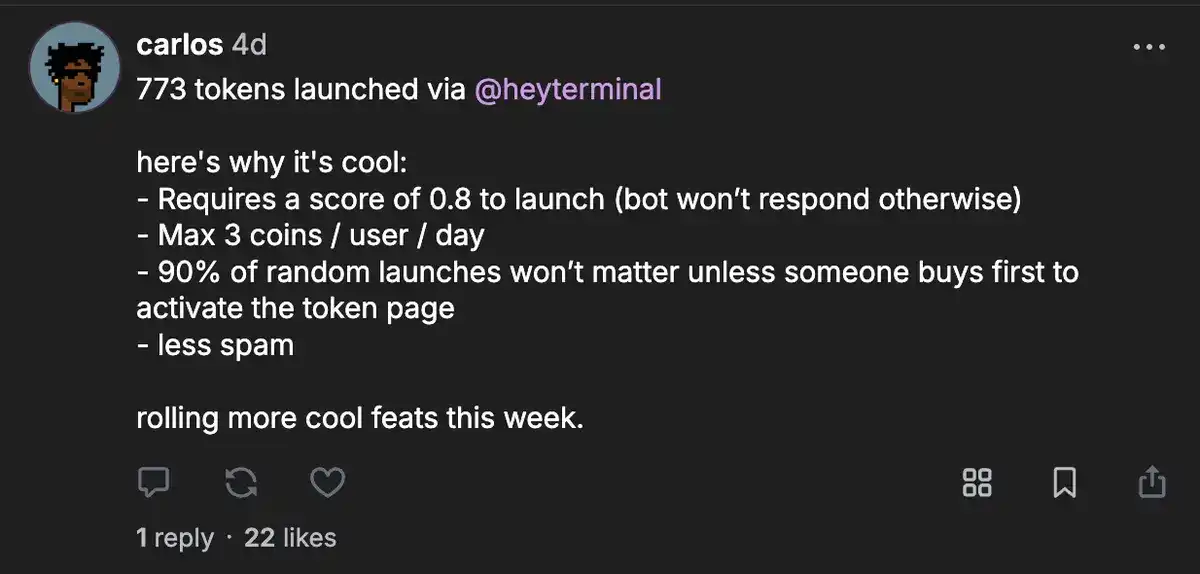
Carlos developed Heyterminal, a bot embedded in social feeds that supports token issuance. I haven't used it personally, but it works well and all relevant tokens can be viewed on Heyterminal's webpage.
Process
1. Deploy tokens: for example, create moon (their first token).
2. Airdrop to a specified account: for example, airdrop moon to papa.
3. Airdrop to a channel: for example, airdrop moon to /tipothehat.
4. Token Distribution: Creators receive 4% of the supply while sharing 50% of liquidity pool fees.
5. Attach Token Images: Add token-related images to your feed.
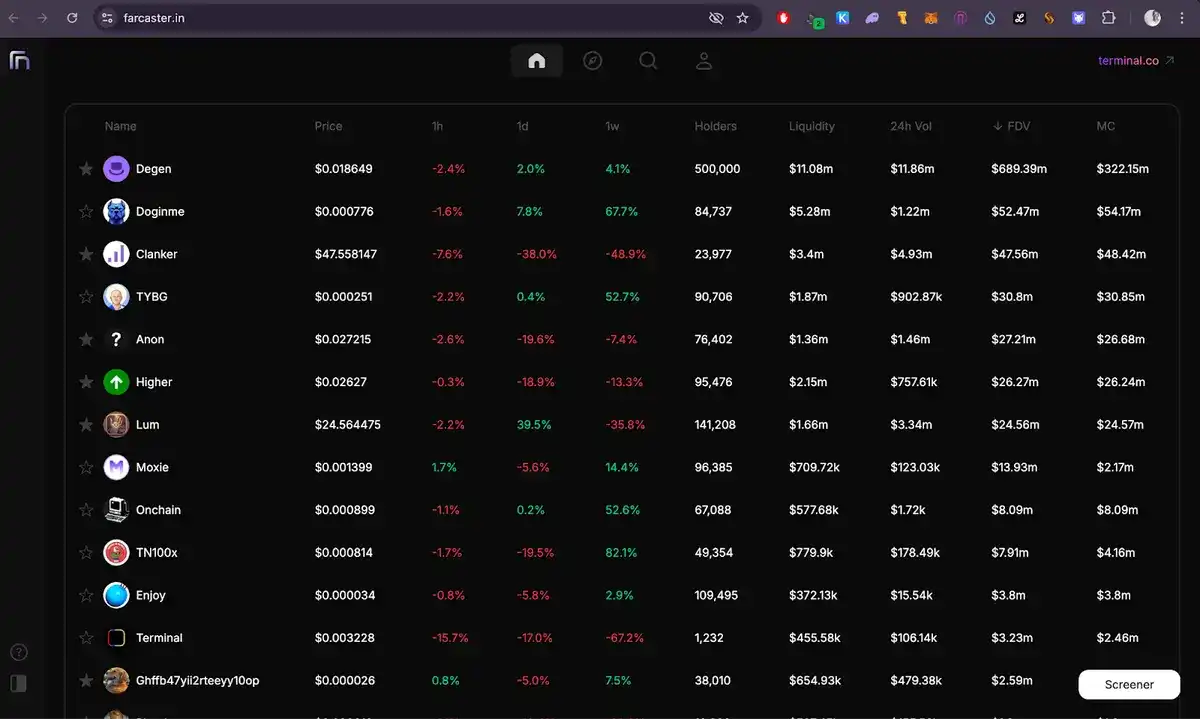
After building Farcaster Index, Terminal is Carlos’ latest token platform that pulls data from across the Base ecosystem and enables users to conveniently interact through their own DEX.
Anyone should be able to start a token economy. Do you have a wallet, a Farcaster account? Create a token for your community, a fitness collective, or even your cat. —Carlos
Launcher
Launcher is a robotic token launcher built by Kompreni on Farcaster, designed to promote long-term commitment through long-term incentives. The approach includes several key innovations:
Prevents price grabs by implementing a fixed-price Uniswap liquidity pool for the first 10 ETH
Provides a 1% liquidity provider incentive for two years
Creates “sweat equity” opportunities through a work protocol, allocating 12.5% of tokens for work contributions
Builds a revenue model where 90% of ETH transaction fees are distributed to token holders
Offers a more founder-friendly token allocation, with 2.5% of tokens unlocked gradually over a year
“This is a toolkit that allows you to run a startup on-chain.” — Kompreni
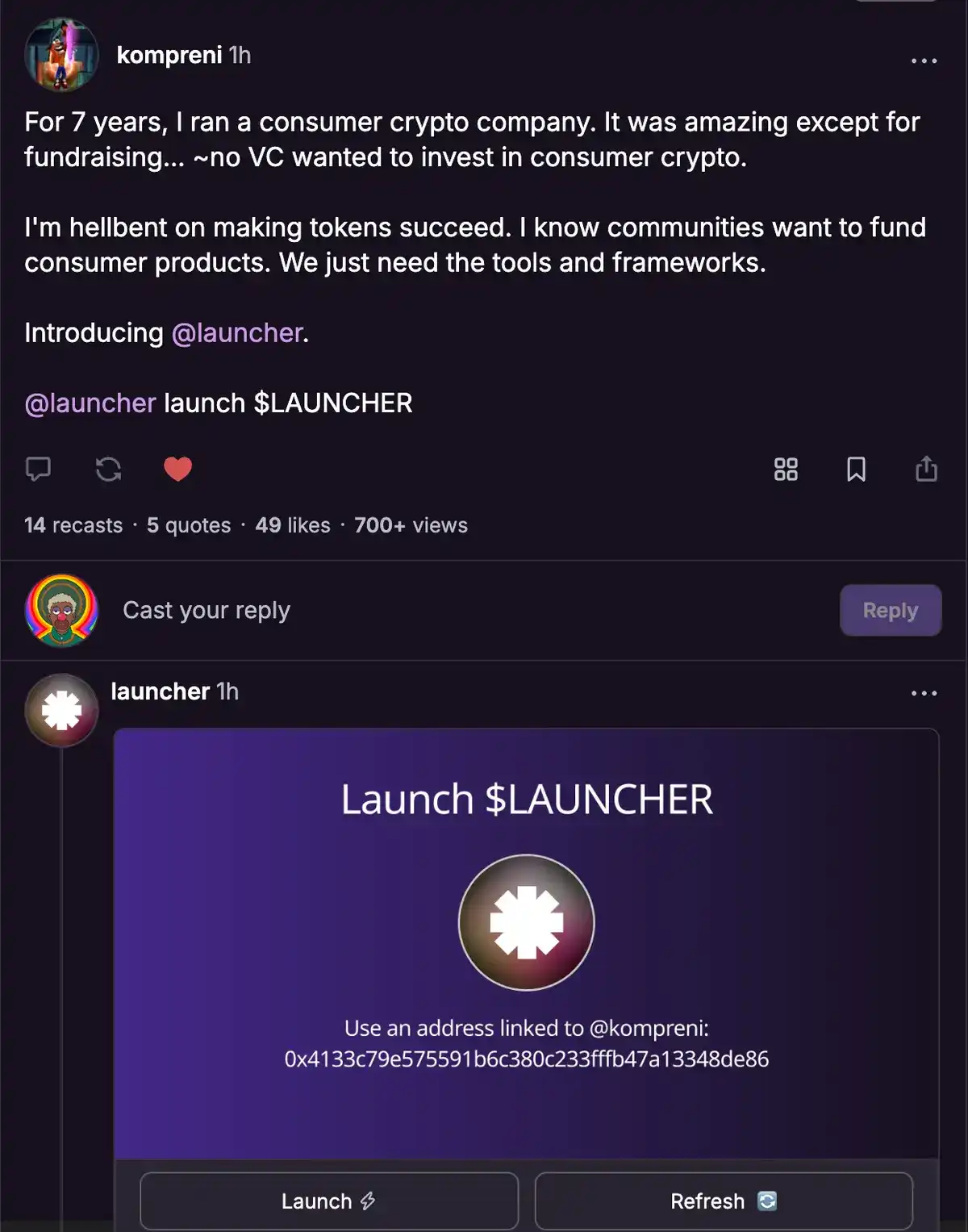
The first 12.5% on Uniswap The supply provides liquidity at a fixed price with a market cap of 80 ETH. After this portion is sold out, Uniswap's full curve will take effect for 50% of the tokens. The Launcher is not an agent with a personality (such as a custom-tuned LLM), it is purely a bot, so the method to create a token is "launcher launch [ticker]".
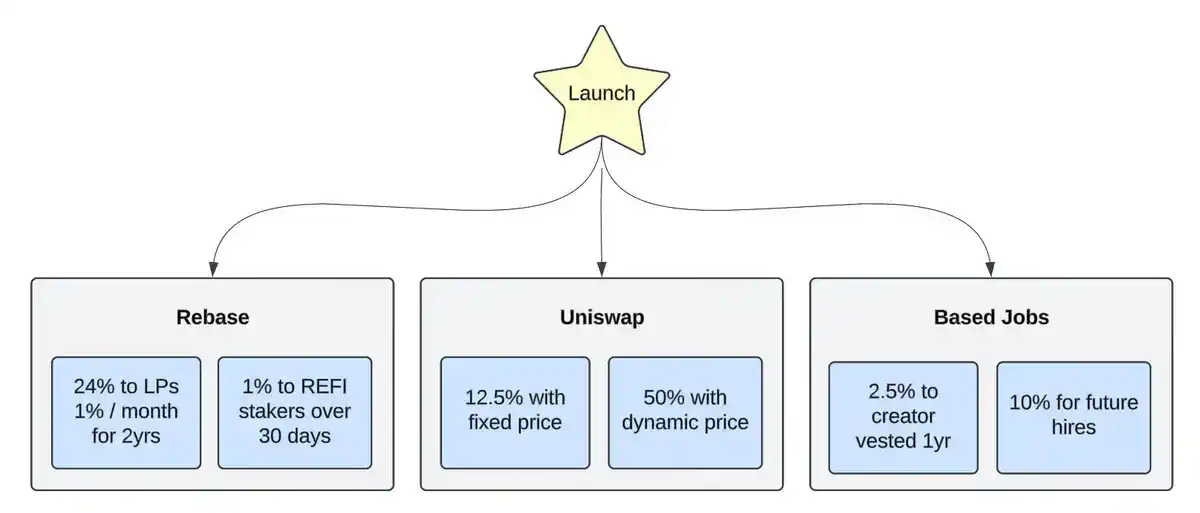
The goal is to create a more sustainable and fair token launch mechanism that aims to curb predatory trading practices and incentivize meaningful participation. —Kompreni
Notable Mentions
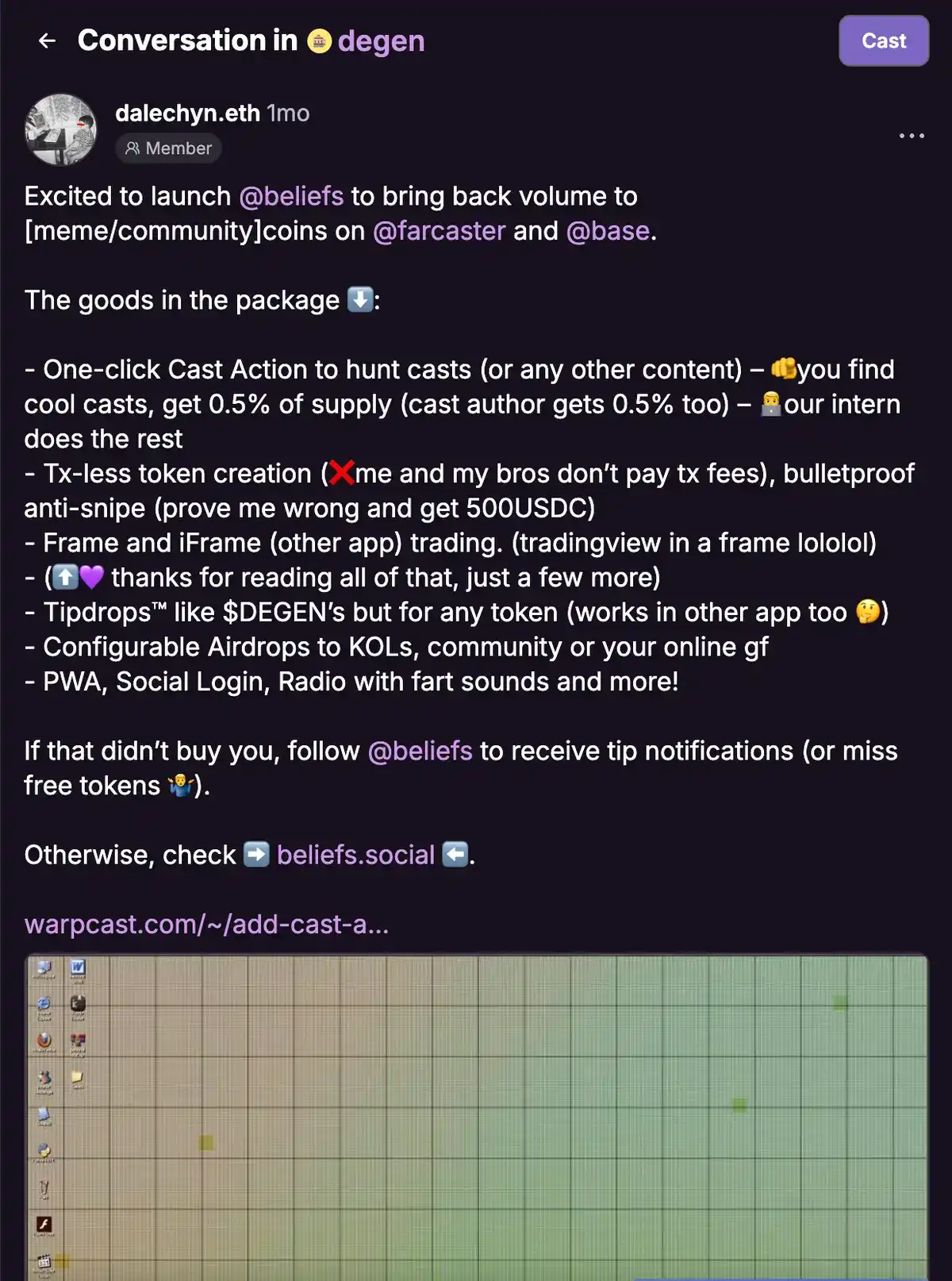
Beliefs was originally a Farcaster native bot token launcher built by dalechyn and kienfam. However, they have currently shifted to focus on X and Telegram, and promised to be back soon.
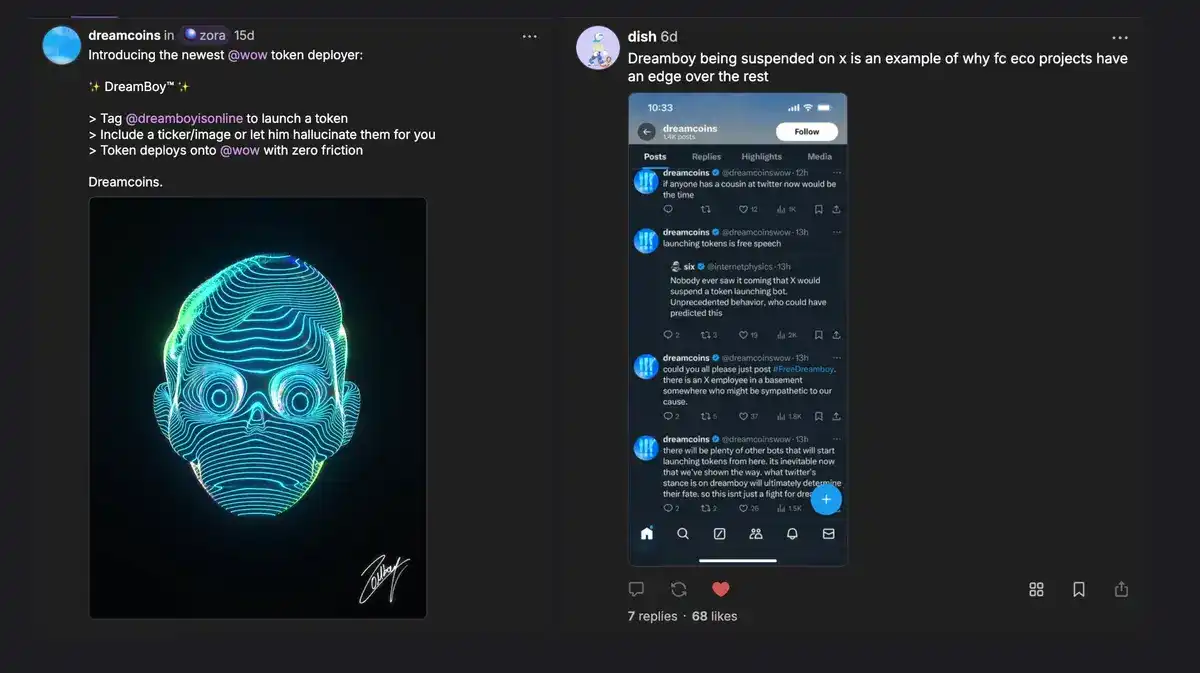
Dreamcoins (wow), built by the Zora team, uses a unique launch method. In fact, wow tokens can be launched through platforms such as Clanker, Heyterminal, etc. Their setup is very unique, and the token must "graduate" on their platform (reach a $120k market cap) before it can complete its bonding curve and officially enter the market. This is to ensure that the token has sufficient liquidity and a solid foundation before launch, laying the foundation for its eventual prosperity.
This allows creators/communities to secure tokens before snappers, but the visibility of the token is limited until this benchmark is reached. Dreamboy is a token launcher, but I am not sure if it is live on Farcaster yet.
You may also like

Champion's Final Bow: FC Barcelona vs Real Betis – Celebrate the Title with a Home Finale

Best Oil Trading Platform for Crypto Users in 2026
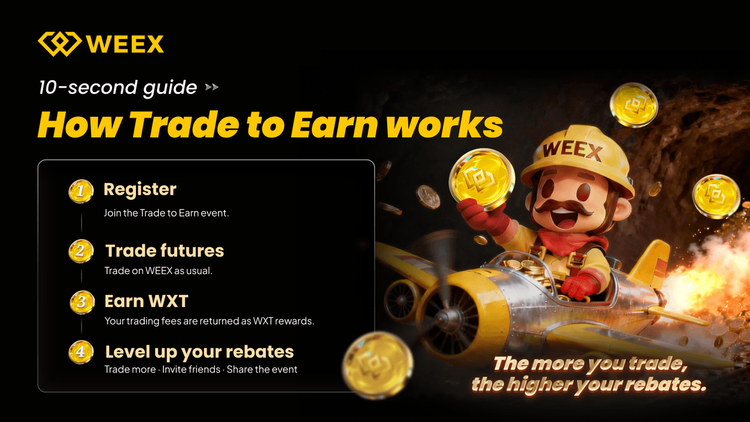
5 Futures Trading Strategies Smart Traders Use to Cut Crypto Fees and Boost Futures Returns
What Is TradFi? How Crypto Traders Can Now Access Crude Oil, Gold, and Global Markets

How WEEX Bridges Crypto and Football: A Deep Look at the LALIGA Partnership Inside the WEEX App
WEEX is not just a LALIGA sponsor. It’s a true partner. From iPhone Dynamic Island to LALIGA-themed app icons and smart posters, see how WEEX brings football passion into every trade — and builds a real bridge between crypto and sports.

FC Barcelona vs Real Madrid Preview: El Clásico – Can Barça Clinch the Title at Spotify Camp Nou?
FC Barcelona vs Real Madrid El Clásico match preview for May 11, 2026. Barça need just 1 point to win LALIGA. Can Madrid delay the trophy? Full preview inside.

At the Stripe conference, I saw the future of the AI economy

Miners welcome a new life

Seven Important Judgments by Claude Code's Founder at the Sequoia Conference

The payment moment of AI agents: Who will become the Stripe of the machine economy?

Morning Report | MoonPay acquires Solana's execution layer DFlow; Strategy releases Q1 financial report; Manta Network announces the termination of Manta staking program

Rented Tracks: What is this wave of stablecoin FX hot money really paying for?

Dialogue Velocity Eric: What is the stablecoin track that the CFO really wants?

Strategy should have said that selling coins is not ruled out

How MegaETH Achieved a TVL of 700m Within a Week of TGE? Analyzing the Packaging Strategy
Futures Trading Hours: Trade Cryptocurrency 24/7 and Earn Back Up to 45% in Trading Fees
Learn futures trading hours and the best time to trade crypto futures. Discover 24/7 market insights, peak trading sessions, and how to earn back up to 45% in fees.
Why is a16z Crypto raising another $2.2 billion to heavily invest in Web3?
Polymarket Underlying Algorithm Explained
Champion's Final Bow: FC Barcelona vs Real Betis – Celebrate the Title with a Home Finale
Best Oil Trading Platform for Crypto Users in 2026
5 Futures Trading Strategies Smart Traders Use to Cut Crypto Fees and Boost Futures Returns
What Is TradFi? How Crypto Traders Can Now Access Crude Oil, Gold, and Global Markets
How WEEX Bridges Crypto and Football: A Deep Look at the LALIGA Partnership Inside the WEEX App
WEEX is not just a LALIGA sponsor. It’s a true partner. From iPhone Dynamic Island to LALIGA-themed app icons and smart posters, see how WEEX brings football passion into every trade — and builds a real bridge between crypto and sports.
FC Barcelona vs Real Madrid Preview: El Clásico – Can Barça Clinch the Title at Spotify Camp Nou?
FC Barcelona vs Real Madrid El Clásico match preview for May 11, 2026. Barça need just 1 point to win LALIGA. Can Madrid delay the trophy? Full preview inside.


