
A 500% Surge in One Week: Understanding Sonic's "DeFi Engine" Shadow Exchange




Currently in the Sonic ecosystem, one of the hottest sectors is Shadow Exchange, with its native token $SHADOW seeing its market cap surge from around $5 million to the current $31.84 million in a week, marking a growth of over 500%. Shadow Exchange currently has a total of 457 liquidity pools, with a 7-day trading volume of $557 million and a daily peak trading volume of $171 million.
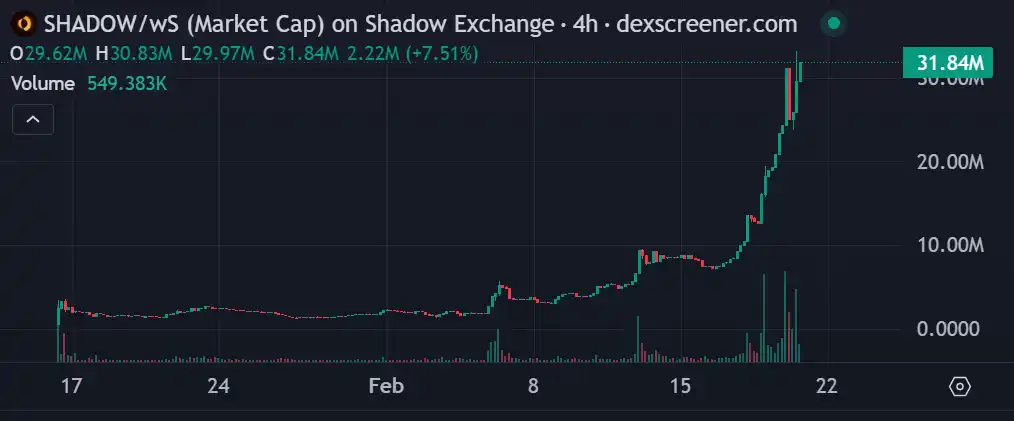
While other chains have been continuously distracted by various unexpected events in the meme market, Sonic Labs has been focusing on DeFi development. Sonic has announced several new measures to incentivize DeFi projects in its ecosystem, causing Sonic's TVL to surge by 500% in the past month. In just two months, Sonic has grown from 0 to over $500 million in TVL, with a net inflow of external funds of $110 million on-chain. Solana accounts for the majority, followed closely by Base and ETH. The DEX trading volume on Sonic has also surpassed the $1 billion mark.
Shadow Exchange is a native centralized liquidity layer and exchange on Sonic. In Sonic's high-speed, low-cost EVM-compatible Layer 1 ecosystem, Shadow Exchange, as one of its core trading protocols, has transformed the traditional ve(3,3) model into an x(3,3) incentive model, attracting the attention of many investors.
Related Sonic Reading: "TVL grows fivefold in one month, will AC Brother turn Sonic into the new DeFi profit center?"
Familiar (3,3), but with an added x
The history of decentralized finance has always been marked by repeated attempts to solve the "DEX trilemma," that is, how to coordinate incentive mechanisms among traders, liquidity providers, and token holders. Although Andre Cronje's ve(3,3) model theoretically addressed this issue by balancing incentives among all participants, the long lock-up period created a high-friction system, forcing users to lock up tokens to fairly participate in the incentive model.
Uniswap focuses on a simple two-sided system: traders and liquidity providers (LPs). ve(3,3) improves on this by adjusting the incentive mechanism to align with token holders' interests, but the distribution of these incentives is unfair and heavily favors the protocol.
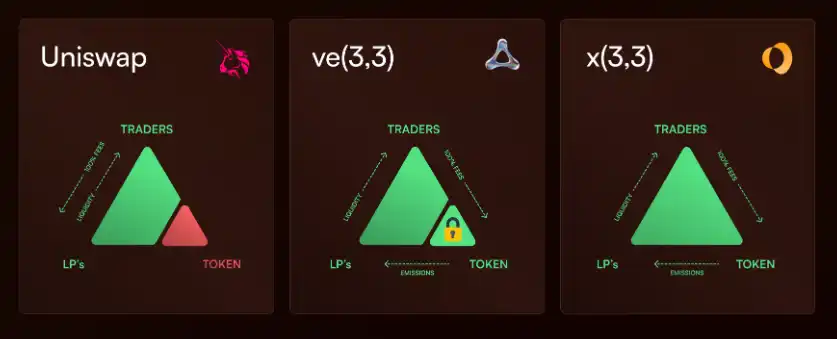
On the other hand, the x(3,3) model addresses these issues, allowing for instant withdrawals and unlocking restrictions through incentives. Users can participate in governance by staking platform tokens and vote on the emission weight of the liquidity pool. Voters can receive fee revenue share and additional "bribe rewards," incentivizing long-term token holders to actively participate in ecosystem development. The following diagram clearly illustrates the entire DeFi model flow:
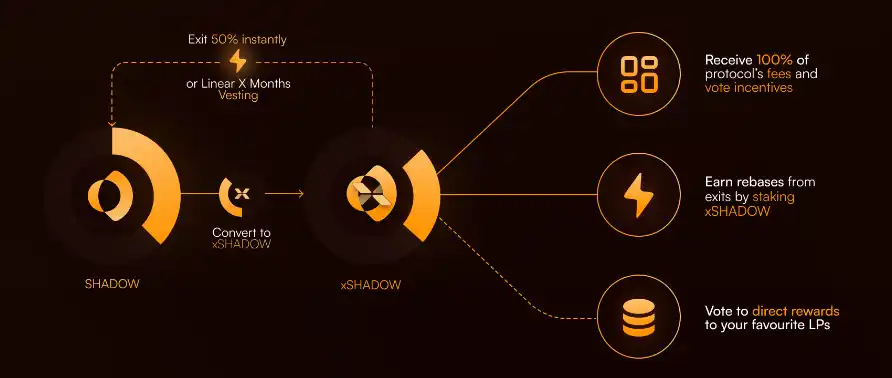
The $SHADOW token is the most fundamental token, freely exchangeable with other currencies. $SHADOW can be exchanged 1:1 with xSHADOW tokens, which are core to the entire model. xSHADOW stakers can vote to direct rewards straight to LPs, and through staking, they can also receive 100% of protocol fees, voting rewards, and exit penalties.
Regarding user exits, Shadow has implemented a unique Player vs. Player (PvP) rebasing mechanism where exit penalties flow to xSHADOW stakers. When a user prematurely exits their xSHADOW position, 100% of the seized tokens will flow pro-rata to existing xSHADOW stakers. In terms of token selection, users can claim more liquid SHADOW for default APY or illiquid xSHADOW for double APY.
Users can convert xSHADOW to SHADOW at any time: an immediate conversion (50% penalty) or a conversion within a user-selected vesting period (based on a ratio, e.g., 3 months = 1:0.73). The longer the vesting period, the more favorable the conversion rate, with a full 6-month vesting period allowing for penalty-free 1:1 conversion.
Voting Incentives
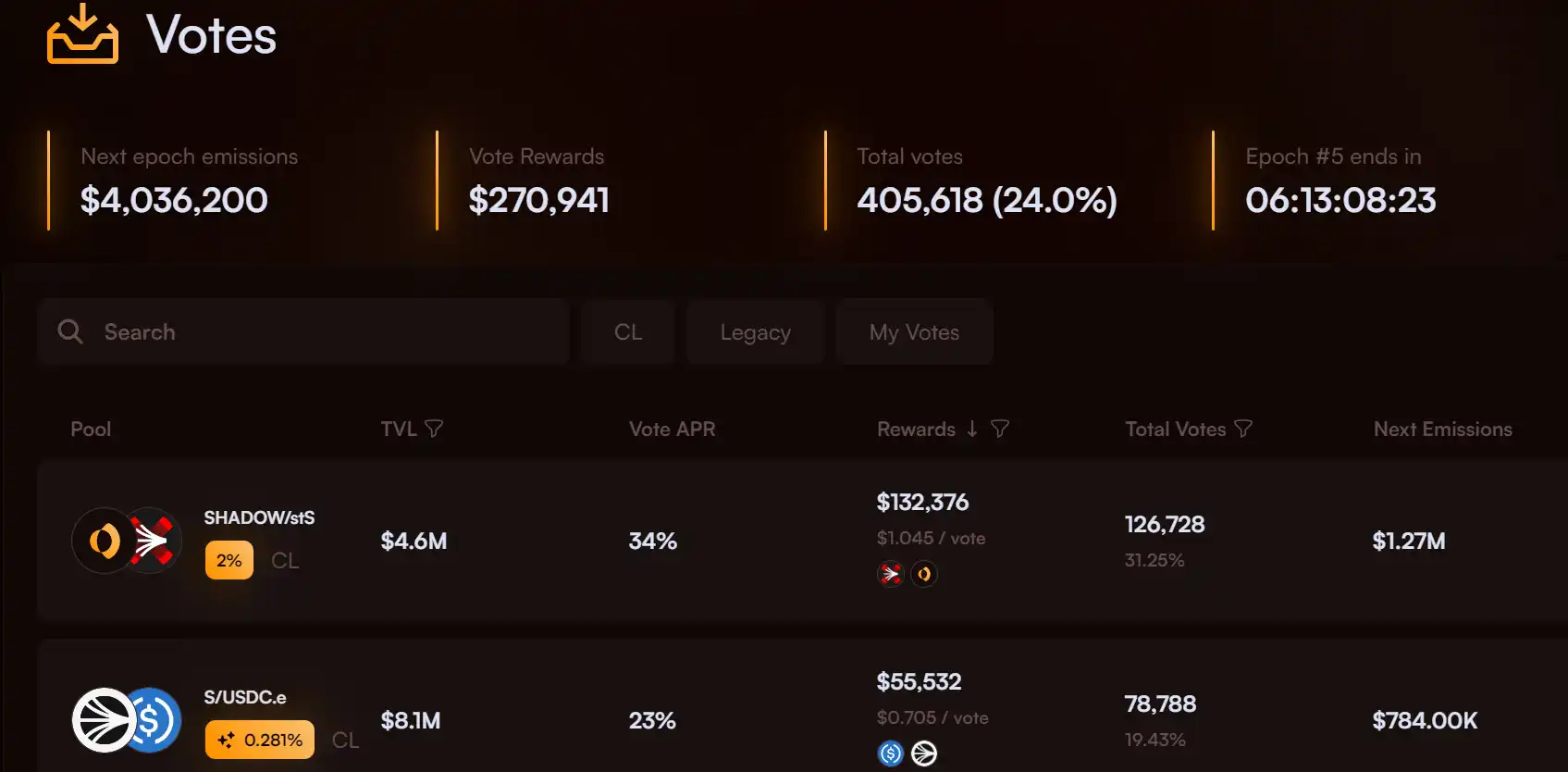
xSHADOW holders earn rewards through active participation and voting. When holders vote to support liquidity through a gauge, they proportionally share in all fees generated by that liquidity pair and additional voting incentives provided by the protocol to encourage participation. The primary purpose of xSHADOW tokens is to direct distributed token rewards through voting toward increasing liquidity, with this portion of the token rewards distributed in proportion to the total percentage of votes in that period. For example, if 100,000 xSHADOW are distributed in a single period and 10% of all votes are allocated to the SHADOW/USDC pair, then that pair will receive 10,000 xSHADOW tokens, which will be linearly distributed to the liquidity providers of the relevant LP pair throughout the period.
Liquidity Staking
The design goal of Shadow is to eliminate friction in the ve(3,3) model, with governance staking being one of the biggest sources of friction. After staking liquidity in xSHADOW, you can mint $x33, simplifying this process through automated voting and reward claiming without disrupting the core mechanism of xSHADOW. The $x33:xSHADOW ratio starts at 1.00:1.00 and gradually skews towards $x33 as rewards accumulate from fees, voting incentives, and resets. At the end of each period, rewards from fees and voting incentives are automatically sold to increase the $x33:xSHADOW ratio. While $x33 provides instant liquidity, it still does not avoid the exit penalty of xSHADOW. As a liquidity staking version of xSHADOW, the market price of $x33 will naturally reflect the instant exit fee structure and cannot be traded below the redemption value of xSHADOW.
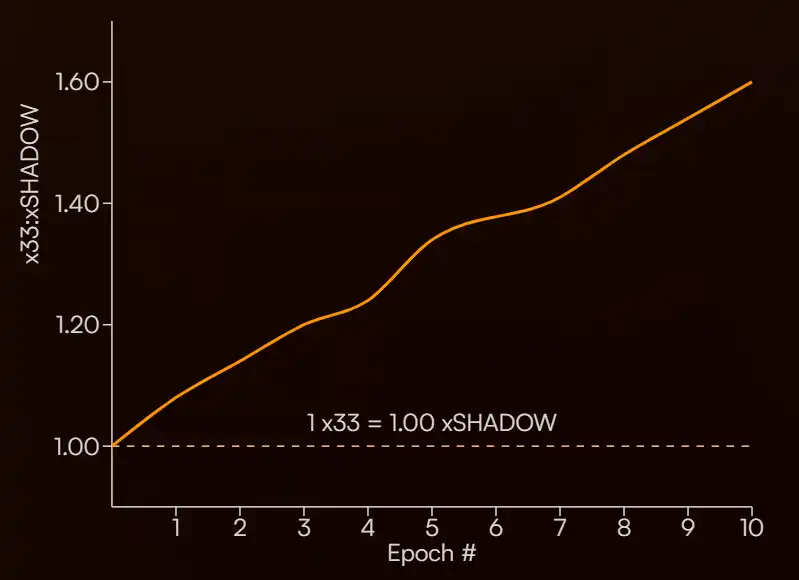
Shadow employs a unique Player vs. Player (PvP) mechanism, enhancing the traditional ve(3,3) anti-dilution model to both protect xSHADOW holders from dilution and incentivize them to maintain their positions and participate in the ongoing success of SHADOW. Stakers who stay longer in xSHADOW will earn more fees, voting incentives, user, and emission exit rewards. Users can exit their positions at any time, ensuring rewards flow to those who value and continue to participate in it the most. This mechanism not only encourages avoiding early exits but also ensures that remaining participants are rewarded for loyalty and active participation.
With the rapid growth of Sonic Chain TVL (increasing 13x from early 2025 to $357 million), and endorsements from core developers like Andre Cronje, Shadow Exchange is poised to leverage ecosystem momentum and become a benchmark for the next generation of DeFi trading protocols. Shadow Exchange is not only a technological playground for the Sonic Chain but also a frontier for DeFi governance and liquidity innovation, offering a new paradigm for traders, liquidity providers, and projects.
You may also like

Morning Report | OpenAI has submitted an S-1 registration statement draft to the U.S. SEC; Morpho completes $175 million financing

Galaxy Deep Research Report: How Hyperliquid's HIP-4 Upgrade Changes the Landscape of Prediction Markets?

Latest research from 13 top universities including Cornell University: The current state, challenges, and misconceptions of the fusion of Crypto and AI

Deconstructing Anthropic: The Best AI Company, Possibly Also a Type of Organizational Invention

Every exchange is a "Universal Exchange."

The counterattack of traditional finance: Alliance chains are quietly reviving
Pantera Capital Partner: How Tokenization is Restructuring the Private Equity and Early Investment Ecosystem?

Mastercard Launches Agent Pay for AI, Plans to Record AI Agent Payment Authorizations on Polygon
Mastercard launched Agent Pay for AI, a new payment protocol designed to help AI agents make small payments such as pay-per-use access to data and APIs. The system plans to record human-granted AI agent permissions on Polygon, focusing on verifiable authorization, identity, and payment controls.

Curve Deploys Llamalend v2 on Optimism With 250,000 OP Incentives
Curve launched Llamalend v2 on Optimism with 250,000 OP incentives from the Optimism Foundation. The upgrade expands Llamalend beyond its earlier crvUSD-focused model, adding broader collateral support, LlamaRisk market reviews, and the ability to use Curve LP tokens as collateral.

Raydium Old Liquidity Pool Reportedly Exploited, With $1.34 Million Moved to Ethereum and Tornado Cash
An old Raydium liquidity pool was reportedly exploited for around $1.34 million in USDC, RAY, and wSOL, with the stolen funds bridged to Ethereum and deposited into Tornado Cash. The incident highlights the tail risks of legacy DeFi pools, old contracts, and cross-chain fund laundering paths.
Kalshi Executive Challenges “SBF Backed AI Unicorns” Narrative, Says Leopold Aschenbrenner Was Key Figure
Kalshi executive John Wang questioned the “SBF backed AI unicorns” narrative, saying Leopold Aschenbrenner was the key figure behind major AI investment decisions.

New York Proposes Stricter Stablecoin Issuer Rules Aligned With Federal GENIUS Act
NYDFS proposed stricter stablecoin issuer rules aligned with the GENIUS Act, covering reserves, custody, redemption timelines, audits, and capital buffers.

CryptoQuant Says Bitcoin Profitable Supply Is Near 45% Pressure Zone as On-Chain Data Points to Market Repricing
CryptoQuant said Bitcoin’s profitable supply is nearing the 45% pressure zone, signaling rising market stress, unrealized losses, and a possible on-chain repricing phase.

Bitcoin Falls Below 200-Week Moving Average as On-Chain Data Shows Over Half of Supply in Loss
Bitcoin dropped below its 200-week moving average as on-chain data showed over 50% of circulating supply is now in loss, signaling rising market stress.

CFTC Reportedly Plans New Prediction Market Rules Focused on Manipulation Risk and Public Interest Review
The CFTC is reportedly preparing new prediction market rules focused on manipulation risk, public interest review, and retail trader protections.

Meet the new WEEX trial fund—your gateway to greater profits

WEEX Labs Lands at Dutch Blockchain Week: A Disruptive Crypto × AI Conversation Sets Sail in Amsterdam
SK Hynix Reportedly Plans U.S. ADR Listing as Early as August, With SEC Approval Possible in Late June
SK Hynix may pursue a U.S. ADR listing as early as August, with SEC approval reportedly possible in late June amid strong AI chip supply chain demand.
Morning Report | OpenAI has submitted an S-1 registration statement draft to the U.S. SEC; Morpho completes $175 million financing
Galaxy Deep Research Report: How Hyperliquid's HIP-4 Upgrade Changes the Landscape of Prediction Markets?
Latest research from 13 top universities including Cornell University: The current state, challenges, and misconceptions of the fusion of Crypto and AI
Deconstructing Anthropic: The Best AI Company, Possibly Also a Type of Organizational Invention
Every exchange is a "Universal Exchange."
The counterattack of traditional finance: Alliance chains are quietly reviving


